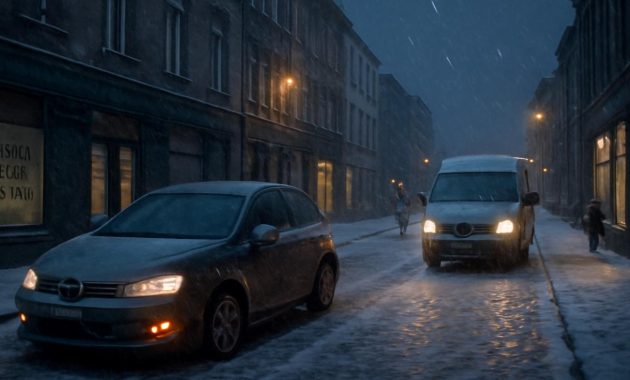
By late afternoon the sky has already begun to lower, flattening into a heavy, pewter lid. You can feel the weather turning in that subtle way it does before a real storm—air suddenly dense, the smell of iron and woodsmoke braided together, the town’s usual restlessness tamped down to a cautious hush. Outside the grocery store, breath hangs in slow white ghosts as people hustle carts through the parking lot, rubber wheels squeaking over old ice and new slush. The snow hasn’t started yet, not really, just a few wandering scouts of flakes drifting down, melting on still‑warm windshields. Yet every conversation, every radio update, every text thread circles the same prediction: heavy snow set to begin tonight, the kind that swallows streets whole and redraws the map by morning.
The Storm That Everyone Saw Coming
By now the storm has become a character in its own right, introduced days ago in weather segments and forecast graphics, upgraded from “winter event” to “major system” and finally to “warning.” Local meteorologists point to purples and blues spreading over the regional map like spilled ink. Twelve to eighteen inches, they say, maybe more in the higher elevations. Wind gusts up to forty. Travel “difficult to impossible.” These are the phrases that make people silently calculate how much milk is left in the fridge and whether the snow shovel survived last winter.
In the hardware store, the clerk shakes rock salt into a paper bag for a customer, both of them glancing up each time someone opens the door, letting in a fresh gust and a flurry of loose flakes. There’s a nervous, slightly giddy energy in the air, part snow‑day nostalgia and part adult dread. On local radio, an emergency management officer’s voice cuts through the usual pop songs and commercials with measured calm: “If you can stay home tonight and tomorrow, stay home. We are strongly urging people to avoid unnecessary travel once the snow begins in earnest.”
You can almost feel thousands of minds pivoting around that word: unnecessary. What counts as necessary when the world outside your window is about to be erased by white?
Warnings from the Plow Trucks
On the edge of town, in a dimly lit public works garage that smells like grease and cold metal, the snowplows wait like giant orange beetles asleep in a row. Chains clink, hydraulics are tested, coffee steams in travel mugs. Drivers go through their checklists: fuel, lights, sand spreaders, radios. They have seen this movie before, though every storm writes its own script.
“We can keep the main routes passable for emergencies,” one driver says, leaning against his truck, his beard frosting with breath. “But passable isn’t the same as safe. Folks forget that.” He knows the math by heart: the more cars on the road, the harder it is to plow, the more fender‑benders block lanes, the longer it takes to get anywhere. Traffic plus blowing snow equals a choreography of near misses and inevitable collisions.
In the control room, maps glow on monitors showing priority routes and problem intersections. The storm’s projected track creeps closer with each hour. The public message is unanimous from police, fire, and transportation officials: stay off the roads unless you absolutely have to be on them. That means no scenic drives, no quick runs across town to see the spectacle, no “I just wanted to pick up a pizza.”
Yet even as the warnings grow more urgent, another set of messages is taking shape across town—this time written on sandwich boards, social media posts, and brightly lit shop windows.
“We’ll Be Open”: Business in the Teeth of a Blizzard
On Main Street, Christmas lights left up past the holidays blink uncertainly in the early twilight. In the bakery, the owner stands at the counter composing a post on her phone: “We’ll be open regular hours tomorrow! Fresh bread and hot coffee for anyone braving the snow.” In the corner, a teenager in a flour‑dusty apron rolls out dough, glancing up at the window where the snow is beginning to stick—soft, silent, and deliberate.
Across town, a big‑box store manager walks the fluorescent aisles with a clipboard, mentally reshuffling shifts. Closing is technically an option, but not one corporate headquarters prefers. “We’re essential retail,” the memo said. “Our communities depend on us in critical weather events.” He thinks of the overnight crew, some of whom live twenty, thirty miles away. He pictures them white‑knuckling steering wheels down unplowed county roads at 4 a.m. to make sure the shelves are faced and the lights are on.
Restaurants post their own storm strategies: “Delivery only after 6 p.m.” “We’ll stay open as long as we can!” “Snow‑day specials!” There is stubborn pride in staying open, a kind of defiance in the face of winter’s blunt force. For some, it is economics more than bravado. A single lost day of sales can ripple painfully through a small business. Rent is due whether or not the sidewalks disappear under drifts.
And then there are the workers caught in the middle—baristas and clerks and line cooks, hotel staff and warehouse pickers—refreshing their group chats, trying to decipher what tomorrow will demand of them. Their managers’ insistence on staying open collides with the state troopers’ plea to stay home. Somewhere between, each person must sketch their own boundary between loyalty and survival.
The Commute Calculus
The night before the storm, phones light up with overlapping conversations. “Are we really supposed to come in?” “My car can’t handle this.” “They said the store never closes for weather.” A nurse lays out her scrubs and packs an overnight bag, prepared to sleep on a cot at the hospital if the roads become impassable. A grocery clerk rummages for jumper cables and digs out an old pair of snow boots from the back of the closet. A teacher, already notified of school closures, texts her sister who works at a retail pharmacy: “They’re still making you go in? Are they serious?”
For many, the decision becomes a personal risk equation. How far is the commute? Is the car’s battery strong, the tires decent? Are there kids at home, an elderly parent, a dog that needs to be let out? Is the job hourly, the paycheck fragile? Snowstorms expose, in stark relief, the distance between instructions issued from behind desks and the physical realities faced by those expected to carry them out.
Authorities on the evening news repeat the same refrain: “If you do not have to travel, don’t.” Yet “have to” is a phrase that stretches under economic pressure. The rent doesn’t know what the weather is doing; the electric bill does not care about plow schedules. For some workers, a day’s wages can be the difference between catching up and falling behind.
| Perspective | Primary Concern | Typical Message Before Storm |
|---|---|---|
| Emergency Officials | Public safety, reduced accidents | “Stay off the roads if at all possible.” |
| Business Owners | Revenue, customer expectations | “We’ll remain open as long as conditions allow.” |
| Workers | Income, job security, personal safety | “Do I risk the drive or risk the paycheck?” |
| Residents | Supplies, comfort, curiosity | “One more quick trip before it gets bad…” |
When the Snow Finally Starts
Around dinnertime, the change arrives almost without fanfare. The lazy exploratory flakes sharpen into something more purposeful. The streetlights click on and reveal a steady white curtain falling, falling, falling. Sidewalks vanish. Parked cars grow soft edges. Tires hiss on the wet pavement, then begin to crunch. The storm that everyone has been talking about is no longer hypothetical; it is here, sifting into every crevice, turning individual sounds into a muffled, shared hush.
Inside an all‑night diner at the edge of the highway, truckers and plow drivers warm their hands around heavy ceramic mugs. The waitress keeps an eye on the snow thickening beyond the plate glass windows. She knows the drill: once visibility drops, the regulars thin out, replaced by the stranded and the desperate—the people who thought they could make it through before the storm hit full stride. The radio behind the counter crackles with updated warnings. “Whiteout conditions possible. Blowing and drifting snow. Travel is strongly discouraged.”
In the town center, a few last‑minute shoppers hurry from door to door, scarves pulled high, noses red. The grocery store lights glare against a parking lot rapidly losing its stripes to accumulating white. Shopping carts wobble through ruts and ridges forming in real time. Car doors slam, engines turn over with faintly anxious whines. Everyone has the same thought: get home, and get there now.
But not everyone is headed home. In quiet neighborhoods, lights blink on in second‑floor windows as overnight workers check the time, watching the storm build. A hotel front‑desk clerk zips her coat and pulls on boots, knowing she will probably be asked to stay past her shift. A warehouse picker shoulders a backpack and steps into the first serious gust of the night, snow stinging his face. The roads that authorities are asking people to avoid are the very roads he must take to keep his job.
Snow as Equalizer, and Mirror
There is a way in which heavy snow erases difference. Under a foot of fresh powder, the mansions on the hill and the bungalows on the side streets all wear the same bright caps. The grocery store roof and the school gym and the little church down the block all shoulder the same cold weight. The storm wraps everything in the same slow silence. Yet, as the night deepens, the idea of snow as an equalizer begins to fray.
Block by block, the variations appear. On one street, driveways are meticulously cleared in stages by snowblowers and four‑wheel‑drive trucks; on another, cars simply disappear behind glacial berms, their owners hoping for a thaw. In some houses, people have the luxury of curling up with thick blankets and a pot of soup, watching the storm as spectacle. In others, someone is layering up to go out, again, because the job doesn’t exist on a screen and the paycheck doesn’t arrive without presence.
The storm becomes a mirror, reflecting back the seams in the way we’ve built our days. Who can work from home, and who must brave the road? Who can call in, and who will be written up for not appearing? Who sees the storm as inconvenience, and who sees it as threat?
The Morning After: Open Signs in a White World
By dawn, the town has been remade. The plows have carved deep, rough canyons through the drifts along major roads, but the side streets look like blank pages. The usual morning soundtrack—garbage trucks, school buses, commuter cars—has been partially replaced by the growl of snowblowers and the scrape of shovels. Trees wear thick coats of white, branches drooping but still holding on. Chimneys puff into an air so cold it almost seems solid.
Drive carefully, the radio announcer says. Stay home if you can, the authorities repeat. Yet, as the sky brightens to a hard, clean blue, neon “OPEN” signs blink awake across town. The coffee shop, miraculously, has lights on and steam in the windows. A few figures trudge along the sidewalks that have been cleared to narrow channels, heads ducked against the lingering wind. At the big‑box store, the parking lot is a patchwork of plowed mounds and icy ruts, yet an early trickle of cars begins to nose into spaces.
At the hospital, shifts change like clockwork; illness doesn’t respect snow days. At the fire station, boots stand ready by the engine. For some businesses—pharmacies, gas stations, grocery stores—staying open is genuinely a lifeline for the community. For others, the line between service and stubbornness blurs. The employees who made it in stamp the snow from their boots and swap storm stories, each having run their own gauntlet of drifts and spinouts.
In living rooms across town, people stand at windows with mugs in hand, considering their own relationship to that blinking “OPEN” sign. Do you venture out for a latte, a clearance sale, a sense of normalcy? Or is staying home, watching the sun spark on the new snow, a small act of solidarity with the plow drivers, nurses, and clerks already out there?
Choosing Stillness in a Culture of Motion
Storms like this offer a paradoxical gift: an excuse, rare and unarguable, to stop. Nature lays down a flat, unnegotiable answer to the constant question of productivity. The roads are treacherous. The visibility is poor. The choices shrink to what is truly necessary—heat, food, care, connection. Yet the reflex to push through, to carry on, is strong. Businesses insist on staying open, and many of us instinctively respond, as if motion itself were a virtue.
But what if, just for a day, stillness counted as participation? Staying off the roads can lighten the load on emergency workers, reduce accidents, make space for plows to do their work quickly and safely. A conscious decision to not turn the key in the ignition becomes a quiet form of cooperation, an acknowledgment that we are all threaded into the same fragile system of roads and power lines and hospital beds.
When heavy snow sets in, the question isn’t simply whether a particular shop will open, or whether the commute is survivable. It’s whether we can recognize the storm’s blunt advice: there are times when the bravest choice is to stay put, to look out at the white‑washed world and decide that, for this one day, home is far enough.
Frequently Asked Questions
Is it really safer to stay off the roads during a heavy snowstorm?
Yes. Heavy snow drastically reduces visibility and traction, increasing the risk of accidents and making it harder for emergency vehicles and plows to move. Staying home, if you can, lowers the overall traffic volume and helps crews clear roads more quickly and safely.
What if my job expects me to come in when authorities say to stay home?
This is a difficult position many workers face. If possible, talk with your employer in advance about severe weather policies, remote options, or using personal time. Ultimately, you have to weigh your personal safety against workplace expectations and communicate honestly about what you can safely manage.
Why do some businesses stay open even during dangerous storms?
Motivations vary. Essential services like hospitals, pharmacies, gas stations, and many grocery stores stay open because communities rely on them. Other businesses may stay open due to financial pressure, corporate policies, or a belief that customers expect them to operate regardless of weather.
How can I prepare if a heavy snowstorm is forecast?
Stock basic supplies such as food, water, medications, and pet needs for several days. Charge devices, check flashlights and batteries, refuel your vehicle, and ensure you have warm clothing and blankets. If you must drive, keep an emergency kit in your car with a shovel, ice scraper, sand or kitty litter, and extra layers.
Is it okay to go out “just for a quick errand” once the snow starts?
Even short trips can become hazardous during heavy snow, especially if conditions worsen while you’re out. If the errand isn’t truly essential—health, safety, or critical work—waiting until roads are cleared and authorities lift travel advisories is usually the safer, more responsible choice.