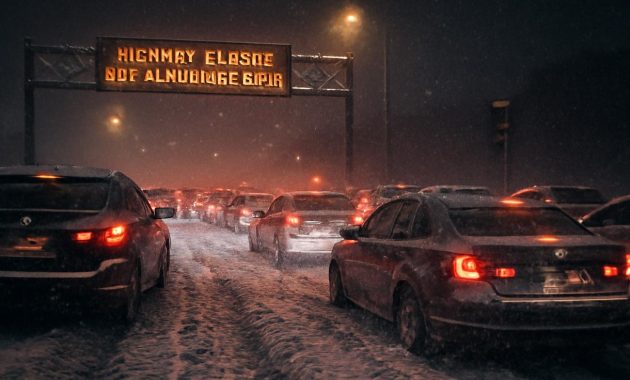
The first snowflake lands on the windshield with a soft, almost polite tap. Just one. Then another. A thin, delicate constellation on cold glass. It doesn’t look like trouble yet—more like holiday-film weather, the sort that makes people nostalgic and a little reckless. The sky is a low, gray ceiling over the highway, and somewhere beneath it, thousands of people are rolling toward the night, toward the promise of family dinners, booked flights, last-minute meetings. Their radios are all saying the same thing: heavy snow confirmed, overnight, travel warnings in effect. But the wipers keep swishing, the engines keep humming, and very few feet move from accelerator to brake.
The Night the Forecast Became a Character
By late afternoon, the weather forecast has stopped feeling like information and started feeling like a character in the story—a looming, insistent presence no one can quite ignore, yet many still choose to underestimate.
Inside living rooms and cluttered kitchens, the warnings run on loop. Authorities speak in controlled tones about “deteriorating conditions,” “treacherous surfaces,” and “non-essential travel.” The language is clinical, but the meaning is simple: if you don’t have to go, don’t. Heavy snow is officially confirmed. Not a chance, not a possibility—confirmed. The kind of storm that dumps its weight on roads and runways, finds every weakness in infrastructure, and tests the fragile threads of everyone’s plans.
At the regional airport, the departure boards are beginning to flicker with red words that weren’t there this morning: CANCELED. DELAYED. Rows of seats fill with travelers who never imagined their short layover would turn into a night on thin carpet, their heads resting on backpacks instead of pillows. Somewhere between Gate 9 and Gate 15, a boy presses his face to the big glass window, watching flakes grow fatter and slower, swirling under the yellow lights of the tarmac. The aircraft, once symbols of speed and freedom, look suddenly fragile, small metal shapes at the mercy of air and ice.
On the highway leading out of the city, however, the story is different. Hazards flash, but the cars keep coming. Pickup trucks loaded with bags and bicycles. Compacts held together by duct tape and ritual hope. Luxury SUVs fitted with the latest safety technology, their drivers leaning on the idea that money and metal can out-think physics. They’ve all heard the same forecast. And they’re all still going.
| Forecast Detail | Official Warning | Likely Impact |
|---|---|---|
| Snowfall | 15–25 cm (overnight) | Buried side roads, reduced visibility, blocked driveways |
| Wind Gusts | Up to 60–70 km/h | Blowing snow, whiteouts, drifting across open highways |
| Temperature Drop | Above freezing to well below 0°C within hours | Rapid ice formation, black ice, frozen car locks and wipers |
| Travel Guidance | Avoid non-essential trips after dusk | Stranded motorists, road closures, significant delays |
The Long, Bright Line of Headlights
The storm doesn’t arrive all at once. It seeps into the evening like ink into water.
Just after sunset, the highway becomes a moving constellation, a slow river of headlights stretching over the dark landscape. Each light is a story: the exhausted nurse driving home from a double shift; the college student who promised their mother they’d leave “before it gets bad”; the couple who decided their weekend away was too important to cancel; the trucker whose deadline doesn’t care about weather patterns.
The snow starts as a delicate noise against the windshield, a faint hiss under the wipers. It’s easy to mistake it for something gentle, something manageable. But the temperature is sliding down, and the air is thickening. What was once rain on the edge of town is turning to sleet, then pellets of ice, then wide, wet flakes that streak past the beams of the headlights like comets.
People adjust. They squint; they lean forward over the wheel. They turn down the radio. They tell themselves they’ve driven in worse. Memory is a dangerous comfort: last year’s storm, the one before that, the time they made it home against all odds. The mind edits out the near misses and keeps the successful arrivals, building a quiet, stubborn confidence.
But nature doesn’t bargain. It simply follows its own physics. A few degrees colder, and the slush on the road becomes something harder, smoother, more treacherous. Tires that gripped an hour ago now skate a little before catching. The steering wheel feels looser in the hands. Braking distances stretch out like rubber bands.
On the side of the road, electronic signs blink in eerie orange: HEAVY SNOW OVERNIGHT – AVOID TRAVEL. There’s a strange, surreal feeling in passing those glowing words while still moving forward, like ignoring a shouted warning in a language you pretend not to understand.
Inside the Control Rooms and Cabins
While drivers wrestle with the decision to keep going, people in windowless rooms stare at screens, maps, and radar sweeps.
In a highway control center, the storm looks almost abstract: swirling bands of color on monitors, shifting shapes that predict where visibility will drop first, where the drifts will form. Operators talk in clipped phrases about plow schedules, salt distribution, lane closures. They know what’s coming. They always do. The models aren’t perfect, but tonight they all agree: this is the kind of snow that buries good intentions and fills the gaps in overconfidence.
Even earlier, airport planners were already dealing with the uncomfortable math of runways and time. De-icing crews can only work so fast. Each plane has a window in which it can safely depart after antifreeze and glycol coat its wings—miss that window, and it goes back in line. Wind shifts, visibility drops, and suddenly a perfectly clear runway on the screen is, on the ground, a white blur under dancing flakes.
Up in the control tower, the snow doesn’t look abstract at all. It’s rolling across the airfield, coating the blue taxiway lights in halos. A pilot leans in, squinting through the cockpit glass, calculating the weight of snow gathering on control surfaces and the friction left on icy concrete. Somewhere between the instruments and the dark, there is a decision to be made: Go now, or not at all.
Below, in the terminal, passengers refresh their phones every few seconds as if the storm will change its mind if they check often enough. Over the loudspeaker, another flat, apologetic announcement: “Due to worsening conditions, your flight has been cancelled.” The words land heavier than the snow itself.
Why We Keep Going Anyway
So why, with all this information, do thousands still refuse to delay their trips?
Part of it is timing. Storms don’t just collide with geography; they collide with human plans. Holidays, reunions, business deals, long-awaited vacations—these things live on calendars, not radar screens. You’ve waited all year to see your family, or you’ve booked those non-refundable tickets, or you’ve promised someone you’d be there. The idea of calling and saying, “I’m not coming because of the weather,” feels like a personal failure, even when it’s the rational choice.
There’s also the quiet pressure of routine. We’re conditioned to believe that systems will bend for us—that roads will be cleared, flights re-routed, trains rescheduled. We trust the invisible network of people and machines to keep the world turning, even when nature is very clearly advising a pause. The heroic plow-driver, the patient air-traffic controller, the mechanic working in the freezing wind—they become the backup plan in our minds, the reason we believe we can push through “just this once.”
And then there’s the deeper, almost primal sense that we are somehow separate from the weather, not of it. We treat storms as obstacles, not as environments. A storm becomes something to get through, not something to respect on its own terms. In reality, the moment you step onto an unplowed road or board a plane racing an ice band, you are in the storm. You are part of its story, not outside it.
Technology amplifies this illusion of control. All-wheel drive. Traction control. Real-time navigation promising “fastest route despite conditions.” It’s easy to mistake assistance for immunity. But all the sensors in the world can’t change the coefficient of friction between rubber and ice.
The Quiet Math of Risk
Most people don’t consciously calculate risk in percentages, but on nights like this, the math is quietly there in every decision. If the authorities are warning of stranded motorists, canceled flights, and rapidly worsening conditions, the message isn’t that travel is impossible. It’s that the cost of bad luck has gone up.
Maybe nine trips out of ten, you would make it home with nothing more than tense shoulders and a story about “how bad the roads were.” But the tenth trip is the one the warnings are about—the jackknifed truck blocking both lanes, the unseen patch of black ice at the curve, the whiteout that erases the world beyond your hood.
The storm doesn’t care that you’re a careful driver. It doesn’t reward experience or punish impatience. It simply reacts to temperature, moisture, and motion. You can do everything right and still end up sideways in a snowy median because someone four cars ahead did something wrong. That’s the brutal arithmetic of shared risk.
What It Feels Like to Be Stranded
By midnight, the forecast has fully arrived. The road you started on is no longer the road you’re driving. It’s something narrower, quieter, and far more uncertain.
Visibility shrinks from kilometers to meters, then from meters to the vague glow of your own headlights. The lines that guided you are buried now, replaced by faint troughs in the snow carved by earlier tires. Oncoming traffic becomes a comet of light and swirling white, blinding you for a second too long. You slow without meaning to.
Somewhere ahead, brake lights flash in a jittery pattern, then hold, then disappear. You edge forward and find yourself entering a strange landscape of hazard lights blinking in the dark. Cars angled wrong. A truck that couldn’t make the hill, its trailer a frozen, shining wall across the lane. The snow keeps falling. There is nowhere for it to go.
When motion stops, everything changes. The heater hisses, working overtime. Snow begins to climb the sides of your tires, building a silent barricade. The world outside the windows is soft and muffled, like someone has wrapped the night in cotton. Inside the car, the air grows stale, flavored with worry and old coffee.
You realize how quickly modern independence shrinks. Your universe is now the size of your vehicle. Battery level matters. The amount of fuel in your tank is suddenly not an abstract number but the boundary of your warmth, your light, your ability to leave when the road reopens. You listen to updates on the radio: closures here, delays there, emergency shelters opening in school gymnasiums.
Farther back, where the plows have not yet reached, some people stand outside their cars, blinking snow out of their lashes, trying to decide whether to walk to the faint glow of a farmhouse porch or stay put and wait. The advice, almost always, is to stay put. A car is easier to find than a person in a whiteout.
How the Story Looks from the Other Side
In emergency dispatch centers, the night is a rising tide of phone calls. Stalled vehicles. Flaring tempers. Quiet, shaky voices saying, “We’re not sure where we are,” and “The kids are getting cold.” The people answering those phones are watching the same storm system move across digital maps, but for them it’s not a swirl of color anymore—it’s a list of coordinates and names and urgent needs.
Rescue crews thread their way between stranded vehicles, their own lights flickering in the thick air. They move slowly, not because they want to, but because they have to. They know this road, but not tonight’s version of it. There may be a drift around the next bend, a car invisible under a snowbank, a fallen power line. The storm has rewritten the map.
Every person they reach is a reminder that the line between “inconvenienced” and “in danger” is thinner than we like to think. A forgotten blanket. A half-empty fuel tank. A dead phone. A decision to “just push on a little further.” These are small things on a clear day. In a confirmed heavy snow event, they are the difference between a story you tell later and a story someone else tells about you.
Choosing a Different Ending
There is another version of this night, though, one that plays out behind insulated windows and steaming mugs of tea.
In that version, the radio warning came on in the afternoon, and instead of shrugging it off, someone looked out the window, saw the bruise-colored sky, and felt a quiet tug of humility. They called their parents and said, “I’m coming tomorrow instead.” They emailed their boss: “The forecast looks bad. I’ll join by video.” They checked their flight status and took the airline’s offer to rebook before the cancellations cascaded.
It’s not as dramatic a story. No near-miss on the interstate, no shivering hour waiting for a tow, no late-night rescue from a snow-choked exit ramp. There is no heroism in this version, just foresight. Just the simple, slightly uncomfortable act of changing plans because the natural world has made its own plans, and they are bigger than yours.
The storm still comes, of course. The snow still piles up on porches and clogs gutters and bends branches under its quiet weight. The wind still snakes down chimneys, rattling old glass. Flights are still canceled, roads still close, and some people still end up exactly where the authorities warned they might: stranded, delayed, humbled.
But for those who chose to step out of the path early, the storm becomes something else—a thing to watch rather than fight. To stand at a window’s edge and feel the smallness of being human in a large, indifferent system of cloud and cold, and to accept that smallness not as defeat but as wisdom.
The Memory We Carry Forward
Every major storm leaves behind two sets of traces: the physical ones, and the stories. The plowed piles at the edge of parking lots that last for weeks. The broken branches frozen in place. The sand and salt ground into sidewalks. And then, the tales we tell each other:
“Remember that night the snow came in all at once?”
“We slept on the airport floor with fifty strangers.”
“We spent eight hours in the car and didn’t move more than a kilometer.”
“We turned around, stayed home, and watched it from the hill.”
Those stories become quiet teachers. They shape what we do next time the forecast is confirmed and the warnings crackle through our speakers. They remind us, or they fail to—depending on how much we’re willing to listen.
Somewhere, in a future winter, another storm will be “officially confirmed to arrive overnight.” Authorities will speak again of stranded motorists, canceled flights, and rapidly worsening conditions. The lights along the highway will flicker on. People will look at their calendars, their tickets, their maps, and then up at the sky.
And in that moment—before the first polite snowflake lands on the windshield—each of us will quietly choose what kind of story we want to tell about this night.
Frequently Asked Questions
Why do authorities issue strong travel warnings before heavy snow?
Authorities base their warnings on weather models, past storm behavior, and the capacity of emergency and road services. They know that once heavy snow, wind, and freezing temperatures combine, response times slow dramatically, and minor incidents can quickly become life-threatening.
If I drive carefully, is it still dangerous to travel during a confirmed snowstorm?
Yes. Even the most careful driver shares the road with others who may not be as cautious. Visibility can drop without warning, and road surfaces can change from wet to icy in minutes. Your skills cannot eliminate the unpredictable behavior of other vehicles or sudden changes in conditions.
What should I have in my car if I must travel in heavy snow?
At minimum, pack warm clothing and blankets, a charged phone and power bank, water, non-perishable snacks, an ice scraper and brush, a small shovel, sand or kitty litter for traction, a flashlight, and any necessary medications. Keeping your fuel tank at least half full is also important in case you become stuck.
Why are flights canceled even when the snow doesn’t look that bad from the terminal?
Airlines and air-traffic controllers consider runway conditions, visibility, de-icing times, wind patterns, and the situation at both departure and arrival airports. A runway might appear usable from a distance, but ice, drifting snow, or low visibility can make safe takeoff and landing impossible.
Is it really worth delaying my trip for a storm?
Yes. Delaying a trip by 12–24 hours can mean the difference between a difficult but manageable journey and a dangerous ordeal. Roads and runways can be cleared, crews can catch up, and emergency services are less overwhelmed once the peak of the storm has passed.