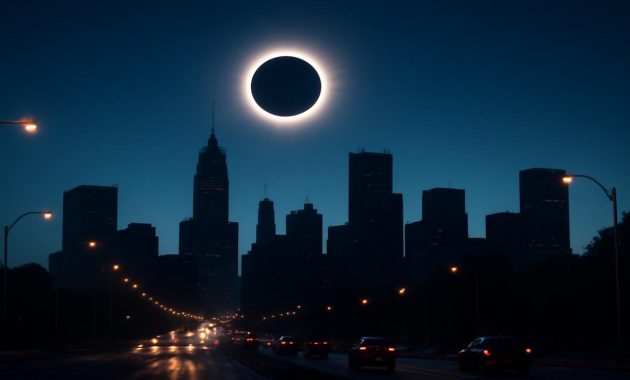
The first thing most people will notice is the sound. Not the sky itself, not the shadow sliding over neighborhoods and cities, but the sudden quiet that comes when daylight fails in the middle of the day. Traffic hum softens. Birds hesitate mid‑song, then fall strangely silent. Somewhere, a dog begins to bark as if at an intruder no one else can see. By then, overhead, the familiar blue has already begun to thin and dim, as if someone has taken hold of the edge of the afternoon and started to turn it down like a dimmer switch.
A warning from the sky
When space agencies around the world stepped up to the microphone this year, their message wasn’t one of panic, but of preparation. Astronomers and mission planners, usually careful with their language, found themselves describing what’s coming with words you don’t often hear from people trained to be cautious: “unprecedented darkness,” “deep shadow,” “profound sky dimming.”
In plain terms, day is about to turn into night—swiftly, dramatically, and in a way no living generation in many regions has seen before.
This isn’t the opening scene of a disaster movie or the arrival of some cosmic anomaly that slipped past our detectors. It’s something we’ve known was coming for years, its path plotted and refined, its timing calculated to the second. Yet even with that certainty, scientists speak with the reverent unease reserved for forces far larger than ourselves.
On a map, the event looks clean and simple: a band sweeping across the planet’s daylight side, tracing its path over continents and oceans, sliding across borders without a visa or a pause. But maps are tidy. Reality will be messy and deeply human: office workers on sidewalks with cardboard glasses; schoolyards buzzing with teachers trying to turn a celestial event into a science lesson and a memory that sticks; elderly neighbors remembering “the last big one” while wondering if this will feel different.
To understand why this particular event has space agencies speaking in unusual tones, you have to picture what usually happens during the most familiar sky dramas. A typical solar eclipse is a brief, narrow cut across the world. Many people stand outside its path; many more are caught under clouds. This time, the path of totality—the track where the Sun will be fully blotted out—will pass directly over, or close to, some of the most densely populated regions on Earth. Hundreds of millions of people will feel the day slip, not just toward evening, but into something closer to an improvised night.
The anatomy of an artificial night
What’s coming is technically simple: the Moon, orbiting Earth, moves directly between our planet and the Sun. For a short time, the Moon’s shadow paints a racing footprint across Earth’s surface. Inside that shadow, day collapses into twilight and then into a kind of temporary night. Outside, even thousands of kilometers away, the sky grows strangely dim.
But the experience of it—what it feels like on skin and in the body—is anything but simple. You may be reading this in a fluorescent office hallway, on a train scrolling through news, or in a sunlit kitchen. Wherever you are, imagine this: in the middle of your normal day, the light begins to cool, as if an invisible filter is being drawn across the sky. Shadows sharpen first, their edges turning knife‑clean. Colors flatten. The temperature dips, subtly but undeniably—like stepping into the shade of a giant passing cloud that never quite moves on.
Space agencies have tried to capture this with tidy diagrams and animated simulations: arrows for orbits, shaded cones for shadows, precisely timed charts. But they’ve also started using a different kind of language in public briefings. They talk about how animals may react—birds settling as though evening has fallen, insects starting their nocturnal chorus, farm animals heading for barns or fence lines as if someone has rung a bell no one can hear. They talk about city lights flickering to life in the middle of what, on the clock, is still afternoon.
In many of the regions under the path of totality, the sky darkness will be deeper and longer than anything remembered in living memory. In some places, the Sun’s corona—the delicate crown of plasma that is normally erased by daylight—will blossom into view, a silver halo etched against a sky so dark the first stars and planets will stare back.
This is what agencies mean when they say “unprecedented.” Not that eclipses are rare in the grand scheme—they happen somewhere on Earth roughly every 18 months—but that this one collides directly with our built world at a scale that will be impossible to ignore.
The shadow’s path across our lives
To illustrate just how many people will find themselves under a dimmed or darkened sky, planners at several agencies compiled rough projections—not of orbits and angles, but of humanity itself. It’s a strange kind of census: a count not of who lives where, but of who will stand in the penumbra of an ancient alignment.
| Region | Estimated Population Experiencing Noticeable Darkening | Approximate Duration of Deepest Darkness | Expected Sky Appearance |
|---|---|---|---|
| Major North American Cities | 150–200 million | 2–4 minutes in totality zone; up to 1 hour of dimmed light overall | From eerie twilight to full “ghostly noon” darkness |
| European Urban Corridors | 80–120 million | 1–3 minutes in core path; gradual dimming up to 45 minutes | Heavy dusk, visible planets, sudden streetlight activation |
| Dense Asian Population Zones | 200–300 million | Up to 4+ minutes in some areas | Rapid shift from harsh daylight to deep, hushed gloom |
| Other Affected Regions Worldwide | 100–200 million | Short totality; extended partial phases | Muted sun, long blue‑gray shadows, cooler air |
The numbers are estimates. The feeling will not be.
Science in the sudden dark
Hidden in the drama of this sky‑darkening is a scientific opportunity so rich that teams have been quietly rehearsing it for years. Underneath the public advisories—don’t stare at the Sun without protection, expect traffic disruptions, prepare your power grids—there’s a second set of plans unfolding: a choreography of instruments, satellites, aircraft, and ground‑based telescopes all waiting for those few minutes when daylight collapses.
For heliophysicists, the darkness is a temporary curtain parted just enough to study the Sun’s outer atmosphere, the corona, which sings with charged particles and magnetic storms. Even with modern coronagraphs that artificially block sunlight, there are details—faint structures, subtle waves—that only reveal themselves when the universe itself lends a hand and uses the Moon as a perfect, moving shield.
Meanwhile, atmospheric scientists are less interested in the Sun and more interested in what happens down here. When the light cuts out, the upper atmosphere responds almost immediately. Temperatures drop, wind patterns twist, and the thin, invisible layers where radio signals bounce and scatter begin to dance. Sensors tucked on mountaintops and mounted on research balloons will be watching the sky’s invisible skeleton flex and relax.
Biologists, too, are preparing. In forests and wetlands, tiny tags and recorders have already been placed on birds and bats, in ponds and along animal trails. The goal is simple: witness confusion. How quickly do nocturnal creatures respond to deep daytime dimming? Do birds roost twice? Does the chorus of frogs surge and then falter as light returns too soon?
In cities, researchers will watch a different sort of organism: us. Traffic patterns, electricity demand, emergency calls, noise levels, even social media posts will sketch out how we react when the most constant backdrop of our lives—the steady assurance of daylight—wobbles.
Living in the shadow: human rituals of darkness
There’s an ironic tenderness in how people prepare for a moment like this. For all the technical language orbiting the event, the advice that trickles down into households looks almost domestic: make a plan, step outside, look up—safely. Check on pets. Check on neighbors who might be unsettled by the sudden dimming. Give children something simple but true to hold onto.
In schools, science teachers lay out cardboard eclipse viewers and hold rehearsals. “When I say glasses on, they go on,” one teacher tells their class, already anticipating the flutter of excitement that will ripple through the playground. Roof decks in crowded cities are quietly booked. Parks departments weigh whether to add extra staff for what will feel, in many places, like a pop‑up festival of strangers staring at the sky.
Some communities will lean into ritual. You can picture it now: a local band playing as the light thins; someone reading a poem about shadows and time; a wellness group leading meditation during totality, asking participants to breathe with the fading of the Sun. Others will approach it like a sporting event—countdown clocks, cheering when the last sliver of Sun disappears, more cheering when it comes back.
If you strip away all the technology, what remains is something profoundly old. For as long as there have been humans and sky, there have been days when the Sun disappeared unexpectedly. Our ancient ancestors did not have orbital mechanics, but they had stories. The Sun was being swallowed, stolen, devoured by a dragon or a jaguar, bargained for by gods. People banged pots, lit fires, chanted, begged, celebrated, mourned.
We are less frightened now, but not immune. Somewhere in your body, before your mind catches up with the spreadsheet of facts, a part of you will respond to the wrongness of darkness at noon. Your skin will prickle. Your eyes will search the horizon for something familiar. Perhaps this is why, in public briefings, space agencies have emphasized not just safety, but presence—an invitation, almost, to witness instead of rush.
Shadows on the systems we’ve built
Under the poetry of a darkened sky lies a more practical checklist. Modern civilization is a tapestry of assumptions, and one of the quietest assumptions is light. We count on a certain clarity of day for navigation, for the intricate dance of air traffic, for the balance of power grids, for the behavior of animals we farm and resources we extract.
On the day when the Moon’s shadow glides over major population centers, operators in control rooms will be watching charts as closely as anyone outside watches the sky. Solar power production will dip, sharply and predictably, like a rolling wave across panels scattered on rooftops and fields. Some cities are running simulations of how streetlights and sensor‑driven illumination systems will respond to the rapid change. Will an algorithm trained on dawns and dusks recognize this as evening? Will it flicker, hesitate, or surge?
Traffic planners anticipate an unusual pattern: not rush hour, not weekend quiet, but a strange mid‑day congestion as people drive out of cities or toward parks, then suddenly pull over at the same time, stepping out of cars to gaze upward. Airlines have drawn alternative flight paths and contingency protocols, accounting for pilots whose passengers might surge toward windows and for airports where runways may be briefly lit more like late dusk than afternoon.
Emergency services are bracing too, not because they expect catastrophe, but because any mass event—especially one involving the Sun—can stir anxiety. Space agencies have been careful with their warnings; they speak about “unprecedented darkness” not to frighten, but to help hospitals, city planners, and citizens understand that this will feel different from a cloudy day, a storm, or even a normal eclipse glimpsed from afar.
In power company war rooms, large screens will show model after model of electricity supply and demand, updated in near real‑time. At the moment of deepest darkness, in some regions, electricity demand may spike as lights flip on and air conditioners adjust to sudden temperature changes. Elsewhere, a quiet hush of offices turned outward may temporarily lower usage. The grid will have to flex like a living thing.
How to meet a temporary night
There’s an intimacy to preparing for a sky event you can’t alter. You cannot stop the Moon. You cannot ask the Sun to linger. What you can control, to a surprising degree, is how you move through those minutes of wrong‑way twilight.
Space agencies and science organizations have published their lists of safety guidelines, and they are important—perhaps more important precisely because excitement will tempt people to forget them. Never look directly at the Sun without certified eclipse glasses or a proper solar filter. Sunglasses, no matter how dark, are not enough. Cameras, binoculars, and telescopes can concentrate light dangerously; they need their own filters.
But beyond those essentials, there is gentler advice taking shape, shared in community meetings, school emails, and quiet conversations between friends. It sounds like this:
- Plan to be outdoors, somewhere you can see a wide piece of sky and, ideally, a stretch of horizon.
- Put your phone down for at least part of the event. Let your eyes—not your camera—hold the memory.
- Notice the world around you. Watch how shadows behave, how birds respond, how people nearby fall silent or burst into words.
- If the darkness unsettles someone—a child, a neighbor, an elder—tell them what’s happening while it happens. Narration can be its own kind of comfort.
- Consider not just watching the Sun, but turning occasionally to look behind you, at the racing edge of the shadow approaching or receding.
The space agencies’ warnings are essentially an invitation: this will not be a normal day. Arrange your tasks and meetings and errands around that fact, if you can. Let the event be not an interruption but an encounter.
When the light returns
The strangest part, many people report after witnessing a total eclipse, is not the darkness but how quickly it ends. There is a moment—sometimes it feels like a held breath—when the world seems caught between states. The Sun is gone, the sky is deep and unfamiliar, the air cool and still. Then, abruptly, a single bright bead of light appears on the Moon’s edge, a “diamond ring” against blackness. The first rays spill over, and the shadow begins to race away.
The temperature ticks back upward. Birds launch from their sudden roosts. Streetlights, tricked into early evening, stumble toward daytime logic. The sky shifts through stages of ghostly blue until, almost imperceptibly, it looks ordinary again.
Yet nothing is quite the same, at least not for a while. You may find that colors seem a little too bright, sounds a little too sharp. For a few hours, conversations will drift back to the moment when the Sun was there—and then not. People will compare impressions, some with scientific language, others with metaphors: “It felt like being underwater,” “like the world was holding its breath,” “like time slipped sideways.”
Later, in the numbers collected by scientists, the eclipse will live a second life as data. Graphs will show kinks where temperatures dropped, where grid loads shifted, where birds changed their flight patterns. Papers will be written, careers modestly nudged forward. In space agency archives, images of the corona will join the long lineage of solar portraits stretching back through technological history.
But the thing that will likely endure most vividly is simpler than all of that: the memory of standing outside, whatever your age or profession or worries at the time, and feeling, deep in your animal body, that the world you know can briefly become strange.
Soon enough, routine will reclaim the hours. Deadlines, traffic, chores, news cycles—they will all resume their familiar claim on attention. Yet somewhere, months or years later, you may catch yourself glancing at the afternoon Sun and recalling the day that was designed and predicted to go wrong. The day that turned to night while clocks insisted it was still early. The day when space agencies warned of unprecedented darkness—and, for a fleeting collective moment, humanity looked up together and said, in its own many languages, “We see.”
Frequently Asked Questions
Is this sky darkening dangerous?
The event itself is not dangerous; it is a natural alignment of the Sun, Moon, and Earth. The main risk comes from looking directly at the Sun without proper eye protection during the partial phases. Using certified eclipse glasses or safe viewing methods keeps you protected.
Will it become completely dark where I live?
That depends on whether you are in the path of totality. In that narrow path, day will briefly resemble night or deep twilight. Outside it, you will still notice significant dimming, but it may look more like an eerie late evening than full darkness.
How long will the deepest darkness last?
In most locations along the center of the path, totality—the period of deepest darkness—will last between about 2 and 4 minutes. The entire event, from the first slight bite out of the Sun to the last, can last a couple of hours.
Do animals really react to this?
Yes. Many animals rely on light cues to time their behavior. Birds may go quiet or head to roost, insects may start their night calls, and farm animals often respond as if evening has arrived. When light returns quickly, they may appear briefly confused before resuming normal patterns.
How should I prepare for the event?
Obtain proper eclipse glasses in advance, choose a safe viewing location with a clear view of the sky, and allow extra travel time if you are heading into the path of totality. If you can, plan to pause your usual activities for at least part of the event so you can experience the changing light, temperature, and sounds around you.