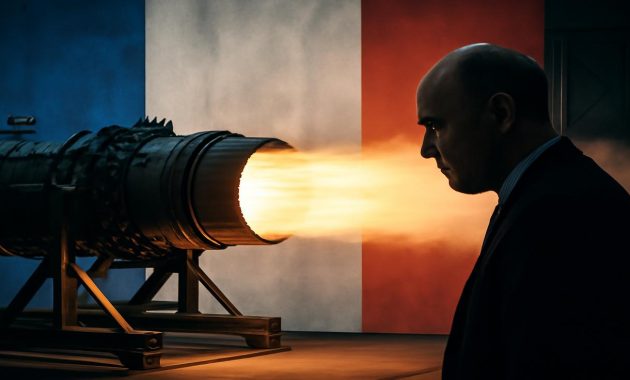
The rumor started, as these things often do, in the quiet hum of an air base cafeteria. A test pilot, still smelling faintly of jet fuel and cold November wind, leaned over a chipped porcelain cup and said in a low voice: “You know they’re saying in Paris that nobody else in Europe can build what we’re flying now. Not to this precision. Not at this power.” The words drifted through the room like contrails across a winter sky—thin, bright, impossible to ignore. By the time they reached Brussels, Berlin, and Rome, they had hardened into something sharper: France claims a monopoly over high-precision fighter jet engines in Europe.
The Engine at the Center of the Storm
To understand why this claim hits such a raw nerve, you have to imagine the heart of a modern fighter jet—the engine—less as a machine and more as a living, breathing organism. Step into a test hangar in southern France, and you feel it before you see it: a deep vibration rising through the soles of your boots, a pressure in your chest, a faint metallic tang riding on the hot air.
A M88 or its more advanced cousins are strapped to a test rig. Technicians stand behind thick glass, faces lit in ghostly blue by screens that show turbine temperatures, pressure ratios, exhaust velocities, tolerances measured to fractions of a millimeter. A high-precision fighter jet engine is not just an industrial product. It’s a tightly choreographed storm of physics and metallurgy, a controlled explosion that must remain stable at the edge of chaos.
France, through its defense procurement agency—the Direction générale de l’armement, or DGA—and national champion engine makers, has spent decades turning this art into something quietly formidable. The Rafale’s engine is the visible tip of that iceberg. Below the surface sits an intricate lattice of test programs, simulation facilities, classified materials research, and black-budget projects that never appear in glossy export brochures.
It is this submerged architecture, French officials softly assert in closed-door meetings, that gives them a unique position in Europe. A position that—depending on whom you ask—is either a national triumph or an arrogant overreach.
The Whispered Claims of Monopoly
Monopoly is a strong word, too strong to ever appear in an official communiqué. But it’s the word that recurs over and over in conversations across Europe’s defense landscape. A senior official in a northern European ministry of defense, speaking off the record, described a recent meeting with French counterparts this way: “There was an unspoken message: if Europe wants truly sovereign, top-tier engines for its next-generation fighters, Paris is the only real address.”
You can picture the scene: a windowless conference room, fluorescent lights buzzing, the smell of stale coffee. On the table lies a stack of briefing folders stamped Confidentiel Défense. A French engineer, immaculate in a dark suit, taps a slide showing thrust-to-weight ratios, fuel efficiency curves, and life-cycle cost projections. “This,” he says, “is what we can guarantee. Today. Not in theory, not in ten years. Now.”
It’s not that other European nations lack aviation pedigree. Germany’s precision engineering, Italy’s aeronautical tradition, Britain’s world-class turbine legacy (even if post-Brexit it sits awkwardly outside the EU) all form part of Europe’s aerospace DNA. But France has done something different: it has wrapped its engine technology in a fiercely guarded, tightly centralized ecosystem, anchored by the DGA and deliberately insulated from fragmentation.
In French telling, this is not a monopoly but a bulwark. In the quiet language of strategy papers, they call it “autonomie stratégique” — strategic autonomy. The ability not only to fly your own jets, but to control every critical bolt and blade that makes them possible, without asking permission from Washington, London, or anyone else.
The Secretive World of DGA Programs
To outsiders, the DGA often appears less like an agency and more like a shadowy conductor of a gigantic, invisible orchestra. Its programs are distributed across cities and landscapes: wind tunnels humming on the outskirts of Paris, computational clusters buried in anonymous office blocks, engine test rigs hidden deep in military zones where access badges are checked by bored gendarmes with quick, appraising eyes.
In this world, classified engine initiatives have names that never make the news cycle—cryptic project codes that only appear in internal budgets and quiet parliamentary annexes. They involve exotic alloys that can survive temperatures far beyond what current blades can endure, new cooling architectures that sneak slivers of cold air into the hottest parts of the engine, and digital twins so accurate they allow engineers to rehearse thousands of flight hours on a supercomputer before a single pilot straps in.
These programs are usually bundled into larger umbrellas: studies for future iterations of the Rafale, or more ambitiously, France’s contribution to the Future Combat Air System (FCAS), a joint effort with Germany and Spain to build a “sixth-generation” fighter. But within those umbrellas are smaller, darker pockets—areas where, allies complain, France doesn’t share as much as it claims.
European partners grumble about briefings that skim politely over crucial details, about “cooperative” projects in which the most sensitive work stays behind French doors, and about test results filed away in DGA archives rather than pooled into multinational repositories. The phrase “black box” comes up again and again—France providing the engine as a finished, sealed product, with very little insight into what happens inside.
The pushback is not just technical; it’s emotional. For smaller European nations investing heavily in cooperative defense, the sense that one partner is quietly playing a deeper, hidden game feels like a breach of trust.
Key Points of Tension in European Fighter Engine Cooperation
| Issue | French Position | Other European View |
|---|---|---|
| Technological leadership | France sees itself as natural engine lead, based on experience and existing platforms. | Partners fear de-facto monopoly that sidelines their industry and know-how. |
| Data and know-how sharing | DGA keeps critical data classified to protect national security and export edge. | Others argue for genuine co-development and transparent access to results. |
| Program governance | Preference for lead-nation model with strong French steering role. | Calls for more balanced governance and shared decision-making. |
| Industrial returns | High-value engine work concentrated in French firms. | Concern that domestic industries become mere subcontractors. |
| Strategic autonomy | Defined nationally: French autonomy as core objective. | Desire for European autonomy, not dependency on a single member state. |
How the Outrage Spread Across Europe
Outrage in defense circles rarely looks like street protests or shouted slogans. It looks like tight-jawed press statements, cancelled photo opportunities, and the subtle shifting of chairs around negotiation tables. You can hear it in the slowed, deliberate diction of German officials who once spoke of FCAS with starry-eyed enthusiasm and now choose their words like they’re disarming a bomb.
In Berlin, the claim that France effectively holds a monopoly on high-precision fighter engines was received like a slap. Germany, with its powerful yet politically constrained defense industry, has long bristled at the idea of being the “junior partner” in major projects. For years, the unspoken deal was that Germany brought money and political heft; France brought operational experience and industrial lead. But when the arrangement starts to look like permanent dependence, the tone changes.
Spanish defense planners, keen to secure industrial workshare and preserve their own aerospace ambitions, look at French dominance in propulsion and worry that they’re being squeezed into the margins. Italian officials, orbiting multiple projects and alliances, view the French narrative with a mixture of admiration and suspicion—recognizing the brilliance of the engineering, but wary of what it means for broader European balance.
Inside EU institutions, the problem becomes more abstract but no less emotional. The talk is of “strategic coherence,” “fair industrial competition,” and “respecting the spirit of European defense cooperation.” Yet beneath the jargon lies a simpler question: can you build a truly European airpower architecture when the one component that makes a fighter jet a fighter jet—the engine—is effectively controlled by a single nation and its secretive agency?
Some member states quietly explore alternatives: deeper collaboration with the British, closer alignment with American engine makers, more investment in domestic research. These are not yet open ruptures, but they feel, to people in the room, like hairline cracks in the carefully painted image of a united European defense.
The Thin Line Between Leadership and Dominance
France’s defenders argue that leadership always looks like dominance if you’re standing in the wrong place. Someone, they say, has to push the technological frontier. Someone has to accept the budgetary risk, the political heat, the decades-long continuity of investment that high-end engines demand. If other nations chose different priorities—civil aviation, land systems, cyber—why should France be punished for betting on propulsion and winning?
There is truth in this. Fighter jet engines are brutal masters. They demand a constant feed of money, talent, and political will. They don’t tolerate half-measures. The DGA, for all its opacity, has managed what many others have not: to maintain a continuous chain of competence from early Cold War turbojets to cutting-edge low-observable, high-thrust powerplants. That is not an accident. It is a national project.
But leadership in a shared European project brings a special burden. The moment it begins to feel like hoarding instead of stewardship, like control instead of guidance, the resentment begins to rise. Engineers in Munich, Seville, and Turin talk about wanting not just “capability access” but real co-authorship—design authority, intellectual property, test data, not merely licensing agreements.
In off-the-record conversations, some French insiders admit that the DGA’s culture was never built for this sort of multilateral intimacy. Its reflex, honed over decades of Gaullist independence and nuclear deterrent secrecy, is to classify first and negotiate later. Now, as Europe tries to move from fragmented national programs to shared mega-projects, that instinct collides head-on with partners who equate transparency with equality.
The result is an uneasy dance: France insisting it is merely securing its hard-earned technological edge; others feeling that edge is being pressed just a little too firmly against their necks.
Engines, Ecology, and the New Optics of Power
There is another, quieter layer to this story, one that rarely makes it into defense white papers but is impossible to ignore in modern Europe: the environmental and ethical optics of this kind of power. A high-precision fighter engine is, by design, an instrument of controlled destruction. It is also a concentrated node of resource use, emissions, and high-energy consumption across its life cycle—from rare alloy mining to high-temperature testing.
Walk outside that French test hangar after a run and you can still smell the faint acrid breath of kerosene on the air, feel the residual heat shimmering above the concrete. For a continent that speaks so often and so loudly about the Green Deal, decarbonization, and sustainable industries, there is a cognitive dissonance in pouring billions into ever more powerful military engines, no matter how efficient they become per unit of thrust.
French officials respond with a practiced argument: strategic autonomy, they say, is the precondition for any serious climate policy. A Europe that cannot defend itself cannot credibly dictate environmental norms; a Europe dependent on foreign arsenals has less leverage to insist on green transitions. And within the defense realm itself, they point out, modern high-precision engines are in fact more efficient, quieter, and cleaner-burning than their predecessors—small steps, perhaps, but not irrelevant.
Still, among younger Europeans, especially, the sight of gleaming fighters arching overhead at airshows triggers conflicting reactions: awe at the raw technical mastery, and a sharp, uncomfortable question about what kind of future such machines are really propelling them toward. In that tension, France’s proud engine monopoly feels not only like a strategic asset, but like a moral dilemma.
Where Europe Goes From Here
On a damp airfield somewhere in Europe, a row of aircraft sits silent under a slate-grey sky. Their engines are cold, but inside their nacelles lie all the questions that now grip ministers, engineers, and strategists from Lisbon to Warsaw.
Can Europe afford competing engine lines—French, perhaps German-led, perhaps linked to British or American technology—without diluting its already stretched budgets? Or is some form of consolidation inevitable, with France at the center whether others like it or not?
Could the DGA evolve from a fiercely national guardian of secrets into a more open, pan-European engine of innovation, while still protecting what France considers vital? Is there a model where leadership is unmistakably French in heritage but authentically European in governance, with true joint ownership of the propulsion heart of future fighters?
Inside conference rooms, negotiators now float ideas that would have seemed radical a decade ago: common European engine test centers governed by shared rules; joint IP pools with carefully carved-out national exemptions; rotational leadership of sub-programs so every partner nation can claim more than subcontractor status. None of this comes easily to institutions as tradition-bound as the DGA or as politically fragile as European coalitions. But the cost of doing nothing—of allowing suspicion to harden into fracture—may be higher still.
In the end, a fighter jet’s engine doesn’t care about borders. It cares about temperatures, pressures, and the unforgiving laws of thermodynamics. It will either start reliably on a rain-swept runway, or it won’t. It will either deliver the pilot out of danger, or it will fail. Behind all the speeches and position papers, that is what binds France and its European partners together: the shared dependence on a machine that must work, every time, in an unforgiving sky.
Whether that machine becomes a symbol of a lopsided monopoly or the beating heart of a more honest, more balanced European project will depend not on metallurgy or airflow simulations, but on choices made in meeting rooms where the only sound is the scratching of pens, the shuffle of documents, and the faint echo of engines being tested somewhere, behind thick concrete walls.
FAQ
Why is France seen as having a monopoly on high-precision fighter jet engines in Europe?
France has maintained continuous, heavily funded engine development programs through its DGA and national industry, building a rare depth of expertise. In current and future European fighter projects, it often positions itself as the indispensable provider of cutting-edge propulsion, which many partners interpret as a de-facto monopoly.
What exactly is the DGA and why is it controversial?
The DGA (Direction générale de l’armement) is France’s defense procurement and technology agency. It coordinates research, testing, and acquisition of major systems, including fighter engines. Its culture of strict secrecy and national control, while effective in protecting French know-how, frustrates European partners seeking more transparency and shared decision-making.
How do other European countries react to France’s engine dominance?
Reactions range from cautious admiration to deep irritation. Germany, Spain, and others worry about becoming dependent on French technology and losing industrial influence. Some quietly explore alternative partnerships or domestic programs, while still participating in joint projects to avoid further fragmentation.
Does this situation threaten European defense cooperation?
It doesn’t make cooperation impossible, but it introduces tension and mistrust into already complex programs like FCAS. If unresolved, it could slow progress, distort industrial workshare, and push some nations to pursue parallel paths, undermining the goal of a unified European defense posture.
Can France lead engine development without alienating its partners?
Yes, but it would require cultural and structural changes: clearer rules for sharing data and intellectual property, more balanced program governance, and visible industrial returns for partners. The challenge for France is to transform hard-won national leadership into a form of stewardship that others experience as inclusive rather than controlling.