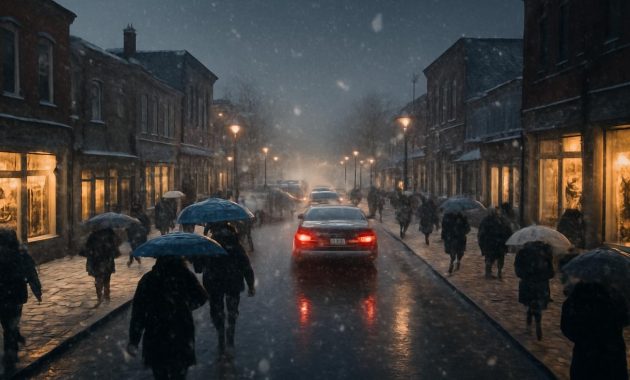
The forecast arrives like a rumor at first—a coworker mentioning it in the elevator, a quick notification on your phone, a passing comment from the barista: heavy snow tonight. By noon, it’s no longer a rumor. Weather alerts bloom red across screens. The mayor appears in a neatly framed livestream, a banner sliding under his chin: “Heavy snow expected to begin tonight. Non-essential travel discouraged.” Outside, though, the afternoon looks ordinary, almost stubbornly so. The sky is only slightly smudged with cloud, traffic runs on its usual bored rhythm, and the air carries the faint smell of exhaust and fried food from a nearby takeout place. It feels like any other Tuesday. That’s the trick snowstorms play—they arrive first in prediction, then in tension.
The City Holds Its Breath
By late afternoon the light changes first. The world shifts toward that quiet pewter tone that comes before real snow, when the sky feels both low and endless. People spill out of office buildings, blinking at the dimming day. Phones are held up, screens glowing with weather radar—swirls of blue and purple shading toward what meteorologists lovingly call “significant accumulation.”
On one corner, a digital billboard scrolls through its loop of ads: winter clearance sale, new gym membership, limited-time coffee flavor. It doesn’t mention the forecast. But beneath it, mounted on the same steel frame, a smaller emergency alert board flashes: “HEAVY SNOW WARNING. TRAVEL TONIGHT NOT ADVISED.” The two messages flicker back and forth: buy more, go home. Keep moving, stop now.
Inside a downtown café, the windows are still clear, only misted by breath and steam from paper cups. A young barista wipes down a counter, glancing every few minutes at the glass, as if the snow might start mid-wipe. At a corner table, an older man folds a paper map he’s been studying, smoothing its creases with work-worn fingers.
“They’re saying a foot, maybe more,” the barista says, unprompted, when she delivers his drink. “You driving home tonight?”
“I’ll have to,” he says. “Boss says business as usual unless the power drops out of the sky.” He smiles, but it doesn’t reach his eyes. Out on the street, a delivery van rumbles past. The sidewalks are crowded with people who act as if they might beat the storm simply by walking faster.
Warnings from the Quiet Voices
By early evening the warnings grow sharper, less like suggestions and more like pleading. Authorities host press conferences framed by sign-language interpreters and anxious graphics. A police chief, still in his snow-dusted uniform from an earlier patrol, speaks with the careful cadence of someone used to being ignored.
“We are urging everyone who does not absolutely need to be on the roads tonight to stay home,” she says. “Our plows will not be able to keep up with accumulation if this storm tracks as expected. If you don’t have to go out, don’t.”
Behind her, a slideshow clicks through images of previous storms: jackknifed tractor-trailers, cars buried up to their side mirrors, an ambulance stuck behind a pileup that stretches out of frame. The message is clear in any language: we’ve been here before.
In the emergency operations center, the air tastes like over-brewed coffee and recycled breath. Maps cover the walls—streets, power lines, flood zones, snow routes. Screens flash radar images like glowing abstract art: the storm spiraling in, pixel by pixel. Dispatchers lean over headsets, voices low, dialing through lists of nursing homes, shelters, and high-risk residents. Snow is beautiful in isolation; in a city, it’s logistics.
Across town, in a small suburban police station, a younger officer scrolls through social media posts on his phone. A bakery announces that it will “bravely remain open for your pre-storm sugar rush.” A big-box retailer posts cheerful graphics insisting “We’ll be open regular hours! Don’t let the snow slow you down!” Beneath the posts, comments argue like dueling forecasts. One reads, “We don’t shut down for some snow. Toughen up.” Another answers, “Tell that to the EMTs scraping you off the highway at 1 a.m.”
The officer sighs, tosses his phone onto his desk, and reaches for his reflective vest. Out the window, he notices the sky has gone from pewter to something heavier, almost metallic. The first flakes haven’t fallen yet, but the world feels like it’s holding its breath.
| Time | Forecasted Conditions | Advisor’s Message |
|---|---|---|
| 6:00 PM | Light flurries beginning, temps dropping below freezing | Finish essential errands, plan to be off the roads soon |
| 9:00 PM | Steady snow, visibility decreasing, slick bridges and overpasses | Avoid non-essential travel; stay home if at all possible |
| Midnight | Heavy snow bands, 1–2 inches per hour, plows struggling to keep up | Only emergency and critical workers should be on the roads |
| 3:00 AM | Blowing snow, possible whiteout conditions, drifting | Stay sheltered; call for help only in real emergencies |
“Business as Usual” Meets the Sky
While public safety officials ask people to stay home, a different drumbeat continues from the glass towers and strip malls and corner stores. The phrase “business continuity” circulates in emails with all the urgency of a fire alarm. Managers forward memos reminding staff that “our customers count on us” and “we aim to maintain normal operations.” Normal, that elusive creature people keep chasing even as the sky prepares to redraw the landscape.
In a grocery store just off the highway, the overhead speakers play a cheerful pop song that sounds oddly at odds with the harried energy in the aisles. Carts rattle faster than usual. A man in a suit stands in the frozen foods section, phone to his ear.
“Yes, I know what the mayor said,” he says, voice tight. “But corporate hasn’t authorized a closure. We’ll play it by ear. We’re open until ten unless someone physically drags me out.”
Behind the deli counter, an employee glances toward the big front windows. Outside, small specks of white have started to drift down, sparse but determined. They splatter against the glass, melting into tiny starbursts of water. It’s the first undeniable proof: the forecast has crossed the threshold into reality.
Next door, a small pharmacy has taped a handwritten sign to the door: “Closing at 7 PM tonight due to weather. Please pick up prescriptions early. Stay safe.” Inside, the owner stands with her hands on the counter, watching the snow begin. She knows she’ll lose money closing early. She also remembers the storm five winters ago, and the staff member who skidded into a guardrail trying to drive home after a late shift.
“Some things aren’t worth the receipts,” she says quietly, turning the key after the last customer leaves.
Where Responsibility Begins
There’s an unspoken tug-of-war in the air now. On one end, thick ropes of responsibility stretch around hospital workers, utility crews, firefighters, plow drivers, transit operators—people who don’t get to bow out when weather turns vicious. On the other end, looser lines attach to coffee chains, clothing outlets, open office plans. Somewhere between them are small business owners, managers, and line workers trying to decide where necessity ends and risk begins.
In an office park at the edge of town, a call center of glowing cubicles hums with voices. Many of the employees arrived by bus before the first flakes appeared. Now, as snow thickens into a steady curtain outside, someone sends around a chat message: “Authorities advising non-essential travel to stop. Anyone else think we should close?” There are heart reactions, thumbs-up, a few jokes. Somewhere up the chain, though, the reply comes back predictable as gravity: “We’re monitoring the situation. For now, we remain open.”
“Monitoring the situation” does nothing to sand the ice off the roads at midnight, but it sounds reassuring typed into an email. It doesn’t tell the story of tires spinning uselessly on unplowed side streets while the last shift of the night tries to get home.
Driving into the White
By nine o’clock, the storm has found its rhythm. Snow slam-dances under streetlights, swirling in loose, luminous columns that look almost liquid. The world takes on that muffled soundscape particular to heavy snowstorms, when traffic noise dulls and voices seem closer somehow. Street signs grow softer around the edges. Cars move with a kind of cautious, hunched posture, tail lights glowing like nervous eyes.
On the highway, lines disappear under rapidly accumulating slush. Wipers thump in ragged unison. Drivers squint, leaning forward as if their bodies might coax more visibility from the storm. A digital message board above the interstate flashes its mantra: “HEAVY SNOW. AVOID TRAVEL. STAY HOME.” Below it, a convoy of commuters creeps onward exactly the way they always do, heading toward the exits that lead to neighborhoods, to parking garages, to late shifts that weren’t canceled.
Inside one of those cars, the air smells faintly of old coffee and dashboard plastic. The driver, a night-shift nurse, wraps her hands tighter around the steering wheel. Her phone buzzed three times that afternoon with automated calls from the hospital: “This is a reminder of your upcoming shift. Please allow extra travel time due to weather.” She listens now to the sound of snow hissing under her tires, thinking of ICU beds and ventilators and the patients who won’t wait for clearer skies.
In the lane beside her, another car drifts slightly, then corrects, then drifts again. The driver there works in a warehouse that packs and ships online orders labeled “2-day guaranteed delivery.” When the storm warning came, he asked his supervisor if the overnight shift might be suspended.
“We’ve got quotas,” came the answer. “People still expect their packages. Roads will be fine. Just take it slow.”
Now, as the highway’s white lines vanish under accumulating snow, he wonders if any of those packages contain something urgent enough to justify skidding across three lanes.
Silent Streets, Loud Choices
Deeper into the city core, side streets begin to empty. The few cars that remain wear growing caps of snow on their roofs. Bursts of laughter drift from doorways as neighbors shovel early, trying to keep ahead of the storm. In some windows, lights flick on in living rooms where people have settled into improvised snownight rituals: pots of soup simmering, extra blankets unrolled, candles gathered near in case of power flickers.
From apartment balconies, the world looks softened and slowed. Footsteps print briefly crisp patterns on sidewalks before being blurred by new flakes. The air tastes sharper—cleaner than it did this afternoon, as if the storm is scrubbing the exhaust and noise out of the sky, at least for a little while.
Still, every few minutes, a lone car trudges through the intersection at the corner. Headlights diffuse into broad halos. Tires churn sludge where the snow has already started mixing with half-frozen street grit. These drivers are the ones who couldn’t convince a boss, or themselves, to stay put. Some are essential, ferrying people or supplies that genuinely can’t wait. Others are delivering pizza or clocking out from a late shift at a department store that decided to “close early”—a relative term when the heaviest snow is only just beginning.
The storm doesn’t know who is essential. It doesn’t distinguish the car containing an on-call surgeon from the one carrying a stack of takeout orders. Gravity shows the same indifference, pulling every sliding tire with equal enthusiasm toward the nearest ditch.
The Storm’s Perspective
By midnight, the city is changed enough that an out-of-town visitor might not recognize it. Parked cars have become rounded white shapes. Bushes and mailboxes wear caps and cloaks of snow. The usual geometry of the streets is softened; corners blur, curbs vanish under even layers of white. Snow, in quantity, is an artist that favors minimalism—it hides detail to reveal shape and contrast.
Standing at a window, if you’re lucky enough to be home, you might sense the strange dual nature of a storm like this. Up close, each snowflake melting on the glass is an individual event, a tiny sculpture that exists for only a few seconds. Step back, and the scene is dominated not by the flakes but by the blanket they form—thick, relentless, indifferent.
Authorities measure the storm in inches per hour and wind speeds. Businesses measure it in lost revenue or overtime pay. But the snow measures nothing. It simply falls, obeying physics and the invisible script written by air currents and pressure systems far above human schedules.
Somewhere in the city, a plow blasts past, orange lights spinning, carving temporary corridors through the deepening drifts. Behind it, within minutes, the tire streaks soften and narrow. In a neighborhood two miles away, untouched by plows, a sedan attempts a hill, stalls, slides backward. Its headlights pinwheel, then vanish into white. The driver’s breath beads on the windshield; their hazard lights blink impotently into the storm.
Who Gets to Stay Home?
This is where the real tension of nights like this lives—in the question that hides inside every urgent advisory: who actually gets to heed the warning to stay home? When authorities step up to microphones and plead with residents to avoid unnecessary travel, the word “unnecessary” expands and contracts depending on who you are, where you live, and what your paycheck depends on.
For some, the choice is straightforward. They can open a laptop at the dining table and attend the morning meeting over video, snow piling against the window while their commute shrinks to the length of a hallway. For others, work exists only at a physical place: behind a counter, on a factory floor, behind the wheel of a route that doesn’t drive itself.
A delivery driver, cheeks reddened under a knit hat, shrugs as he loads the last orders of the night.
“Management said we’re staying open until the orders stop,” he says. “Weather advisory or not. People still want their stuff. I still need my paycheck.” He pauses, looking up at the swollen sky. “But I told my kids to keep an ear out. If I’m not home by breakfast, they call my brother.”
The storm reveals the thin places in the stories we tell ourselves about “normal operations.” Normal for whom? At what cost? For whose benefit? Snow doesn’t answer, but it forces us to sit with the questions, at least for one long, muffled night.
After the Fall
By the time dawn approaches, the storm has either begun to tire or redoubled its efforts, depending on the track and the luck of geography. Plows scrape past again and again, their progress measured in fleeting rectangles of exposed asphalt. Parking lots transform into topographical puzzles of ridges and piles. The city wakes slower than usual, as if emerging from a heavy dream.
This is the moment when the previous night’s choices become visible. Towing companies trawl the main roads, hooking stranded vehicles from snowbanks. A small knot of cars sits at the bottom of an iced-over off-ramp, abandoned at odd angles. Somewhere, an ambulance crew returns to base with salt-dusted boots and stories they’ll tell only to each other.
In the morning light, the snow looks almost innocent. It glows soft, smooth, inviting. Kids drag sleds to the nearest hill, their shouts threading through the crystalline air. Dogs bound and burrow, leaving joyous, chaotic trails. For a few hours, the storm is just beauty—a rare chance to see familiar streets made new and strange.
Inside offices and boardrooms, though, emails multiply. There are reports to file, risk assessments to complete, hindsight promises to consider. Some managers wish they’d closed sooner. Others double down on the narrative that “we made it through, just like always,” brushing past the skids and near-misses that could have gone another way with a millimeter more ice, an inch more snow.
Authorities, their eyes ringed with fatigue, step back in front of microphones. They list numbers: accidents responded to, power outages fixed, calls received, rescues performed. They remind everyone that, even as the sky begins to clear, side streets remain treacherous, sidewalks a hazard of packed snow and hidden ice.
The city starts to move again, cautiously at first, then with the mounting confidence that comes with daylight and the human habit of assuming that the worst is behind us. But for some, the storm lingers—not just in the drifts against their door, but in the recalibrated understanding of what “stay home” really asks of people whose lives are tied to paychecks, and of the institutions that decide whether tonight is business as usual or a night to finally let the streets go quiet.
Choosing Stillness
Next time, the forecast will arrive again in stages: a rumor, a push alert, a red banner beneath a familiar anchor’s face. Heavy snow expected. Travel discouraged. The cycle will spin up: advisories, projections, corporate emails, family group texts sharing screenshots of radar maps like weather Rorschachs.
Maybe, having lived through this storm, a few more decision-makers will choose differently. Perhaps a manager will read the advisory and decide that “monitoring the situation” isn’t enough—that sending people home early, or closing altogether, is the only responsible option. A commuter might look at the sky, then at the message from their boss insisting on attendance, and press back: “Authorities are urging people off the roads. Can we revisit this?”
Storms don’t negotiate, but people do. We negotiate with ourselves, with our employers, with our expectations of what productivity looks like when nature draws a hard line across the evening. Heavy snow has a way of clarifying priorities. It reminds us, in the bluntest possible language, that underneath the schedules and sales targets there is something more fragile: a body in a car on a dark, icy road. A choice to leave that body at home might be the quietest, wisest act of resistance against the myth that everything must continue uninterrupted, no matter what the sky is doing.
Outside, on nights like this, the snow falls heavy and sure, blanketing highways and back alleys, office parks and cul-de-sacs in equal measure. Seen from above, the city under snowfall doesn’t care where the downtown ends and the suburbs begin, which building sells necessities and which sells luxuries. The storm is honest that way. It simply asks a question as it silences the streets:
Will you slow down? Will you listen? Will you let the world, for one night, be something other than business as usual?
FAQ
Why do authorities urge people to stay home during heavy snow?
Authorities ask people to stay home because heavy snow quickly reduces visibility, hides ice beneath fresh powder, and overwhelms plows. Fewer cars on the road means fewer accidents, faster emergency response times, and safer conditions for essential workers who must travel.
What counts as “essential” travel in a snowstorm?
Essential travel usually includes medical emergencies, hospital and healthcare commutes, critical utility and public safety work, and sometimes urgent care for vulnerable family members. Trips for shopping, dining out, or non-urgent appointments are generally considered non-essential during the height of a storm.
Why do some businesses stay open despite severe weather warnings?
Businesses often weigh revenue, customer expectations, and contractual obligations against safety concerns. Large chains may have corporate policies that default to “business as usual,” while smaller businesses may feel financial pressure to remain open. That tension often puts employees on the road even when officials advise staying home.
How can drivers decide whether it’s truly safe to go out?
Check official weather alerts, road condition reports, and local advisories rather than relying on how things look from your window. If authorities are explicitly discouraging non-essential travel, it’s wise to postpone trips. When in doubt, ask whether the reason you’re going out is worth the risk of being stranded or injured.
What can employers do differently during major snow events?
Employers can allow remote work where possible, close early to give workers time to get home before conditions worsen, stagger shifts, and clearly state that employees should not endanger themselves to commute. Treating official advisories as serious guidance rather than background noise can save both lives and long-term costs.