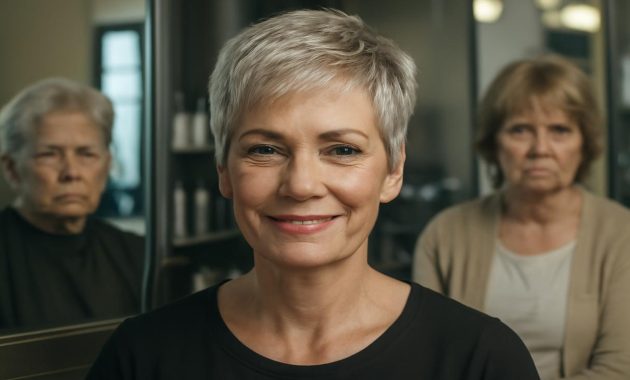
The woman in the salon chair is staring at herself the way you look at an old photograph you’re not sure you recognize. Her hair, long and familiar, pools around her shoulders like an old habit. She’s in her early sixties. Her stylist, a man with silver at his temples and unapologetically sharp glasses, is suggesting something “shorter, sharper, lighter.” She laughs it off. “Oh no, that’s for younger women,” she says, clutching the cape. He pauses, meeting her eyes in the mirror. “Or,” he says gently, “it’s for women who aren’t afraid to look vibrant and modern.”
The Quiet Rules No One Admits Out Loud
Somewhere along the way, an invisible rulebook appeared for women over 60. The pages are soft and almost polite: Don’t draw attention. Don’t go too short, you’ll look “trying too hard.” Don’t go too long, you’ll look like you’re “not accepting your age.” Don’t go too bold, don’t go too textured, don’t, don’t, don’t.
But when you start listening to the stylists who work every day with women in their sixties, seventies, and eighties, another story emerges. One that’s frankly a bit controversial. Many of them say the biggest thing holding women back from fresh, youthful cuts isn’t their face shape, their hair texture, or “what’s appropriate for their age.” It’s fear. Fear of being visible again. Fear of being mistaken for someone who still wants to be looked at. Fear of looking vibrant and modern in a world that keeps nudging you toward the comfortable gray blur at the edges.
“I see it all the time,” one veteran stylist confided recently. “Women tell me, ‘I can’t wear that cut, it’s too young for me.’ But what they’re really saying is, ‘I’m afraid of what it might wake up in me—and how people will react to that.’”
The irony? The hairstyles many women sidestep—the airy bobs, the playful shags, the sculpted pixies—aren’t “too young.” They’re simply alive. They move, they swing, they catch the light. They are conversations, not apologies. And they often look more natural, current, and flattering than the careful, “safe” styles that huddle around the face, trying not to offend.
The “Youthful” Cut Everyone Argues About
Ask a room full of seasoned hair experts which cut women over 60 avoid the most, and you’ll hear some version of the same answer: a modern, slightly messy, layered short cut—think somewhere between a textured bob and a soft, choppy pixie. Not the stiff helmet hair of the eighties, but a shape with movement, with lightness, with deliberate imperfection.
It’s the cut many magazines label “youthful,” almost like a warning sign. But youthful doesn’t have to mean you’re trying to rewind the clock. It can also mean something far quieter: your hair still tells the world you’re here, awake, paying attention.
Experts say women often recoil from this style because it feels emotionally risky. Cutting your hair above your jawline, or daring to create volume at the crown, can feel like throwing off a cloak. Your neck is visible. Your jaw is visible. Your cheekbones are suddenly in the spotlight. It’s exposing. It’s honest. And in a culture that has taught older women to become softly invisible, that honesty can be deeply unsettling.
But hairdressers, the ones who see every flinch and every smile in the mirror, notice something else: when women take the leap, when they choose that airy bob or a slightly wilder, modern crop, their whole posture changes. They sit taller. They move differently. They touch their hair not with apology, but with curiosity, even pleasure.
Why This Cut Works Better After 60 Than Before
Here’s what doesn’t get said often enough: your sixties are, anatomically, a perfect time to try a more sculpted, shorter shape. Your face has more story in it now—soft lines around the mouth, a stronger sense of who you are around the eyes. Shorter, modern cuts frame that story instead of hiding it. While longer, heavy styles can drag the face downward, a shorter, layered shape does the opposite. It lifts.
Experts point out that hair itself changes with age: it often becomes finer at the crown, dryer at the ends, sometimes sparser near the temples. Shorter, layered cuts take advantage of this new texture. They allow lift at the roots instead of collapse, softness around the face instead of frizz, definition instead of limp length that’s only there because you’ve had it that way forever.
“People think short hair is harsh,” one stylist in her late sixties explained. “But actually it’s the opposite when done right. It softens the features because it removes the dragging weight and the heavy outlines. It lets light in—the light around your eyes, your smile, your skin. It’s the emotional weight that makes it feel harsh, not the cut itself.”
The Sensory Shift: What It Actually Feels Like
Imagine, just for a moment, walking out of the salon with your hair grazing your jaw instead of your shoulders. The air actually touches your neck. A breeze finds its way between the soft pieces near your ears. You feel lighter, as if someone unclasped something you didn’t know you were wearing. You run your fingers through your hair and they meet the shape of your skull, not the curtain of habit that used to hang there.
The first time you wash it, there’s that tiny shock: this is fast. The water doesn’t have to drag through lengths. It glides. Shampoo becomes a few circular motions and then the sound of water on tile. Your hands find their way through the new texture—shorter, springier, freer. You squeeze it out, and there’s no long, wet rope to twist. A towel, a few presses, and suddenly you’re not fighting your hair; you’re having a conversation with it.
That sensory reality—lightness, breeze, movement—is one of the things stylists say their older clients underestimate the most. “They think about how it will look,” says a salon owner who specializes in 60+ clients, “but they never imagine how different it will feel to live in. How much easier morning becomes, how much less they dread humidity or rain.”
And yet, behind all of that, there’s another feeling: the quiet flutter of doing something unmistakably visible. Walking into the grocery store with a cut that looks like now, not twenty years ago. Seeing your reflection in a café window and recognizing someone you haven’t seen in a long time: the version of you who tries things.
Comparing Classic “Safe” Styles to Modern Cuts
To understand why this debate is so heated, it helps to look at the differences side by side. Many women have worn some variation of the same style for decades: shoulder-length, maybe with bangs, perhaps tinted or carefully highlighted. Hair experts say there’s nothing wrong with that, but it often doesn’t serve who you are now.
| Style Type | How It Often Looks After 60 | How It Feels Day-to-Day |
|---|---|---|
| Long, one-length or minimally layered | Can drag the features downward, emphasize thinning, look dated if too uniform | Heavier, more time to dry and style, more prone to flatness on top |
| Short, structured but soft (modern bob, shag, or pixie) | Lifts the face, highlights eyes and cheekbones, reads as current and intentional | Lighter, quicker to wash and style, easier to add texture or volume |
| Helmet-style “set” hair | Can look overly stiff or aging, less movement, often associated with “old-fashioned” looks | High-maintenance salon visits, difficult to recreate at home, less adaptability |
The cut experts keep pushing—the modern, layered, shorter shape—is the one many women label “too bold.” From a technical angle, though, it’s actually the most forgiving and practical for aging hair. The controversy isn’t about suitability; it’s about daring to be seen.
Fear Masquerading as “I’m Just Low-Maintenance”
When stylists gently suggest a more modern cut, the protests often come dressed as logic. “I’m too busy for that kind of style.” “My hair doesn’t do what it used to.” “I’m low-maintenance.” Hidden in those phrases is a quieter worry: if I look too vibrant, will people think I’m trying to be 30 again? If I look too current, will it feel like a costume on this sixty-something face I’ve worked hard to accept?
But consider this: is it truly low-maintenance to wrestle every morning with hair that won’t cooperate, just because the length feels safe? Is it really practical to cling to a cut that needs constant coloring to avoid a stark line of demarcation, when a shorter, textured style might blend silver and pigment in an intentional way?
Hair experts who specialize in older clients say the women who resist change the longest are often the ones who, deep down, are most tired of their hair. They complain about the time it takes to make it look “presentable.” They sigh about flatness, dryness, or the odd way it falls. But when offered a solution that would require them to be newly visible, they retreat. “I don’t want to look like I’m trying to be young,” they say, as if daring to look awake past 60 is some kind of crime.
The controversial stance many stylists quietly hold is this: refusing a modern cut isn’t about age appropriateness—it’s about comfort with your own aliveness. We’ve been trained to interpret vibrancy on older women as vanity, when it’s really just another form of presence. Hair that moves, catches light, has shape and playfulness—this isn’t the domain of youth. It’s the domain of anyone who refuses to fade out politely.
Letting Gray Be Part of the Modern Story
One of the most radical combinations experts love—though clients often fear—is a modern, youthful cut paired with unapologetically natural gray or silver hair. Not the yellowed, neglected gray that happens when you “give up,” but the intentional silver that’s cut with precision and shaped to flatter your skin tone and bone structure.
Stylists see magic in this mix: the color speaks of experience, while the cut whispers of present-tense energy. Together, they create a look that doesn’t pretend to be younger, but refuses to be categorized as “done.” This, more than anything, can feel socially rebellious: to show up fully as a sixty-something woman—lines, silver, laughter—and still wear a cut that says, “I’m in the room. I’m not on the sidelines.”
Designing a Modern Cut That Fits Your Actual Life
It’s easy for experts to advocate bold changes; it’s your head that has to live with them. So what does it look like to move toward a more modern, youthful cut in a way that honors your daily rhythm rather than fighting it?
First, think in terms of movement and shape, not slogans. “Pixie” or “bob” are too broad. What you want is a cut that works with your hair’s natural behavior. Does your hair wave when it’s short? That’s an asset, not a problem. A slightly mussed, layered bob that hits at the cheekbones, with soft pieces near the jaw, can look elegantly undone. Got very fine hair? Strategic layering and the removal of excess length can create lift you haven’t seen in years.
Second, be honest with your stylist about what you’re willing—and not willing—to do each morning. If you hate blow-dryers, they can design a cut that air-dries into its best self. If you’re okay spending five minutes with a round brush, that opens other possibilities. The point of a modern cut is that it should look intentional, not labored over.
Third, plan the transition in steps if you’re terrified. Many stylists suggest a “bridge” haircut: shorter and more layered than you’re used to, but not yet the full leap you imagine when you hear the word “pixie.” Each appointment becomes less about drastic change and more about refining what feels most like you now.
A Few Modern Shapes That Shine After 60
While every head of hair is its own small planet of quirks, some cuts tend to resonate especially well with women over 60 who are ready to look more current without sacrificing ease:
- The textured jaw-length bob: Soft layers, subtle graduation at the back, light fringe or face-framing pieces. Works beautifully with glasses and shows off the neck without feeling severe.
- The soft shag: Modern, not 1970s costume. Gentle layers around the crown and face with movement through the ends. Great for wavy or slightly curly hair that resists perfection.
- The airy pixie-bob hybrid: Longer on top, slightly cropped at the nape, with versatility to push back, tousle, or smooth. Gives the drama of short hair without fully exposing every contour.
All of these cuts share the same DNA: movement, softness, deliberate imperfection. They’re not “young” styles so much as awake styles. They are as appropriate on a 65-year-old as on a 25-year-old, because looking like you exist in the current moment is not age-restricted.
When the Mirror Shows Someone New
The real story happens the first week after the cut. You catch your reflection in unexpected places—the microwave door, a store window, a passing car—and for a heartbeat, you’re not sure who that is. There’s a flicker of recognition that arrives from the inside out: This looks like me when I’m telling the truth.
Sometimes there’s a wave of regret in the early days, especially if you’ve been attached to long hair for decades. But give it time. Learn the new texture. Figure out how it behaves when you sleep on it damp, or when you let it air-dry. Ask your stylist to walk you through styling again at your next visit; a good one will happily show you little tricks for coaxing volume or taming a stubborn bit of wave.
More interesting than the technical adjustment is the social one. Friends may comment, “You look so much younger!” and you might bristle, because youth isn’t the goal. You don’t want to erase your age; you want to inhabit it fully. But translated, what they often mean is, “You look more present, more lit from within.” You might receive the occasional sideways remark—“Oh, you’re brave, I could never”—which says more about the speaker’s relationship with visibility than about you.
In quieter moments, something else settles in. A sense of alignment between how you feel and what the world sees. The story in your hair finally matches the story in your bones: you are still changing, still experimenting, still refusing to freeze yourself at some comfortable, unthreatening version that reassures everyone else you’ve retired from boldness.
Claiming Vibrancy Without Apology
The most radical thing about a modern, youthful haircut after 60 isn’t that it takes years off your appearance; it’s that it puts your aliveness back on display. In a culture that suggests older women should dim themselves politely, choosing a cut that is stylish, current, and intentionally flattering is an act of quiet rebellion.
Experts who’ve watched thousands of women move through this transformation say the real controversy isn’t about hair at all. It’s about who’s allowed to look like they’re in the middle of life rather than at the edge of it. A short, textured bob or crop doesn’t erase your years. It honors them by refusing to pretend the story’s over.
If you’ve been circling the idea but backing away at the last minute, ask yourself gently: Is this really about what suits my face—or about my comfort with being seen as fully alive at my age? If the answer feels uncomfortably close to fear, that’s not a sign to retreat. It might be an invitation.
Not every woman has to go short, or choppy, or textured. There’s no single correct cut after 60. But if you feel a quiet tug toward a style everyone keeps calling “youthful,” maybe the bravest move isn’t to resist it on principle. Maybe it’s to admit you’re not done looking vibrant and modern, and then sit down in the chair and let the scissors catch up to the person you already are.
FAQ: Hairstyles After 60 and the “Youthful” Cut
Is short hair always more flattering after 60?
No. What’s more flattering is a shape that works with your hair’s natural texture and your facial structure. That said, shorter, layered cuts often lift the face and work better with aging hair than long, heavy styles that can drag features downward.
Will a modern, youthful cut make me look like I’m trying to be younger?
Not if it’s tailored to you. A well-cut, modern style simply makes you look current and intentional. Pairing a contemporary shape with your natural silver or softly blended color usually reads as confident, not “trying too hard.”
What if my hair is thinning—can I still wear a textured cut?
Yes. In fact, thinning hair can benefit from strategic layering and shorter lengths. Removing weight allows for more lift at the roots and creates the illusion of fullness, especially around the crown and sides.
How do I talk to my stylist about wanting a change without going too extreme?
Bring photos of cuts you like and be very clear about your comfort level. Ask for a transitional step rather than a drastic chop. Explain how much time you realistically want to spend styling each day so they can design something you can maintain.
Can I keep my gray hair and still look modern?
Absolutely. A sharp, contemporary cut is one of the best ways to make gray or silver hair look intentional and stylish. The contrast between modern shape and natural color often looks more sophisticated than heavily dyed styles.
How long should I give myself to adjust to a new, shorter cut?
Give it at least two to three weeks. You need time to learn how it behaves, how it air-dries, and how a quick styling routine feels. If something really doesn’t work, talk with your stylist about small tweaks at your next visit.
Is it ever “too late” to try a bold new hairstyle?
No. Hair grows, and style is not age-locked. Whether you’re 60, 70, or 85, you’re allowed to experiment. If a more vibrant, modern cut appeals to you, your age is not the barrier—only your willingness to be seen is.