The wind gets in first. It wriggles under your jacket, lifts the hair at the back of your neck, and carries with it the sour tang of wet earth and sheep. You stand there on the line of Hadrian’s Wall, stones dark with recent rain, and for a moment you do what we’ve been trained to do for generations: you imagine clean lines of shining armor, disciplined ranks, a stoic Roman frontier holding back the chaos of the north. It feels heroic. It feels simple.
And it’s almost entirely wrong.
Not the wall itself, of course. The stones are real enough beneath your boots. But the story we’ve been sold – the postcard vision of noble legionaries, high Roman hygiene, marble discipline against barbarian mud – is beginning to come apart like old mortar under fresh frost. In its place, a new, messier, strangely more human picture is emerging, and it is full of things no glossy brochure ever mentioned: rotting latrines, swarming parasites, aching backs, bad beer, and men who itched beneath their armor so badly they probably wanted to claw their own skin off.
The Day the Soil Started Talking
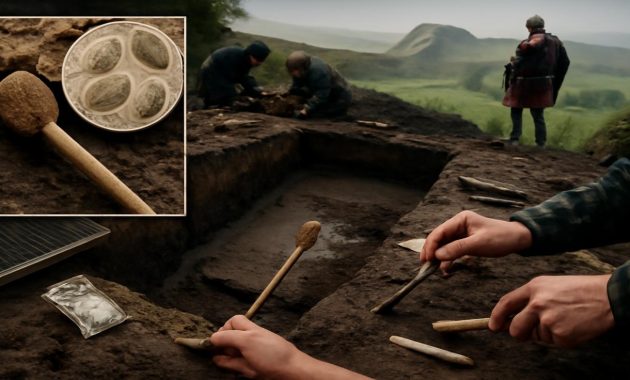
The reimagining started, as revolutions often do, in something tiny and overlooked. In this case: eggs. Not the sort in nests, but microscopic relics of intestinal worms preserved in latrine soil and old rubbish pits along the length of Hadrian’s Wall. Archaeologists have been sifting through these silent, unlovely deposits for years, but only recently have new analytical techniques begun to give them a voice.
Under a microscope, what looks like uniform brown sludge turns into a busy, grotesque archive: whipworm eggs shaped like little barrels, roundworm eggs like tiny missiles, the shell fragments of fleas and lice. Each is a time-stamped confession from a body that lived, suffered, and relieved itself in the shadow of the Wall. Together, they paint a picture that clashes violently with the clean, orderly world of textbook Romans.
At one fort bathhouse site, researchers found so many parasite eggs that the bath itself starts to look less like a symbol of refined Roman cleanliness and more like a warm, steaming incubator for disease. The water was changed, yes, but not nearly as often as you might imagine. Men rinsed dirt and sweat and feces from their bodies into shared pools, and the worms, delighted, kept the party going.
“You look at the egg counts,” one field scientist remarked, “and you start to realize these guys weren’t just a little infected. They were riddled.” Riddled is not a heroic word. It’s a word that sounds like wood gone soft, like something quietly falling apart inside.
When Heroism Starts to Itch
Walk the ramparts in your mind. Armor clinks, boots strike stone, the horizon shivers under northern cloud. The stories say these soldiers were the pinnacle of ancient discipline, marching geometry made flesh. But now add something the stories forgot: the constant, humiliating itch of lice and fleas.
Combs found in Roman forts along the Wall come with their own microscopic footnotes. Under magnification, the fossilized shells of lice cling to the teeth of those combs like desperate passengers. Nit eggs are lodged where hair once caught. These weren’t occasional outbreaks; this was daily life.
Imagine fastening your belt for sentry duty while your waistline burns with bites. Imagine crouching in a damp corner of a barrack, trying to scratch discreetly while your centurion shouts orders. This isn’t the shiny bronze of movie epics; it’s a raw, human intimacy with discomfort.
Parasites don’t only itch. They steal. Worms hoard nutrients, slowly robbing bodies of iron and strength. A legionary who looked perfectly fine from a distance might have carried a belly full of freeloaders, turning each meal into a negotiation. Tiredness. Shortness of breath. Faintness on long marches. We picture Roman soldiers as near-superhuman, but a surprising number of them may have been fighting their own guts as much as any enemy beyond the Wall.
Inside a Fort That Was Never Really Clean
The forts dotting Hadrian’s Wall have long been interpreted as models of Roman order. Rectangular layouts. Barrack blocks in neat lines. Granaries lifted on stone piers to keep rats at bay. But when archaeologists started looking not just at walls and floors but at the microscopic life they trapped, a more pungent reality rose to the surface.
Take the humble latrine, that unsung stage of ancient living. Some were engineering marvels by contemporary standards: stone seats, channeled water, long drainage systems. For years, these structures helped fuel the myth of the ultra-hygienic Romans. How could people with such sophisticated toilets possibly wallow in filth?
The answer, it appears, is: surprisingly easily.
The water that ran through Roman latrines was often reused, circulating through bathhouses and drains before finally staggering away toward ditches. Parasite eggs rode along, oblivious to engineering pride. Soil samples taken near these drains are thick with them, proof that contamination was never fully contained.
In some forts, dumps full of animal bones and kitchen debris huddled close to living spaces. Rats, those connoisseurs of human sloppiness, thrived. Their fleas, potential carriers of disease, likely mingled with human parasites in the straw mattresses and between the folds of wool cloaks.
Here is the uncomfortable truth: Roman order existed, but it coexisted with very Roman mess. On stormy nights, fort interiors might have smelled less like wax and leather and more like a livestock yard crossed with a low-budget boarding house. The Wall was not a clean white line in the landscape; it was a 73-mile-long ecosystem of humans, animals, microbes, and everything in between.
A Closer Look: What Lived With the Legionaries?
| Type | Likely Culprit | Effects on Soldiers |
|---|---|---|
| Intestinal worms | Roundworm, whipworm | Anemia, fatigue, bloating, abdominal pain |
| External parasites | Lice, fleas | Itching, infection risk, disturbed sleep |
| Rodent-borne pests | Rat fleas, mites | Disease transmission risk, contamination |
| Water contaminants | Fecal bacteria, egg-laden sludge | Diarrhea, dehydration, chronic illness |
This is the unseen army that stood alongside the legionaries – and sometimes, against them.
The Myth We Bought, and Why It Was So Easy to Sell
How did we end up with such a scrubbed, heroic vision of life on the Wall in the first place? The answer loops back through Victorian imaginations, nationalist storytelling, and our own modern hunger for tidy heroes.
When early excavations of Hadrian’s Wall sites began in earnest in the nineteenth and early twentieth centuries, they happened in a world obsessed with Empire. Britain looked at Rome and saw a flattering mirror: another great power extending law and order to the fringes of civilization. The remains of forts and bathhouses were seized on as evidence that these ancient invaders were bearers of sophistication, bringing stone architecture and structured streets to a land painted as rough and backward.
In that narrative, Roman soldiers became paragons: hard, clean, rational, superior. You can still see the afterglow of that storyline in guidebooks that talk of “civilizing influences” and “bringing Roman hygiene” to the north. It’s a reassuring tale. It suggests that power equals progress, and that the men on the frontline of that power were something like armored civil servants bravely enduring the weather for the greater good.
Parasites puncture that fantasy with rude insistence. They don’t care about marble or military glory. They thrive on what all humans do, no matter how disciplined: sweat, waste, close living, imperfect plumbing. The Wall’s new microscopic evidence reminds us that Rome was not a clean white ideal but a flesh-and-blood organism, complete with dirt under its fingernails and worms in its belly.
“We were sold a history that matched what we wanted to believe,” one historian told me, “not necessarily what the soil was trying to tell us.” And for decades, the soil had no voice. The gleaming hypocaust systems and neat stone barracks spoke louder than the latrine pits quietly festering in the corners of excavation plans.
Redefining Heroism on the Edge of the Empire
Once you let go of the old clean hero myth, a more complicated, arguably deeper kind of heroism starts to come into view on Hadrian’s Wall.
Picture a Thracian recruit, dragged from some sun-struck corner of the empire to this wet, wind-tormented frontier. He has never seen so much cloud. He shares a cramped barrack room with men whose languages he barely understands. The straw in his bunk is full of lice. The bread is sometimes moldy. His stomach roils for weeks at a time with invisible passengers.
And still, night after night, he trudges up to the wall. The northern hills are black against the sky. The wind finds the gaps in his cloak. Somewhere beyond the line of stone, people he has been told are dangerous move through the dark with their own stories and hungers and parasites. He holds his spear a little tighter, shifts his weight on aching feet, and does the job.
This is not the superhuman clean-lined heroism of sculpture. This is the quiet, stubborn heroism of “again.” Again, he gets up. Again, he drills in the yard. Again, he shovels snow from the rampart stones, ignoring the ache in his gut. There is nothing false about this endurance; it’s just less glamorous than the version carved into marble.
Knowing that these men were often weakened, uncomfortable, sometimes desperately unwell, does not strip away their courage. It reframes it. The Wall becomes less a stage for triumph and more a long negotiation between bodies and environment, between imperial will and local reality. In that light, the legionaries’ persistence starts to look less like propaganda and more like something deeply, almost painfully human.
History From the Gut, Not the Pedestal
The hardest thing about this new, parasite-riddled view of Hadrian’s Wall isn’t the gross-out factor. It’s what it asks us to do with our sense of the past. It nudges us away from marble busts and victory arches and back toward flesh, toward failure, toward mess.
There’s a phrase some archaeologists use: “history from below.” Usually it’s about telling the stories of ordinary people instead of just elites. Parasites take this literally. They force us to read history from below the belt, from the intestines outward. They drag our gaze from the commanding officer’s sculpted profile down to the latrine pits that kept his camp limping along.
Once you accept that, other parts of the Wall’s story start to bend. The idea of a sharp divide between “civilized Romans” and “barbarian tribes” beyond the frontier begins to soften. Both sides of that line were dealing with many of the same bodily realities: hunger, cold, disease, vermin. The uniforms and languages differed; the parasites did not care.
In this sense, the new science doesn’t just correct the record. It democratizes it. The lowliest legionary and the highest-ranking officer share similar parasite signatures in the soil. Even the emperor who ordered this stone barrier raised could not have escaped the worms common in his world. No amount of marble can outvote a roundworm.
Standing on the Wall With New Eyes
So what do you do with this knowledge when you come back to the Wall in the present, boots damp, fingers numb on a blustery afternoon? The stones haven’t changed. The line still cuts the landscape, running over fells and through farms, an almost impossibly patient scar of empire.
But maybe you look a little closer now at the low humps of ruined barracks inside a fort. You imagine not only neat ranks of beds but the rustle of straw harboring lice. You picture the smoke of cooking fires tangled with the smell of sweat, latrines, wet wool. You understand that the tidy drainage ditch you’re careful not to fall into once carried water laced with egg-filled excrement, sloshing quietly along while men grumbled about the weather.
The heroism you sense here becomes less cinematic and more granular. It lives in each step a soldier took on swollen feet, in every night he spent on patrol despite the cramps twisting his gut. It lives in the simple fact that the Wall functioned at all, given how many ways the human body can fail even in comfort, let alone on a wind-blasted northern frontier.
Far from ruining the romance of Hadrian’s Wall, this grittier truth can make it more compelling. The past ceases to be a museum diorama under perfect lighting and becomes something stranger, darker, more like real life. It’s harder to worship, but easier to relate to.
As you turn away from the Wall, the wind still slicing at your ears, the sky low and restless, you might feel an odd, unexpected kinship. The men who once shivered here, scratching under their armor and cursing their lot, were not clean myths. They were tired, sick, stubborn humans holding a line in deeply imperfect bodies. Whatever else we change about the story we tell, that part – the raw, unpolished persistence of it – may be the most heroic thing of all.
FAQ
Were Roman soldiers on Hadrian’s Wall really “riddled” with parasites?
Evidence from latrine soils and rubbish pits along the Wall shows extremely high concentrations of parasite eggs, including roundworms and whipworms. Combined with lice and fleas revealed by comb and textile analysis, this strongly suggests that many soldiers were heavily and chronically infected rather than suffering only occasional outbreaks.
Does this mean Roman hygiene was a myth?
Not entirely. Romans did invest in baths, latrines, and drainage systems that were advanced for their time. However, these systems were far from perfect. Water was often reused, sanitation practices were inconsistent, and close-quarter living conditions meant that parasites spread easily despite the presence of infrastructure that looks “modern” to us.
How did these parasites affect the soldiers’ daily lives?
Intestinal worms could cause anemia, fatigue, and digestive pain, weakening soldiers over time. Lice and fleas led to constant itching, skin infections, and disturbed sleep. Together, these problems would have reduced overall health and resilience, making military duties on a harsh frontier even more punishing.
Why did earlier histories ignore this side of life on the Wall?
For much of the nineteenth and twentieth centuries, historians and popular writers were more focused on architecture, military organization, and imperial politics. Microscopic analysis of soils and parasite remains is a relatively recent specialization. Earlier narratives were also shaped by romantic views of Rome and empire, which favored clean, heroic images over messy bodily realities.
Does knowing about the parasites change how we should view Roman soldiers?
It challenges the idealized vision of them as near-invincible, perfectly disciplined super-soldiers, but it doesn’t diminish their endurance or bravery. If anything, realizing they served and fought while coping with chronic infections and poor health highlights a quieter, more human kind of heroism that is easier to empathize with, even if it is less glamorous than the traditional myth.