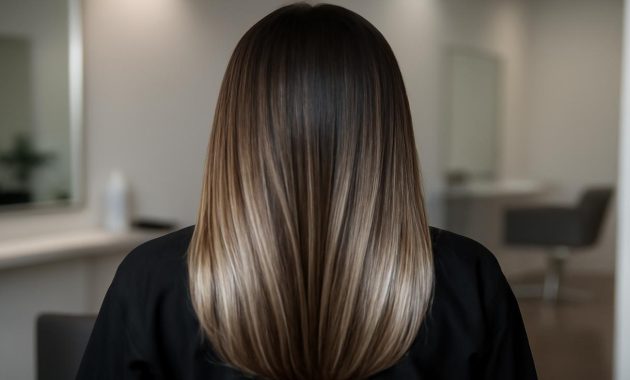
The first time I saw “melting” in real life—not on a glossy Instagram square, but in the wild—it was on a woman in line at a tiny bakery, right before closing. Her hair caught the last of the afternoon light: chestnut, caramel, a whisper of silver, all blending together like steam evaporating off hot bread. I squinted, trying to figure out where her gray ended and her color began. I couldn’t. It was like watching watercolor bleed across a page, every shade dissolving softly into the next. When she turned, I caught a glimpse of soft silver wisps at her temples, but they seemed more like deliberate highlights than the “uh-oh” markers of age. I realized I wasn’t looking at balayage—those familiar painted ribbons of light. This was something quieter, and far more subversive. This was “melting.”
From Painted Ribbons to Quiet Gradients
For more than a decade, balayage was the undisputed queen of low-maintenance color. Those sun-kissed streaks, the artfully grown-out roots, the “I woke up like this” energy—it was freedom in foils. Or, more accurately, freedom from foils. But balayage has always had one little enemy: gray hair. Once the silvers started marching across the hairline, the whole effect changed. Balayage could soften, distract, add brightness, yes. Yet grays still stood there, stubborn and unblended, like static on an otherwise beautiful channel.
Enter melting. If balayage was about contrast and hand-painted ribbons, melting is about disappearance—a magic trick in slow motion. Instead of sharp transitions from dark roots to brighter mids and ends, melting dissolves one shade into the next so gently that you’re almost not sure where the shift happened. Forget stripes. Think gradient. Think river stones underwater, impossible to count where one color ends and another begins.
Melting isn’t brand-new in the technical sense. Colorists have whispered about root melts, color melts, shadow melts for years. But in the last few seasons, as more people embraced their natural texture, their natural silver, and their natural lives, this technique quietly stepped forward, raising its hand like, “I can help with that.” Suddenly, melting wasn’t just another salon add-on. It was a philosophy: stop fighting the gray; fold it into the story.
What “Melting” Really Means in the Chair
Imagine sitting in a salon chair, the mirror framed by plants, warm light, and the faint smell of developer and eucalyptus. Your colorist stands behind you, fingers combing through your hair, gently lifting sections and watching where the gray lies. It’s not about covering anymore; it’s about mapping. Your gray isn’t the enemy. It’s the landscape.
In a classic balayage session, your stylist would paint lightener onto select strands, usually from mid-length to ends, and maybe feather a bit closer to the root. The aim: bright ends, darker base, visible ribbons of light. With melting, the goal shifts. Instead of ribbons, your stylist wants fog. A soft, hazy transition from your natural base to tones that match—and blur—your grays.
They’ll usually start by creating a slightly deeper shade at the roots—your natural color plus maybe half a level or a full level darker, or just subtly cooler or warmer. Then, through the mids and ends, they’ll apply one or two additional tones, each one just a breath lighter or softer than the last. The real magic happens not in the choice of colors, but in how they overlap, feather, and blend.
Color is pulled through with fingers, combs, brushes held at angles that look almost casual, but are anything but. The boundary between root shade and mid-length shade is smudged, blurred, tapped. A little more here, a little less there. Gray hair, especially around the face and part line, is allowed to peek through in controlled ways, matching the lighter shades so closely that it reads like intentional shimmer, not random scatter.
The Alchemy That Makes Gray Hair Almost Invisible
Here’s the quiet genius of melting: it doesn’t actually make your gray hair vanish. It makes it irrelevant. It folds your silver into a broader, more fluid story so that a new gray strand isn’t a jolt—it’s just another brushstroke.
Gray hair has its own personality. It’s often drier, more stubborn, more reflective. Under harsh color, it can flash too bright, too flat, or too cool. Balayage, with its strong contrast, tends to highlight these differences. You see the gray; you see the warm bronde next to it; your eye picks up the clash. With melting, though, your colorist selects tones that harmonize with the natural reflect of your gray—slightly ash, slightly pearl, or lightly beige—then surrounds those stubborn silver pieces with neighbors so similar they just…blend.
The root is usually kept deeper, but not blocky. A soft shadow that lets gray hairs along the part and hairline sway in and out of view like flickers of light. As you move, your hair responds: sometimes a little more silver, sometimes a little less, but always within the same gentle temperature family. From a distance—and often even up close—those grays stop looking like isolated wires of rebellion. They look like texture, dimension, the kind of depth people pay good money for in highlight services.
It’s like someone took the idea of “blurring” from photo editing and applied it directly to hair color. Instead of correcting everything to a flat ideal, melting leans into real life and makes it beautiful in motion, in imperfection, in growth.
Why Melting Feels Different—Emotionally
There’s something else happening here, beyond chemistry. Melting has a psychological sweetness that balayage never quite offered. With balayage, the message was: let’s look sun-kissed, youthful, effortless. With melting, the message shifts: let’s look like ourselves, just softer around the edges. Your roots grow in, and instead of dread, there’s a shrug—and maybe even a little pride.
You start noticing it in tiny moments. The first time you see yourself in a harshly lit bathroom and don’t flinch. The first time your hair air-dries on a random Tuesday and, instead of two-tone banding or sharp demarcation lines, there’s just a washed, seamless flow of color. The first time someone says, “Your hair looks so healthy,” instead of, “Wow, did you get your color done?”
It’s hard to pin down, but melting doesn’t scream, “I have highlights!” or “I cover my grays!” It whispers, “I live in my hair. We’ve made peace.” That’s a wild shift from the old rush to chase and camouflage every new silver.
Melting vs. Balayage vs. Traditional Color: A Quick Look
If you’re trying to decide whether melting is worth a switch from your usual, it can help to see how it compares to more familiar approaches. Think of it like this: same canvas, different brushstrokes, different relationship with time.
| Technique | Look | Gray Hair Effect | Maintenance |
|---|---|---|---|
| Traditional full coverage | Solid, uniform color from root to end | Grays fully hidden, but regrowth is obvious | High – touch-ups every 3–6 weeks |
| Balayage | Hand-painted highlights with visible ribbons and contrast | Softens around grays, but doesn’t truly blend them | Moderate – 8–16 weeks depending on contrast |
| Melting | Seamless gradient of tones; no harsh lines | Grays become part of the overall tone; less noticeable regrowth | Low to moderate – 10–20+ weeks depending on base and goal |
Melting lives in that delicious middle ground. It doesn’t demand your constant return to the salon, but it also doesn’t force you to commit to full-on silver if you’re not there yet. It’s a bridge—a soft, forgiving, beautifully lit bridge.
Who Melting Loves: Hair Types, Personalities, and Thresholds
Melting isn’t exclusive. It doesn’t belong only to the young, or the suddenly silver, or the Instagram crowd. But it does have certain sweet spots where it shines almost unfairly well.
If your gray is just beginning—sprinkled along your part, haloed around your hairline—melting is like a soft-focus filter. Your colorist can choose shades a half-step lighter than your natural base, then diffuse them outward so those early grays blur into the mix. You can delay the “every-four-weeks root touch-up” era, sometimes indefinitely.
If you’re partially gray—say 30 to 60 percent—melting becomes a kind of truce. Instead of waging war on the silver, you negotiate. Areas with more gray are toned a bit lighter, a bit cooler or more pearly, while deeper areas of your natural pigment are allowed to ground everything. The result is hair that moves like real hair: no solid root block, no obvious two-tone stripe, just ebb and flow.
Even if you’re mostly gray but not quite ready to go au naturel, melting gives you a way to live in the in-between gracefully. Your colorist can deepen the root slightly to add definition, then melt into tones that echo your natural white or silver, almost like shadows and light on a cloud. As your gray grows, there’s no harsh line. Just a gradual surrender, if and when you want it.
Texture-wise, melting is generous. On waves and curls, the blended tones catch and release light as each bend and coil twists; grays become sparks rather than streaks. On straight hair, melting prevents that harsh “banding” effect—those horizontal lines of color that scream “old dye job.” Instead, there’s a vertical softness, like sunlight filtering through layered curtains.
The Conversation to Have With Your Colorist
Walking into the salon and saying, “I want melting,” is a good beginning, but the real magic starts with honesty. How much gray do you have? How much do you actually care about seeing it? What’s your maintenance threshold—are you a six-week person, a twice-a-year person, or a “see you when I see you” person?
Tell your colorist how you wear your hair most days: air-dried? Blown out? Pulled back? Curly? This matters when they design how the tones will move. Ask them how many shades they envision using—often, a true melt uses two to three tones at minimum. And make sure you bring photos, but pay attention not just to color, but to how visible the gray is in those images. Does it disappear entirely, or is it allowed to glint through? Which feels more like you?
Good colorists are like translators, turning your lived reality—your time, your budget, your tolerance for “sparkles”—into a workable plan. With melting, that plan is almost always gentler than you expect. It’s not about erasing the years. It’s about pouring them into a more beautiful vessel.
Living With Melted Color: The Day-to-Day Magic
One of the most underrated pleasures of melting is how it grows. At first, you get that fresh-out-of-the-salon gloss: soft, fluid tones, the faint smell of product clinging to your hair. But where solid color feels perfect only for a week or two, melting actually gets more interesting with time.
As your gray grows in, it doesn’t slam into a hard line of dye. It drifts into neighboring tones, some lighter, some darker, all related. Your eye doesn’t catch on a single strand; it slides over everything, taking in the whole. You can stretch appointments. You can skip a month because life happens. Your hair forgives you.
Care becomes less about hiding roots and more about maintaining tone and health. Gentle, sulfate-free shampoos keep the color from dulling too fast. A purple or blue toning product once in a while can tame brass if your hair leans warm. A good mask keeps those gray strands—naturally coarser, naturally thirstier—soft enough to mingle with the rest. And when you finally do go back to the chair, your colorist isn’t starting from crisis; they’re layering, refreshing, evolving.
Old rules start to slip away. The panic before vacations, the hat-wearing days before an appointment, the constant math of “If I go next Thursday, I’ll be okay for that wedding”—they begin to fade. Melting stretches the distance between the stakes and the mirror. Gray hair becomes less of a countdown and more of a companion.
Goodbye Balayage—or Maybe, See You Around
This isn’t really an execution of balayage. It’s more like a gentle demotion. Balayage had a beautiful run, and in many situations, it still makes sense: for those big, beachy transformations, for teens and twenty-somethings who want surf-kissed ends, for anyone chasing drama and light. But for hair that’s starting to tell stories—about late nights, years lived, responsibilities carried—melting has a tenderness that balayage never quite mastered.
It honors the gray without spotlighting it. It respects the calendar without ruling it. It doesn’t force you to choose between “cover it all” and “let it grow.” It offers a third way, one that feels, in this age of extremes, almost radical in its softness.
That woman in the bakery that day? I almost asked for her colorist’s name. But instead, I watched how she moved, how her hair shifted in the light, how nothing about her looked urgently curated. Just…lived in. Elegant. Unbothered. That’s what melting really promises under all the terminology and technique: the freedom to let your hair be in progress, and still feel beautiful every single step of the way.
FAQ
Does melting completely cover gray hair?
No. Melting doesn’t aim for 100% opaque coverage. Instead, it blends gray into a gradient of similar tones so it becomes far less noticeable. You’ll still have gray, but it will read as soft dimension rather than obvious regrowth.
How often do I need to touch up melted color?
Most people can go 10–20 weeks between appointments, depending on how fast their hair grows, how much gray they have, and how much contrast exists between their natural shade and the melt. It’s usually less frequent than traditional root touch-ups.
Is melting damaging for my hair?
Melting uses similar products to other professional color services, but with a focus on subtle transitions rather than heavy lifting. When done by a skilled colorist with proper products and aftercare, it’s no more damaging than standard salon coloring and can often feel gentler than repeated full-coverage processes.
Can melting work on very dark or very curly hair?
Yes. On dark hair, your colorist will usually work with softer shifts—subtle warm or cool variations instead of drastic lightness. On curly or coily hair, melting can be beautiful, because the blended tones move with each curl, making gray look like luminous texture. The key is a colorist experienced with your specific texture.
Can I transition from balayage to melting?
Absolutely. Many people shift from brighter, more contrast-heavy balayage to softer melting as they gain more gray or want easier upkeep. Your colorist may deepen the root, add in transitional tones, and gradually soften the bright ends into a more seamless gradient over one or several appointments.