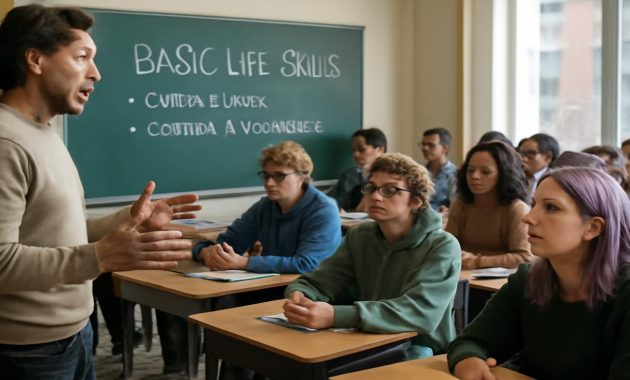
The class meets on a gray Wednesday afternoon in a windowless room that smells faintly of dry erase markers and instant coffee. Twenty-three college students sit in a loose circle, backpacks slumped at their feet, phones face down by force of policy. At the front, the instructor writes three words on the board in loopy blue marker: “How to Live.” For a moment, everyone just stares. Outside, the campus hums: deadlines, dining halls, dorms. In here, another kind of education is supposedly about to begin—one that, not so long ago, people assumed you picked up somewhere between childhood and your first rent check.
“Wait, We Need a Class for This?”
Attendance in this elective filled within hours. On the syllabus: basic cooking, budgeting, how to read a lease, what a credit score is, how to schedule a doctor’s appointment, how to have a hard conversation without ghosting someone. The course has a sturdier, more respectable official name—something like “Adulting and Life Skills”—but everyone just calls it “How Not to Fall Apart After Graduation.”
The irony is not lost on the students. They can parse complex climate models, design apps, and write Python scripts, but several admit they’ve never mailed a physical letter. One confesses it took them two weeks to figure out how to refill a prescription alone. Another says they didn’t know you had to unscrew the showerhead to clean it until mold bloomed like a slow disaster above them.
There’s a joke adults like to make about this generation—that Gen Z can’t take care of itself, that they’re good at TikTok but bad at, well, living. The punchline lands easily over Thanksgiving dinners and online comment sections. But sitting in this classroom, the joke feels thinner, more brittle. The students here don’t just laugh at themselves; they’re a little scared. They’re also tired of being the punchline in a story they didn’t exactly write.
“My parents both worked late,” one student says quietly as others nod. “We ate a lot of takeout. I wasn’t taught how to cook. Then everyone turned around and acted shocked that I don’t magically know which pan to use for what.” The room hums with a strange mix of embarrassment and relief. No one here thinks there’s something inherently broken about them; what they feel is something closer to abandonment.
How We Lost the Quiet Lessons
A generation ago, you might have learned life skills without calling them that. You watched your dad argue with the electric company over a wrong bill, your mom stretch a pot of soup for three nights, your grandfather sharpen a knife with slow, patient strokes. You saw your older cousin pack for college and noticed what they remembered, what they forgot. Certain knowledge seeped in through the cracks of daily life: how much toilet paper you really need, what a “copay” is, how to tell if something in the fridge has gone from “fine” to “absolutely not.”
But the world Gen Z grew up in is noisier, faster, and somehow less hands-on. Parents are working more, commuting more, exhausted more. Even when they’re home, they’re often tethered to phones and laptops. Many households outsource what used to be shared domestic work to services: grocery delivery, meal kits, cleaning crews, subscription everything. Millennials, burned by debt and precarity, sometimes responded to adulthood not by passing down skills but by frantically trying to survive it.
Meanwhile, childhood has been colonized by structure. Instead of learning to thread a needle from a grandmother on a slow Saturday or being sent to pay the gas bill in person, kids bounce from practice to tutoring to SAT prep to “enrichment” activities. Time that might once have been spent wandering in the orbit of adult life is now boxed into scheduled, supervised productivity. In many families, chores became negotiable, a bargaining chip, a thing parents did themselves because it was faster.
School, too, swelled to fill every available corner. Gen Z grew up in an era where success was measured not by knowing how to replace a tire but by how many AP classes you took. Teachers, pressured by standardized tests and ever-tightening curricula, didn’t have the luxury of detouring into “here’s how tax brackets work” during algebra. The hidden syllabus of adulthood—how to soothe yourself on a lonely night, how to resist a predatory contract, how to cook an egg—isn’t on any exam. And if it’s not being tested, the system quietly signals, it doesn’t matter.
The Myth of the Self-Sufficient Digital Native
Hovering over all of this is a seductive myth: if you can Google it, you don’t need to know it in advance. Why learn to cook when recipes live in your pocket? Why remember how to budget when apps track your spending? Why memorize your doctor’s number when the portal has a “contact us” button?
But this myth breaks under real pressure. When the power goes out. When the Wi-Fi is down. When you’re standing in a pharmacy line, panicked, trying to explain your insurance to a stranger under fluorescent lights. When your roommate moves out suddenly and you’re staring at a lease you never actually read. The internet can give you instructions; it can’t give you the calm, practiced hands of someone who’s done this before.
That gap—the one between information and integration—is where classes like this step in, trying to retrofit what used to be absorbed by osmosis. They can’t entirely replace watching your aunt haggle at a yard sale or your neighbor fix a leaky faucet while you hand them tools, but they can offer at least a blueprint for how not to be swallowed by the logistics of being alive.
Inside a Class on How to Live
In the second week of “How to Live,” the classroom smells like onions. The students are crowded around portable induction burners and cutting boards, learning knife skills. The instructor demonstrates the difference between slicing and chopping; the room fills with that crisp, alive sound of blade on board. Someone drops a clove of garlic; it skitters away across the floor like it’s trying to escape.
Nobody is scrolling. They’re too busy measuring oil by sight, wrestling with wooden spoons, trying to remember which burner knob they just turned. A student in a thrifted denim jacket squints at a recipe and mutters, “What does ‘simmer’ look like?” Another confesses they’ve only ever cooked using microwave buttons that say “popcorn,” “pizza,” and “reheat.”
The class isn’t really about making one passable meal. It’s about something subtler: the sensation of being a body competent in space, of turning raw ingredients into something steaming and fragrant that you can actually eat. When, after a while, the room fills with the smell of tomato and basil and browning garlic, the mood lightens. Their faces relax.
Later in the semester, the fluorescent-lit world of spreadsheets replaces the stovetops. The instructor projects a sample budget on the screen, the kind of simple grid you might assume everyone just instinctively understands. Rows for rent, groceries, transportation, savings, “surprises.” Columns for “planned” and “actual.” There’s an audible intake of breath when the class sees what percentage of a hypothetical $42,000 salary disappears into taxes before you even touch it.
“Wait,” someone says. “So that number on the job posting isn’t what I actually get?” Laughter ripples through the room, edged with panic. The instructor nods gently. “Welcome,” she says, “to the part no one puts in the college brochures.”
Week by week, the curriculum moves through the invisible infrastructure of adulthood: how credit cards really work, why “interest” is both your friend and your enemy, how to scan a benefits package without your eyes glazing over, what to say when you call a doctor’s office for the first time. There’s a day on mental health care that feels less like a lecture and more like a group exhale. For some, it’s the first time anyone has explained the difference between a therapist and a psychiatrist, or how to recognize that you’re not just tired—you might be sliding into burnout.
A Generation Under Glass
To blame Gen Z for not knowing these things is to ignore the ecosystem that raised them—an ecosystem that monitored them obsessively while failing, in many ways, to prepare them. This is the generation that grew up with school lockdown drills, climate disaster headlines, and social media’s panopticon gaze. From elementary school onward, they’ve been watched, measured, commented on, compared.
At home, “helicopter parenting” and its more intense cousin, “snowplow parenting,” often cleared the path of obstacles instead of teaching kids how to climb over them. Soccer practice field left? Water bottle forgotten? Someone would bring it. Missed deadline? A parent’s email would swoop in. Broken friendship? Adults might intervene before the kids ever learned to apologize on their own.
Then, almost overnight, the scaffolding drops. At eighteen, nineteen, twenty-two, these same young people are expected to execute a flawless pivot into sovereign adulthood—juggling bills, boundaries, bureaucracies, and bodies that suddenly have to be fed something other than vending machine snacks. When they wobble, older generations squint at them like a curious experiment gone wrong.
Universities, feeling this tension, have started filling the vacuum. Life-skills workshops pop up in student centers: how to sew a button, how to navigate a job interview, how to plan meals that don’t involve instant noodles. Some schools formalize it into courses like the one we’re sitting in. Critics roll their eyes, call it infantilization. But talk to the students and you hear a different story: “relief,” “finally,” “why did it take this long?”
What Gen Z Actually Knows
To say Gen Z “can’t take care of itself” is, in many ways, to look only at the parts of the story that confirm an easy stereotype. It conveniently skips the fluency they’ve developed in terrains older generations barely understand.
This is a cohort that can decipher privacy policies (or at least understand they’re dystopian), that knows not to trust every email, that grew up fact-checking adults with a search bar. They learned, earlier than most, how to sense when an online space is toxic, what it feels like to be manipulated by an algorithm, how to mobilize thousands of people around an issue using tools their grandparents still call “the Facebook.”
They have, unusually, vocabulary for feelings their parents swallowed without names: “anxiety,” “boundaries,” “burnout,” “consent.” Many of them know more about mental health than previous generations did at twice their age. When they share tips on regulating nervous systems or how to find a sliding-scale therapist, they’re engaging in a kind of care their elders often outsourced to stoicism and silence.
Yet even this emotional literacy can feel fragile when set against the weight of logistics. Knowing that you deserve rest doesn’t automatically teach you how to organize your day so that rest is possible. Understanding that debt is dangerous doesn’t mean you know how to build an emergency fund. Gen Z isn’t broken; they’re specialized. They’re skilled at living in an era of collapsing certainties and omnipresent screens—but like any specialist, they need cross-training.
The Numbers Behind the Story
When you step back from the anecdotes and look at data, a more complex picture emerges. Surveys and studies keep returning to the same themes: financial stress, mental health challenges, and a craving for practical knowledge. Consider a simplified snapshot of what many Gen Z college students are facing:
| Challenge Area | What Many Students Report | Common Impact |
|---|---|---|
| Money & Debt | Limited understanding of loans, credit, and realistic cost of living | Anxiety about the future, risky financial choices, avoidance of planning |
| Health & Self-Care | Uncertainty about navigating healthcare and building sustainable routines | Delayed medical care, burnout, irregular sleep and eating habits |
| Housing & Logistics | Confusion about leases, utilities, and basic home maintenance | Housing insecurity, unexpected fees, dependence on others to “handle it” |
| Communication & Conflict | Comfort with texting, discomfort with calls and in-person conflict | Ghosted conversations, unresolved conflicts in work and relationships |
Seen this way, life-skills classes aren’t a punchline; they’re triage. They’re an attempt to stitch together the parts of an education that were quietly cut away in favor of test scores and digital efficiency.
Learning Together, Not Alone
Back in the “How to Live” classroom, there’s a surprising intimacy that grows over the semester. When you ask people to reveal the cracks in their competence, you’re really asking them to be brave in a very particular way. It’s one thing to admit you’re bad at calculus; that’s just a subject. It’s another to say, out loud, “I don’t know how to be a person who lives alone without falling apart.”
Yet that’s essentially what everyone is saying, collectively, every week. The class starts to function less like a traditional course and more like a community workshop. Students trade tips and stories: here’s how I finally stopped overdrafting my account; here’s the script I used when I called my insurance company; here’s the stir-fry trick my older brother taught me.
The instructor is less a distant expert and more a guide, an older traveler pointing out landmarks on a map she’s walked herself. “You will mess up,” she tells them. “You’ll buy the wrong size trash bags. You’ll forget a bill. You’ll stay in a job or a relationship too long because the alternative is terrifying. None of that means you’re broken; it means you’re learning.”
There are small, quiet victories. A student who used to DoorDash every meal sends a photo to the class group chat: a slightly lopsided, home-cooked dinner, captioned “FIRST TRY.” Another reports that they called their dentist without waiting for their mom to remind them—and scheduled their own appointment. It sounds laughably small until you remember that every new skill, no matter how simple, is a micro-dose of dignity.
None of this erases the broader structural issues—sky-high rents, precarious job markets, health systems that feel like obstacle courses. But it does create a sense that perhaps, together, they can navigate the maze with a little less panic.
What It Really Means to “Take Care of Yourself”
Perhaps the most radical thing about these classes is that they quietly redefine what self-sufficiency means. It’s not the rugged, bootstrap myth of earlier generations—the lone figure who never asks for help, who knows how to fix everything, who never admits confusion. Instead, it’s something more relational, more honest:
- Knowing when you need help—and how to ask without shame.
- Recognizing the difference between a problem you can solve with a YouTube video and one that needs a professional.
- Understanding that budgeting isn’t about deprivation but about choosing where your limited energy and money actually go.
- Accepting that rest, joy, friendship, and meaning are as basic to survival as knowing how to change a lightbulb.
Underneath the spreadsheets and recipes, students in classes like this are really learning a more tender art: how to extend care to their future selves. How to be the kind of adult who doesn’t abandon themselves when things get hard, because they’ve practiced, in small, unglamorous ways, staying with the difficulty.
Not Helpless, Just Underserved
So, can Gen Z take care of itself? The answer, looking around that classroom, is yes—and not yet. Yes, in that they’re capable, intelligent, resourceful, and often startlingly clear-eyed about the broken systems they’ve inherited. Not yet, in that no one handed them the user manual for those systems or gave them much space to practice.
When older generations scoff at life-skills classes, they’re really scoffing at the idea that practical knowledge is worth teaching on purpose. But treating it as optional has given us what we see now: millions of young adults who know more about calculus than how to renegotiate a phone bill, more about Shakespearean sonnets than how to read a pay stub.
Maybe the fix isn’t to mock them for seeking help, but to expand the help we offer. To weave life skills into curricula earlier. To invite kids into the quiet backstage of adult life instead of whisking them away from it. To admit that being alive, in this era, is complicated enough that “learning to live” is not an insult but a curriculum in its own right.
In the last week of the semester, the “How to Live” class ends not with a final exam but with something closer to a ritual. Each student writes a brief note to their future self: a promise, a reminder, a piece of advice they want to carry forward. They fold the pages and tuck them into envelopes. The instructor will mail them out a year from now, when many will be in their first jobs or new cities, or back at their childhood homes trying to recalibrate.
Some of the notes say things like, “You survived worse; you can figure this out.” Others are more practical: “Don’t forget to cancel free trials,” “Check the smoke alarm batteries,” “Cook at home this week; you’ll feel better.” All of them, in their own way, circle the same quiet revelation: taking care of yourself is not a test you either pass or fail, but an ongoing, improvisational practice.
It’s tempting to laugh at a generation that signs up for classes just to learn how to live. But maybe the more honest response is something else: relief that they’re willing to ask, “How?” and humility from those of us who pretended we always knew.
FAQ
Why do colleges offer “adulting” or life-skills classes now?
Colleges are responding to what students themselves are asking for: practical support with finances, housing, health care, and everyday responsibilities. As families and schools have become more focused on academics and safety, many basic life skills stopped being taught informally. These classes try to fill that gap.
Isn’t it the parents’ job to teach these things?
Ideally, yes—families play a huge role. But many parents are overworked, stressed, or never learned some skills themselves. Others rely heavily on digital services or do things for their kids to save time. The result is a patchwork of knowledge. Schools and colleges stepping in doesn’t replace parents; it complements them.
Does needing a class to learn life skills mean Gen Z is less capable?
No. It means their environment didn’t prioritize these skills, not that they’re incapable. Gen Z is navigating a more complex economic and technological landscape than previous generations. Seeking education instead of pretending to know everything is a sign of maturity, not weakness.
What kinds of topics are usually covered in these classes?
Common topics include basic cooking and nutrition, budgeting and credit, understanding taxes and paychecks, reading leases, scheduling medical appointments, basic home maintenance, time management, and communication and conflict resolution skills.
How can someone start building life skills if they don’t have access to a formal class?
Start small and specific: pick one area—like cooking three simple meals, tracking expenses for a month, or learning how to navigate your health insurance. Use books, reputable online resources, or videos, but also ask real people for help. Friends, coworkers, neighbors, or community programs can often offer guidance. The key is to practice regularly and accept that mistakes are part of learning, not proof that you’re failing at adulthood.