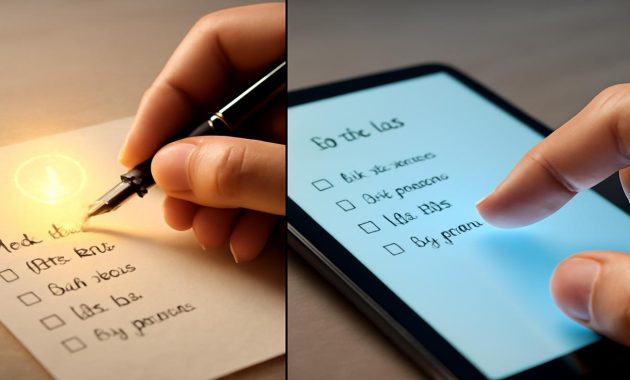
You’re standing in your kitchen, pen hovering over a crumpled notepad. The grocery list has already started itself: milk, eggs, coffee. Your handwriting leans a little to the right, a faint smear of ink where your hand brushed the paper. The list feels oddly solid, as if it has weight. Later that day, you’re in the store, scrolling through a glowing checklist app. Your thumb flicks, boxes appear, items vanish in a soft digital blink. Same tasks, same items. But buried inside your skull, very different things are happening.
The Quiet Electricity of Pen on Paper
When you write a list by hand, your brain is doing more than just spelling out words. It’s choreographing a small symphony of senses and movements. Your fingers wrap around the pen; you feel its weight, the friction of the tip dragging across the page. Your eyes follow the trailing ink, watching each letter appear in real time. You hear the faint scratch, maybe the soft rustle of paper as you shift the pad.
That simple act lights up a web of brain regions: the motor cortex, which controls movement; visual areas that track shape and space; and memory centers like the hippocampus, which store and retrieve experiences. It’s as if your mind takes the moment of writing and pins it down more firmly than if you’d just tapped a screen.
In a way, handwriting is an act of slow thinking. Each letter demands a mini‑decision about form and spacing. Your brain has to plan the gesture, execute it, check it, adjust. The pace is deliberate, and that slowness matters: it gives your thoughts enough room to settle into longer-term memory. The list doesn’t just exist on the paper; it begins to exist in you.
You might notice how a handwritten list lingers in your mind even when you’ve left it at home. You can almost see it: the word “bread” scrawled in the top corner, the crooked “b,” the way you circled “birthday cake” three times. Those visual quirks become tiny anchors. They tether your memory to the actual moment you wrote the words.
The Glass Screen and the Stream of Distraction
Now step back into that store with your phone in your hand. The list is tidy, uniform, and lit from behind. Every item is in the same familiar font. The moment you open the app, your brain shifts modes. There’s a small, almost imperceptible gear change—into what could be called “screen brain.”
Your fingers don’t shape letters anymore; they tap or swipe. The motor patterns are smaller, more repetitive, more automated. You can scroll through ten items with one flick, barely noticing the movement. The brain loves efficiency, but it often trades depth for speed. With fewer complex motions and less sensory variety, your memory encoding becomes thinner, like a sketch instead of a painting.
And then there’s the background noise. Notifications hover just out of sight: a new message, a news alert, a social ping. Even if you don’t tap them, your brain knows they’re there. Part of your attention splinters off to monitor that possibility—what cognitive scientists call “attentional residue.” Your list is no longer alone; it’s one voice in a crowd.
That crowd matters. The prefrontal cortex, the part of your brain involved in attention and planning, now has to juggle more. It filters, prioritizes, suppresses. This constant micro‑filtering takes a toll. What might have been a quietly focused moment with a handwritten list becomes a shallow, interrupted check‑in with a glowing checklist.
Why Lists Written by Hand Feel So “Sticky”
Imagine your brain as a landscape with paths carved into it. Every time you do something, you press your foot into the ground, leaving a faint trail. The richer the experience—the more senses involved, the more effort required—the deeper the trail. Handwriting is like walking with heavy boots on soft earth. Digital tapping is more like gliding by on a bicycle.
When you write an item like “laundry” by hand, you’re connecting meaning (“I need clean clothes”) with motion (forming each letter), with sight (your unique script), and often with location (this word is near the top of the paper, left side). These multiple hooks give your memory more places to grab onto later, even if the page is nowhere in sight.
Digital lists, by contrast, often blur together. A typed word in the same font and size as every other word doesn’t stand out much. It’s neat, but a little anonymous. Your brain gets less help in distinguishing one item from another, one moment of planning from the next. Everything exists in the same flattened, polished space behind glass.
This doesn’t mean digital lists don’t work—they obviously do, especially when you have dozens of things to track. But their “stickiness” is different. It’s more about immediate access (“my list is always with me”) than deep internalization (“my list lives in my head now”).
Memory, Attention, and the Texture of Thought
There’s another quiet difference between your brain on paper and your brain on screen: how your thoughts themselves feel as you list them. Handwriting often invites a more wandering, reflective state. The speed of the pen can’t quite keep up with the speed of your thoughts, so your mind has to choose. Instead of pouring everything out, it trims, edits, and reorders as you go.
That slight bottleneck can be helpful. As you slow down to write “call mom,” your brain has a few extra seconds to surface connected thoughts: ask about her doctor’s appointment, send her that photo, check travel dates. The list becomes more than a set of tasks—it becomes a quiet conversation with yourself about what actually matters.
On a screen, where text appears as fast as you can type and delete, your thinking can drift toward rapid-fire capture. You throw items into the app like tossing clothes into a laundry basket: quick, efficient, a little mindless. This is great for not forgetting things. But often, you engage less deeply with each entry. Your brain treats them as small, transient data points passing through a system, not as meaningful pieces of a day you’re sculpting.
Attention works differently too. The physical page has edges, margins, empty space. You can sense where you are on it. Your eyes move in arcs and loops rather than endless scrolls. The list is a part of your environment, something you can glance at from across the table. On a screen, the list lives in a confined window; it vanishes with a swipe or a home button. The brain, as a creature of habit and place, cares about these boundaries more than we notice.
A Small Table of Big Differences
Here’s a simple comparison to see how your brain might engage with each type of list:
| Aspect | Handwritten List | Digital List |
|---|---|---|
| Sensory input | Rich: touch, motion, sound of pen, texture of paper | Limited: mainly visual, light tapping |
| Motor activity | Complex, varied hand movements; more brain regions involved | Simple, repetitive taps and swipes |
| Memory “stickiness” | Higher: multiple cues and slower encoding | Moderate: relies on external storage more than internal recall |
| Attention demands | Focused, fewer competing stimuli | Often fragmented by notifications and multitasking |
| Emotional tone | Personal, tangible, sometimes nostalgic | Efficient, shareable, but more impersonal |
The Emotional Lives of Our Lists
Beyond nerves and synapses, there’s another layer: feeling. Lists are not neutral. They carry a faint scent of who you are on the day you write them. A handwritten list captures that most clearly. The hurried scrawl of a packed Monday looks different from the rounded, careful letters of a slow Sunday. Coffee rings bloom in one corner. A half‑crossed‑out word hints at a change of plan.
Your brain is tuned to pick up on these traces. When you later glance at a handwritten list, you’re not just seeing words—you’re glimpsing a frozen moment of your own life. That can make the tasks feel either more urgent or more human. There’s a kind of accountability in seeing your own hand saying: you promised yourself this.
Digital lists, on the other hand, are airy. They float above time, easily edited, easily forgotten. You can delete an entire week’s worth of tasks with a flick, and there’s no residue: no stack of old notepads, no pile of sticky notes at the bottom of a bag. This lightness can be a relief, but it can also flatten your sense of progress. You did things—you checked the boxes—but where’s the evidence that you moved through your days with effort and care?
The brain responds differently to these emotional textures. Tangible records tug at memory, reflection, and even reward circuits. They let you see not just what you did, but that you did it over time. Digital records often bury the past under new notifications; the accomplishment fades faster, making it easier to drift into feeling perpetually “behind,” no matter how much you actually complete.
Blending Both Worlds: A Brain-Friendly Strategy
Most of us aren’t going to abandon our phones, nor should we need to. The magic lies in choosing the right kind of list for the right mental job. Think of digital tools as your external hard drive and handwritten notes as your internal sculpting tool.
For planning your day or week—the bigger picture that benefits from real thinking time—handwriting can be powerful. Sitting down in the morning with a pen and a piece of paper, you give your brain permission to slow down, sort, and prioritize. The physical act of writing a short list of key tasks helps encode those intentions more deeply. You’re telling your brain, this is today’s shape.
For fast-moving details—travel itineraries, complex work projects, shared errands—digital lists shine. They’re searchable, sharable, and adjustable. Your brain doesn’t have to store every little thing; it can offload the clutter and focus on doing.
Some people find a hybrid rhythm: each morning, they pull a few important items from their sprawling digital backlog and copy them by hand into a simple, short list. It’s not about aesthetic journaling; it’s about giving your brain a tactile moment of commitment. The digital system remembers everything. The handwritten page remembers what matters now.
Listening to Your Own Mind at the Edge of the Page
There’s a moment, pen in hand, where your brain hesitates. Should “go for a walk” really be on today’s list? Does “start novel” belong here, or is that a gentler dream for another time? In that pause, something interesting happens: you’re not just listing tasks; you’re quietly sifting values.
Handwriting makes you feel the weight of adding each item. Your list can only hold so much before it looks crowded, anxious, unrealistic. That visual crowding is a form of feedback. Your brain reads it and prods you to reconsider: do you truly want to carry this into your day?
On a digital list, space is practically infinite. You can add, add, add, never forced to confront how impossible it all is. Your brain may begin to treat the list as a dumping ground, not a meaningful plan. The result can be a subtle, chronic sense of failure: the list never ends, and you never catch up.
By choosing, even occasionally, to write things by hand, you’re choosing to encounter your limits more honestly. Your brain gets clearer messages about what’s realistic, what’s urgent, and what’s quietly calling for your attention beyond the glow of the screen. The list becomes less of a scoreboard and more of a map.
Knowing When Your Brain Wants Ink, and When It Wants Glass
You don’t need a neuroscientist hovering over your shoulder to tell which kind of list your brain is asking for. It speaks in small signals: a sense of fogginess, a spike of anxiety, the way your attention scatters when you open a certain app.
If you feel overwhelmed, mentally noisy, or weirdly disconnected from what you’re supposed to be doing, that might be a moment for paper. The physical act of writing a short list—three to five things—can be like clearing brush from a trail. You see your path again.
If, instead, you feel energized and in motion, juggling multiple projects or coordinating with other people, digital lists can keep that momentum from turning chaotic. Your brain doesn’t have to remember every detail; it just has to remember where the details are stored.
In both cases, you’re not just managing tasks. You’re managing the conditions under which your own mind works best. Each handwritten word and each digital checkbox is a choice about how you want your brain to feel as you move through the day.
Frequently Asked Questions
Does handwriting really improve memory compared to typing?
Handwriting often leads to better memory because it engages more areas of the brain—motor, visual, and cognitive—at the same time. The slower pace forces you to process information more deeply, which helps it stick. Typing or tapping can still be effective, but it tends to encourage faster, shallower processing.
Are digital lists bad for the brain?
Digital lists are not bad for the brain; they’re powerful tools for organizing complex, changing information. The challenge is that screens often come with distractions and encourage multitasking, which can hurt focus and memory. Using digital lists intentionally—without constant notifications—can reduce those downsides.
What type of list is best for reducing stress?
Many people find that a short, handwritten list of key priorities reduces stress more than a long digital backlog. Writing by hand slows thoughts down and makes your responsibilities feel more concrete and manageable. However, keeping an organized digital system for everything else can also reduce stress by preventing forgotten tasks.
Can I get the benefits of handwriting if I use a stylus on a tablet?
Using a stylus to write on a tablet can capture some of the benefits of handwriting—especially the motor and visual aspects—though it may lack a bit of the tactile richness of pen and paper. For many people, it’s a good middle ground, combining the flexibility of digital storage with the cognitive advantages of writing by hand.
How can I practically combine handwritten and digital lists?
One simple approach is to keep a master digital list for all tasks and projects, then create a small handwritten list each day with just your top three to five priorities. The digital list acts as long-term storage; the handwritten list gives your brain a focused, tangible guide for the next few hours.
Originally posted 2026-03-05 00:00:00.