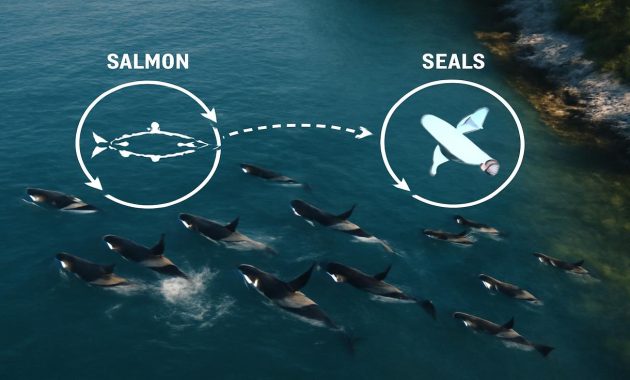
The sea is not quiet, even when it looks that way. On a calm summer morning in the Gulf of Alaska, the ocean wears a polished skin of silver light, mountains crouch on the horizon, and a gull’s cry drifts over the water. Then, from that glassy surface, a black fin rises like an exclamation mark. Everyone on the small research boat falls silent. They know this particular fin, this particular orca, and they know what she’s usually hunting. But today, she’s about to surprise them.
Shadows Under the Silver Water
The first sign isn’t the fin—it’s the absence of something else: salmon. A decade ago, this stretch of water near Prince William Sound was famous among biologists for one predictable thing. When the salmon ran, fish-eating orcas gathered in tight family groups, echolocating in crisp clicks, corralling schools of shimmering fish and plucking them from the water like fruit from a tree.
Those days felt almost like clockwork. Researchers could name the matrilines that would show up: mothers, daughters, calves, aunts, each one tightly bound by lifelong family ties. They knew which pods were “residents,” specialist fish-eaters with strong cultural traditions. They knew what calls the whales used when salmon were thick, and how the soundscape shifted when the fish thinned out.
But across Alaska’s sprawling seascape—from the inside passages hugging forested islands to the raw, wind-thrashed outer coast—something began to change. Salmon returns grew erratic. Water warmed, prey shifted, and so did the orcas. Not by abandoning their fish-only culture overnight, but by quietly re-writing the map of where and what they hunted.
It’s easy to think of orcas as fixed characters with fixed diets: salmon hunters here, seal hunters there, “resident” beside “transient” as neat labels in a field guide. Out on the water, though, these whales show a different story: they are flexible, curious, and absolutely paying attention to what the ocean offers on any given year.
Highways of Sound and Memory
If you could see the North Pacific from above, not just its surface but all its swirling layers—the cold tongues of current, the upwelling plumes, the drifting clouds of plankton—you’d realize Alaska is stitched together by underwater highways. Fish follow those paths. Orcas follow the fish.
For fish-eating orcas, especially the salmon specialists, these highways are lifelines. Spring begins in one bay rich with returning chinook. Summer draws them toward a different fjord, where pink and chum saturate the water. Autumn might push them toward offshore hotspots where schooling fish gather tightly before winter spreads the ocean thin.
What researchers are now seeing is that these “routes” aren’t just geographic. They are cultural, passed down like recipes or stories. A grandmother orca knows when the salmon at one site have dwindled, and she turns, leading her family elsewhere—to another region, another foraging hotspot that may offer sablefish, halibut, or dense clouds of herring. In a sense, it’s a recipe swap in the middle of the sea.
In Alaska, several key foraging regions have become part of this unfolding narrative: Prince William Sound, the outer Kenai coast, the deep fjords of Southeast Alaska, and the subarctic waters skirting the Aleutian chain. Each region has its own personality: kinds of fish, temperatures, underwater canyons, even its own acoustic backdrop of storms, surf, and boat traffic.
From satellite tags, drone footage, and countless hours listening through hydrophones, scientists can now watch pods of fish-eating orcas “thread” these regions together. Some pods stay fiercely loyal to traditional salmon grounds. Others have started to hopscotch between hotspots, shifting their prey along the route—chasing not just one fish, but a patchwork of seasonal feasts.
Where the Menu Changes
Imagine being in a small skiff off the Kenai Peninsula in late summer. The air smells like kelp and diesel and distant rain. The water is teal, streaked with glacial flour. A cluster of orcas surfaces ahead, black and white against the dull sky—close-knit, clearly resident-type whales. You brace for the familiar: salmon scales flashing at the surface, the thunk of tails, the chaotic glitter of scattered fish.
But instead, you see something else. The whales whirl around a dense, oil-slicked patch of water where herring are boiling near the surface, driven upward by deeper predators. The orcas herd them into a tighter and tighter ball, then slice through the school, each whale emerging with a mouthful of silver. On the hydrophone, their calls are bright, almost excited, a cacophony more often associated with social play than serious feeding.
These are the same families known for salmon feasts in another bay—yet here, in this pocket of the ocean, the prey menu is different. And the whales, it seems, are more than willing to swap courses.
Farther west, near the Aleutian Islands, the story takes another twist. Deep trenches and upwelling currents stack the water column with fish that rarely see the light of day: sablefish, rockfish, and other long-lived species. In some years, fish-eating orcas linger here, diving repeatedly along the steep slopes. Acoustic data and stomach-content studies suggest they’re targeting these deeper fish in addition to the classic salmon and herring.
The idea that a “salmon specialist” might opportunistically target other fish isn’t entirely new, but what stands out is scale and coordination. Whole family groups appear to reroute themselves, timing their visits to hotspots when certain fish are most abundant, then moving on when the returns fade. Where once their year might have been tightly anchored to one or two salmon rivers, many now travel a more flexible circuit of shifting hotspots, swapping prey like travelers changing cuisines from town to town.
| Region | Primary Traditional Prey | Observed New/Alternative Prey | Seasonal Peak Use |
|---|---|---|---|
| Prince William Sound | Chinook & coho salmon | Herring, juvenile pollock | Late spring–summer |
| Kenai & Outer Gulf Coast | Mixed salmon runs | Herring, cod, rockfish | Summer–early fall |
| Southeast Alaska Fjords | Chum & pink salmon | Sablefish, halibut | Mid-summer |
| Aleutian & Offshore Banks | Salmon in transit | Deep-water rockfish, sablefish | Late summer–fall |
Culture, Crisis, and the Art of Switching
Orcas don’t learn to hunt by instinct alone. They learn from each other. A calf’s early life is a masterclass taught by her mother and grandmother: how to track a salmon through turbid water, which calls bring the family together, what to avoid. These behaviors form what biologists call “culture”—not in some poetic sense, but in the measurable way knowledge is inherited.
In Alaska, that culture has historically been divided along clear lines. Fish-eating “residents” stick to fish. Marine mammal–eating “transients” hunt seals, sea lions, porpoises. They have different dialects, different social structures, even different ways of moving through the water. And for decades, that divide seemed inviolate.
What’s shifting now is not that fish-eaters are suddenly hunting seals, but that the fish menu is broadening within their own tradition. The switch isn’t from fish to mammals, but from one type of fish to another, from one foraging hotspot to several, and from rigid timing to a more opportunistic calendar.
In many ways, this is a response to a changing North Pacific. Warmer waters and marine heatwaves have scrambled the predictability of prey. Salmon returns that orcas’ great-grandmothers could almost set their internal clocks by now arrive late, or small, or not at all. Some years, certain rivers boom; others bust. The whales don’t get a printed forecast, but they get something better: a constant, living feedback of what the ocean is actually doing.
Through echolocation, they assess fish density directly. Through memory, they compare this year’s feast or famine to years past. Through social bonds, they share discoveries: a new bay rich with herring, a canyon where rockfish cluster, a specific shelf edge that suddenly hums with life in El Niño years. Prey switching across hotspots is, in that sense, a cultural coping mechanism—an art form refined under pressure.
Yet the transition isn’t uniform. Some pods remain fiercely loyal to traditional salmon corridors, even as returns erode, and their body condition reflects the strain. Others, often led by older, experienced matriarchs, appear to be early adopters of new routes and prey. Who changes, and who doesn’t, may be one of the quiet forces shaping orcas’ future survival in Alaska’s waters.
At the Crossroads of People and Whales
There’s a moment few people forget: watching an orca surface near a fishing boat hauling in longlines. It’s a collision of worlds, both literally and metaphorically. As fish-eating orcas follow shifting prey across Alaska’s hotspots, they increasingly intersect with human fisheries—sometimes as competitors, sometimes as opportunists.
Halibut and sablefish longline fisheries, for example, can concentrate the very species orcas are now using as alternative prey. The sound of a winch hauling gear can become, to an orca, a dinnertime bell. In some regions, whales have learned to strip fish directly off lines, a behavior that fishermen call “depredation” and the orcas might, if they could talk, call simply “easy calories.”
Meanwhile, subsistence and commercial salmon fishers watch the same climate-driven uncertainty unfold that the whales feel underwater. When salmon runs falter, everyone downstream of that abundance struggles. For coastal communities whose diets, economies, and identities are stitched to the return of salmon, the idea that orcas are adjusting by expanding their foraging map can be both fascinating and unsettling.
Yet the overlap between human and whale needs isn’t only about conflict. When biologists map where fish-eating orcas feed most intensely and when they shift prey, they often find strong echoes with the patterns fishers have observed for decades: which rivers have changed, where herring still boil in good years, which sea valleys hold life even when the surface seems poor.
Shared knowledge is beginning to grow in those overlapping spaces. Skippers report unusual whale behavior; scientists relay broader trends; local communities bring generations of place-based wisdom. Increasingly, conservation plans for orcas and fisheries are being built not just around single prey like salmon, but around the richer picture of how whales move among multiple hotspots, switching species as conditions demand.
Listening to a Moving Ocean
On some research days, the ocean looks empty. No geysers of breath, no arching black backs. Just swell, wind, and the distant blue-gray line where sky folds into water. But under that seeming emptiness, the story continues, carried as much by sound as by sight.
Many of the clues about prey switching come from listening. Hydrophones moored in fjords and along shelf breaks record the underwater conversations of whales month after month, year after year. Distinctive resident orca calls reveal when fish-eating pods arrive in a feeding ground, how long they stay, and how chaotic or focused their social lives are while they hunt.
Shifts in call patterns can hint at changes in behavior. A hotspot that once resounded with long, structured foraging bouts might suddenly show short, scattered visits—like someone dashing through an empty pantry. In other places, new or unfamiliar pods begin to appear on the audio record, their dialects hinting that far-ranging families are adding fresh stops to their annual circuits.
Pair that with satellite-tag data—slow, looping tracks over one canyon, straight transit lines over another—and a living map emerges. It shows orcas not as fixed salmon chasers, but as dynamic foragers weaving through a network of opportunities, swapping prey as they go.
In this sense, the ocean isn’t just moving physically. It is moving culturally, as whales update their collective memory of where food lives. Each prey switch, each newly visited hotspot, becomes another thread in a vast tapestry of ecological memory stretching across generations.
A Future Written in Fins and Currents
One autumn evening in Southeast Alaska, the sky is soaked with the last gold light of the day. A light rain has been falling all afternoon, turning the surfaces of leaves and dock planks slick and reflective. Offshore, where a steep fjord drops into shadowy depths, a small group of resident orcas fans out along the rocky shoreline.
You can hear them first—sharp exhalations, then softer, as though they’re catching their breath after a sprint. On the hydrophone, their calls ring clear and purposeful. A few decades ago, this would almost certainly have been a salmon scene: fish tracked along the river outflow, a smudge of scales left in the whales’ wake.
Tonight, the echoes tell a more complicated story. The whales are moving in and out of deeper water, diving along the fjord’s steep walls. There are flashes of large, slow-moving fish on the sonar, silhouettes that look more like sablefish than flurries of salmon. When one whale surfaces nearby, the smell on the air—that sharp, oily trace that lingers just above the water—is different too, thicker, heavier.
Standing on the rocking deck, it’s tempting to read the scene as a tidy parable of resilience: the whales adapting, the ecosystem finding new balances, nature bending but not breaking. There is truth to that. Fish-eating orcas are not passive passengers in a warming ocean; they are quick learners with rich cultural toolkits, now visibly reshuffling those tools.
But there is another truth layered beneath. Not all prey can be replaced, and not all switches come without cost. Some fish—especially long-lived deep species like rockfish—cannot withstand heavy predation and human fishing indefinitely. Some hotspots may boom for a few exceptional years and then go quiet again, leaving whales and people equally hungry.
What the orcas are doing across Alaska’s foraging hotspots is, in many ways, a mirror held up to us. They are reading the ocean’s signals, adjusting in real time, rewriting their own traditions under pressure. Their movements sketch an urgent map of which corners of the sea still pulse with life and which are dimming.
To watch them is to glimpse a future that’s not yet fully written—a future where salmon may no longer be the unshakable backbone of their diet in every place, where family traditions must stretch to include new prey, new routes, new risks. It’s a future where our choices about fisheries, climate, and coastal ecosystems will determine whether flexibility is enough.
For now, the whales continue to travel these highways of memory and sound, trading one prey for another as the seasons spin by. Their dorsal fins carve brief black signatures against gray skies, then vanish again into the silver skin of the sea. Somewhere below, in the moving dark, they are still hunting, still learning, still rewriting the story of what it means to be a fish-eating orca in a changing Alaska.
Frequently Asked Questions
Do fish-eating orcas in Alaska really change what they eat?
Yes. While many Alaskan orcas have long specialized in salmon, research shows that some pods now shift among different fish species—such as herring, rockfish, sablefish, and halibut—depending on which foraging hotspot they’re visiting and what’s most available in a given season.
Are these orcas starting to hunt marine mammals like seals or sea lions?
No. The prey switching described here is mostly within the realm of fish. Fish-eating “resident” orcas and mammal-eating “transient” orcas remain distinct in their hunting cultures, vocal dialects, and social behavior. There’s no strong evidence that residents are widely adopting marine mammals as prey.
What is a foraging hotspot?
A foraging hotspot is an area of the ocean where food is consistently concentrated—because of currents, underwater topography, or seasonal events like salmon runs. For orcas, these are places where hunting is especially efficient, and they may return to them year after year.
How does climate change influence orca prey switching?
Climate-driven changes in ocean temperature and circulation can alter where and when fish species congregate and how abundant they are. When salmon runs become less predictable or other fish bloom in new places, orcas may adjust by shifting among hotspots and targeting whichever fish are most available.
Does prey switching mean orcas are safe from ecosystem change?
Not necessarily. Flexibility helps, but many of the alternative prey species also face fishing pressure and environmental stress. If too many key species decline at once, even adaptable orcas could struggle. Prey switching is a sign of resilience, but it’s also a warning that the old certainties in the ocean are fading.
How do scientists know which prey orcas are eating?
Researchers use a mix of methods: direct observation of feeding, analysis of fish scales and remains at the surface, biopsy samples to study diet through chemical signatures, acoustic recordings to track foraging behavior, and occasionally stomach-content data from stranded whales.
Why does orca culture matter for their survival?
Culture—learned behaviors passed down through families—guides orcas to reliable food, safe routes, and effective hunting techniques. When the environment changes quickly, pods with richer, more flexible cultural knowledge may adapt more successfully. Protecting orcas means protecting not just individuals, but the cultural traditions that help them thrive.