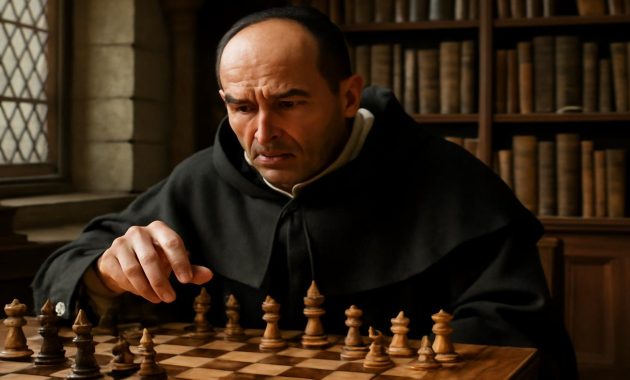
On a winter afternoon in Madrid, in a quiet corner of a secondhand bookshop, I opened a cracked leather volume and felt the faint electric thrill of discovery. The paper smelled of dust and citrus, and on one yellowed page a woodcut showed a thin man in a priest’s robe, his fingers resting lightly on a strange old chessboard. Underneath, in spidery Spanish, someone had written a name I barely recognized: Ruy López de Segura. The caption called him “uno de los grandes jugadores del siglo XVI” — one of the great players of the 16th century. A priest, I thought, squinting at the faded ink. A priest was once the terror of the European chess world. How had I not really heard of him?
The Village Priest Who Played Like a Storm
Imagine the dusty hilltop town of Zafra in Extremadura, Spain, in the mid-1500s. The sun presses down on whitewashed walls, church bells scatter their sound over terracotta roofs, and through narrow stone streets walks a young cleric with a face more curious than devout. This is Ruy López de Segura: priest, scholar, and—though neither he nor his neighbors fully grasp it yet—a pioneer of chess at a moment the game itself is being reborn.
In those days, chess was not quite the game you know. The rules had only recently undergone a revolution. The queen, once a timid piece, had gained astonishing power: able to cut across the board in wild diagonal and straight lines. The bishop, too, had been unleashed, gliding any distance instead of stepping stiffly like a bureaucrat with short legs. Europeans called this new, faster, more violent version “chess of the mad queen,” or ajedrez de la dama loca. It was exploding across Spain and Italy like an intellectual wildfire—and Ruy López stood at its center.
By vocation, he tended souls and altars. By passion, he studied the 64 squares with the same quiet intensity he brought to scripture. He would have known Latin, theology, canon law. But at night, by candlelight, he also knew the dance of pawns and knights, the structure of attacks, the secret equivalence between a strong pawn and a fragile conscience. In the silence of the rectory, the clicking of wooden pieces across a board must have sounded almost like another form of prayer.
Some nights, he reportedly placed stones or beans on a chessboard and played against himself, investigating new openings the way a botanist might probe the petals of a strange flower. There was no internet, no databases, no engines throwing cold numbers at his every idea. There was only the board, his mind, and the slow feedback of human opponents from neighboring towns. Yet from this remote corner of Spain, he would eventually travel to the greatest courts of Europe and leave his name on one of the most enduring openings in chess.
The Road to Rome: When a Priest Becomes a Legend
By the time Ruy López traveled to Rome in the 1560s, his reputation as a fearsome player had already begun to circulate. Picture him climbing the worn marble steps of a Roman palazzo, the air inside smelling of incense and wax, frescoes blooming over the ceilings. Around a heavy wooden table, noblemen and prelates lean in toward a chessboard, their voices a low murmur of Latin and Italian. The Spaniard is invited to sit.
We don’t have transcripts of those games, of course, but we know that López’s performance in Italy made people talk. In a Europe where national rivalries simmered beneath polite conversation, chess became another arena where Spain, Italy, and others tested each other’s brilliance. The Spanish were reputed to play with cool, strategic patience; the Italians, especially in Rome, loved tactical fireworks, open lines, sacrifices—the chess equivalent of baroque architecture exploding in stone.
Ruy López, the quiet priest from Zafra, held his own. More than that, he impressed. Stories say he defeated some of the strongest Italian masters of his time, men like Giovanni Leonardo and Paolo Boi, considered illustrious “chess gentlemen” of the peninsula. History being the partial, rumor-stained thing that it is, we can’t reconstruct every game. But we know enough to say this: when Ruy López sat at a board in Rome, people began whispering that he might be the best in the world.
In elegant chambers and smoky taverns, candle flames trembled while bishops and knights met in curious collisions. There must have been moments when López leaned back, fingers steepled, eyes closed in thought, the soft murmur of Latin prayers from some nearby chapel mixing with the inner calculations of rooks and pawns. For a priest, this was a delicate balance: to shine so brightly at a game without letting pride become a sin. Yet he leaned into the work with a methodical calm that would soon reshape the theory of chess itself.
The Book That Taught Europe to Think
In 1561, back in Spain, Ruy López published his great work: Liber de la invención liberal y arte del juego del axedrez, usually shortened today to Libro de la invención liberal y arte del juego del ajedrez. The title alone tells you something about how he saw chess. It was both invención liberal—a noble invention—and an arte, an art. This wasn’t just pastime; it was a discipline worthy of structured thought, a subject that deserved a book thick with analysis and careful description.
The book, written in Spanish rather than Latin, brought systematic chess thinking to a broader public. López did what we now take for granted: he named openings, analyzed them move by move, and evaluated positions not just with intuition but with repeatable ideas. He discussed how to control the center of the board, how to develop pieces, how to coordinate an attack. To a modern player, these may sound like basic lessons. In the 16th century, they were pioneering.
One of the most striking things about his approach is how modern some of it feels. He recommended developing knights before bishops, valued development and center control, and warned against grabbing material greedily at the expense of position. Through the haze of centuries, it’s possible to glimpse a line connecting his candlelit studies to the structured openings repertoires of today’s grandmasters hunched over digital boards.
At a time when printing technology was still relatively young, López’s book spread through Spain and beyond. It changed the way serious players thought about the game. Where chess had often been treated as a parlor entertainment, he insisted it could be studied with rigor. You could almost say that with this book, a Spanish priest helped nudge chess from pastime into proto-science.
The Opening That Carries His Name
If you have ever taken even a casual interest in chess, you have probably heard his name, even if you didn’t recognize it as belonging to a priest. The “Ruy López Opening” is one of the oldest and most respected openings in the game. It begins with the simplest of sequences:
1. e4 e5
2. Nf3 Nc6
3. Bb5
That last move—bishop to b5, pinning the knight on c6 to the black king—was the priest’s idea, studied and refined in those long sessions of self-play and analysis. The concept is subtle and strategic rather than flashy. White doesn’t go for an immediate attack. Instead, the move increases pressure on black’s center, hints at doubling black’s pawns, and quietly prepares for a long, positional struggle.
Centuries later, this same idea is still played at the highest level. World champions have aimed their bishops at that same knight: Bobby Fischer, Garry Kasparov, Magnus Carlsen—all have used the Ruy López in their arsenals. It’s as if Ruy López, from his 16th-century study with its fixed candles and wooden table, reached through time to offer a tool still worth using in the age of LED lights and online blitz.
To see it in action is to feel the layering of history in a single move. Somewhere in a noisy café, a teenager taps “Bb5” into a phone app, unaware that the move was first analyzed by a Spanish priest who walked Roman streets under frescoed ceilings. The quiet persistence of his idea is a kind of secular immortality.
Chess, Faith, and the Quiet Radicalism of Thought
In the 16th century, the Church governed not only religious life but also, to a large extent, intellectual life. A priest might study Aristotle and Aquinas in the same breath, navigating both sacred and secular knowledge as part of a single, divinely ordered universe. For Ruy López, chess fit inside that world as a mental discipline—one that could sharpen the mind and perhaps even reinforce the habits of patience, foresight, and humility.
There is something quietly radical about that. While some Church authorities, in different times and places, frowned on games as distractions or potential sources of vice, López embodied a softer, more generous view: that a game, studied seriously, could be an expression of the intellect God had given humans. The very title of his book—calling chess an art and a noble invention—signals respect rather than suspicion.
Perhaps he saw in chess a metaphor for moral life: every move has consequences; every grab for short-term gain can create long-term weakness; every careless advance of a pawn may leave your king exposed. In that sense, his work on the board and at the altar may not have felt so separate. Both involved systems of cause and effect, of structure and sacrifice.
And yet, Ruy López never became an icon in the way great scientists or artists did. He didn’t found a religious order or launch a political movement. His legacy is almost modest: a book, stories of tournaments in far-off cities, and a single opening that has rooted itself so deeply into chess culture it’s easy to forget it ever had an author. His faith and his chess merged quietly, like incense smoke dissolving into cathedral light.
A Glimpse at His Era Through a Chessboard
One way to understand Ruy López is to place him in his historical landscape. Spain in the 16th century was a proud, powerful empire awakening to a broader world. The printing press was spreading ideas faster than ever. The Americas were being conquered and colonized, gold and silver were pouring in, and alongside all this turmoil, Europeans were reconsidering old games, old sciences, old beliefs.
Chess had arrived in Europe centuries earlier through Islamic Spain, where it had evolved from its Indian and Persian ancestors. By López’s time, the game had been fully “Europeanized,” clothed in kings and queens and bishops. When he sat at a chessboard, he was touching a layered cultural artifact: part Islamic, part Indian, part medieval, now recast in Renaissance clothing.
To make this more tangible, here’s a compact snapshot of Ruy López’s context that fits comfortably on a phone screen:
| Approximate Lifespan | c. 1530 – c. 1580 |
| Home Region | Zafra, Extremadura, Spain |
| Primary Roles | Catholic priest, chess player, author |
| Major Work | Libro de la invención liberal y arte del juego del ajedrez (1561) |
| Enduring Legacy | The Ruy López Opening (1.e4 e5 2.Nf3 Nc6 3.Bb5) |
This was the age of the Counter-Reformation, of El Greco’s elongated saints, of ships crossing the Atlantic with sails swollen by ambition and fear. In small Spanish towns, villagers might never travel more than a few dozen miles from home. Yet in those same towns, a priest could sit at a wooden table and play a game whose roots stretched to India and whose future would reach into silicon chips and global tournaments.
Why Ruy López Still Matters to Us
In our age of relentless novelty, it’s tempting to treat the past as a dusty warehouse: interesting, maybe, but not especially relevant to the bright blinking now. But Ruy López’s story invites a different perspective. It suggests that some human pursuits—like the fascination with a small, bounded universe of rules and possibilities—travel more gracefully through time than we do.
Think about how most of us meet chess today. Maybe it’s a cheap plastic set at a family gathering, or a smartphone app that pairs you with a stranger halfway across the world. Perhaps you stumble across a streaming platform where two grandmasters whisper breathless commentary about a tense endgame. The tools are new, but the core thrill is ancient: the quiet battle of minds, the feeling that time has narrowed to a board and 64 squares.
Knowing that one of the early architects of this mental landscape was a Spanish priest changes the texture of that thrill, just a little. It reminds us that the people who shaped our hobbies and habits were not abstractions. They were flesh-and-blood individuals standing at windows, listening to distant bells, worrying about rent or salvation or the next harvest—and in between, carving out time to push small carved figures across a grid.
It also reminds us that expertise and passion can grow in unlikely soil. Zafra was not a capital of the world. Yet from there emerged a thinker whose ideas still echo in the choices made in world championship matches today. You do not have to be born in a great city or in the center of power to leave a mark, especially if you’re willing to sit in silence with a problem and turn it over patiently, again and again, as Ruy López did with his openings.
Playing His Moves, Hearing His Footsteps
Next time you see a chessboard, try a small experiment. Set up the pieces, play 1.e4 e5 2.Nf3 Nc6 3.Bb5, and pause. Leave the position there for a moment. Look at the bishop, a slender piece leaning into the center from its new post on b5, and listen—really listen—to the room around you.
Maybe you’ll hear only modern sounds: the hum of an appliance, a distant car, the faint ping of a notification. But if you let your imagination do a bit of time travel, you might hear other things layered underneath: a church bell from 16th-century Zafra, the creak of a wooden chair in a Roman palazzo, the murmur of Latin prayers filtering through stone walls while a priest contemplates whether to exchange that bishop for the knight it pins.
It’s possible, in that moment, to feel that you are not just playing a game but participating in a long, quiet conversation passed down through centuries. Ruy López’s voice in that conversation is subtle but clear. It says: think ahead. Respect structure. Don’t rush your attack. See the whole board.
Few people know it, but one of the great chess players of the 16th century wore a cassock and said mass, moved easily between altar and chessboard, and left us not a cathedral of stone but a cathedral of ideas—opening variations, cautious plans, careful words printed on yellowing pages. And every time someone, somewhere, plays the opening that bears his name, a little echo of that Spanish priest walks once more across the 64 squares.
Frequently Asked Questions
Who was Ruy López de Segura?
Ruy López de Segura was a 16th-century Spanish Catholic priest and one of the earliest known chess masters. He is best remembered for his influential chess treatise published in 1561 and for the opening that now bears his name, the Ruy López.
Why is the Ruy López Opening so important?
The Ruy López Opening is one of the oldest and most respected openings in chess. It leads to rich, strategic positions and has been used by many world champions. Its enduring popularity shows how deeply Ruy López’s ideas have shaped modern chess.
Did Ruy López really travel to Italy to play chess?
Historical accounts indicate that Ruy López visited Rome in the 1560s and played against leading Italian masters of his time. While exact game records are scarce, his reputation from those encounters helped cement his status as one of the strongest players in Europe.
Was chess accepted by the Church in the 16th century?
Attitudes varied, but many church figures played and enjoyed chess. In Ruy López’s case, being both a priest and a prominent chess player suggests that his involvement with the game was generally accepted and even respected in his circles.
Can beginners still learn from Ruy López’s ideas today?
Yes. While modern theory has advanced far beyond what was known in the 16th century, the fundamental principles Ruy López emphasized—development, control of the center, and long-term planning—are still essential lessons for any new player learning the game.