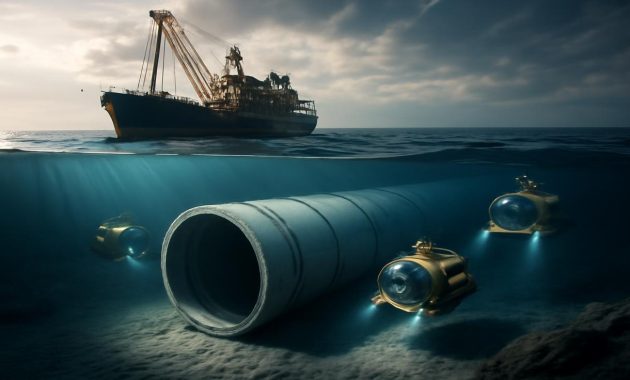
The first time I heard someone say the words “underwater rail line linking continents,” I thought it sounded like the plot of a glossy science-fiction film—something sleek, futuristic, and forever just out of reach. Yet here we are, in an era where engineers are no longer sketching this idea on whiteboards and napkins, but actually standing on wind-whipped decks, beneath cranes and floodlights, confirming what once seemed impossible: construction has begun. Somewhere beyond the horizon, in waters so deep sunlight never touches the seafloor, the bones of a new world-spanning tunnel are being laid down piece by pressure-tested piece.
A Ribbon of Steel Across the Abyss
Out on the ocean, the construction platform doesn’t look like the birthplace of a new era. It looks like an enormous, ungainly ship: steel scaffolding, rattling chains, the echo of shouted instructions in the wind. But look closer. Beneath the surface, below the tugboats and sensor buoys, the work is almost surreal. Modular tunnel segments, each the size of a city block, are gently lowered toward the abyss by cranes that move with the deliberate slowness of heartbeats. Cameras, sonar, and autonomous submarines dance around them, making minute course corrections so the segments meet their neighbors with millimeter precision on the seafloor.
Engineers describe it in the matter-of-fact language of load calculations and geodetic coordinates. Yet they’re also the first to admit that standing on that platform can feel like staring at the edge of an unfolding myth. For centuries, oceans separated us—barriers of salt, storm, and depth. Now, instead of simply crossing above the water, humanity is starting to thread a line beneath it, a continuous rail artery meant to knit continents together as if they were districts in a vast, shared city.
The tunnel’s path traces some of the most hostile terrain on Earth: submarine canyons, fracture zones, and plains of silt that have not been disturbed in geological time. Between them swarm the quiet citizens of the deep—bioluminescent jellyfish pulsing like floating lanterns, slow-drifting squid, and fish with eyes adapted to permanent night. To build here is to enter their domain with care, math, and an enormous sense of responsibility.
The Deep Engineering Behind a Daring Idea
The project’s scale is almost absurd. Parts of the rail line will run through more than 4,000 meters of water. At that depth, the pressure is crushing, like balancing the weight of a skyscraper on a single fingernail. Every material, every bolt, every seal has been tested—not just in lab pressure vessels, but in long-term immersion tanks replicating the corrosive reality of salted, oxygen-poor deep water.
The tunnel itself won’t be a single, simple cylinder. Think of it as a braided system. In some regions, pre-cast concrete and steel segments will rest in carefully dredged trenches, later covered with protective rock. In others, where the seafloor drops away into almost unfathomable depths, the design shifts toward a suspended or semi-buoyant structure, tethered to the seabed at intervals, like a colossal metallic kelp forest rooted in the dark.
Inside, the rail system is being engineered to feel almost mundane to future passengers—by design. Trains are expected to run at ultra-high speeds, but the ride should be as smooth as gliding on glass. Complex active damping systems will adjust to micro-movements of the tunnel. Air pressure will be carefully regulated so ears don’t pop. Emergency pods and cross-connection service tubes will be tucked into the structure, almost invisible until needed, like hidden lifeboats in a ship’s hull.
When you talk with the engineers, their eyes light up at the details. They describe how they model thermal gradients between deep cold seawater and interior climate control, the way the structure flexes with undersea currents, how sensors will constantly listen for the faintest crack or shift. It’s a living project, they say, one that will be in conversation with the planet itself—weather, waves, tectonics, and time.
What It Means to Stitch Continents Together
If all goes as planned, a traveler, decades from now, might walk into a station in one hemisphere and emerge, half a day later, on a different continent altogether—without ever boarding a plane. Imagine stepping into a bright terminal, coffee in hand, the rumble of a train pulsing beneath your feet. You pass customs booths and security checks that feel more like an international metro than an airport. Outside, the sky might be gray, but below your shoes, the rail line is already alive, humming in the dark, ready to launch you under oceans.
Onboard, the windows could show curated projections: live feeds from deep-sea cameras, artist interpretations of what lies outside, or serene, star-like animations. In reality, the world just beyond the walls is a black, high-pressure wilderness. Yet the psychological comfort of seeing a slow drift of blue, or the gentle sweep of a virtual whale, will help remind passengers they are part of a planetary crossing, not trapped in a tube.
The implications ripple far beyond tourism. High-speed rail links between continents could transform trade in ways even container shipping never managed. Freight trains moving through the tunnel could carry critical goods with less carbon than fleets of cargo planes. Data lines and energy conduits threaded through the same route could knit electrical grids and internet backbones across hemispheres. For border towns and coastal cities that become terminal hubs, this project could be as transformative as the first harbors or airports were in their time.
There is also a quieter, almost philosophical shift. When continents connect beneath the sea, our maps change—mentally, if not physically. Places we once thought of as distant may begin to feel like neighboring districts in a sprawling global neighborhood. The ocean, long a divider, becomes a roof under which we pass.
Environmental Questions in the Blue Shadow
Of course, nothing of this magnitude comes without questions—especially from those who love the ocean for what it already is. Environmental scientists, oceanographers, and coastal communities have been vocal: How will this enormous intervention affect marine life? What unseen costs hide behind the shimmering promise?
From the outset, the project team has been forced to treat the sea not as an empty backdrop, but as a complex, living landscape. Detailed environmental impact assessments have mapped migratory routes of whales, schooling patterns of fish, and breeding grounds on the seafloor. Noise, light, sediment plumes—each of these can disrupt marine ecosystems if not carefully managed.
To reduce noise, many heavy construction phases are scheduled away from key migration seasons. Acoustic shielding and quieter anchoring techniques are being tested to keep the seismic echoes of pile driving to a minimum. In some segments, equipment is deployed from dynamically positioned ships rather than fixed rigs, decreasing the need for permanent structures on sensitive seabeds.
There is an irony here: the same engineering ambition that lets humanity carve a rail line beneath oceans may, if guided well, set new standards for how we build with a lighter hand. LED lighting inside maintenance zones is tuned to wavelengths less disruptive to deep-sea creatures. Material choices and smooth external surfaces are designed not only for hydrodynamics but also to eventually host stable, low-impact communities of marine life—as if the tunnel could double as a discreet, artificial reef line in some regions.
| Aspect | Key Focus | Long-Term Intention |
|---|---|---|
| Construction Noise | Seasonal timing, acoustic shielding, quieter piling | Minimize disruption to marine mammals and fish |
| Seafloor Disturbance | Careful trenching, sediment control barriers | Protect benthic habitats and coral or sponge fields |
| Energy & Emissions | Low-carbon electricity, efficient train systems | Offer a cleaner alternative to long-haul flights |
| Monitoring | Seismic sensors, bioacoustic listening posts | Adapt operations as ocean conditions and ecosystems evolve |
Still, critics warn that the deep sea is the last, least understood wilderness on Earth, and that even the most carefully designed intervention is, in some sense, a gamble. This tension—between the hunger to connect and the obligation to protect—hangs over every meeting room and public hearing about the project. Out at sea, under the gulls and the steel, that debate flows silently below, in the pathways of unseen whales and the drift of microscopic plankton.
The Human Hands Behind a Planet-Scale Project
Stand in the control room on one of the main construction vessels and you’ll see a wall of screens showing sonar sweeps, engineering diagrams, and live feeds from remotely operated vehicles. What you won’t see are capes or sparkling sci-fi uniforms. The people here are wearing fleece jackets, coffee-stained shirts, and hard hats. They are civil engineers, marine biologists, welders, robotics technicians, navigators—ordinary professionals doing something extraordinary.
They work in shifts that bend time: two weeks out at sea, then a week back on land. Days and nights blur, regulated by alarms, shifts, and the steady rhythm of tasks: adjust winch tension, inspect welds, cross-check coordinates, review safety procedures. Outside, the weather can turn from glassy calm to white-capped fury in hours. Inside, the team maintains a calm that feels almost sacred. Precision, they say, is a kind of respect—for each other’s safety, and for the scale of what they are building.
In quieter moments, over late dinners in the ship’s mess, conversations drift from stress-testing results and tidal projections to more personal topics: where they grew up, which coastlines shaped their childhoods, what it means to spend your life constructing something whose completion you might never fully see. Some talk about their grandparents seeing the first jumbo jets; others mention early childhood memories of clattering trains into big-city terminals. The underwater rail line, they say, is part of the same story—another chapter in how we learn to move across our planet.
When Trains Replace Jet Trails
There is also the climate question, pressing and urgent. Long-haul air travel is one of the most stubborn sources of carbon emissions: difficult to decarbonize, woven deeply into global business and lifestyle. High-speed rail, by contrast, is a known climate ally when powered by low-carbon electricity. Linking continents by train might sound outlandish, but so did crossing them by air, once.
The tunnel is being designed as a multi-use corridor. Beyond the twin rail tubes, planners are reserving space for high-voltage cables and high-capacity fiber lines. In theory, these could allow nations on different continents to trade renewable power—sending surplus wind energy across oceans during stormy nights, or solar power across time zones to meet dawn peaks.
Picture it: instead of checking an app for flights, future travelers might scan an international rail schedule. Instead of contrails streaking overhead, the real action could be happening invisibly beneath the waves. Journeys would still have a cost, still require energy and materials, but the balance might tip toward a slower, steadier, more grounded kind of global movement—one that acknowledges the physical distances we cross even as it shrinks the time they demand.
Living With a Tunnel Under the Sea
For coastal communities near the planned terminal stations, the project feels both intimate and overwhelming. Suddenly, once-quiet harbors are temporary homes to massive engineering barges and survey vessels. Cafés fill with visiting technicians from distant countries. Local fishermen swap stories with sonar operators about the lay of the seafloor, comparing generational knowledge with laptop readouts.
Some residents are uneasy, worried about noise, changing property values, and the transformation of their once-remote shorelines into bustling international gateways. Others see opportunity: new jobs, new industries, new cultural exchanges. Town meetings stretch late into the night as people voice fears and hopes. It’s not just a tunnel; it’s a redefinition of what it means to live on an “edge” of the world when that edge is suddenly threaded to somewhere far away.
Near one planned station site, a teacher described asking her students to draw how they imagine traveling through the underwater rail line. Some sketched sleek trains glowing like comets in a dark tube. Others drew themselves floating above strange deep-sea creatures, pressed up against panoramic windows that may never exist in reality, yet say something true about how they want to relate to the ocean—not as something to be conquered, but as a neighbor to be observed and respected.
Standing at the Threshold of the Unknown
Every era inherits a frontier. Once it was distant continents. Then the sky. Then space. The deep ocean has always been there, quietly waiting in the background, less visible but just as mysterious. With this underwater rail line, humanity isn’t so much “conquering” the deep as threading a careful path through it—accepting the risks and responsibilities of becoming a species that can, in some sense, live across the whole surface of its planet, not just the solid bits.
It’s tempting to imagine a ribbon-cutting day years from now: dignitaries in crisp suits, the flash of cameras, a first ceremonial train easing into the tunnel while crowds cheer. But the more haunting, lasting image might be a different one: a silent moment thousands of meters below, where the new structure casts a vague, linear shadow over a seafloor that hasn’t seen change in eons. Tiny creatures drift in its wake; a curious fish inspects a smooth, human-made surface. The tunnel becomes just another fact of the deep, another layer in the story of Earth.
Engineers confirm that construction is underway, but what they really mean is that a conversation has begun—a negotiation between vision and caution, speed and scale, ambition and humility. Each new segment lowered into the dark is both a promise and a question: Can we connect this world more tightly without unraveling the places and systems that sustain it?
The answer won’t arrive all at once. It will come in the quiet hum of future trains, in the data from ocean sensors years after the last weld has cooled, in the lives of people who grow up taking for granted that slipping beneath an ocean is no more remarkable than crossing a river. For now, on windswept decks and in humming control rooms, the work continues—slow, steady, and astonishingly real.
Frequently Asked Questions
Is the underwater rail line already open to passengers?
No. Engineers have confirmed that construction has begun, but the project is still in its early phases. It will likely take many years before passenger services become a reality.
How deep will the tunnel go beneath the ocean?
Some segments are planned to lie beneath more than 4,000 meters of water. The tunnel structure itself is at the seafloor or slightly above it in tethered sections, designed to withstand enormous pressure.
Will traveling through the tunnel be safe?
Safety is central to the design. Redundant structural supports, constant sensor monitoring, emergency escape routes, and strict international standards are being built into the system from the start.
How will this project impact marine life?
There will be some impact, especially during construction. Environmental teams are working to minimize noise, sediment disturbance, and habitat disruption, and long-term monitoring is planned to track effects on ecosystems.
Why build an underwater rail line instead of more airports?
High-speed rail powered by low-carbon electricity can significantly reduce emissions compared with long-haul flights. The tunnel also provides a stable corridor for data and energy sharing between continents.
Will freight trains use the tunnel too?
Yes, the design anticipates both passenger and freight use. Freight services could shift some cargo away from air transport and help create more resilient, lower-carbon trade routes.
When might the project be completed?
Large-scale infrastructure under the sea typically unfolds over decades. While timelines are ambitious, exact completion dates depend on engineering progress, funding, international cooperation, and environmental approvals.