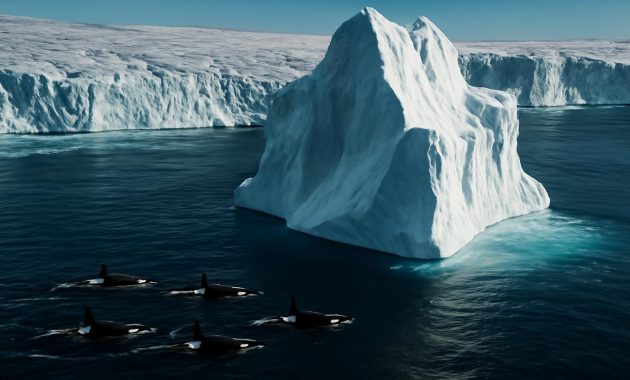
The first orca appears where no one is expecting her—an ink-black fin cutting the steel-blue water at the very edge of a Greenland ice shelf. For a heartbeat, everyone aboard the research vessel goes silent. Cameras hang useless at their sides. A single exhale, a heavy, thunderous whoosh, rises into the cold air. Then another fin, and another, until the water stirs and boils with moving shadows. The ice groans in the distance, a low, ancient sound, as if the continent itself is waking up to watch what happens next.
When the Ocean Crosses a Line
On the bridge of the vessel, a young glaciologist named Freja leans close to the frosted window. She has been coming to this same stretch of coast near western Greenland for five summers. Her work has always followed a rhythm as predictable as the tide: ice, silence, wind, measurements, then more ice. But this summer, the pattern has snapped.
Below her, on the aft deck, biologist Tomás is already shouting into his radio, voice tight but oddly calm: “Orcas. Pod size… at least eight. Near the shelf edge. Marking coordinates now.” He doesn’t say the other part out loud, the part wedged under everyone’s tongue: They’re not supposed to be here.
Orcas—top predators of the Arctic seas—have been sighted at high latitudes before, but usually along open-water corridors, far from the heavy pack ice and solid shelves that clamp the coastline in something like permanence. Those shelves, until recently, were a frozen barrier: too thick, too long-lasting, too inhospitable for these hunters to regularly patrol. Now the barrier is thinning, cracking, retreating.
In the ship’s small command room, a cluster of researchers hunches over screens, watching satellite imagery update in near-real time. Swaths of once-brilliant white appear mottled and gray, fractured into floes and melt ponds. Numbers on the monitors tell a quiet story of temperature spikes, unusual wind patterns, and a summer that came weeks too early and shows no sign of leaving.
Then, as if the ocean itself is underlining the message, the orcas breach again—sleek, muscular bodies erupting from the dark water, framed against a pale wall of ice studded with blue cracks. Someone finally breaks the silence and whispers what everyone has been thinking: “We’re crossing a line, aren’t we?”
“Emergency” in a Place Built on Ice
A few hours later, the word travels from ship to shore, from satellite phone to government inbox. Greenland’s environmental authorities, already on edge from a season of record melt, receive the call and the preliminary data packet. They see the same images: killer whales weaving along the base of a melting ice shelf like black signatures on a white page.
It’s not that orcas themselves are the emergency. It’s what their presence means.
For years, scientists have warned that shifting predator patterns—who hunts where, and when—can act as warning lights on the dashboard of a changing climate. When animals that once stayed clear of dense ice suddenly appear in those regions, it signals that the ice is no longer dense, no longer fixed, no longer predictable.
By evening, Greenland declares a localized environmental emergency. The language is careful, wrapped in technical phrasing, but the message underneath is as sharp as fractured ice:
- Unusual predator activity detected near rapidly retreating ice shelves.
- Accelerated melting undermining marine and coastal stability.
- Increased risk to local wildlife, traditional hunting grounds, and navigation.
Across coastal towns, the news spreads not through formal bulletins at first, but in the soft buzz of text messages, in radio chatter, in conversations over coffee where windows look out onto the same waters scientists are now anxiously mapping.
For people in these communities, the word “emergency” does not conjure up a distant, abstract catastrophe. It is immediate, textured: thinner sea ice for winter travel, unpredictable hunting seasons, shifting fish routes that pull livelihoods just out of reach. It is the gut-deep knowledge that the old calendar of the North—once etched in snow and stars and the slow dance of seasons—is being frantically rewritten.
The Sound of Melting
On deck, the sounds of this rewriting are everywhere.
Ice doesn’t just melt; it talks as it dies. It pops and sighs, trickles and thunders. At the edge of the shelf, vertical cliffs of ice crumble in slow motion, shedding chunks the size of houses into the churning sea. Each collapse sends out a rolling wave that slaps the ship’s hull and sets equipment rattling.
The orcas move along this jagged boundary as if reading it, their dorsal fins tracing invisible lines between what was once solid and what has become fluid. Every few minutes, one breaks the surface in a high, clean arc, the white of its patch gleaming almost blue against the ice. The exhalations of their breath hang briefly in the cold air like ghosts.
“They’re exploring new hunting grounds,” Tomás says quietly, binoculars pressed to his face. “Following openings in the ice, new leads, new prey routes. The ice used to keep them out of certain fjords. Now those doors are open.”
The “doors” he’s talking about are not merely geographic. The melting of Greenland’s ice shelves doesn’t just reshape coastlines—it redraws ecological relationships. Narwhals, belugas, seals: species that evolved to use sea ice as refuge are losing their fortresses. Predators like orcas, who once circled at a distance, kept back by solid ice, can now surge into bays and inlets that were previously safe harbors.
In the low-angle sunlight, the water around the shelf looks almost oily, stippled with fragments of ice. The air tastes faintly metallic, laced with brine so sharp it stings the insides of your nose with every breath. Meltwater streams off the shelf in braided, silvery threads, pouring ancient freshwater into a quickly warming sea.
Freja stands with one gloved hand on the railing and thinks about the ice buried deep inside those walls—snowflakes that fell before her country even existed, compressed through centuries. She imagines those trapped air bubbles, tiny time capsules of atmosphere from another world, finally released with a hiss into this one.
What the Orcas Are Telling Us
Scientists sometimes talk about “indicator species,” creatures whose presence or absence acts like a gauge on environmental health. Here, watching these orcas move through an unraveling ice-scape, the term feels almost too tame. This is not a discrete gauge; it is a siren.
Orcas have always been extraordinary navigators, their world stitched together by sound. They listen for the shapes of coastlines, the thickness of ice, the density of prey. As ice retreats and waters warm, some pods are redrawing their mental maps, extending their range northward, nosing into fjords that were once unnavigable.
That shift is telling scientists several things at once:
- Sea ice is thinning earlier in the season and for longer stretches.
- Marine food webs are reorganizing as fish and seals move with changing conditions.
- Top predators are responding quickly, exploiting new access—but at a cost to ice-dependent wildlife.
The emergency declared in Greenland is, at its core, a recognition that these are not small adjustments. They’re tectonic, ecosystem-wide. Watching orcas breach near collapsing ice shelves is like seeing a boundary between eras collapse in real time.
Lives Entwined with Ice
Hundreds of kilometers away, in a coastal village pressed between rock and sea, the news arrives with the morning’s first light. An elder named Anina stands near the shoreline, heavy coat pulled tight against the wind, and looks out at the same waters that fed her grandparents and their grandparents before them.
For her, the changes are written in the body, not the data stream. She remembers sleds running across firm winter ice in late October. Now, some years, it’s December before the sea hardens enough to trust. She remembers the reliable march of seals and fish, the steady return of birds. Now, the timing feels erratic, off-beat. Storms arrive with a new and violent frequency, testing old houses and older nerves.
When word spreads that researchers have declared an environmental emergency after spotting orcas near shelves that rarely saw such visitors, Anina isn’t surprised. The emergency, to her, is already decades old. It shows up in worn boots after longer hunting routes, in the worry lines on younger faces as traditional knowledge tries to keep pace with unprecedented shifts.
Still, she listens. She wants to know what the scientists are seeing, what names they give to the grief and unease she has carried like a stone in her pocket. She wants to know if there is a plan—not to bring things back to the way they were (because even she knows that river has already rushed by) but to slow the unraveling, to soften the landing for the generations after her.
Science Under Pressure
Back aboard the vessel, laptops glow late into the polar night. The researchers’ work takes on the frenetic stillness of urgency: quiet voices, fast hands, endless coffee. Satellites, drone footage, underwater microphones, temperature sensors embedded in the ice—all of it feeds into an emerging picture.
To condense the chaos of this unfolding emergency, they begin to chart the story in numbers as well as images.
| Indicator | Recent Observation | Why It Matters |
|---|---|---|
| Sea surface temperature | Higher than average for the season | Warmer water accelerates ice-shelf melting and alters marine habitats. |
| Ice-shelf edge position | Retreated noticeably compared to last decade | Opens new pathways for orcas into once ice-protected fjords. |
| Orca sightings | More frequent, closer to ice shelves | Signals shifting predator-prey dynamics and ecosystem stress. |
| Glacier melt rate | Spikes during warm air and ocean events | Contributes to sea-level rise and destabilizes local coastal environments. |
Every cell in that table is a doorway into another layer of complexity, into feedback loops that ripple far beyond Greenland’s coasts—circulating through global weather patterns, sea levels, and food systems.
There is a particular kind of pressure that comes with studying a system while it is changing faster than you can fully understand it. The data show a world in motion; the orcas outside underline that motion with every surfacing breath. Scientists are trained to be cautious with words like “emergency,” but they are also humans standing on the deck of a ship, watching their study site melt and fracture before their eyes.
Beyond the Horizon of Ice
Late one night, the ship’s engines hum softly as it holds position near the shelf. The sky is bruised purple, the sun only dipping far enough to flirt with the idea of darkness before sliding back up. A thin mist rises off the comparatively warm ocean, wrapping the ice cliffs in a gauzy veil.
The orcas are still there.
They travel in loose formation, surfacing in a rhythm that has the strange power to slow a heartbeat, to draw your breath into sync with theirs. Somewhere beneath them, sonar clicks pulse out, painting a sound-map of this new frontier: changing depths, tumbling ice chunks, pockets of fish pushed into dense shoals by the chaos of meltwater.
In the coming months, the images and data from this expedition will enter reports, policy discussions, climate models. Words like “threshold,” “tipping point,” and “non-linear response” will become more common in summaries sent to decision-makers. Emergency declarations will be debated for their language—too soft, too alarmist, or, perhaps, finally honest enough.
But here, in this moment, standing under a sky that refuses to fully darken, the reality is both simpler and harder to carry: a vast country made of ice is being redrawn in water, and the creatures of the sea are sketching the new borders with their own bodies.
What Happens Next?
When the emergency declaration is filed, it’s not a magic key that stops the melt or sends the orcas back south. It is, however, a signal flare—a way of saying, with official weight: Attention. Something fundamental is changing, and we ignore it at our peril.
In practice, that can translate into several urgent steps:
- Expanded monitoring of ice-shelf stability and marine life.
- Stronger protections for vulnerable species that depend on sea ice.
- Support for local communities whose traditions and safety are tied to frozen seas.
- More forceful participation in international climate negotiations, armed with firsthand evidence.
None of these paths are simple. They involve trade-offs, funding battles, and a clash between the slow pace of policy and the quickening pace of melt. Yet, even in their imperfection, they represent a refusal to treat Greenland’s transformation as background noise.
The orcas, for their part, will continue to follow the openings they’re given. They are not villains in this story, just highly intelligent opportunists trying, as all species do, to survive in a shifting world. If there’s a culprit here, it’s not in their sleek shapes slipping through the water, but in the invisible blanket of greenhouse gases thickening year after year above us all.
Somewhere between the ice cliffs that still stand and the open ocean that waits beyond, the ship’s wake spreads into ripples, then disappears. What remains is the echo of breath, the hiss of melting, and the quiet understanding that we have entered a chapter of Earth’s story where boundaries long taken for granted—between predator and refuge, between land and sea, between past and future—are dissolving.
Frequently Asked Questions
Why is Greenland’s emergency declaration significant?
Greenland’s declaration is significant because it formally recognizes that rapid ice loss and changing ocean conditions are creating immediate ecological and social risks. It marks a shift from viewing melt as a distant climate signal to treating it as a present-tense crisis requiring urgent monitoring, policy responses, and support for local communities.
Are orcas normally found near Greenland’s ice shelves?
Historically, dense and persistent sea ice limited orca access to many Greenlandic fjords and ice-shelf fronts. While orcas have been seen in Arctic waters for a long time, frequent sightings right at the edges of formerly stable ice shelves suggest that melting is opening new pathways for them into areas that once acted as barriers.
How does ice-shelf melting affect marine life?
Melting ice shelves change water temperature, salinity, and light conditions, which can disrupt plankton blooms and fish distribution. Species that rely on ice for resting, breeding, or protection—such as certain seals—lose critical habitat, while predators like orcas may gain easier access, altering long-standing food webs.
What does this have to do with global climate change?
Greenland’s ice shelves are part of a global system. Their rapid melt is driven largely by rising air and ocean temperatures linked to human-caused greenhouse gas emissions. As these shelves thin and retreat, they contribute to sea-level rise and can influence broader ocean circulation patterns, affecting weather and climate far beyond the Arctic.
Can anything still be done to slow these changes?
Yes. While some degree of change is already locked in, reducing global greenhouse gas emissions can still limit how fast and how far ice loss proceeds. At the same time, stronger conservation measures, locally informed adaptation plans, and sustained scientific monitoring can help ecosystems and communities adjust more safely to the transformations already underway.