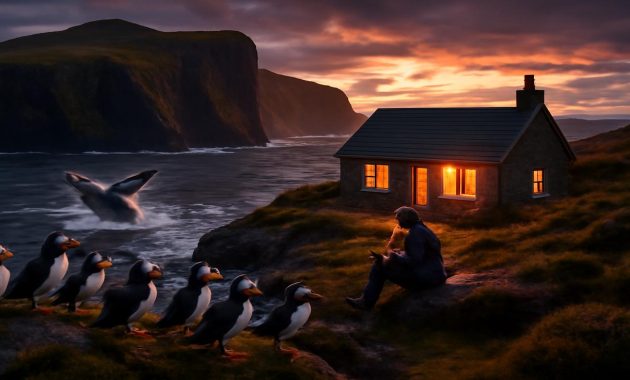
The email arrived on a Tuesday afternoon, folded between grocery ads and a reminder to pay the electricity bill. The subject line looked like spam: “€5,000 a month, free housing, remote Scottish island.” You almost deleted it. But something in those words tugged at the tired part of your brain that had forgotten what wild wind feels like on a salt-stung face, or what silence sounds like when it’s full of waves and wings instead of traffic and notifications.
The Island That Calls Your Name
Picture this: a speck of land rising out of the North Atlantic, ringed with cliffs and swirling tides, somewhere off the west coast of Scotland. The mainland is a charcoal blur on the horizon, your old life receding into a mist you’re not entirely sad to lose sight of. The ferry that brought you here is already a distant dot, turning back toward the busy world. On this island there are no supermarkets, no coffee chains, no late-night neon, just a cluster of whitewashed buildings, a small pier, and a weather station that blinks like a patient heartbeat against the broad-shouldered sky.
Your home for the next six months is a simple stone cottage with thick walls and small, deep-set windows that remember every winter since the 19th century. It comes with creaking floorboards, a wood-burning stove, and a kitchen table scarred by the elbows and stories of people who’ve sat at it before you. The bedroom smells faintly of salt, old books, and wool. From the tiny window above the bed you can see the edge of a cliff and, beyond it, a sheet of restless blue — the Atlantic, moving constantly, a living thing.
You stand in the doorway on your first evening, mug of tea steaming in your hands, and you listen. Not just for sounds, but for the absence of them. The mainland hum of cars and sirens and passing conversations has been replaced by something older. Wind in the grass. The boom of surf against rock. Distant, disembodied voices of seabirds, elastic and eerie. You don’t know it yet, but over the coming months, you will learn each voice by heart.
A Job Description Written by the Sea
On paper, the position seems almost unreal: six months as a seasonal warden or wildlife observer on a remote Scottish island, with a salary of around €5,000 a month and housing included. It sounds like a prank, or a fantasy. Yet here you are, unpacking your rucksack in front of a fireplace that still remembers last year’s driftwood.
Your official duties are straightforward enough. You are part naturalist, part caretaker, part storyteller. You monitor bird colonies — especially the puffins that tumble and bob and dig into the soft turf like nervous, overdressed miners. You log sightings of marine mammals: minke whales that roll up from the deep with the quiet grace of submarines, dolphins that stitch silver lines through the waves, grey seals that watch you from the water like half-forgotten gods. You check paths for erosion, repair simple things around the buildings, and — when boatloads of summer visitors appear — you become the island’s interpreter, translating wind and feather and rock into words.
But the job description doesn’t mention what it feels like to step out of your front door in the morning and realize that the entire horizon is yours. Or what happens to your sense of time when clocks become less important than tides and sunrise. It doesn’t warn you about how quickly your phone becomes a paperweight, how emails shrink to tiny, unurgent dots in a life newly widened by weather and wild things.
Living Among Puffins and Giants
The puffins arrive first, or at least that’s how you remember it. One day the cliffs seem bare, the next they are punctured with burrows and dotted with these improbable birds that look like someone designed them during a particularly whimsical afternoon. From a distance, they’re specks of black and white, confused with guillemots and razorbills. Up close, they are startling: bright sunset beaks, red-rimmed eyes, orange feet that look too buoyant to belong to such frantic, flapping flyers.
You sit quietly on the cliff-top, settling into a patch of heather still damp with the morning’s mist, and watch them. Puffins are not graceful; they crash-land, stumble, and trip over tufts of grass. They squabble and nod and clack their beaks together in rituals you are just beginning to understand. Yet when they lift from the cliffs and skim low over the waves, there is a kind of purpose in their flight, a determination that feels both comic and profound. They are carrying sand eels to their nests — rows of glinting silver gripped crosswise in their beaks, each fish angled at just the right degree so they don’t slip free.
Then come the whales. At first they’re just rumours in the radio chatter from passing boats, or quick notes in the logbook: “minke at 14:32, heading north;” “porpoises bow-riding off the starboard.” You scan the horizon until your eyes ache, sea and sky blurring into a single shimmering sheet. And then one day, there they are — a back as smooth and curved as wet slate, breaching the surface in a slow, confident arc. The breath, when it comes, is not a dramatic spout like in documentaries. It’s smaller, a soft burst of white that vanishes almost as soon as it appears. Yet it is enough to shift something in you. You are watching a creature older than most of your myths, living its life in deep water, passing your borrowed home like it’s the most ordinary thing in the world.
The island, once just a romantic word in the job advert, begins to reveal itself as a whole intricate neighborhood. Fulmars skim close to the cliff face, seemingly carved from the same pale stone. Skittish oystercatchers pipe from the tideline. At night, the calls of storm petrels — tiny birds who spend their days far out at sea — scratch softly against the dark as they return to burrows hidden in stone walls. Even the wind feels more personal now: you can tell from its temperature and smell if a weather front is rolling in from the Arctic or sliding up from the south.
What the Offer Really Buys You
Those numbers — €5,000 a month and free housing — shimmer in the mind like a winning lottery ticket. But after a few weeks on the island, you start to sense the quieter economy you’ve entered, one measured in something other than euros. The real salary of a life like this is paid in dawns and tides, in the slow unravelling of stress knots you didn’t even know you carried.
Of course, the practicalities still matter. The money means you can pause the treadmill of rent and groceries and city transport passes. It covers the student loans or the credit card debts waiting patiently at home. It pays for your winter, for the months when you’ll be landlocked again, missing the sea. But in the day-to-day, your expenses shrink. There is one tiny island shop or weekly supply runs. Social spending evaporates; there’s no place to buy a flat white just because you’re bored. You begin cooking what’s available, not what an app can deliver. Beans, root vegetables, lentils, huge wedges of cheese, thick bread, tins of tomatoes. Comfort food for a body that spends most of its daylight hours outdoors.
Time rearranges itself too. You learn to plan your week around the supply boat and the weather forecast. A storm can mean three extra days without fresh fruit, but it also gifts you a symphony of wind moaning through every crack in the cottage, a reminder that you are a guest in a place shaped first and always by the elements.
| Aspect | Typical City Life | Remote Scottish Island Life |
|---|---|---|
| Monthly Pay & Housing | Rent, utilities, commute eat into salary | €5,000 salary, housing included, minimal bills |
| Daily Commute | Traffic, crowded trains, screen time | Cliff paths, sea spray, wind and birdsong |
| Noise & Pace | Constant background noise, rushing schedules | Waves, wind, and long unbroken stretches of quiet |
| Social Life | Many people, shallow encounters | Few people, deep connections (or cherished solitude) |
| Wildlife Encounters | Pigeons, park squirrels, maybe a fox at night | Puffins, whales, seals, raucous seabird colonies |
The Hidden Costs of Paradise
None of this is an escape without shadows. The job advert probably mentioned “resilience” and “ability to work in remote conditions” in a line or two of polite HR language, but those words acquire weight once the first storm settles over the island and refuses to move for days.
There are evenings when the fog drops so thick and sudden that the world beyond your front step simply disappears. The cottage becomes a small circle of lamplight suspended in a milky void. The usual reassurance of distant landforms — a jag of cliff, a lone radio mast — is gone. You are floating, essentially, on faith and memory. It is beautiful, and unsettling, and after a while it can get under your skin.
There are the logistics too: a sprained ankle on a slippery path becomes a serious concern when the nearest doctor is a boat ride away and the sea is too rough for visitors. A broken boiler, a cracked window, a malfunctioning radio — you become more resourceful, more patient, or more accepting of discomfort than you ever expected. Isolation is romantic when you can turn it off at will; here, it’s a full-time reality.
Loneliness can arrive quietly, even if you came here craving solitude. On some mornings, gulls might be the only voices you hear until evening. The island community — if there is one — is tiny. A handful of permanent residents, perhaps, people whose families have known this wind for generations. You learn the art of the long conversation, the unhurried exchange of stories over mugs of strong tea. You also learn that sometimes the most faithful companion is not another person, but the horizon itself.
Six Months That Change Your Sense of “Home”
Slowly, almost imperceptibly, the island begins to seep into your bones. You find yourself waking before the alarm, tuned to the pale lift of dawn over the sea. Your body calendar shifts with the season: in early summer you live in wide technicolour daylight; as autumn approaches, evenings draw in closer, and the cottage fills with the golden smell of burning peat and the low crackle of logs.
You measure days now in tasks that leave visible marks on the island’s story. You mend a fence the wind has bullied too far, and weeks later you walk past it and feel a small, surprising spark of pride. You record the first fledglings of the season, map their nests, and months later watch them throw themselves into the air for the first time, beating their wings with clumsy faith. Your notes feed into research, conservation plans, the quiet machinery of protecting places like this from becoming emptier versions of themselves.
Some nights, when the sky opens and the clouds roll back, the stars look close enough to touch. There’s no city haze, no orange veil of streetlights. Just the raw, dizzying knowledge of how small your cottage, your island, your entire life really is. And instead of feeling crushed by that, you feel oddly anchored. You are a speck on a rock, yes, but you are also part of a migration pattern, a food web, a chain of decisions that ripple outward in ways you can’t quite see.
By the halfway point of your contract, the idea of “going back” starts to feel less like a return and more like another departure. The city you left — with its networks and noise and always-on connections — begins to seem more foreign than this cliff you’ve learned to walk in the dark without stumbling. You catch yourself worrying about the puffins’ nesting success, the health of the kelp forests, the seals’ pupping season, as if they’re neighbours whose mail you’ve promised to keep an eye on.
Would You Say Yes?
Back at that kitchen table, months from now, you’ll try to answer the question people always ask when you tell them about your time here: “So… should I apply for something like that?” They expect an easy yes, a breezy endorsement of the dream job. What you want to tell them is more complicated.
Say yes if you are comfortable with your own company and with the thought that some days will be stitched from small, quiet moments rather than big, cinematic ones. Say yes if you’re willing to trade constant stimulation for depth, if the idea of truly learning a single place — watching the same bay through a storm, a calm, a fog, a blazing sunset — sounds more appealing than ticking off a dozen destinations in a year.
Say yes if you’re ready to have certain illusions gently but firmly stripped away: the illusion that humans are in charge here, for one. The illusion that more noise equals more life. The illusion that your days must be filled with visible productivity to have value. There will be afternoons when your only tangible output is a few lines in a logbook and a renewed memory of the way a whale’s back cuts the surface like a slow, careful smile.
But also say yes with honesty. This is not a permanent escape, not a glitch in the system where you get paid well to do nothing. It is a job, with responsibility and early mornings and occasionally uncomfortable weather. There will be wet socks, short tempers, radio calls crackling with tasks, data sheets that don’t care how poetic the lighting was over the cliffs that morning.
Yet beneath it all there is something undeniably rare: the chance to live, for a finite slice of your life, at a slower, wilder tempo. To let the usual scaffolding of your identity — your commute, your social calendar, your favourite barista — fall away, and see who you are when your days are shaped instead by tide tables, migration charts, and the way the wind shifts when rain is coming.
When the Island Follows You Home
Eventually, the ferry returns for you. Your contract ends, the puffins begin to leave their cliff-top burrows, the whales follow invisible routes to other feeding grounds, and your cottage door closes behind you with a final, echoing click. The island shrinks in the distance until it is once more a smudge on the sea, a story you’ll tell at dinner parties to people who cannot quite imagine the taste of that wind.
But the island refuses to stay behind. It shows up on crowded trains, when you glance at the advertisements and suddenly hear, in memory, the eerie call of a seabird carried on a yawning wind. It appears when you stand in front of a supermarket shelf and feel faintly bewildered by the abundance of choices, remembering instead the simple, finite pantry of your cottage. It finds you the first time you walk under a sky dulled by city lights and feel a pang for the vertigo of those island stars.
Maybe you return to your previous career, your previous city. Maybe you pivot, steering your life closer to conservation, to fieldwork, to anything that lets you keep your hands near the wild world. Either way, those six months become a quiet kind of compass, a hidden needle that swivels whenever you’re faced with decisions about what to value: time or status, space or speed, depth or variety.
So when you see an oddly-worded posting scroll past your screen — something about a remote Scottish island, a surprisingly generous salary, and a house perched on the edge of the Atlantic — you might pause a little longer than you did before. You might picture the puffins and the whales, the thick-walled cottage and the way the wind sounded in the chimney on stormy nights. You might remember how it felt to wake up in a place where the horizon wasn’t just scenery, but a living, shifting promise.
And you might, just for a moment, imagine your name on that door.
Frequently Asked Questions
Is this kind of island job actually real?
Roles like seasonal wardens, wildlife observers, and island caretakers do exist in Scotland and other coastal regions. They are usually offered by conservation organizations, local authorities, or trusts managing protected areas. The exact salary and conditions vary, but well-paid, fixed-term posts with accommodation included are possible.
What kind of work would I really be doing?
Typical tasks include wildlife monitoring (especially seabirds and marine mammals), maintenance of paths and facilities, welcoming and guiding visitors, keeping records for research, and basic caretaking duties such as cleaning, stocking supplies, and checking safety equipment.
Do I need to be a scientist or biologist?
Not always. Some roles do ask for a background in ecology or conservation, but many focus more on practical skills, reliability, and enthusiasm for wildlife. Experience with outdoor work, volunteering with conservation groups, or strong communication skills for dealing with visitors can be just as valuable.
How isolated is “remote” in this context?
It can mean anything from a small island with a tiny resident community and a daily boat, to a truly off-grid place with only occasional supply runs. Internet and phone reception may be limited or patchy. You should be comfortable with fewer social contacts, limited services, and a strong dependence on weather conditions.
What are the biggest challenges people underestimate?
People often underestimate the emotional weight of isolation, the impact of rough weather, and the need to be self-reliant when things break or plans change. Simple tasks can become complicated by tides, storms, or transport limitations. Flexibility, patience, and a steady temperament are as important as a love of nature.
Is six months on a remote island good for mental health?
For some, the slower pace, immersion in nature, and reduced digital noise are deeply restorative. For others, the lack of social life and stimulation can feel hard. It helps to arrive with realistic expectations, strategies to stay connected with loved ones, and an honest understanding of how you handle solitude.
Would an experience like this help a future career?
Yes, it can. It demonstrates resilience, responsibility, and the ability to work in challenging environments — qualities valued in conservation, outdoor education, research, and many other fields. It also gives you rich, first-hand stories and skills that stand out in interviews and applications.