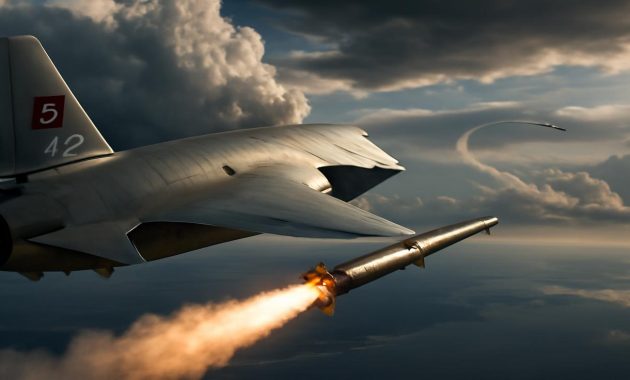
The sea air smelled of salt and hot metal as the drone rose from the Anatolian coastline, no louder than a distant swarm of bees. On the ground, a small knot of engineers watched their monitors in absolute silence. A white trail began to carve itself high across the sky—a supersonic target drone, a dart of speed, moving too fast for the eye to track. Somewhere between the blue of the Black Sea and the darkness of the upper atmosphere, history was about to be written by a machine that, only a decade ago, many countries quietly doubted could ever come out of Turkey.
The Day the Sky Blinked
There are moments in aviation that feel like the sky itself pauses to pay attention. The Wright brothers lifting off at Kitty Hawk. Chuck Yeager breaking the sound barrier. Sputnik humming over a sleeping planet. And now, in a quieter but no less radical moment, a Turkish drone locking onto a moving, supersonic target and firing with deadly precision—becoming the first unmanned combat aerial vehicle ever to do so.
On that test day, the command trailer was thick with the smell of coffee that had long gone cold. Lines of code, green and white, crawled down black screens. The drone—sleek, angular, with the predatory silhouette of a bird that had traded feathers for carbon fiber—was streaming live data: wind speed, altitude, fuel, weapon status, radar signatures. Outside, the air vibrated faintly with its distant engines.
The target was no slow, lumbering object. It was designed to mimic what keeps air-defense planners awake at night: a fast, agile, supersonic threat, the kind that screams through the upper air at more than a kilometer every second. Traditionally, this kind of quarry is hunted by manned fighter jets, piloted by humans with oxygen masks pressed tight to their faces, hearts thudding against their flight suits. That day, however, the hunter had no heartbeat at all.
Operators watched as the drone’s sensors fused information from radar, electro-optical cameras, and infrared signatures into a single fluid picture. The target, in the interface, was just a small, stubborn blip—moving too quickly to stare at, demanding prediction instead of reaction. An operator gave the command, voice level, almost bored from repetition, but his fingers trembled just enough to rattle the headset mic. The drone’s targeting system locked. The weapon bay opened with the mechanical calm of a curtain being drawn.
High above the haze, a missile streaked away. For a heartbeat, there was only ordinary sky—some cloud, some contrail. Then, a sudden pinprick of light. A blossom of white vapor. The supersonic target, which had been so certain of its own speed, disintegrated into shards and heat and stories that would later be replayed in slow motion. On the monitors, a neat line of text scrolled into existence, as unemotional as an invoice: Hit confirmed.
The Long Road to an Overnight Miracle
For those who had spent years in fluorescent-lit labs and echoing hangars, that “overnight” success was built on decades of stubborn ambition. Turkey’s journey toward this moment began not with a single test but with a growing discomfort—an unease at depending on foreign suppliers for critical defense technologies. When export licenses could be revoked overnight with the flick of a diplomat’s pen, the idea of sovereignty became more than a slogan; it became a technical specification.
In workshops across Ankara and Istanbul, young engineers hunched over circuit boards and 3D-printed parts, writing code that flew simulated wings through digital storms. The earliest Turkish drones were small, tentative—eyes in the sky rather than clenched fists. They watched, recorded, tracked. But they didn’t yet reach into the fast, rarified layer of combat where supersonic targets live and die within seconds.
To make the leap, the teams had to tackle a question that sounds simple and turns out to be anything but: How do you make a machine think fast enough to win against something traveling faster than sound?
The answer sprawled across multiple disciplines. Aeronautical engineers sculpted airframes that could remain stable at altitude in turbulent, high-speed air. Software architects built targeting algorithms that learn from every flight, turning the sky itself into a feedback loop. Weapon designers miniaturized guidance systems that could ride shear winds and shockwaves and still find a moving speck at closing speeds that would make a Formula 1 car look stationary.
The result wasn’t just a better drone. It was the emergence of a new kind of hunter—one that doesn’t fatigue, doesn’t black out under g-forces, and can maintain the cold, precise attention that supersonic intercepts demand.
The New Face of Aerial Predators
If you were standing beside the runway as Turkey’s record-making drone taxied for its test flight, your first impression might not be fear but fascination. Its skin is a matte, almost liquid gray that seems to drink in the daylight. The wings stretch wide and lean, with angles that suggest both aggression and efficiency. Sensors nestle in smooth housings around the nose and under the belly like small, unblinking eyes.
Every curve is an answer to a question asked by the sky: How will you handle crosswinds at high altitude? Can you cut your radar reflection down to a whisper? Will you slip through clouds without losing your bearings? Recessed weapon bays close flush with the fuselage, preserving the silhouette, hiding the sting until the moment it’s needed.
Inside, where no human ever sits, it is all cables, circuitry, and tightly packed logic. Guidance computers cross-check incoming data from multiple sensors hundreds of times per second. Navigation modules constantly re-evaluate trajectory, banking, climb, and dive, turning turbulence into just another variable in the equation. In-warhead navigation allows missiles to listen to the same invisible symphony of signals.
And yet, despite its inhuman calculations, there’s something eerily familiar about it. The drone circles, hunts, commits, and returns—a behavior as old as hawks over cliffs and falcons over deserts. Nature has always rewarded the predator that could best read the air. Only now, it’s silicon instead of sinew doing the reading.
Turkey’s Quiet Revolution in the Skies
The first successful shootdown of a moving supersonic target by a drone is not just a line in a press release—it’s a hinge, swinging open onto a new era of air power. For Turkey, the milestone carries a particular charge. In a region where airspace is crowded with interests, alliances, rivalries, and uneasy truces, mastery of the high, thin layers above the clouds is more than prestige; it’s strategic insulation.
Turkish UAVs have already redrawn maps of conflict far from that coastal test site. In past years, their drones have helped shape outcomes in complex theaters, performing reconnaissance, strike missions, and real-time battlefield coordination. This new feat adds a sharper edge: the ability to reach up and challenge fast, cutting-edge aerial threats without risking a single pilot.
There is a political narrative here, but beneath it is a quieter cultural story—a national engineering psyche waking up to its own power. High school students visit drone factories and ask about propulsion instead of just smartphones. University labs spin out startups focused on composite materials, sensor fusion, autonomous flight software. The drone program has become, in its own way, a lighthouse, sweeping a beam of possibility across a young, tech-hungry population.
The numbers tell part of that story.
| Aspect | Before Supersonic Intercept | After Supersonic Intercept |
|---|---|---|
| Primary Role of UAVs | Reconnaissance, light strike, surveillance | Air defense, anti-air, high-speed target engagement |
| Perceived Threat Level | Moderate, tactical | Strategic, capable of challenging advanced aircraft |
| Operational Risk | Low for pilots, limited in high-end air combat | Still no pilot risk, extended to high-intensity air engagements |
| Global Impact | Incremental shift in ground warfare | Paradigm shift for future air combat doctrine |
You can almost feel the air-defense planners around the world taking out their pens, making hard, quiet notes in the margins of their strategy documents.
Supersonic: Where Physics Gets Personal
To appreciate why this test matters, it helps to step, briefly, into the cockpit of physics. Supersonic isn’t just “very fast.” It’s a threshold where the air in front of a moving object can no longer get out of the way in time. Shockwaves form. Pressure piles up. The sky, usually a compliant medium, starts to behave like a stubborn, textured surface.
A target flying at supersonic speed is compressing time itself for the defender. The window between “detection” and “too late” shrinks to seconds. A missile, once launched, must not only catch up but also predict where the target will be in the future, weaving through invisible ripples of disturbed air. Any delay in computing, any lag in sensor data, any miscalculation of trajectory, and the intercept point dissolves into empty sky.
This is why historically, intercepting such a target has demanded highly trained pilots in extremely fast jets, coordinated with ground-based radar networks and complex command chains. Placing that kind of responsibility on an unmanned system is a bold wager that algorithms, sensors, and actuators can substitute for muscle memory, gut feeling, and human experience.
In Turkey’s case, the wager paid off. The process looked almost mundane on screens—a cursor moving, a lock tone in the headphones, numbers stabilizing, a launch command. But behind that apparent simplicity were millions of lines of code and years of simulated flights through digital storms that never touched soil, only silicon.
Ethics in the Thin Air Above Conflict
There’s a strange duality to this achievement. On one hand, it is a marvel of human ingenuity—a demonstration of mastery over materials, mathematics, and the unruly nature of the atmosphere. On the other, it is unmistakably a weapon, refined for precision in ending things: flights, machines, potentially lives.
The idea of unmanned systems taking on more complex combat roles raises questions that flicker at the edges of every briefing room. If a drone can track and destroy a supersonic target, what else will we trust it to decide in the future? How much autonomy is acceptable? When does software cross the line from tool to actor?
For now, Turkish officials emphasize human-in-the-loop control: the idea that a person, not an algorithm, authorizes lethal force. The drone may see, track, compute, and suggest, but the finger on the virtual trigger still belongs to a human operator. The test that made history, after all, was initiated by a voice, a command, a human breath pushed past human vocal cords.
Yet the slope is there, visible against the horizon like a distant ridgeline. As more nations pursue similar capabilities, pressure will grow to make systems faster, more reactive, more autonomous—because human reaction speed is now, more than ever, the bottleneck. Against a supersonic threat, milliseconds matter, and we are somewhat slow creatures.
Nature storytelling often lingers on wolves, falcons, sharks—apex predators tuned to their ecosystems. But what happens when the apex predator over a landscape is no longer an animal, or even a person in a machine, but the machine itself? The test over Turkish skies hints that we are edging closer to that question than ever before.
A New Map of the Possible
For aviation enthusiasts, the test is like a stone tossed into calm water—the ripples are subtle at first, then spread wider than anyone expects. Defense ministries will note that drones, once considered inferior to manned fighters in air-to-air roles, are now stepping into their lane. Aerospace companies will study every published detail, looking for clues on guidance, control, and integration with existing networks.
Civilian industries may ultimately benefit too. The same sensor fusion and rapid decision-making tech that allows a drone to hit a supersonic target could, in time, help passenger aircraft avoid debris, birds, or even other aircraft more intelligently. Autonomous air taxis, long a dream of the urban futurist, might borrow from this moment’s technical DNA, applying it to the far gentler task of not colliding with anything at all.
Back in Turkey, the runway where history was made will, on some mornings, look completely ordinary again. Gulls will drift overhead. Mechanics will walk out with toolboxes that clink softly in the cool dawn. Technicians will check hydraulic lines with gloved fingers, feel the thrum of pumps through their palms. A new test will be queued; a different aircraft will taxi out. But there will be an invisible layer over everything now—a knowledge that in this place, once, a machine reached out through the upper atmosphere and proved that the future of air combat may belong to things that do not breathe.
Somewhere, a young student will watch the grainy test footage on a phone, the missile an almost pixelated streak, the distant explosion a white burst against blue. Their heart will tilt slightly in their chest. Not toward war, necessarily, but toward the realization that the sky, however well mapped, still holds new frontiers—and that humans, by proxy of their machines, are still learning to write their names a little higher up.
Frequently Asked Questions
What exactly did Turkey’s drone accomplish?
Turkey successfully tested a military drone that shot down a moving supersonic target in flight. This is widely recognized as the first time an unmanned aerial vehicle has intercepted and destroyed a target traveling faster than the speed of sound, demonstrating advanced air-to-air combat capability without a pilot onboard.
Why is hitting a supersonic target such a big deal?
Supersonic targets move extremely fast, giving defenders only a few seconds to detect, track, predict, and engage them. The physics of shockwaves, rapid closure rates, and limited reaction time make interception technically very challenging. Achieving this with an unmanned system shows that the drone’s sensors, software, and weapons can operate at a level previously reserved for top-tier manned fighter jets.
Does this mean drones can replace fighter pilots now?
Not completely, at least not yet. While this test proves drones can handle complex, high-speed engagements, manned fighters still bring flexibility, situational awareness, and broader mission roles. However, the line is shifting. Drones are increasingly capable of taking on missions that were once thought to require a human in the cockpit, especially those that are high-risk or extremely demanding.
How does this change Turkey’s position in aviation and defense?
It significantly boosts Turkey’s status as a drone and defense technology leader. The country has already become known for its effective UAVs in various conflicts. Demonstrating the ability to engage supersonic targets moves Turkey into a smaller group of nations capable of producing highly advanced, indigenous air-defense and strike systems.
Are there concerns about the ethics of such advanced drones?
Yes. As unmanned systems gain more capability, especially in lethal roles, questions arise about autonomy, accountability, and the speed of decision-making. While Turkey emphasizes human control over weapon release, the technological trend worldwide is pushing toward faster, more automated responses. Policymakers, ethicists, and engineers are still grappling with how to ensure these powerful tools are used responsibly.