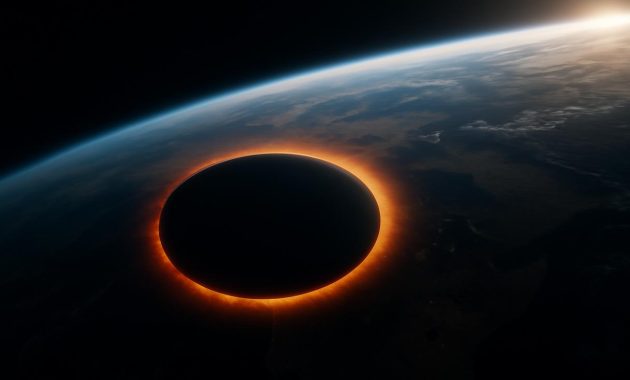
The notice arrived in the quiet way big news sometimes does: a sentence tucked into a press release from a roomful of astronomers, a date circled on a calendar that hasn’t even been printed yet. But make no mistake—this is one of those moments our descendants will talk about. On that day, in a band of shadow wrapping itself across Earth, day will quite literally turn to night. Birds will roost at noon, stars will shimmer in an indigo sky, and a river of cool twilight will sweep across crowded cities and empty deserts alike. The longest total solar eclipse of the century now has an official date, and it is coming for us all, one heartbeat and one rotation of the planet at a time.
The Date the Sun Will Disappear
Every great story begins with a when. For this one, astronomers have now settled on it with the certainty that only orbital mechanics can provide: a specific day when the Moon will slide between Earth and Sun in such perfect alignment that sunlight will be completely blotted out for an extraordinary stretch of time. Not just the ordinary few minutes—this one will linger, stretching the word “totality” into something you can breathe in, something you can feel in your bones.
Schedules can still shift slightly as calculations are refined, but the core is set: the longest total solar eclipse of the 21st century will occur in the mid-2030s, sweeping a corridor of darkness across continents and oceans. If you are alive to read these words, chances are decent you can be alive to stand in that shadow. It won’t be a moment reserved for scientists in mountaintop observatories. It is for the farmer in a rice field, the child on a city rooftop, the commuter who steps out of an office for “just five minutes” and ends up changed.
To the uninitiated, a few extra minutes of darkness may not sound like much. But eclipse chasers—people who cross time zones and bank accounts to stand in that eerie midday night—are already marking their calendars in bold ink. They know what it feels like when the world holds its breath, when the Sun’s fierce white face is replaced by an obsidian disk ringed with a crown of fire. They also know this: the difference between two and seven minutes of totality is the difference between watching a storm through a car window and camping in its wild center.
The Path of the Shadow
Picture the Earth from far above, a blue and green marble spinning through space. Now imagine a narrow, moving bruise of darkness sliding over the sunlit side, tracing a curving path thousands of kilometers long but only a couple hundred wide. That moving bruise is the umbra—the Moon’s darkest shadow—and if you stand under it, the Sun disappears.
On the appointed day, that umbra will first brush Earth over a quiet sweep of ocean, turning rolling waves ink-black beneath a sudden star-strewn sky. Fishermen may pause, hands resting on coiled nets, as the sea and sky change places. Then the shadow will race inland, faster than the sound of thunder, crossing coastlines and mountain ranges, salt marshes and megacities. Some places will get a taste of totality for just over a minute. Others, perfectly poised near the heart of the path, will be plunged into darkness for what will feel like an impossible span of time: over seven full minutes of night in the middle of the day.
If you stand near the center line of that path, you will be in the slowest part of the Moon’s shadow, where its geometry aligns just right with Earth’s curvature and the relative distances of our three celestial bodies. From there, the world falls away in layers. The Sun is high, bright, ordinary—and then, almost imperceptibly at first, the light begins to go strange. Colors flatten, as if someone turned down the saturation on the day. Your own shadow sharpens at the edges. A chill creeps in, more psychological than physical, at least at first.
Then you look up, and the Sun is no longer round. A tiny black bite appears on its edge: first contact. The eclipse has begun.
How Long Will Day Turn to Night?
Total solar eclipses are common on cosmic timescales. Somewhere on Earth, every year or two, the alignment snaps into place. Yet for any given spot on the planet, the odds are terrible. A single town might wait centuries for a total eclipse to return. And a total eclipse this long—this generous—is something far rarer still.
For most eclipses, totality lasts a couple of minutes. That’s enough time to gasp, photograph the corona, maybe glance at the horizon, and it’s gone. The coming one will be different. In some lucky locations, the Moon will fully cover the Sun for more than seven minutes, a stretch rivaling the grand eclipses recorded in old ship logs and temple carvings. If you already feel time slowing down in those numbers, you’re on the right track. Imagine what can unfold in seven minutes when the rules of daylight have been temporarily suspended.
| Feature | Typical Total Eclipse | Longest Eclipse of the Century |
|---|---|---|
| Maximum totality duration | 1–3 minutes | Up to ~7+ minutes |
| Width of path of totality | 100–200 km | Similar, but with longer central line |
| Chance to see bright stars/planets | Limited, very brief | High—night-sky feel for several minutes |
| Atmospheric cooling | Noticeable but quick | Deeper, more sustained cooling |
| Travel interest | Moderate to high | Extremely high—once-in-a-century event |
During those minutes, you will have time to do something most eclipse veterans rarely manage: to simply stand and feel it. To let your eyes travel from the blackened Sun to the 360-degree twilight on the horizon, where distant landscapes glow as though lit by a perpetual sunset. To listen as birds stop singing, as insects rise in a confused chorus, as humans nearby fall abruptly, reverently quiet.
A Sky That Feels Alive
There is a very old human impulse to treat celestial events as messages. Ancient cultures interpreted eclipses as omens—of kings falling, wars ending, gods speaking. We know better now, or at least we tell ourselves we do. We can calculate the alignment of the Sun and Moon to the second, map the exact streets that will lie under the path of totality, predict the shape of the corona using solar physics. Yet, for all that, when the light starts to warp, something equally ancient stirs in the body.
You might notice it first in the temperature. As more of the Sun is covered, the warmth on your skin fades. The breeze, if there is one, carries a new edge of cool. The color of the world shifts from golden to silvery, an almost metallic blue that cameras never quite capture. Shadows become unnervingly crisp, each leaf painting a tiny crescent Sun on the ground beneath your feet.
Above you, the Sun sinks into a narrowing arc of light. In the last seconds before totality, the world fractures into spectacle: the diamond ring effect flares as a single brilliant bead of sunlight explodes from the lunar edge; beads of light shimmer along the rugged mountains on the Moon’s limb; then, sudden and absolute, the bead vanishes.
Totality.
In that instant, the Sun is not gone; it is transformed. The photosphere—the blinding outer surface—has been perfectly hidden by the Moon. What remains visible is the corona, the Sun’s ghostly outer atmosphere, streaming out in tendrils of soft white fire. It is delicate and wild at the same time, shaped by magnetic fields we cannot see, arching and twisting millions of kilometers into space. Planets step forward into view—Venus glaring, perhaps Jupiter or bright stars like Sirius puncturing the indigo dome. If you are close enough to others, you will hear the collective gasp, the involuntary shout, the choked laughter of people whose expectations just shattered.
Preparing for a Once-in-a-Century Shadow
An eclipse like this is a logistical event as much as a celestial one. Long before the shadow arrives, there will be traffic jams of the hopeful and the curious converging on that narrow band of totality. Cities in its path will brace for crowds; tiny rural communities will find their quiet streets unexpectedly full of languages and rental cars from faraway places. Schools may plan curriculum around it. Airlines will tweak routes. Photographers will overpack gear, and somewhere, a hotel clerk will realize their tiny inn is suddenly the most sought-after property on the continent.
If you want to stand in the path of this longest eclipse, your preparations won’t just be about where you go, but how you choose to be there. Eclipses are notorious for being held hostage by clouds, and this one will be no different. Some will gamble on clear skies in deserts, others will pick coastal locations, trusting sea breezes to sweep away late-morning haze. Seasoned chasers often travel in small, mobile packs, ready to drive hundreds of kilometers overnight if cloud forecasts shift.
But there is a quieter kind of preparation too. You might think about who you want standing beside you: a child who has never seen the Milky Way? A parent who taught you the constellations? A partner who listens with you for owls on summer nights? Eclipses, especially long ones, are as much about community as they are about science. Under that shadow, everyone shares the same sky, the same brief, strange darkness. Professional astronomers with hydrogen-alpha filters will be shoulder-to-shoulder with people wearing cardboard glasses bought from a convenience store.
And yet, as communal as it feels, each experience of an eclipse is deeply personal. Some people cry. Some laugh. Some spend the entire totality fiddling with camera settings and later discover they barely remember what the corona looked like. For this one, with so many minutes at your disposal, consider the radical choice: take a few photographs in the first moments, then put the technology down. Let your eyes and your nervous system do the recording.
Safety in the Shadow
There is an important, practical piece to all this wonder: our eyes. The Sun, even when partially eclipsed, is still ferociously bright. Looking directly at it without specialized, certified eclipse glasses can permanently damage your vision. The irony of a once-in-a-century eclipse is that, in the excitement, it’s easy to forget caution.
In the run-up to the event, you’ll likely see eclipse glasses everywhere—libraries handing them out, schools stockpiling them, local shops selling them near cash registers. Not all protective gear is created equal. The safe kind will comply with international safety standards, reducing the Sun’s intensity to a comfortable, non-damaging level. Regular sunglasses, no matter how dark, will not suffice.
There is, however, one magical exception: the brief window of totality itself. When the Sun is completely covered and the corona appears, you can—and should—remove your eclipse glasses. The corona is safe to look at with the naked eye. In those minutes, the danger is gone. The instant even a sliver of the Sun’s photosphere returns, you must look away and put the glasses back on. The return of that first brilliant bead of light is beautiful, but also the moment your eyes are vulnerable again.
Beyond eye safety, the eclipse brings subtler considerations. Temperatures can drop several degrees; if you’re in a place where the air cools quickly, bring an extra layer. If you’re traveling to remote locations along the path, think like a camper: water, snacks, a way home if roads clog with departing eclipse-watchers all at once. This is one of those days when preparation lets you be fully present for the spectacle.
Why This Eclipse Matters So Much
It is tempting to think of eclipses as spectacles and nothing more—stunning sky shows, cosmic entertainment. But they are also scientific laboratories and cultural mirrors. During total solar eclipses, astronomers test instruments, refine models of the Sun’s corona, and sometimes make discoveries that shift entire branches of physics. It was during a total eclipse in 1919 that Arthur Eddington measured the bending of starlight by the Sun’s gravity, offering early proof of Einstein’s theory of general relativity.
The longest eclipse of this century will be a dream scenario for such work. Instruments will have unprecedented uninterrupted minutes to collect data on the corona’s structure and temperature. Teams will coordinate along the path of totality to hand off observations from one site to the next, creating a continuous record of changes in the Sun’s outer atmosphere over the course of the event. Meteorologists will monitor how local weather responds to such a sudden, dramatic dimming of solar energy. Ecologists will record how animals react when the sky lies to them for more than seven minutes in the middle of their day.
But there’s also a quieter kind of importance, harder to quantify. In a world where many of us live under light-polluted skies and behind screens, we rarely experience the night as our ancestors did, and we almost never witness the sky doing something truly unfamiliar. An eclipse like this slices through that numbness. It reminds us that we live on a moving world under a changing sky. It punctures the illusion that the Sun is just “up there” as a permanent, background light. For a few minutes, the solar system is no longer an abstract diagram. It is something you stand inside.
Years later, people who watch this eclipse will remember where they were, who they were with, what they felt. Some will trace big life decisions back to that day: someone who decided to study astronomy, someone who finally felt the scale of the universe and found their problems a little lighter, someone who realized how fragile and precious our illuminated days really are.
Looking Ahead to the Shadow
Between now and the day the Moon’s shadow races across continents, the world will go about its noisy, complicated business. Elections will be held and forgotten. New technologies will change how we work and communicate. Children not yet born will be old enough to hold eclipse glasses in their own hands and look up. The Sun will rise and set thousands of times in utterly ordinary ways.
But stitched into that ordinary sequence is one extraordinary day when the pattern breaks. The date is now written into the quiet clockworks of our future, as precise and inevitable as tides. Some people will wake that morning and treat it like any other, barely noticing when the light goes strange. Others will have spent years waiting, traveling, rehearsing. Wherever you are, whether you stand directly in the path of totality or watch a partial bite taken out of the Sun from farther away, you’ll be sharing in a story much bigger than any one place or person.
There’s something humbling in that shared shadow. When day turns to night, we will all, for a moment, be united in the oldest of human acts: looking up, wondering, and feeling ourselves very small and very lucky under a sky that still has surprises left.
Frequently Asked Questions
What exactly is a total solar eclipse?
A total solar eclipse happens when the Moon passes directly between Earth and the Sun and completely covers the Sun’s bright face for observers within a narrow path on Earth’s surface. During totality, daylight briefly turns to night and the Sun’s faint outer atmosphere, the corona, becomes visible.
Why is this eclipse the longest of the century?
The duration of totality depends on the precise distances and alignments of the Sun, Moon, and Earth. During this event, several factors line up favorably: the Moon is relatively close to Earth, the Earth is near aphelion (a bit farther from the Sun), and the path crosses regions where the geometry stretches out the shadow, producing unusually long totality near the center line.
Is it safe to look at the eclipse?
It is only safe to look directly at the Sun without protection during the brief period of totality, when the Sun is completely covered. At all other times—including partial phases before and after totality—you must use proper eclipse glasses or indirect viewing methods to protect your eyes.
Do I need to travel to see it?
To experience full darkness and see the corona, you must be within the path of totality, which is relatively narrow. Outside that path, you will see a partial eclipse, which is still impressive but will not bring full night or reveal the corona. Many people choose to travel into the path for a total eclipse, especially one this long.
What if it’s cloudy on eclipse day?
Clouds can obscure the view, and they are a risk for any eclipse. While the eerie dimming of daylight will still be noticeable through cloud cover, you may not see the corona or the detailed phases. This is why many eclipse chasers watch weather forecasts closely and remain flexible with their observing location.
How often do total solar eclipses happen?
Somewhere on Earth, a total solar eclipse occurs roughly every 18 months or so. However, they are visible from only a small part of the planet each time, and any specific location may wait centuries between total eclipses. Long events like this century’s record eclipse are much rarer.
Can I photograph the eclipse with my phone?
Yes, but use caution. During partial phases, your phone’s camera should be protected with a proper solar filter, just as your eyes should be. During totality, you can safely remove the filter and photograph the corona. Keep in mind that phone cameras can struggle to capture the full beauty of the scene, and it’s wise to spend some of those precious minutes simply watching with your own eyes.