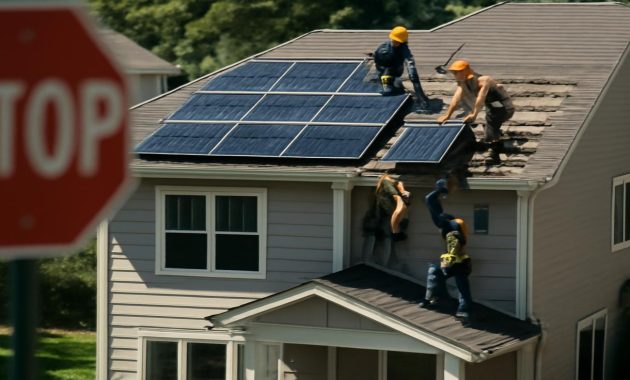
The morning the city truck rolled onto the quiet cul-de-sac, the sun had barely cleared the rooftops that were causing all the trouble. Dew glittered on shingles, birds stitched the air with song, and somewhere a lawn sprinkler ticked in lazy arcs. It could have been any suburban Tuesday, except for the flatbed carrier with its orange hazard lights and the man in a neon vest holding a clipboard, asking which house had the “non-compliant solar array.”
When the Sun Becomes a Zoning Violation
For months, the panels had been silent neighbors—black glass tiles laid out in clean, geometric rows. They didn’t play loud music, didn’t throw parties, didn’t leave trash bins at the curb past pickup day. They just soaked up sunlight and quietly turned it into electricity.
But to the woman next door, they were an eyesore. A “giant mirror,” she’d called them, though they hardly reflected anything. To the man across the street, they were an economic threat, a harbinger that would “drag down property values” in a neighborhood of carefully manicured sameness. To the homeowners’ association, they were a question mark, hovering between old rules that never considered solar and a new world where the sun could be summoned from every rooftop.
So the letters began. First the polite one: a “friendly reminder” that all exterior modifications needed prior approval. Then the curt one: an official violation notice citing vague clauses about “architectural harmony” and “community character.” Finally, the heavy envelope stamped with city letterhead: an order to remove the rooftop solar system within 30 days or face fines of up to $500 per day.
On paper, this was local code enforcement in action. But standing on the sidewalk watching the city truck idle in front of the house, it felt like something stranger—like watching a town order someone to turn off the sun.
The House That Tried to Catch the Light
The system had gone up in late summer. The homeowners—let’s call them Maya and Daniel—had spent years eyeing their south-facing roof, running back-of-the-envelope calculations between sips of coffee. The numbers were compelling, even with the initial cost. Rising electric bills, a gnawing awareness of climate change, the sense that maybe their biggest untapped resource was not in a bank, but overhead, blazing down every day.
They had pored over options, clicked through forums deep into the night, learned a new vocabulary: net metering, kilowatt-hour, inverter, array. They chose a modest 7-kilowatt system, enough to shave most of their bill, not some gleaming sci-fi megaproject. The installer had pulled permits, navigated inspections, and nodded through a final walkthrough with a city inspector who, according to Maya, had seemed almost cheerful.
“You’ll be sending power back to the grid by next week,” he’d said, pausing to take a photo of the neat rows of panels. At that moment, the whole thing felt benign, even hopeful—like they were plugging into a quieter, more self-reliant future.
The pushback started three days later.
The first complaint arrived folded in half and slipped into their mailbox, unsigned. “The panels are distracting and reduce the visual quality of the street,” it read. “Please consider the rest of us and remove them.” Then came the HOA notice, citing the reflection as a “nuisance” even though the installer’s measurements showed minimal glare. “We’re just not that kind of neighborhood,” a board member told them over the phone. “This isn’t a science project.”
Yet when they checked state law, they discovered something interesting: a solar rights provision that explicitly limited HOAs from banning solar installations outright. It sounded like a shield, a simple promise that the sun, at least, was beyond committee control.
Then the city stepped in.
When NIMBY Meets the Sky
The trajectory is familiar by now. NIMBY—“Not In My Backyard”—began as a label for residents resisting landfills, prisons, or highways near their homes. Over time, it expanded to mean almost any local opposition that pits private comfort against public benefit. Solar, wind, transit, housing—if it changes the view out someone’s kitchen window, odds are you’ll hear the word.
In Maya and Daniel’s case, their backyard wasn’t even in the line of fire. This was a fight over their roof. But the logic was the same: We support clean energy, just not here, not above my head, not where I have to look at it when I back out of the driveway.
What made this conflict feel new—and not in a good way—was who picked up the fight. Not just the HOA, but the city itself. A neighbor complaint about “safety concerns” and “improper installation” triggered a re-review of their permits. Suddenly, the paperwork that had cleared their project weeks earlier was under suspicion.
City staff dug into setback requirements, structural load calculations, obscure lines about “neighborhood aesthetics” baked into a decades-old zoning code. A planning officer, seemingly uneasy, told them over the phone, “We’re getting a lot of pressure on this.” The “this” was never defined, but its source was clear: a few vocal neighbors who didn’t want to see the future from their front porch.
The irony is hard to miss. Cities sign climate pledges, publish glossy sustainability plans, and celebrate every new EV charger in a press release. Yet at the granular level—the level of roofs and alleys and side yards—old habits still rule. Where policy says “decarbonize,” the local mood sometimes says “just keep things the way they’ve always been.”
The Quiet Arithmetic of a Solar Roof
Lost in the noise is the simple math of what rooftop solar actually does, both for the homeowner and the people filing complaints.
Consider a fairly common system, like the one Maya and Daniel installed:
| Item | Approximate Value |
|---|---|
| System size | 7 kW rooftop solar |
| Annual electricity produced | ~9,000–10,000 kWh |
| Equivalent CO₂ avoided per year | ~6,000–7,000 pounds |
| Homes powered (fraction) | Roughly 80–100% of one average home |
| Typical payback period | 8–12 years, depending on rates & incentives |
Those numbers don’t just live on one roof. That electricity flows into the wider grid, reducing strain on aging infrastructure, cutting peak demand, often right when power is dirtiest and most expensive. In a heat wave, when air conditioners scream and fossil-fuel plants spin up to meet demand, rooftop solar is the local cavalry.
Yet the complaint letters rarely mention carbon or kilowatt-hours. They talk instead about “neighborhood character,” about “visual clutter,” about the right to an unchanging streetscape. They treat the sky as part of the property, an implicit contract that no one will alter the geometry of the roofline without a consensus vote.
There’s a strange intimacy to it: the sun as a shared resource, the roof as a private decision, and the space between them suddenly contested territory.
The Many Ways to Say No Without Saying No
In the end, most rooftop solar doesn’t get banned outright. Instead, it dies a death of a thousand conditions. The city isn’t against it, officials will insist; they just need it to comply with all applicable codes. And so a familiar dance begins.
Perhaps panels must be set back further from the eaves “for firefighter access,” even if fire officials never requested it. Maybe they can’t be visible from the street, effectively banning them from most of the best sun-facing roofs. Or they have to lie flush with odd angles, reducing efficiency and raising cost. In Maya and Daniel’s case, the city cited a requirement that had never been enforced for other installations: a specific setback that, if applied, would slice their array in half.
“We’re not telling you you can’t have solar,” the enforcement officer explained, standing in their driveway. “We’re just telling you you can’t have this solar.”
That distinction might look tidy on a legal memo, but on the ground, standing under the syllables of “non-compliance,” it felt like a ban by another name. Removing and redesigning the system would cost thousands. Some of the panels would likely never make it back onto the roof at all.
Behind the careful language of regulations, a quieter reality pulsed: a few neighbors with strong opinions had effectively reached up and rearranged someone else’s roof.
Roof Freedom in the Age of Climate Anxiety
The phrase “roof freedom” sounds like a slogan until you’re the one on the ladder, looking across a sea of asphalt shingles and thinking, This could be doing something. For most of modern history, roofs have been dead spaces—weather barriers and little else. The moment we start to treat them as active surfaces, they become sites of negotiation, even conflict.
We’ve been here before. Clotheslines, satellite dishes, even simple window air conditioners all sparked aesthetic and property value battles in their time. For each, the argument pitted one person’s functional need against another person’s desire for a certain visual order.
But rooftop solar carries an added weight: a planetary urgency. It’s not just about lowering one family’s bill. It’s about participating in a collective pivot away from fossil fuels, about turning millions of small surfaces into a distributed power plant.
When a city orders a system removed after neighbor complaints, it’s not just a private dispute. It’s a cautionary tale, a message rippling quietly through the neighborhood: This might not be worth the trouble. Every homeowner who reads about a forced removal, every friend who hears Maya and Daniel’s story at a backyard barbecue, drifts a little further from the edge of the solar decision. Not because the economics don’t work, but because the social friction feels exhausting.
That’s the invisible cost of NIMBY sabotage of clean energy. It doesn’t always shut down projects with a decisive “no.” More often, it makes them never get started.
What a Supportive City Looks Like
Some cities are rewriting this script. They’re standardizing permits so rooftop solar is a same-week approval, not a months-long odyssey. They’re passing “solar access” protections that limit the ability of neighbors or HOAs to block installations on purely aesthetic grounds. Fire codes are being updated collaboratively, ensuring safety without stealth bans.
In those places, the conversation sounds different. The city employee at the counter is less likely to say, “We’re getting a lot of pressure” and more likely to say, “Let’s figure out how to make this work.” Inspectors treat panels as routine infrastructure. Neighbors get used to the sight of black rectangles glinting above them, the way we all got used to garage doors and satellite dishes and fiber-optic boxes.
The irony is that once a neighborhood passes a certain tipping point, solar stops looking like a disruption and starts reading as normal, even desirable. A block with ten solar roofs signals something about the people who live there: resourceful, forward-looking, maybe even a little resilient. The panels that were once feared as property value poison can become, over time, part of the value story.
The difference between those two futures often comes down to what happens in moments like the one on Maya and Daniel’s street—the morning the truck pulls up, the inspector flips through a folder, and the city decides whether to be an ally of the sun or of stagnant aesthetics.
Living Next Door to the Future
In the weeks after the removal order, the block was tense in the way only a quiet suburban cul-de-sac can be. Conversations grew shorter at the mailbox. Curtains twitched when the solar installer’s truck reappeared to take measurements. Someone began parking their car halfway over the property line, just enough to be noticed, not enough to be clearly punishable.
At night, the panels kept working while everyone slept—until, eventually, they didn’t. Under threat of escalating fines, Maya and Daniel negotiated a partial compromise with the city. Some modules would come down, others shifted. Their system would shrink. Their production would fall. Their payback period would stretch out in years that suddenly felt heavier.
On the day the crew arrived to unbolt the panels, the street felt oddly hushed. Even the birds were subdued, as if the neighborhood’s small drama had dampened the air itself. The workers moved methodically, gloved hands on cold aluminum, glass flashing briefly in the sun every time a panel tilted free.
From the sidewalk, it looked like time moving backward—a future being slowly unbuilt. The bare patches left behind on the roof felt almost indecent, pale rectangles of wasted potential exposed to the sky.
Later, one of the crew members would tell Maya something she already knew but needed to hear out loud. “We’ve seen this before,” he said quietly. “It usually starts with one or two neighbors. Sometimes the city backs them. Sometimes it doesn’t. But every time, it slows everything down.”
Slows everything down. In the climate clock, in the race between warming and adaptation, those slowings add up. They’re not as dramatic as a coal plant belching into the sky, not as photogenic as a wildfire cresting a ridge. But they matter—tiny frictions lodged in the machinery of transition.
Choosing Sides on the Roofline
There’s a temptation to frame this as a story about villains: the spiteful neighbor, the overcautious bureaucrat, the HOA board obsessed with uniformity. But the reality is more human, and therefore messier.
The neighbor complaining about glare is also worried about their retirement nest egg tied up in their home. The city planner is juggling outdated codes, limited staff, and an inbox full of competing demands. The HOA board members are volunteers, wary of setting precedents they don’t fully understand.
Yet empathy doesn’t change the physics of a warming planet. The sun will keep blazing, the atmosphere will keep reacting, and every unused surface will remain an unanswered question. At some point, each community will have to decide which discomfort it can live with: the discomfort of seeing the built world change, or the far deeper discomfort of watching the natural world unravel.
Roofs are where that decision becomes visible. They’re the thin line between private and public, habit and necessity, old codes and new realities. The fight over one array on one cul-de-sac isn’t just about that house. It’s about the story we tell ourselves when we look up.
Do we see a skyline cluttered with unwanted hardware—or a city finally starting to catch the light it’s been wasting for a century?
Frequently Asked Questions
Can my city or HOA legally force me to remove rooftop solar panels?
It depends on your state and local laws. Many states have “solar rights” or “solar access” laws that limit an HOA’s ability to ban or unreasonably restrict solar. However, cities can still enforce building, fire, and zoning codes. If you receive a removal notice, it’s important to review state statutes, your HOA documents, and consult an attorney or local solar advocacy group.
How can I reduce the chance of neighbor complaints about my solar installation?
Talk to your neighbors before installation, share design renderings, and explain glare studies or panel placement. Using low-glare panels, keeping wiring tidy, and choosing a layout that’s as clean-looking as possible can help. Early, respectful communication often prevents small worries from turning into formal complaints.
Do rooftop solar panels really affect property values?
Multiple studies in the U.S. have found that homes with owned solar systems often sell for more than similar homes without them, especially where buyers understand the energy savings. Concerns about reduced value are usually perception-based rather than data-based, and those perceptions tend to change as solar becomes more common in a neighborhood.
What should I do if my solar project is delayed or blocked by vague “aesthetic” rules?
Document all communication, ask for specific code citations in writing, and request a clear list of requirements for compliance. You can then compare these with state solar rights laws. It may help to attend public meetings, bring supportive neighbors, or contact local environmental or consumer groups who can spotlight unreasonable barriers.
How can cities support rooftop solar while still addressing safety and design concerns?
Cities can adopt standardized, streamlined permits; update fire codes with input from both firefighters and solar experts; and create clear design guidelines that allow visible rooftop solar while avoiding arbitrary aesthetic bans. Training inspectors and public-facing staff to see solar as essential infrastructure—not a fringe experiment—also makes a major difference.