The sky above Rehovot had that quiet, bluish clarity you only get after a dry desert wind blows through the night. On the campus of the Weizmann Institute of Science, the jacaranda trees were dropping their last purple blossoms, and a handful of students, still in lab coats, were laughing about something trivial as they walked between glass-fronted buildings glowing with fluorescent light. Behind them, in climate-controlled rooms humming softly like beehives, decades of work were frozen in tiny vials, etched on hard drives, coded in the gentle choreography of lab mice, and stacked in the tidy chaos of paper notebooks. No one knew that, hundreds of kilometers away, a missile with a precise trajectory already had their coordinates memorized in its steel bones.
When a Missile Meets a Microscope
It happened faster than human comprehension could keep up with. First, the sirens—those rising, insistent wails that slice through thought and conversation and sleep alike. Then the shouted, half-panicked, half-practiced scramble: downstairs, into stairwells, fortified rooms, underground corridors. Somewhere on campus, a graduate student named Amir tried to decide whether to shut down the confocal microscope or just run. A postdoc, Léa, hesitated for a fraction of a second in front of a freezer that held ten years of cancer research and then slammed the door instead of logging off properly. The institute had drills for this. People knew where to go. But nothing on any checklist could show them how to protect time itself.
In the sky, one bright streak split the air, then another. Defense systems traced invisible grids; operators spoke in hardened syllables. Some missiles were intercepted. One was not.
Later, the blast would be described in technical terms—coordinates, yield, trajectory, structural impact. But in the moment, for those who lived it, it was simpler: a shuddering concussion through the ground, windows flexing and bursting, a sound like metal tearing the sky, a hot wind punching down corridors that smelled of dust, ozone, and the chemical ghosts of solvents. Where moments before there had been the quiet murmur of centrifuges and coffee machines, a single impact pulse turned the familiar into something jagged, glass-strewn, and dark.
The Smell of Burnt Knowledge
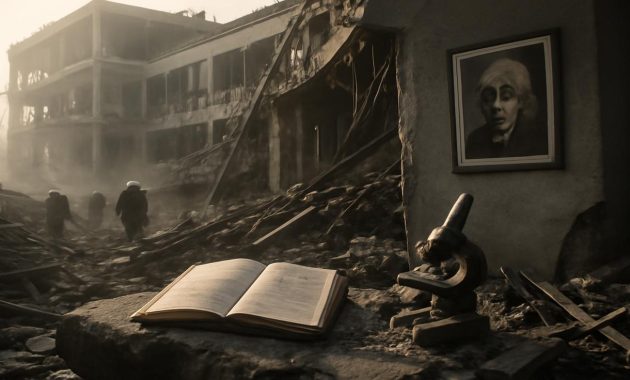
By dawn, the emergency lights had dimmed, and the first thin wash of sunlight showed the damage in real color rather than in the blurry red of alarm lamps. One wing of a research complex—home to multiple labs, offices, and specialized facilities—was a torn-open box. Walls were peeled away like cardboard. A shockwave had reached deeper than the crater, shredding equipment that looked structurally intact but silently failed to turn on when power was restored.
The air held a mingled scent: burnt plastic, charred paper, the acrid whisper of melted insulation, and under it, stubborn traces of life in science—the slightly sweet note of culture media, the vinegar sting of buffers, the ghost of ethanol. In one half-collapsed lab, racks of carefully labeled tubes lay on their sides, their color-coded caps scattered like confetti. A toppled incubator had spilled its meticulously grown cells, once alive with division and possibility, now nothing but a drying smear across broken glass.
There’s a particular silence that follows destruction—not the silence of absence, but a dense, listening hush. People stepped through it that morning, moving carefully among the fragments, crunching glass, lifting notebooks from puddles, pulling open drawers whose handles had warped from heat. No one cried at first. They were too busy counting, mapping, cataloging the damage. The tears would come later, in private—triggered not by the crater outside, but by the realization that a single splotch of soot on the wall used to be the corner of an annotated whiteboard nobody had photographed in months.
The Weight of Invisible Loss
You can measure a crater. You can photograph a collapsed roof. You can list the machines lost: electron microscopes, mass spectrometers, cryo-EM rigs, freezers, servers. Insurance adjusters and government officials like that kind of data. But what happened at the Weizmann Institute was not just a loss of hardware; it was the erasure of time, patience, and those fragile threads of insight that scientists follow through the dark.
In one room, a liquid nitrogen tank had ruptured, thawing years’ worth of biological samples in a single calamitous afternoon. Some of the labels on the thawed vials read like the table of contents of humanity’s best hopes: “Pancreatic organoids, patient set 3,” “PD-1 KO line – final,” “Longitudinal MS samples,” “Soil microbiome series, Negev/Arava.” Each of these represented not just hours at a bench, but stories of human volunteers, animals carefully bred and monitored, field trips in harsh sun with painstaking collections of dust and leaves and water. Decades of collaborations were reduced to an inventory line: “irretrievably damaged.”
The data, too, were fragile. Some was backed up off-site, but not all. There were always those in-between stages—raw imaging files temporarily stored on local arrays, half-processed datasets waiting for a final check, instrument logs that lived on dedicated machines no one thought to mirror weekly. Algorithms carefully tuned over late nights, handwritten code annotated with inside jokes, simulations whose parameters made sense only to the small team that built them—some of this could be rebuilt, but not exactly, not without that texture of iteration and learning underscored in the margins.
The Lab Becomes a Memory
Ask any scientist what makes a laboratory feel like home, and they will rarely mention the costly machines first. They’ll talk about the way someone always leaves a note next to the shared pipettes reminding others to calibrate them, the ritual of Friday afternoon seminars and mediocre pastries, the inside jokes about failed experiments taped to refrigerators, the comfort of a cluttered desk where three generations of postdocs have left their ghosts in doodled diagrams and dog-eared printouts.
One of the strangest sights, in the days after the strike, was a corridor where one side remained almost untouched and the other was a jagged ruin. On the intact side, an office door still bore a cartoon of a fruit fly in a superhero cape, captioned “CRISPR-Man to the rescue!” On the demolished side, the door was simply gone, replaced by open sky and a dangling slice of ceiling. Wind moved through the corridor freely now, lifting loose printouts on surviving desks and scattering them like migrating birds.
People walked there with the slow, stunned gait of visitors in a museum of their own lives. A senior immunologist paused in front of what used to be her lab and stared at the absence. “We still have our brains,” she said finally to the young researcher beside her, voice unsteady. “They can’t bomb those. We’ll start again.” But the tremor on the last word gave away the unspoken part: not from zero, not at this age, not with the same people in the same configuration, not with the same world waiting for answers that were halfway done.
What Vanishes When Science Burns
There is a cruel asymmetry in how war touches science. A missile is immediate; it acts in seconds. Science is slow by design. Every reliable result is made of cautious repetition—checking, rechecking, testing again with a slightly changed protocol, arguing over controls, recalibrating instruments because a spike in the noise might mean a real signal or just a loose cable. That slow, careful stubbornness is its superpower. It is also its vulnerability.
The Weizmann Institute had been building something intangible for generations: a culture of curiosity that tried, in its better moments, to stand slightly aside from the country’s upheavals and tensions. Its people came from Tel Aviv and Tehran, from Moscow and Marrakesh, from small kibbutzim and sprawling foreign cities. There were research collaborations that quietly crossed political and religious lines, friendships that began at conferences and solidified over shared code and countless coffees. A missile does not distinguish between these threads. It does not care that, in one of the destroyed labs, a postdoc from Iran and an Israeli principal investigator had been co-authoring a paper about protein folding that might have landed them together on some future stage.
The fragility of that space—of any academic refuge in a conflict zone—is not news. But on this morning, with dust still settling on the ruined buildings, that knowledge stopped being abstract. It was there in every jagged edge of a shattered petri dish, every warped metal shelf bowed under debris. It was in the way a junior technician picked up a single intact lab notebook from the rubble as gently as if it were a newborn, eyes bright with something too complicated to name.
Counting the Ashes, Naming the Years
In the days that followed, committees formed almost reflexively. Scientists are, if nothing else, world-class organizers of uncertainty. They began to do what they always do: take measurements.
| Category | Approximate Loss | Human Time Behind It |
|---|---|---|
| Biological Samples | Tens of thousands of vials, strains, and cell lines | 10–30 years of cumulative experiments |
| Digital Data | Unbacked raw imaging, instrument logs, analyses in progress | Thousands of hours in coding, analysis, and validation |
| Specialized Equipment | Advanced microscopes, sequencers, cryo-EM components | Years of grant-writing and setup, months of calibration |
| Physical Records | Lab notebooks, annotated printouts, sketches | Generations of cumulative lab memory |
These numbers, however carefully assembled, could not capture the texture of loss: the specific mouse line whose breeding had finally stabilized after five frustrating years; the custom-written software that only two people really understood; the freezer box labeled in a shy master’s student’s handwriting with a project title that would never now become a thesis.
Grant agencies requested detailed impact reports. Donors called, asking whether their named buildings still stood, whether their endowed chairs still had offices. News cameras lingered on the crater. But inside the institute, the conversations were quieter, more practical, and more haunted. Could a long-term experiment on soil carbon cycling, disrupted mid-measurement, ever truly be started again? What did it mean for a decades-spanning longitudinal human study when half the stored samples were gone but the participants still lived, expecting answers to questions about their bodies and their futures?
Science Under a Weather of War
There is a common fantasy that scientific institutions are somehow insulated from the world’s tempests—that inside their walls, a more rational order holds. Anyone who has ever worked in such a place knows better. Politics seeps in through funding decisions and visas denied. War arrives in the form of colleagues who do not show up one morning because a border closed overnight, or whose loved ones are called up for service, or whose home cities flicker on screens in the background, wreathed in smoke.
But a direct strike—an Iranian missile physically carving a scar into a campus like Weizmann—shatters even that thin membrane of pretense. It is no longer possible to say, “The lab is my refuge,” when the lab itself bears the direct imprint of geopolitical rage. Every future experiment planned in those rebuilt rooms will be haunted by the knowledge that its timeline is not just bound by funding cycles and publication deadlines, but also by the arc of regional volatility.
And yet, paradoxically, it is exactly in these moments that the core impulse of science—to ask, to probe, to persist—asserts itself most stubbornly. In the dust and the heartbreak, people began to ask: how do we design for resilience in a world where precision missiles can unmake years of work in seconds? Not just physical resilience (reinforced freezers, distributed backups, hardened infrastructures), but intellectual resilience: redundancies in mentorship, knowledge, and skills, so no insight lives solely in one person’s head or one vulnerable notebook.
Starting Again on Shaken Ground
Weeks later, the campus looked different. The raw, broken edges had been tidied into construction zones; twisted rebar gave way to scaffolding and tarps. It was no longer a disaster site so much as a work-in-progress. The jacaranda trees still bloomed. Cafeterias reopened with shorter hours. Someone, in a small but telling act of defiance, taped a new cartoon to the door of a temporary lab space: a pipette dressed as a firefighter, squirting water at a stylized missile.
Inside those temporary labs, the work of reassembling science began. New freezers arrived, hulking and white. Replacement computers flickered to life. Shipments of reagents trickled in, delayed by the same tensions that had sent the missile in the first place. There were meetings—so many meetings—about revised project plans, emergency funding routes, ethical questions around partially lost datasets. Some experiments would be rebuilt from scratch. Others would be abandoned, their questions ceded to a future that might or might not have the patience to ask them again.
Amir, the graduate student who had once hesitated at the microscope, found himself spending days not at the bench but on the phone, tracking down archived imaging runs on old servers, cross-referencing lab member laptops for forgotten raw files. Each recovered set of data felt like a small rescue, a lifeboat pulled from a sea of loss. Léa, the postdoc, started mentoring younger students whose first experience of research was now intertwined with the knowledge that anything they built might be abruptly unbuilt. Their conversations about experimental error bled seamlessly into conversations about sirens, shelters, and the ethics of staying or leaving.
Why This Story Matters Beyond One Campus
From a distance, it might be tempting to file this entire episode under the growing ledger of modern conflicts: another strike, another headline, another tragic footnote in a region furrowed by overlapping grievances. But what happened at the Weizmann Institute is more than a local misfortune. It is a case study in how fragile the scaffolding of global knowledge really is.
Science is often portrayed as a linear march of progress, always upward, always accumulating. The reality is more like a mycelial web: sprawling, delicate, heavily dependent on local conditions. Cut enough strands in one place, and faraway fruiting bodies wither. The experiments abruptly halted in Rehovot are not isolated; they sit in a global mesh of collaborations, references, and shared tools. A line of inquiry into neurodegenerative disease that stumbles here alters what a lab in Boston will try next year, what a hospital in Berlin will test on its patients, what a startup in Bangalore will risk its investors’ money on.
When a missile wipes out decades of research, it ripples. Some of those ripples will be invisible—papers that never get written, cures that arrive later than they might have, a whole generation of young scientists who quietly pivot away from high-risk long-term projects because they have seen how easily time can be stolen. Others will be more immediate: gaps in international datasets, holes in comparative studies, odd discontinuities in long-term environmental records.
That is why this story is not only about Iran and Israel, not only about one institute and one crater. It is about what we choose to make brittle in our world and what we insist on making resilient. It asks whether we are content to treat knowledge itself as collateral damage.
Questions We Carry Forward
Long after the scaffolding comes down and new instruments hum where the old ones once stood, the memory of that night will remain. It will live in the reflexive way a hand tightens around a pipette when a distant boom echoes. It will surface in the nervous laughter when someone jokes, “Back up your data—seriously,” and everyone in the room knows exactly why that isn’t funny. It will shape how architects design the next generation of research facilities and how policymakers think—if they think at all—about the sanctity of places where our species tries, however imperfectly, to understand itself and its planet.
Somewhere, in a future conference hall, a scientist from Weizmann will stand at a podium and present results built partly on reconstructed datasets and hastily re-grown samples. The graphs will look clean, the statistics solid, the story coherent. There may be, at most, a passing acknowledgments slide mentioning “interruption due to regional events.” The audience will nod, ask sharp methodological questions, and move on to the next talk.
But beneath those tidy figures lies a different narrative: of smoke in the corridors, of freezers thawing in the dark, of small human rituals interrupted and then stubbornly resumed. Of a missile that, in a few blunt seconds, tried to erase not just buildings, but the slow, luminous work of understanding. And of people who, fully aware of that fragility, chose to begin again anyway.
FAQ
Was the Weizmann Institute completely destroyed by the missile strike?
No. The strike caused severe damage to specific buildings and laboratories, but the entire institute was not destroyed. Many facilities remained functional or repairable, and reconstruction and relocation efforts began quickly.
Why are decades of research so vulnerable to a single attack?
Scientific work accumulates slowly through instruments, samples, data, and tacit knowledge. Much of it is concentrated in particular labs, freezers, servers, and notebooks. When those physical and digital nodes are hit, years of incremental, interdependent work can vanish in moments.
Can the lost experiments and data ever be fully recreated?
Some can be rebuilt, especially if backups and duplicate samples exist, but many cannot. Long-term experiments, unique biological lines, and partially processed data are especially difficult—sometimes impossible—to reproduce exactly.
How does this kind of event affect young scientists and students?
It reshapes their sense of what a scientific career looks like. Alongside learning techniques and theory, they learn to live with abrupt interruption and uncertainty, which can influence their choice of projects, fields, and even whether they stay in research at all.
Why should people outside the region care about damage to one institute?
Because modern science is globally interconnected. Work done at a single institute feeds into international collaborations, clinical trials, environmental monitoring, and technological development. Losses in one place create gaps and delays that can affect knowledge, innovation, and health outcomes worldwide.