The first thing you notice is not the age. It’s the way they move.
On a cool autumn morning in the park, there’s a small cluster of people moving together under the amber trees. They’re in their seventies, some in their eighties, one man with a silver ponytail well into his nineties. No one is counting steps on a wristband. No one is marching in neat fitness-walk lines or grinding away at a boot camp. Instead, they’re flowing.
A woman in a blue fleece squats down easily to pick up a fallen leaf, then swivels, reaches one arm to the sky, and stands without using her hands. Another man steps sideways over a low bench, turns, then steps back with a small hop that makes his grandson laugh out loud. Someone is crawling, of all things, hands and knees on the grass, then transitioning to a low crouch, then to a lunge. It looks less like “exercise” and more like play, like life in fast‑forward, every movement you’d need to stay free in your own body stitched into an easy, unhurried sequence.
This is not a walking group. It’s not a gym class. It’s something quieter and far more radical: a pattern of movement designed, very intentionally, to stretch healthspan—the healthy, independent years of life—far beyond what daily walks or weekly gym sessions alone can usually offer.
The Quiet Problem with “I Walk Every Day”
Ask most healthy people over 70 what they do to stay active and the answer often arrives with pride: “Oh, I walk every day.” Maybe there’s a weekly swim, a yoga class, or even time on the stationary bike. These are good things. They matter. But there’s a quiet catch that very few doctors or fitness posters mention.
Walking keeps you moving forward in a straight line. It’s predictable. It’s rhythmical. It’s safe. But aging isn’t predictable or rhythmical or safe. You don’t fall in a straight line. You don’t get off the floor in just one direction. You don’t reach for a cupboard, step off a curb, turn to greet someone or catch your balance using only the muscles that walking trains.
The research is stark: after 70, the greatest risks to healthspan aren’t simply weak hearts or stiff joints, but three intertwined losses—strength, balance, and the ability to move in and out of the ground. Put simply, the things that quietly disappear are the things that let you live in your space: getting off the floor after a fall, turning quickly without toppling, bending to tie a shoe, stepping up onto a bus, catching yourself when a grandchild barrels into your knees.
Daily walks and weekly gym sessions tend to sharpen a narrow slice of your physical life: forward motion, a bit of leg endurance, maybe some machine-based strength. But life, especially after 70, demands something richer and more three-dimensional. It demands a movement pattern that rehearses the full script of being human: standing, lowering, getting up, reaching, twisting, stepping, reacting, catching, and, yes, playing.
The Movement Pattern That Aging Bodies Secretly Crave
From “Workouts” to “Movement Practice”
The people in that autumn park aren’t doing random exercises; they’re engaging in what many gerontologists and movement researchers now point toward as the golden thread of healthy aging: a daily movement practice that weaves together four core ingredients—strength, balance, mobility, and coordination—into natural, everyday motions.
It’s less “three sets of ten” and more “can you do this, smoothly and comfortably, for the rest of your life?” It focuses on patterns instead of muscles, capability instead of calories burned. Its secret is simple: practice exactly the kinds of things you’d lose if you don’t use them.
Imagine your movement practice like a compact, personal choreography, done in your living room, your garden, or a patch of park grass. Ten to twenty minutes most days, not so hard that you fear it, and not so easy that your body can sleepwalk through it. Over time, this pattern stops being “exercise” in your head—it becomes a ritual of staying possible.
The “Ground-to-Standing” Pattern: The Spine of Healthspan
If there’s one movement pattern that predicts how long you’ll stay independent, it’s this: your ability to get down to the floor and back up again without help. In some countries, there’s even a simple longevity test called the “sit‑to‑rise test” that measures it.
That’s why, at the core of a healthspan‑upgrading routine after 70, you find a family of ground-to-standing patterns. They may start small and gentle—but within them, you’re sneaking in strength, balance, mobility, and coordination all at once.
Here’s how a simple version might unfold, like a slow, thoughtful dance:
- Begin standing, feet hip-width apart, feeling all ten toes on the ground.
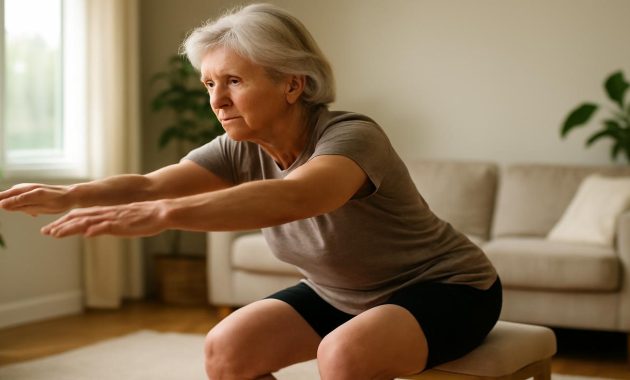
- Reach your arms forward and gently lower into a comfortable squat, holding onto a sturdy chair or table if you need.
- From there, place a hand on the seat or floor, lower one knee, then the other, until you’re in a kneeling position.
- Slide yourself into a seated position on the floor—maybe on a cushion if that feels kinder.
- Pause. Breathe. Look around from this low vantage point. You’re rehearsing a place many people are afraid of: the ground.
- Now reverse the journey: roll to one side, use your hands to help you into a kneeling position, plant one foot, lean onto that leg, and slowly rise, using a chair or wall for support as needed.
That’s one cycle. It doesn’t look heroic. No sweat pouring, no stopwatch, no trainer shouting “push.” And yet, if you repeat this cycle a few times most days, gradually making it smoother and a bit more challenging—perhaps fewer hands, a deeper squat, a lighter touch for support—you’re quietly training one of the single most meaningful abilities for staying independent: floor competence.
Building a Daily Movement Ritual After 70
Think “Small, Often, Forever”
Most fitness advice still lives in the “three times a week, 45 minutes” mindset. For an older body, that structure can be intimidating, easy to skip, and strangely disconnected from daily life. The movement pattern that stretches healthspan works differently. It trades intensity and duration for consistency and relevance.
The mantra looks more like this: small, often, forever.
Ten minutes in the morning while the kettle boils. Five minutes in the afternoon after a nap. Another ten before bed. That’s already more movement variety than many people manage in a full gym session, and it’s anchored seamlessly into the fabric of your days. Your joints never go too long without gently exploring their range. Your balance is re-educated daily. Your body never quite forgets how to rise, lower, twist, and reach.
What does such a ritual actually look like in plain terms? It might include:
- A few minutes of gentle joint circles for ankles, hips, shoulders, wrists.
- Two or three ground-to-standing cycles, in whatever version feels safe.
- A handful of slow, controlled sit-to-stand repetitions from a chair without using your hands (or with light hand help at first).
- Side steps and gentle turns, practicing looking around you while you move.
- Optional: 20–30 seconds of supported one-leg balance, holding the back of a chair.
Each of these is simple enough on its own. Done together, most days, they become something like brushing your teeth: not optional, not dramatic—just part of how you care for the body that carries you through the day.
Why Variety Beats Volume
Here’s the quiet magic: your body loves variety more than volume. After 70, three different five‑minute movement snacks sprinkled through the day will usually serve your healthspan better than one exhausting 45‑minute class once a week. Variation challenges your nervous system, which is where balance and coordination live. Repetition with variation tells your brain, “We still need these abilities. Don’t shut them down.”
| Movement Snack | Duration | Key Benefit |
|---|---|---|
| Morning joint circles & easy reaches | 5–7 minutes | Lubricates joints, wakes up posture |
| Midday ground-to-standing practice | 5–10 minutes | Maintains independence, total-body strength |
| Evening balance & gentle stretches | 5–8 minutes | Improves stability, calms the nervous system |
None of this replaces walking; it upgrades it. Your walks become the long, easy‑breathing backdrop, while your daily movement ritual sharpens all the skills that walking alone neglects.
Beyond Muscles: Training Your “Future Self”
Practicing Tomorrow’s Challenges Today
Think, for a moment, like your future self at 85 or 90. What will matter?
Not whether you ever ran a marathon. Not how many pushups you once did. It will be moments like:
- Getting off a low couch without grunting or asking for a hand.
- Stepping into a bathtub or over a doorstep without hesitation.
- Turning quickly when someone calls your name without losing your balance.
- Reaching the overhead shelf without fear of toppling.
- Lowering yourself to play on the floor with a grandchild, a pet, or a puzzle—and then getting back up with dignity.
A powerful movement pattern after 70 asks: What do I want to be able to do at 85? Then it pulls those futures back into the present as practice.
You practice backward stepping because one day you’ll need to step back from an open dishwasher or retreat from a sudden bicycle on the sidewalk. You practice getting onto and off the floor because one day there might be a fall, or a dropped object, or simply a restless cat hiding under the bed. You practice looking over your shoulder while you walk because life doesn’t come with a “face forward only” rule.
Every small, repeated rehearsal is a message to your body: “Keep this ability; it’s important to me.” The body listens. Slowly, discreetly, it chooses not to retire those capacities.
The Role of Play and Curiosity
One of the best-kept secrets: people who move well into their seventies, eighties, and nineties often retain a streak of playfulness in how they move. Not childishness—curiosity.
They ask: “Can I still step over this log safely if I go sideways?” “How low a seat can I comfortably stand up from?” “Can I turn a circle without feeling dizzy if I do it slowly?”
This mindset transforms your environment into a gentle training ground. The kitchen counter becomes a balance rail, the hallway a spot for slow, backward steps, the garden a place to practice gentle squats as you tend the soil. A park bench is no longer just for sitting; it’s a safe place to rehearse sit‑to‑stands, step‑ups, gentle support while you do ankle circles.
In this way, your lifestyle itself becomes the “gym,” and your movement pattern is no longer something you only do in special clothes or special places. It’s layered into how you live, hour by hour, in small, sustainable ways.
Designing Your Own Healthspan Movement Pattern
The Four Pillars to Include
You don’t need a personal trainer or complex equipment to build a powerful, personalized movement pattern. What you do need is to make sure four pillars are present in some form most days:
- Strength: Especially in legs, hips, and grip. This is your “get up, hold on, carry that” capacity.
- Balance: Your inner anti-fall system; trained through single-leg work and changes of direction.
- Mobility: Comfortable range of motion in spine, hips, shoulders, and ankles.
- Coordination: The ability for body parts to work together smoothly, especially with turning, reaching, and stepping.
A simple, home-friendly pattern might look like this:
- Strength: 8–10 slow sit‑to‑stands from a sturdy chair, 1–2 sets per day.
- Balance: Standing on one leg for up to 20 seconds while holding a counter lightly, each leg 1–2 times.
- Mobility: Gentle cat‑camel spine movements on hands and knees (or seated), plus hip and ankle circles.
- Coordination: Ground-to-standing practice, plus slow turning in place, looking over each shoulder.
Each element can be modified for your level. If getting on the floor is not yet possible, your “ground” might be a low ottoman or firm bed. If one-leg standing feels scary, keep both hands on the counter and start by just shifting weight from one foot to the other. Progress, at any age, is still progress.
Safety as a Skill, Not a Limitation
After 70, “be careful” is advice handed out like candy, but often without nuance. The goal is not to avoid all challenge; it’s to practice challenge safely.
That means:
- Always having a stable support nearby for new moves—a wall, countertop, or sturdy chair.
- Moving slowly enough that you can stop at any moment without lurching.
- Respecting pain as information: a nudge to change the angle, ease the depth, or try a variation rather than push through.
- Checking with your healthcare provider before beginning if you have significant health conditions, dizziness, or recent surgeries.
Safety is not the enemy of progress; it’s the frame that allows you to keep practicing, day after day, without being sidelined by preventable injuries or fears.
When Movement Becomes Identity, Not Chore
At some point, if you keep going, something honest and beautiful happens. You stop seeing your movement pattern as “what I have to do to not fall apart” and start seeing it as part of who you are.
You become the person who can still get down to the floor and back up, who steps sideways with confidence, who bends to tie their own shoes without thinking about it, who can stand at the sink washing dishes without the low-back ache that used to creep in. You may still have stiff days. You may still have diagnoses, medications, follow-ups. But inside those realities, you occupy more of your own physical life.
For many, this identity shift is the true upgrade in healthspan: not just more years, but more you in those years. More agency. More “I can do that.” More small, daily freedoms that add up to a quietly extraordinary later life.
Back in that park, the silver‑ponytailed man has just finished another slow, careful set of ground-to-standing. His breath is steady, his movements unhurried. A teenager jogs past, earbuds in, barely noticing. But if the two could trade time, could zoom forward or backward a few decades, the younger one might understand: this is not an old man working out. This is a person, very much alive, rehearsing tomorrow’s independence today.
After 70, the invitation is not simply to fill your calendar with more walks or to dutifully attend the gym once a week. It’s to claim a small, daily movement pattern that protects the simple, powerful acts that make life feel like it still belongs to you: getting up, reaching out, turning freely, lowering without fear, rising with ease.
Not heroic. Not flashy. Just deeply human. And very much worth practicing.
Frequently Asked Questions
Isn’t walking enough if I already walk every day?
Walking is excellent for your heart, mood, and general stamina, and you should keep it. But it mainly trains forward motion on flat ground. It doesn’t fully cover balance, getting up from the floor, turning, or the strength needed for stairs, chairs, and unexpected stumbles. A daily movement pattern adds these missing pieces so your body is prepared for real life, not just sidewalks.
How much time do I realistically need to spend on this?
Ten to twenty minutes most days is a powerful start. You can break that into smaller “movement snacks” of 5–7 minutes sprinkled through the day. Consistency matters much more than doing long sessions once in a while.
What if I have arthritis, joint replacements, or chronic pain?
You can still benefit, but you’ll need to respect your limits and possibly adjust the movements. Use higher surfaces instead of the floor, keep ranges of motion small and pain-free, and move more slowly. If in doubt, ask a physical therapist or healthcare provider to help you adapt a basic pattern for your body.
I’m afraid of falling. Isn’t ground-to-standing practice risky?
It’s only risky if you do it without support or push too hard, too fast. Start with sturdy furniture, a wall nearby, and maybe another person in the room. You can begin with partial versions—like just practicing going from standing to a chair and back up—before exploring lower positions. Over time, this practice actually reduces your fall risk by training balance, strength, and familiarity with the ground.
Can I still go to the gym or classes if I do this?
Absolutely. Think of your daily movement pattern as the foundation that keeps you capable and safe. Gym sessions, classes, or sports become the “extras” you do because you enjoy them. Many people find that once they add a daily pattern of strength, balance, and floor skills, they feel more confident and capable in every other activity they choose.