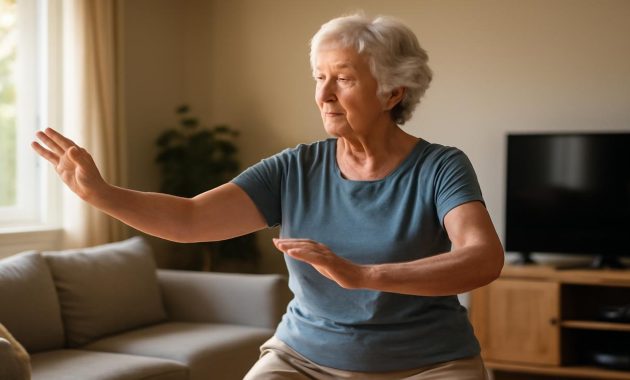
The hallway was only twenty steps long, but to Helen, it might as well have been a mountain trail. At seventy-four, she had listened diligently to her doctor, her daughter, the endless parade of wellness experts on TV: “Walk every day. Hit 10,000 steps. Join the senior fitness class. Lift light weights twice a week.” She tried, sincerely. But her knees bit back. Her lower back flared. Some days, her energy simply disappeared by lunchtime. One gray November morning, shoes in hand, she sat down on the edge of her bed, looked at the door, and whispered, “I can’t keep doing this.”
What she discovered next did not come from a shiny gym, a new app, or a subscription program. It came from her own living room. From the floor. From a movement that almost every child does dozens of times a day, then forgets. A movement that most adults quietly stop doing somewhere between their 40s and 60s. A movement that, for people over 70, may matter more than clocking miles on a treadmill or logging three sets of ten at the gym.
The Quiet Crisis of “Active but Fragile” Aging
When we picture aging well, we often imagine it in steps: walking the dog, strolling the neighborhood, joining a hiking group. Pedometers, smartwatches, and wellness campaigns have etched a single message into our minds: move more, walk more, sit less. For decades, that sounded like unarguable wisdom.
But stand in the lobby of any assisted living facility for an afternoon and you’ll notice something strange. Many residents did walk. They went to yoga. They hit their 10,000 steps when they were in their 60s. Yet here they are, in their 80s, moving with exquisite caution, terrified of one thing: the fall.
Look closely and a different picture emerges: a generation of “active but fragile” older adults. They logged their walks and gym sessions like good students, but in the moments that matter most—when they trip on a rug, when they slip on wet tile, when they must rise from the floor alone in the middle of the night—their training fails them. Their steps don’t prepare them for sudden gravity tests.
We have obsessed over distance, duration, and reps, while quietly neglecting a single, deeply human skill: getting down to the ground and getting back up again.
The Controversial Pattern: Getting On and Off the Floor
The pattern is almost insultingly simple to describe: lie down on the floor, then stand back up. Repeat, in different ways, at different speeds, with different supports. That’s it.
Yet among many older adults—and even some healthcare providers—this suggestion lands like a provocation. “At my age? On the floor? I’ll never get back up.” “My doctor says don’t risk it.” “Why would I choose to do the very thing I fear most?”
Here is the quiet twist: that thing you fear—being on the ground and having to get up—is exactly the thing that may most determine your healthspan after seventy. Not how many miles you walk. Not how many machines you use at the gym. But your ability, confidence, and strength to move between standing and the floor.
In pockets of progressive physical therapy clinics, geriatric research labs, and even traditional cultures where elders routinely sit and work close to the ground, this is not news. They know that the body you need for your eighth and ninth decade is not built by mileage alone. It is built by practicing the very transitions most of us avoid.
Why the Floor Matters More Than 10,000 Steps
Imagine your daily life as a landscape, and the floor is the valley. Most modern adults live on the plateau: chairs, couches, beds, car seats, benches. We hover roughly knee to hip height above the ground, rarely visiting the valley unless we drop something or, worse, lose our balance.
But your nervous system, muscles, and joints read the floor like a brutally honest test. To get down and back up, your body must coordinate nearly every system: legs, hips, core, arms, balance, breath, even your sense of where you are in space. Many researchers now think the ability to get up from the floor independently is a sharper predictor of functional aging than how far you can walk.
Walking tends to be rhythmic and predictable. Treadmills and sidewalks don’t change height dramatically; there are no sudden lows. Getting up from the floor is messy. It is asymmetrical, improvisational. Sometimes you twist. Sometimes you roll. Sometimes you use a chair or your hands; sometimes you don’t. That messiness is precisely what trains your body to handle life’s unexpected dips—a missed stair, a slippery leaf, the dropped remote that somehow skids just out of reach.
So when you practice this controversial pattern—intentional floor-to-stand transitions—you are not just “exercising.” You are rehearsing survival. You are building a body that does not panic at low heights, but knows, quietly and deeply, “I have been here before. I know how to get up.”
From “I Can’t” to “I Did”: Helen’s Living Room Experiments
In Helen’s case, it started with indignation. Her grandson, home from college, had sprawled across the carpet during a visit. When his keys slid under the couch, he simply rolled, reached, and popped back up without thinking.
“Must be nice,” she muttered.
He looked at her. “Gran, when was the last time you sat on the floor?”
She laughed sharply. “I’m not 30, you know.”
But later, alone, the question echoed. When was the last time she had chosen the floor instead of a chair? Ten years? Twenty? She could not remember.
The next afternoon she pushed the coffee table aside, laid an old yoga mat beside the couch, and sat on its edge. The floor waited below like a cold lake. She lowered herself with both hands on the cushion, sliding one knee, then the other, until they met the mat. Her heart raced as though she’d run a sprint. She was, very technically, “on the floor.”
And then the real storm: the thought that she might be stuck there.
She moved carefully, placing one hand on the couch, one foot on the mat, leaning, shifting, fumbling. It took nearly a minute, but eventually, she stood. Her palms were damp. Her legs buzzed. But nothing broke. The house did not collapse. No one had to call 911.
The next day, she did it again. And again. Some days she kneeled and stood twice. Some days, just once. After a week, she noticed something oddly thrilling: climbing the stairs felt easier. After two weeks, getting out of bed in the middle of the night for the bathroom no longer felt like a fragile negotiation.
Later, when her doctor congratulated her on her improved blood pressure and steadier gait, she didn’t mention steps or gym visits. She talked about the mat by the couch.
How This Pattern Works Beneath the Surface
It’s easy to dismiss this as simply “getting up and down,” but under your skin, a choreography unfolds.
First, your hips and knees must flex deeper than walking ever demands. This feeds the very ranges of motion that stiffen with age. Your thigh muscles have to work in both directions—as you lower (controlling descent) and as you rise (driving ascent). Your ankles and feet, planted on an ever-changing base, whisper constant information to your brain about balance and pressure.
Your core must do more than “brace.” It must twist, reach, and adapt as you roll or pivot. Your arms sometimes become power partners, leaning on a chair or your own thigh, training strength in the pushing patterns that many gym routines forget. Even your vestibular system—the inner ear structure that senses motion—gets practice as your head moves through multiple levels and angles.
This rich blend of strength, mobility, coordination, and sensory input is rare in steady-state activities like walking. It more closely resembles climbing, playing, or working on the ground—things we did in childhood, and that elders in many traditional societies still do as second nature.
In a world that measures activity with step counts and heart-rate zones, this looks like nothing. But to the body that must live in a vulnerable, unpredictable world, it looks like readiness.
“But It’s Not Safe”: Rethinking Risk After Seventy
The pushback is understandable. For someone who already fears falling, the idea of deliberately going to the floor can feel reckless. However, there is a crucial difference between an uncontrolled fall and a controlled descent.
When you practice the floor-to-stand pattern thoughtfully, with support nearby, you are doing the opposite of courting danger. You are practicing how to negotiate gravity before gravity negotiates with you.
The question is not, “Is it safe to get down to the floor at my age?” The question is, “What happens if, at my age, I find myself on the floor unexpectedly and have never practiced getting up?”
Consider a simple comparison of movement patterns for someone in their seventies:
| Activity | Main Benefit | Missing Piece |
|---|---|---|
| Daily walks | Heart health, light leg work, mood | Deep bending, floor confidence, upper-body pushing |
| Weekly gym sessions | Targeted strength, routine | Real-world transitions, multi-plane movement |
| Floor-to-stand practice | Fall recovery, balance, full-body coordination | Long-duration cardio (can be added separately) |
Most older-adult programs prioritize the first two rows. The third, in many cases, is ignored entirely—precisely because it feels too risky. Yet it is the very one that prepares you for worst-case scenarios.
Of course, risk is not something to dismiss. It is something to shape. That means starting high and supported. Using sturdy furniture. Working within pain-free ranges. Making sure a phone is nearby. Involving a physical therapist or trainer if balance is severely impaired. With these in place, the “dangerous” pattern becomes closer to a safety drill: like practicing how to use a fire escape, except the escape route is your own body.
What This Can Look Like in Real Life
Imagine three different seventy-somethings, all told that movement will extend their healthspan.
Mary chooses the classic route: she walks forty minutes every day and takes a gentle yoga class once a week. Her legs feel decent, but she still avoids the floor, elevators make her nervous, and she will not step into a bathtub without support.
George joins a gym. Twice a week he does machine circuits: leg press, chest press, seated row. His numbers improve. He likes seeing “progress.” But all of his movements are guided by levers and tracks. When his foot catches on a curb, that neat strength does not automatically catch him.
Esther starts differently. Guided first by a therapist, then alone, she spends five to ten minutes a day exploring ways to get down and back up. Some days she uses both hands and a sturdy chair. Some days she experiments with different lead legs or gentle rolling. Her heart rate rises moderately. Her breathing deepens. Six months later, while visiting friends, she trips over a sleeping dog and ends up on the rug. Her cheeks flush, but her body does not freeze. It recognizes where it is. She turns, plants her hands, braces one foot under her, and stands. Embarrassed, yes. Helpless, no.
Which of these bodies will navigate the unpredictable landscape of late life with the least fear? The answer doesn’t dismiss walking or gym work; it simply points to a missing anchor. The floor work gives context to every other exercise, turning disconnected efforts into a coherent survival skill.
Designing Your Own “Floor Relationship” After Seventy
You do not need to abandon your walks or cancel your gym membership to explore this. The controversial part is not that you stop walking or lifting; it’s that you stop believing those alone are enough.
What changes is the hierarchy. Instead of asking, “Did I hit my steps today?” you begin to ask, “Can I still get up from the ground, in more than one way, without panic?” The second question has a deeper claim on your future independence.
For many people over seventy, a surprisingly effective arrangement looks like this:
Most days of the week, you do a few minutes of floor-to-stand exploration. Not as a workout, but as a daily ritual, like brushing teeth. On some days, you supplement with short walks done at a pace that feels natural, not forced. On one or two days, you might add a few strength movements using household objects or light weights: holding onto a counter for squats, pressing a light load overhead while standing tall, gently rowing with a resistance band.
Within this frame, the floor practice quietly becomes the centerpiece. Walking and strength work orbit around it, supporting your capacity to visit low ground and return.
Even the environment changes. A rug becomes a training mat. A sturdy coffee table becomes an anchor point, not just furniture. The moment you drop a sock or a pen, instead of grumbling and bending from the waist, you consider: Could I turn this into a tiny practice of kneeling and rising?
Over time, a mental shift unfolds that is perhaps more important than any physical metric: your relationship with the ground moves from fear to familiarity. The floor is no longer a threat. It is your oldest playground, reclaimed.
Beyond Exercise: A Different Story of Healthspan
Healthspan—how long you live with good function and autonomy—is not built only in test results and formal workouts. It is written in the micro-moments: how you get down to play with a grandchild, how you kneel to weed a garden, how you pick up a newspaper that skidded just out of reach.
For decades, the story we told older adults was simple: move more, mostly by walking; stay strong, mostly with machines or light weights; avoid the floor at all costs. This story kept many people “active,” yet fragile at the exact moment when robustness matters most.
The emerging story is stranger, and more honest: after seventy, logging miles and reps matters less than your ability to negotiate height. Can you move your body fluently between the ground, a chair, and standing? Can you do it even when you are tired, annoyed, or in a hurry? Can you do it in more than one way?
This is why, for someone like Helen, the controversial movement pattern can be quietly transformative. It doesn’t promise a marathon medal. It doesn’t care how you look in leggings. It cares whether you can fall, breathe, think, and rise.
Imagine the ripple effects. A generation of elders who no longer gasp, “If I go down, I’ll never get back up,” but instead think, “I’ve practiced this.” Grandparents who choose the floor during family gatherings, not because it’s easy, but because they know it keeps them capable. Eighty-year-olds who can access a bottom drawer without bracing on a stranger’s arm. Ninety-year-olds who can wait for help from the floor, not in terror, but in relative comfort, knowing their body has been here before.
In the end, this is less about controversy and more about remembering. Before the fitness industry, before step counters and senior aerobics, there was the human pattern of rising from the earth. The older you become, the more precious that pattern grows.
After seventy, you may never again chase 10,000 steps or feel at home under fluorescent gym lights. You may swap the treadmill for a wooden chair and a patch of carpet. But if, in that small space, you choose to greet the floor a little more often—on purpose, with curiosity—you may find that you’ve quietly extended something much larger than your step count: the years in which your body still feels like a place you can trust.
Frequently Asked Questions
Is getting up and down from the floor really more important than walking?
Both matter, but they serve different purposes. Walking is excellent for heart health and general activity. Floor-to-stand practice directly trains your ability to recover from a fall and maintain independence. After seventy, that specific skill often becomes more critical than total distance walked.
What if I’m afraid I won’t be able to get up once I’m on the floor?
Start where you are, not where you wish you were. You can begin with partial movements—like sitting on a low chair or ottoman and standing, or kneeling with your hands on a sturdy surface. Over time, you can gradually lower the height. Having a phone nearby and a family member or therapist present at first can boost confidence.
I have arthritis and joint pain. Is this kind of movement safe?
It can be, but it must be adapted. Movements should always be pain-free or only mildly uncomfortable. You might use extra cushions, move more slowly, or limit the depth of your bends. Working with a physical therapist or knowledgeable trainer at the start is wise if you have significant pain or joint replacements.
How often should I practice getting up and down from the floor?
Consistency beats intensity. Even three to ten minutes most days can make a difference over time. You don’t need to treat it like a strenuous workout; think of it as a daily skill rehearsal, like brushing your teeth.
Do I have to give up my walks or gym sessions to focus on this?
No. Walking and strength work can complement floor practice beautifully. The key shift is treating floor-to-stand ability as a central marker of your functional health, not an optional extra. Your walks and gym time become support acts for a main event: your ongoing capacity to meet the ground and rise again.