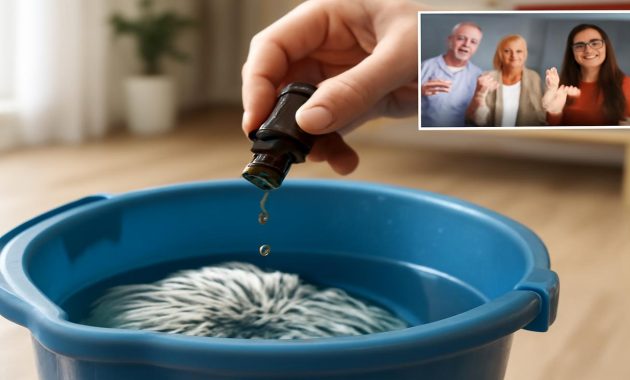
The first time I tried it, the whole house smelled like the lobby of an expensive eco-hotel. Warm, cozy, a little mysterious. Not like I’d been scrubbing floors all morning, but like someone had quietly reset the air itself. Just two drops in the mop bucket—no vinegar, no lemon, no chemical fog hanging in the hallway—and the scent floated through every room for days. Within hours, my phone buzzed with messages: “What candle is that?” “Did you change detergent?” “Why does it smell so good in here?” I didn’t light anything. I just mopped.
The Two-Drop Trick Everyone’s Talking About
The secret isn’t a luxury cleaner or some rare imported detergent. It’s something that might already be sitting on your bathroom shelf or in that messy drawer of “wellness stuff” you swore you’d organize someday: essential oil.
That’s the hack. No vinegar, no lemon rinds stewing in a jar under the sink. Just your usual floor cleaner (or even plain warm water with a mild soap) and one, maybe two drops of essential oil swirled through the bucket. Suddenly, the daily chore transforms into something that feels suspiciously close to self-care.
On social media, it looks almost too simple. Someone films their mop bucket, a small amber bottle in hand. A close-up of the droplets landing in the cloudy water, a quick stir, then flash cuts to gleaming floors and caption overlays promising: “House smells amazing for DAYS.” Comment sections explode with people swearing by lavender and eucalyptus, by tea tree for its “fresh clinic” vibe, by sweet orange for that soft, sunlit kitchen feel.
And honestly, when you try it, it can feel a little magical. As the mop sweeps across tiles and wood, the faint, warm scent rises with the steam. It clings to the air in the hallway, hangs low over the staircase, drifts lazily into bedrooms. You open a closet two days later and get a ghost of the same smell—clean, but not sharp, floral but not cloying. The house doesn’t just smell like it’s been cleaned; it smells like whoever lives here really cares.
The Science, the Skeptics, and the Scented Battle
Of course, the more viral a hack becomes, the more divided the experts get. The “two-drop mop bucket” trend has split cleaning enthusiasts, chemists, doctors, and aromatherapists into two bluntly opposed camps: the “this is brilliant, why didn’t we do this sooner?” group, and the “this might be a terrible idea wrapped in a nice smell” group.
On one side, you’ll find homekeepers, professional cleaners, and aromatherapy fans praising the hack. They point out that you’re using a tiny amount of essential oil, heavily diluted in a big bucket of water. The hope is to get just enough scent to linger, without coating every surface in a sticky, oily residue. Many of them insist they’ve used it for months, even years, with no issues: no streaks, no damaged finishes, no irritated lungs. Just quieter, softer air.
Then the cautious voices show up. Some chemists warn that certain essential oils might not play nicely with specific floor finishes, especially waxed wood or delicate laminates. A dermatologist raises an eyebrow at people with pets or small children crawling on floors lightly scented with powerful plant concentrates. An allergy specialist points out that “natural” does not mean “harmless,” especially for sensitive noses and lungs.
Health professionals worry about people assuming “plant-based” equals “risk-free,” especially in poorly ventilated spaces. A few cleaning experts remind everyone that essential oils are not disinfectants in the way people sometimes imagine. Your floors might smell spa-level clean without actually being more hygienic. It’s like spraying perfume over yesterday’s gym shirt: it smells better, but it’s still yesterday’s gym shirt.
In other words, the hack sits at that complicated intersection of comfort and caution. It works for many. It might be a bad idea for some. And that’s where the story gets interesting.
What Actually Happens When You Add Those Two Drops
To understand why your home smells so good for so long, you have to zoom in, almost microscopically, on what’s happening in that bucket.
Essential oils don’t truly dissolve in water. They float, break into tiny droplets, cling to particles, and get dragged around the house by your mop. When the warm water hits the floor, some of the oil evaporates into the air, some clings to microscopic imperfections in the surface, and some gets trapped in mop fibers. That slow release—the mild evaporation over hours or even days—is what makes the scent linger long after the water itself has dried.
In a sense, you’re misting a whisper of fragrance across every corner of your home with every swipe of the mop. Not as concentrated as a diffuser, not as heavy as a fabric spray—just little traces, particle by particle. That’s why one drop can often be enough, and two drops is usually the outer limit before things turn from “gentle aroma” to “walking through a cloud of perfume.”
But the exact effect depends on what you choose. Different essential oils behave differently—some are bold and fleeting, others are quiet but persistent. And this is where the fun begins: crafting the mood of your rooms, one mop bucket at a time.
| Essential Oil | Scent Profile | Mood It Creates |
|---|---|---|
| Lavender | Soft, floral, calming | Bedroom, evening, relaxed spaces |
| Eucalyptus | Cool, herbal, spa-like | Bathroom, hallway, “fresh air” feel |
| Sweet Orange | Bright, citrusy, sunny | Kitchen, dining area, morning energy |
| Tea Tree | Sharp, medicinal, very clean | Entryway, utility rooms, “just sanitized” vibe |
| Cedarwood | Woody, warm, grounding | Living room, study, cozy evenings |
Imagine a winter afternoon, gray light at the windows, and cedarwood in your mop water. The scent rises as you clean—like walking through a forest cabin, the floorboards soaked in decades of stories. Or a hot summer morning with sweet orange and a hint of eucalyptus: your kitchen becomes less “place where the trash lives” and more “sunny café that just opened its doors at 7 a.m.”
Genius Hack or Hidden Hazard? The Dividing Lines
For every person who swears by the two-drop trick, there’s someone else posting a horror story: cloudy streaks on dark laminate, a dog constantly sneezing, or a migraine that rolled in the same afternoon the floors were mopped with peppermint oil. The experience varies wildly, and that’s what makes this hack so controversial.
Some experts describe it as a clever, low-dose way to bring a bit of aromatherapy into cleaning. Others paint it as a misunderstood use of potent plant concentrates in spaces where everyone—kids, pets, houseguests—has no choice but to breathe the results.
The tension comes down to three big questions:
- How strong is the oil you’re using?
- How sensitive are the people and animals in your home?
- What kind of surfaces are you putting this on?
Veteran housekeepers often say they start with a single drop, test it for a week, and only then consider a second. They watch for signs: a cat avoiding the room, a child rubbing their eyes more than usual, a spouse complaining of “that strong smell.” They check the floors in sunlight to see if any dullness or residue appears.
Chemically speaking, essential oils are concentrated blends of volatile organic compounds. “Volatile” doesn’t mean explosive in this context; it means they evaporate easily, turning from liquid into airborne particles you inhale. That’s the whole point of the smell. But it also means that your lungs, skin, and mucous membranes are participating in this experiment whether you meant them to or not.
Some homeowners embrace that, trusting centuries of traditional plant use and their own body’s feedback. Others hear “volatile organic compound” and want nothing to do with adding more of them indoors, no matter how natural they might be. Both gut reactions make sense.
How to Try It Without Losing Your Mind (or Your Finish)
If you’re curious but cautious, there’s a middle path. It does not involve dumping half a bottle of oil into a mop bucket because an influencer said their house smelled “like a high-end spa.” It looks more like a slow, sensory experiment with a lot of listening—to your space, your surfaces, your body.
Here’s a practical way people who love this hack often approach it:
- Start with just warm water and your usual mild floor cleaner. No bleach, no harsh chemicals—nothing that might react badly with oils.
- Add a single drop of essential oil. Just one. Stir the water well or swish the mop head through until everything seems evenly mixed.
- Test in one small, low-traffic area. A corner of the hallway, a patch behind a door. Mop, let it dry completely, then check for residue or cloudiness in good light.
- Walk away and come back. Return to that space after an hour, later that evening, and the next day. Does the scent feel pleasant or overwhelming? Do you notice any irritation—eyes, nose, throat?
- Ask everyone who lives with you. Maybe you love the lavender, but your partner gets a headache from floral scents. Maybe your dog avoids eucalyptus like it’s an invisible force field.
If all is well after a week of cleaning just that one area, you can slowly expand. Some people never go beyond one drop; the scent is plenty. Others cautiously try two drops in a large bucket meant for the whole home, especially open-plan spaces where the smell can disperse more easily.
And for certain rooms—nurseries, pet corners, small bathrooms with poor ventilation—some simply skip the hack altogether. The house doesn’t have to smell perfect everywhere. Sometimes “neutral” is safer than “amazing.”
The Scented Psychology of a Clean Home
Strip away the chemistry, the warnings, the divided experts, and something very human sits at the center of this trend: the fierce desire for home to feel like refuge.
Think of the homes you remember most vividly. A grandparent’s kitchen that always smelled faintly of cinnamon and soap. A friend’s apartment with that specific blend of coffee, detergent, and something green you never quite identified. The hotel where you slept better than you had in months because the room smelled cool, quiet, and completely not your everyday life.
Smell is the quiet narrator of our memory. When we clean, we’re not just chasing dust and streaks; we’re trying to rewrite the mood of a space. Two drops in a mop bucket is, on some level, an attempt to narrate: “This home is cared for. This is a good place to be. This is mine.”
That’s partly why the hack has exploded, even with professionals sounding alarms in some corners. It offers what we’re often secretly craving: immediate transformation. No renovation, no new furniture, no expensive gadgets. Just water, motion, and scent.
There’s also something strangely mindful about it when done with intention. You fill the bucket, you choose the oil—almost like choosing a soundtrack. You pay attention as you mop: how the smell drifts under doors, how it changes as it dries, how the room feels when you come back with fresh eyes, or rather, a fresh nose. It’s cleaning, but it’s also a quiet ritual.
That doesn’t erase the need for caution or consideration. But it does explain why even cautious people, after reading all the warnings, still sometimes find themselves uncapping that tiny bottle and thinking, “Maybe just one drop.”
Finding Your Own Balance Between Comfort and Care
So is this viral trick genius, or is it dangerously misleading? The frustrating answer: it depends on who you are, how your body responds, what kind of floors you have, and how much risk you’re willing to take with small, daily choices.
For some households, one carefully chosen essential oil, used sparingly, might become a beloved part of their cleaning routine—a sensory signature that says, “You’re home.” For others, the first sign of irritation or the slightest change in a floor’s finish will be enough to banish the idea for good. Both responses are valid. Both are, in their own way, wise.
Maybe that’s the real lesson embedded in this trend: every “miracle hack” that goes viral deserves a moment of quiet questioning. Not panicked rejection, not blind adoption—just a steady, curious pause.
Stand at your sink, holding that small amber bottle. Feel the weight of it in your hand, the sharpness of the scent when you crack the lid. Ask yourself: is this for me, for my people, for my space? Or does this belong to someone else’s video, someone else’s house, someone else’s lungs?
If you do try it, do it slowly, gently, like you’re learning a new language your home might speak. If you don’t, there are still a hundred other ways to make your rooms feel welcoming: open windows, wash textiles, simmer herbs, choose a detergent you genuinely love.
The promise of “two drops, days of amazing scent” will keep circulating, because it taps into something primal. But the decision to bring it into your bucket, your mop, your floors—that belongs only to you.
Frequently Asked Questions
Can I use any essential oil in my mop bucket?
Not necessarily. Some oils are very strong, more likely to cause irritation, or more prone to staining. Gentler options like lavender, sweet orange, or cedarwood are often preferred. Always start with a single drop and test in a small area first.
Is this safe for pets?
It depends on the oil and the pet. Some essential oils can be problematic for cats, dogs, or small animals, even in low amounts. If you live with pets, talk to a veterinarian before using essential oils on surfaces they walk, sleep, or groom themselves on.
Will essential oils damage my floors?
They can, especially if overused or applied to sensitive finishes like certain laminates, waxed wood, or specialty coatings. Always test in an inconspicuous area first, use very small amounts, and avoid undiluted oil directly on the floor.
Does this make my floors more hygienic?
Not reliably. Some essential oils have antimicrobial properties in lab settings, but adding a couple of drops to mop water is mainly a scent upgrade, not a disinfection method. For hygiene, rely on proper cleaners and follow product instructions.
How long will the scent really last?
In many homes, a mild scent can linger for a day or two, sometimes longer in small or less-ventilated rooms. High-traffic, breezy areas may lose the scent faster. The strength and type of oil, plus how much you use, will affect how long it lasts.
Can I mix different essential oils in the same bucket?
You can, but it’s wise to keep it simple. Start with one oil to see how your space and your body react. If all goes well, you can experiment with gentle combinations, still using only one or two drops total in the whole bucket.
Is there a safer alternative if I’m sensitive to scents?
Yes. Stick to scent-free or very lightly fragranced cleaners, open windows while cleaning, and focus on regular washing of fabrics like curtains, rugs, and bedding. Sometimes the best “scent” is simply fresh, neutral air and genuinely clean surfaces.