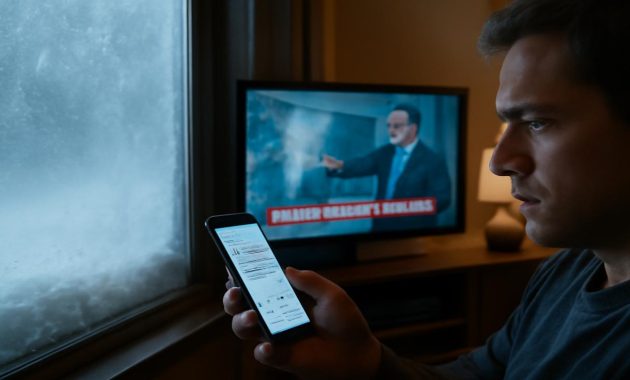
The first flakes arrive like a rumor—soft, uncertain, almost apologetic. They drift past the window of the corner café, catching the yellow light, swirling over parked cars that still wear a thin sheen of road salt from last week’s storm. Inside, the barista has the news on low behind the counter, and the flat, urgent voice of the meteorologist threads itself between the hiss of steaming milk and the gentle clatter of ceramic cups.
“A crippling blizzard,” the voice says. “Travel could become impossible. Widespread power outages are likely. Stay home if you can.”
A woman in a red scarf pauses mid-sip. At the back table, an older man in a camo hat snorts into his coffee. Outside, the snow keeps falling, innocent and pale, as if it has nothing at all to do with what’s about to happen to this town.
The Storm Before the Storm
By early afternoon, the town is split into two weather systems long before the blizzard’s real clouds even arrive.
On one side are the screens: glowing blue warnings on phones, weather apps pulsing with exclamation marks, a banner looping across the bottom of the local news broadcast—SEVERE BLIZZARD WARNING. The radar image looks like an ink spill the size of half the country, curling toward the region like a fist.
On the other side are the conversations: at the grocery store checkout, in the school pickup line, on group chats buzzing awake like wasps. This is where the language changes, where “severe winter storm” turns into “they’re trying to shut everything down again” or “here we go, more fear-mongering” or, simply, “I’m not falling for it this time.”
Outside, the sky is a dull, pewter gray. The air has that particular sharpness that means the snow coming won’t be pretty; it will be heavy, wet, and committed. The wind is starting to gather its arguments in the treetops.
In the hardware store, a worker in a blue apron is replenishing a stack of flashlights and D batteries beneath a hand-lettered sign that reads “STORM PREP.” A young couple carefully compares generator prices, faces tight with that anxious math of what they can afford against what they’re afraid might happen.
Across the aisle, a man in a faded leather jacket shakes his head. “They do this every year,” he says to no one in particular. “Sell fear, sell stuff. Snow is snow. We used to just call it winter.”
The Blizzard as a Battleground
Forecasts used to be background noise—little symbols in the corner of the evening news, a courtesy mention before sports. Now, they’re center stage and supercharged. There is the storm that will move across counties and farm fields, sure. But there is also the storm this town is already living inside: a blizzard of doubt and distrust.
When the National Weather Service issues a “severe blizzard warning,” it doesn’t sound like a suggestion. The words themselves feel like a wall going up around the day you thought you were going to have. Schools start emailing about closures before a flake has stuck. Offices circulate remote-work plans. Shelves at the supermarket empty of bread, milk, and the specific kind of cereal that everyone else apparently likes too.
For some, this is proof that the system works—that we’ve learned, collectively, from the bruises of storms past. Better to be ready and wrong than surprised and stranded. For others, it sounds like another set of orders in a world that seems suddenly full of them.
The language of the warnings doesn’t help. Words like “crippling” and “life-threatening” have become standard in high-impact forecasts, chosen for clarity and urgency. But to ears already tuned to hear control, they can feel like a command disguised as concern.
On social media, the storm has been trending for hours before it arrives. Memes about “Snowpocalypse 3.0” sit beside serious threads from meteorologists walking through model runs and historical analogs. Mixed in are posts insisting that storms are being exaggerated to justify emergency powers or to keep people compliant, homebound, endlessly refreshing the news.
It takes only a few missed forecasts—a storm that jogged north by fifty miles, a predicted ice event that turned to slush instead—to seed doubt. Memory is selective. The blizzard that buried your car to the mirrors sticks; so does the one they promised that never came. Both get folded into the story you tell yourself about who to trust.
The Weather, in Numbers and Nerves
Forecasting a blizzard isn’t armchair fortune-telling. It’s data in dizzying quantities, parsed through models that hum in distant computer clusters. It’s upper-air soundings from weather balloons, satellite loops of cloud tops, ocean temperatures, jet stream patterns.
Yet for most people, all of that resolves into a single push notification: “Up to 24 inches possible. Travel dangerous to impossible.” It arrives with the same digital brusqueness as a calendar reminder or a late-night text. No wonder it’s hard to feel the weight of the science behind it.
In town, people don’t argue about ensemble runs or probabilistic snowfall maps. They argue about whether the school district is overreacting. They argue about whether the grocery run is preparation or panic. They argue about whether this is another way the world is being tightened around them like a belt.
On the library bulletin board, someone has taped up a printout of a simple chart. It tries to bridge the gap between numbers and nerves.
| Forecast Phrase | What It Usually Means | How People Often Hear It |
|---|---|---|
| “Up to 24 inches possible” | A range, often 8–24 inches depending on location | “We will get 2 feet of snow” |
| “Power outages likely” | Elevated risk where heavy snow meets old lines/trees | “The power will go out for everyone” |
| “Travel could become impossible” | At peak hours, plows may be overwhelmed | “They’re trying to keep us from leaving home” |
| “Stay off roads if you can” | Practical safety advice to reduce accidents | “Another restriction on our daily lives” |
It’s a simple thing, paper and toner and thumbtacks. But in its way, it’s a quiet act of translation: a reminder that between the language of risk and the language of fear, there is a narrow but important space.
Fear, Control, and the Memory of Other Emergencies
The blizzard is not arriving in a vacuum. It’s blowing into a landscape already shaped by other warnings, other graphs, other nights spent watching numbers rise on screens. People remember the last time they were told to stay home, to avoid crowds, to stock up.
For some, that time was marked by an invisible danger and weeks of isolation. For others, it was a season of orders that felt arbitrary, inconsistent, or endless. Those memories live in the muscles. They stir whenever officials use language that sounds a little too much like “lockdown,” even when the subject is only snow.
So when the mayor appears on local television—tie slightly askew, eyes tired—and says, “We urge everyone to remain at home during the worst of the storm,” it lands on wildly different soil.
In a small apartment on the edge of town, a nurse just off the night shift nods. “Good,” she mutters, peeling off her boots. “I’ve seen what happens when people drive in this.” She remembers last winter’s pileup on the interstate, the stretchers, the chapped hands working chest compressions under a sky still spitting snow.
Across town, in a bungalow with neatly trimmed hedges now dusted white, a self-employed contractor watches the same broadcast and grimaces. “There it is,” he says to his wife. “Telling us what’s ‘allowed’ again. They don’t pay my bills if I don’t work.” His distrust is not abstract; it’s stapled to the bottom line of his bank account.
Neither of them is entirely wrong. Weather warnings are, in part, about shaping behavior. They are attempts to alter what people do—when they drive, how they stock their pantries, whether they send children to school—based on an informed guess about what the sky will deliver. At their best, they are protective nudges. At their worst, when overused or miscommunicated, they can feel like another form of paternalism.
When the Wind Becomes the Only Voice
By dusk, the rumor has turned into a statement. Snow is no longer drifting; it is arriving with intent. Big, wet flakes splat against windshields. The wind has sharpened into something with edges. It comes around corners and under doors, finds the smallest crack and presses its cold finger through.
The main road is a slick ribbon of gray. Plows have already passed twice, orange lights revolving through the thickening curtain. Their steel blades make a sound like teeth being ground.
Inside homes, preparations have taken on their own weather. Some are warm and methodical: candles lined up on the counter, bathtubs filled just in case, devices charged. Board games pulled from closets. Soup simmering, blankets folded within easy reach.
Other houses hum with a more restless energy. A teenager complains about being “trapped” all weekend. A father toggles between radar loops and online rants about media exaggeration. A mother checks the pantry again, a knot of worry lodged beneath her ribs, wondering what will happen if the power goes and stays gone in this old house with its cranky furnace.
Then, somewhere not far away, a limb gives out. The sound is deep and sudden—wood surrendering under a weight it was never meant to bear. A second later, the neighborhood blinks. Lights stutter and die. The hum of refrigerators, fish tanks, and chargers breathes out and is gone.
Silence has its own roar. When the power dies in a storm, it doesn’t get quieter; it changes key. The steady mechanical chorus is replaced by the raw elements: wind fretting around eaves, snow stinging against windows, the distant growl of a generator sputtering to life down the block.
In that dim, battery-lit space, debates about whether the warning was overblown feel different. The house is suddenly smaller. The air tastes metallic with candle smoke. Shadows climb the walls as the storm presses its cold hands against every surface.
The Morning After, and All Its Stories
By morning, the town is not a town at all. It is a series of white mounds punctuated by the angular black of rooftops and the stubborn green of pines. Cars have become anonymous humps. Mailboxes are hints. The world has been erased and redrawn with one color and a hundred textures.
In some neighborhoods, power is still out. Frost breathes slowly up inside windowpanes. People bundle in layers, exhaling ghosts as they speak. The lucky ones with fireplaces feed another log to the flames, heat blooming against the brick.
Elsewhere, lights have flickered back. Coffee makers burble like small, forgiving gods. Neighbors text: “You okay?” “Got power?” “Need anything?” Kids, released from the shackles of remote classes by a merciful outage or an official closure, dive into drifts with a joy completely untroubled by discourse.
The official numbers roll in. In some places, the forecast nailed it: twenty inches on the nose, winds meeting or exceeding predictions, thousands without power, a handful of rescues from stranded vehicles. In others, the storm swerved, the heaviest bands setting up fifty miles away. They got six inches of messy slush instead of two feet of powder. Traffic was slow but manageable. The grid held.
In those less-buried zones, the post-storm narrative forms quickly.
“See?” one man says at the diner, slapping the newspaper. The front page shows a snow-choked highway two counties over; their own streets are merely slushy. “Shut everything down for this. They love making people scared.”
His waitress, who has a cousin still shoveling out from under actual feet of snow in the next state, shrugs. “They got what we didn’t,” she says. “Could’ve just as easily been here.”
He rolls his eyes. “Could’ve, could’ve. That’s how they keep you in line. Always some new could-be disaster.”
At a nearby table, a teacher warms her hands around a mug. She remembers the bus that slid sideways in a ditch a few winters back. The calls to parents. The trembling voices. She reads the same headline and feels gratitude, not manipulation.
We don’t live in the same storm, even when we share a zip code. We live in the intersection of weather, memory, and belief.
Who Owns the Sky?
At the heart of the blizzard warning—or any severe weather alert—lies a quiet, pulsing question: who owns the sky, or at least, who owns the story we tell about it?
The atmosphere obeys physics, not politics. But the way we talk about that physics is deeply human. It runs through institutions that some trust and others eye with suspicion: government agencies, academic models, media outlets. Every time they are wrong, or seem overstated, or fail to convey uncertainty, another small piece of public trust melts away like ice in a too-warm river.
In that gap, alternative narratives flourish. Some are mundane (“they hype storms for ratings”); others stray into the conspiratorial (claims that weather alerts are tools for conditioning compliance, or even that storms are being engineered). In between lies a more ordinary skepticism: the simple, weary belief that “they” like to keep people a little bit afraid because afraid people are easier to manage.
Meanwhile, in a small, windowless forecast office miles from town, a meteorologist rubs tired eyes and scrolls through post-storm verification stats. He sees where the models overperformed, where they underdid. He thinks about the phrases he chose for the public advisory, the line between urgency and fear, the weight of being wrong in either direction.
When he steps outside, the snow squeaks under his boots at ten below. The air bites his cheeks bright. For a moment, there is no discourse, no argument, no accusations of control—only the stark, indifferent beauty of a world remade overnight. The sky is a flawless blue now, its earlier rage hidden entirely, as if weather, too, prefers not to dwell on its own extremities.
Learning to Read the Weather—and Each Other
Somewhere between blind faith in the forecast and blanket dismissal of it lies a more difficult, more adult place: learning to live with uncertainty without letting it rule, and without assuming every warning is a leash.
That means getting more comfortable with words like “chance,” “range,” “if,” and “could.” It means recognizing that when a meteorologist says “power outages likely,” they’re speaking in probabilities over a wide area, not issuing a personal prediction about your living room lamp.
It also means demanding better communication: clearer graphics that show uncertainty, language that avoids gratuitous drama, officials willing to explain what they don’t know as plainly as what they do. It means remembering that a warning is an invitation to prepare, not proof of a plot.
On the other side, it requires a kind of civic generosity. To see that for your neighbor with heart medication that must stay cold, the warning is not control—it is time to find a backup plan. For the snowplow driver who will be out all night, it is a cue to rest now. For the nurse headed into a 12-hour shift, it is information to weigh alongside everything else she carries.
The blizzard, when it arrives, does not care what you think of it. The snow will land on the skeptical and the cautious in identical flakes. The wind will rattle the windows of those who call it hype and those who call it a crisis with equal indifference.
But after the storm, when we step back out into the stunned brightness and begin to dig paths to one another’s doors, we carry our stories about what happened. Those stories shape how we will listen next time the radar blooms red or purple or a sickly shade of green. They decide whether the next warning will be heard as a lifeline or as a leash.
Snow still falls outside the café, where this all began. The television is muted now. Conversations have shifted to who lost power and for how long, to kids’ sledding triumphs and near-misses on the highway. Somewhere in the mix, a question lingers like breath on a cold day: how do we live in a world where the sky is changing, the forecasts are sharper, and the trust in those forecasts is—like everything else—so unevenly piled?
The answer, if there is one, will not come entirely from satellites or sensor towers. It will come from the slow work of learning how to read the weather honestly, and how to weather each other with a little more grace.
Frequently Asked Questions
Why do meteorologists sometimes sound so dramatic in blizzard warnings?
Forecasters use strong language when they believe there is a genuine risk to life, property, or infrastructure. Research shows that clear, urgent wording can prompt people to take protective action. The challenge is balancing urgency with accuracy so warnings don’t feel like sensationalism.
Are severe weather warnings a form of government control?
Weather warnings are intended as risk communication, not mandates. They can influence behavior—by design—but they don’t carry legal force in most situations. Concerns about control often stem from past experiences with other types of emergency orders, which can color how people hear any official alert.
Why do blizzard forecasts sometimes “bust” or miss the mark?
Small changes in storm track, temperature, or timing can dramatically affect snowfall totals. A shift of 30–50 miles can mean the difference between a major storm and a minor one for a given town. Forecasts are probabilistic, but they’re often interpreted as guarantees.
How can I tell if a storm warning is serious or just cautious?
Look for multiple cues: the type of alert (watch vs. warning), how many agencies are issuing it, and whether local officials are adjusting services (plow schedules, school decisions). Consistent messaging from different sources usually signals a genuinely high-impact event.
What’s the best way to respond when a severe blizzard is forecast?
Prepare calmly: check flashlights and batteries, charge devices, have some extra food and water, and plan for not driving during peak snowfall. Stay informed with updates, but limit doom-scrolling. Treat warnings as informed advice, adapting them to your own situation and needs.