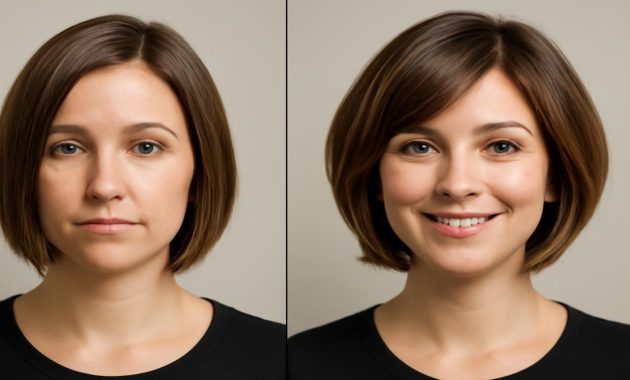
The angled bob has been many things to many women: sharp, chic, a little bit defiant. For years it sliced neatly along jawlines and napes, a geometric promise that if everything else refused to behave—jobs, children, marriages, the world—at least your hair would. But somewhere after 55, in bathrooms and salon chairs all over, something quieter has been happening. The mirror leans close, the fingers lift the ends, and a small, almost guilty thought slips out: “Why does it feel like there’s less of it… and why does this cut suddenly feel like it’s working against me?”
The Morning You Notice It’s Different
It tends to happen on an ordinary morning. You’re not braced for revelation; you’re just standing there under the soft, forgiving light of the bathroom, towel crooked around your shoulders, comb in one hand, coffee cooling nearby.
Your hair is freshly washed, still damp at the roots. You tip your head forward, like your stylist taught you years ago, blow-dryer humming. When you flip your head back up, you expect that familiar swing of an angled bob—heavy in the front, sloping toward your chin, that crisp line along your jaw.
Instead, what you see is… collapse. The sides cling closer than they used to. The back, once a satisfying cushion of volume, feels sparse. You push the front pieces back, tilt your head, squint. No, it’s not your imagination. The angle that used to feel bold now reads as harsh, dragging the eye downward. The front lengths seem to point right at the lines you’ve made peace with—but don’t feel like emphasizing.
You run your fingers along your scalp and feel the new landscape of it: a little more scalp, a little less density. Not dramatic, not tragic. Just different. Thinner. Softer. And suddenly the iconic angled bob, the one that carried you through your energetic 40s and polished your 50th birthday photos, feels… out of sync with the woman looking back at you.
This is where the quiet revolution begins—not with a drastic chop or a celebrity inspiration, but with a gut feeling: it might be time to say goodbye to the angled bob and discover a cut that doesn’t just flatter thinning hair, but actively supports it. A kind of “anti-ageing” cut, not because it turns back the clock, but because it refuses to let time flatten your hair or your spirit.
The Problem with the Angled Bob After 55
On paper, the angled bob sounds perfect forever. It’s structured. It frames the face. It looks good with glasses, with lipstick, with a plain T-shirt. But hair—especially hair after 55—doesn’t read paper. It behaves by its own rules.
After midlife, several things typically happen at once: hair strands get finer, overall density decreases, and the growth cycle slows. The angled bob, with its longer front and shorter back, places more visual weight exactly where your hair is now the weakest. The front pieces must carry the drama, but they’re often the first to look frayed, wispy, or stringy as hair thins.
Meanwhile, the stacked back that once gave that effortless “lift” starts to flatten. Those tight, graduated layers that used to build volume can begin to expose the scalp if the hair is no longer full enough to support them. You might notice a triangle effect—too wide at the bottom, not enough at the crown—or worse, a style that somehow manages to look both flat and fluffy at the same time.
The angled bob also draws lines. Its geometry pulls the eye along the jaw and down the neck. When your face had more natural volume, that strong line was gorgeous, even edgy. But as your face subtly changes—with bones a little sharper, cheeks a touch softer, skin more textured—that same precision can feel unforgiving. It outlines everything, rather than harmonizing with it.
Under harsh bathroom lighting, with wet hair clinging to the scalp, the effect can feel stark: the cut is still youthful, but the hair it sits on is telling a different story. And then comes the deeper realization: maybe “youthful” is the wrong goal. Maybe what you’re after now is something else entirely.
The “Anti-Ageing” Cut: Softer Lines, Hidden Architecture
“Anti-ageing” is a loaded phrase. We are not here to erase the years like they were a mistake. But haircuts can absolutely work with the realities of ageing hair rather than against them, and when they do, something quietly magical happens: you look more awake, more lifted, more yourself. Not younger exactly—just beautifully present.
The new cut that’s gently pushing the angled bob off center stage is not one single rigid style, but a family of shapes built around a few shared ideas:
- Softer, more subtle angles that don’t drag the eye downward
- Light, invisible layers that create lift at the crown and sides
- A length that doesn’t weigh hair down but still feels feminine
- Ends that are slightly rounded, not sharply straight or aggressively stacked
Imagine something between a classic bob and a soft, modern shag—let’s call it a “cloud bob” or a “soft volume crop.” The back is no longer dramatically short and severe; instead, it gently curves, following the nape without exposing too much scalp. The sides graze the cheekbones or just skim the collarbone, depending on your preference and density.
The secret weapon of this anti-ageing cut is what your stylist does inside the shape. Instead of heavy, blunt layers, they use whisper-light internal layering—subtle snips hidden under the top layer of hair. These are not the choppy, obvious layers of the early 2000s. They’re structural supports, creating air pockets so the hair can lift off the scalp and move.
The result is hair that looks fuller without requiring a full salon routine every morning. You shake it out, maybe rough-dry the roots with your fingers, add a light volumizing spray—and the cut does the rest.
What This Cut Actually Looks and Feels Like
Picture yourself sitting in the salon. Instead of asking for “just the usual trim,” you take a breath and say it out loud: “I think I’m ready for something that helps with volume. My hair is thinning, and the angled bob is starting to feel too harsh.” In that moment, you’re not just changing a cut—you’re allowing your hair to evolve with you.
Your stylist sections your hair and starts reshaping, not just shortening. The angle from back to front becomes more relaxed, almost horizontal when viewed from the side. The nape is tidied, but not shaved or dramatically stacked. Around the crown, they lift sections and remove weight from the undersides, letting the top layer float just a little higher.
Near your face, instead of one long, heavy slab pointing at your chin, you get gentle face-framing pieces. They might hit at the soft dip of your cheek, or the line where your jaw meets your neck. They’re cut to bend in or out, depending on your features, so they blur and soften rather than slice and divide.
When you run your fingers through it, it feels lighter yet somehow thicker. The ends don’t cling together in sparse little clumps; they diffuse softly, like a halo. The outline of your haircut is less like an arrow and more like a cloud—rounded, alive, forgiving.
Most importantly, when you sit up straight and see yourself in the mirror, your eye goes up. The volume is at the crown and around your cheekbones, not dragging toward your collarbones. Your expression looks more open. Your neck looks a little longer. People might tell you that you look “rested,” or “happy,” or “different somehow.”
Choosing Your Version: Length, Fringe, and Texture
This anti-ageing, volume-restoring cut isn’t one-size-fits-all. It’s more like a language your stylist can speak fluently, adjusting the accent to suit you. A few key decisions help tailor it.
Length: Cheek, Chin, or Collarbone?
If your hair is quite fine or very sparse at the ends, going slightly shorter (around chin length) can instantly make it look thicker. The bulk of the hair is concentrated in a smaller area, so it feels fuller and more resilient.
If you’re attached to a bit more length, a soft, shoulder-skimming version can work beautifully—as long as the ends are slightly curved and supported by light internal layers. A dead-straight, one-length lob will tend to collapse; a rounded, airier cut will float.
Fringe or No Fringe?
A fringe (bangs) can be transformative on thinning hair, but it must be thoughtfully done. A heavy, blunt fringe can thin out the rest of the hair and draw attention to sparse areas at the hairline.
Instead, consider a soft, wispy fringe or long, side-swept curtain bangs that blend into the rest of the cut. These can:
- Disguise thinning at the front hairline
- Draw attention to your eyes instead of your part
- Add movement and softness without sacrificing much density
Texture: Working With What You Have
If your hair has even a hint of natural wave, this new cut is like a gentle invitation for it to come out and play. Light layering encourages your hair’s natural bend, which can make it appear fuller and more textured without a curling iron.
If your hair is straight and fine, the architecture of the cut does more of the work. Root-lifting spray or mousse, applied only at the scalp, can help. A quick rough-dry with your head tilted forward, then a cool blast to set, might be all you need.
A Quick Comparison at a Glance
| Feature | Traditional Angled Bob | Modern Anti-Ageing Cut |
|---|---|---|
| Overall Shape | Strong angle, longer front, shorter back | Softly rounded, gentle or minimal angle |
| Impact on Thinning Hair | Can expose scalp at back; front looks stringy | Builds volume at crown; disguises sparse areas |
| Face Effect | Emphasizes jawline and neck lines | Softens features, lifts attention to eyes and cheeks |
| Styling Effort | Needs precise blow-dry to sit right | Designed to air-dry or rough-dry with movement |
| Vibe | Sharp, graphic, sometimes severe with age | Airy, soft, quietly confident |
How to Talk to Your Stylist So You Get What You Want
The key to successfully saying goodbye to the angled bob is conversation. Stylists are artists, but they aren’t mind-readers. Going in with a few clear phrases—and a willingness to be honest about your hair—can change everything.
You might say something like:
- “My hair is thinning, especially on top and at the front. I need a cut that makes it look fuller.”
- “My angled bob feels too harsh now. I’d like a softer shape that lifts my face.”
- “I don’t want to spend 30 minutes styling every day. Can we cut it so it falls into place more naturally?”
Then let them look, touch, and move your hair. A good stylist will:
- Check your crown, part line, and hairline for thinning patterns
- Ask about your daily routine and how much styling you’re willing to do
- Suggest a length that suits your density and lifestyle, not just current trends
When they propose a shape, ask them to describe it in simple terms: “Will the back be soft or stacked? Will there be layers I can see, or are they hidden? How will this cut look in three weeks?”
In that chair, you’re not chasing youth—you’re commissioning a frame for the life you’re actually living now: lunches with friends, long walks, caring for aging parents, planning trips, picking tomatoes from the garden. You want hair that keeps up, not hair that requires you to keep proving something to it.
Caring for Thinning Hair So the Cut Can Shine
Even the most brilliantly designed anti-ageing cut needs the right environment to thrive. Thinning hair is often more fragile and deserves a gentler rhythm in your daily routine.
Think of it like this: your hair has less natural margin for error now. Each strand matters. So instead of trying to bully it into submission with heavy products and high heat, you partner with it.
- Lightweight products only: Heavy serums and oils will drag fine hair down. Choose volumizing or thickening shampoos and conditioners, and use conditioner mainly on mid-lengths and ends.
- Scalp first: Healthy hair starts at the root. Regular, gentle scalp massages with your fingertips can stimulate circulation. Keep the scalp clean but not stripped.
- Heat with care: Lower heat settings, a heat protectant spray, and less frequent hot tools will preserve the cut’s movement and prevent breakage.
- Regular micro-trims: Thinning hair shows damage more quickly. A trim every 6–8 weeks helps maintain shape and fullness.
But beyond the technical, there’s something else that happens when you care for your hair with this kind of attention: you begin to regard it not as something that’s “failing” you, but as something that’s shifting, asking for a new kind of kindness. The new cut becomes a reminder of that gentler approach.
More Than a Haircut: The Quiet Confidence of Letting Go
There’s a moment, often after the first wash at home with your new cut, when the decision truly lands. You’ve gone to bed, slept on it, woken up with those confusing little kinks, and stepped in front of the mirror thinking: “Now we see what this really is.”
The water runs. The shampoo foams. You towel-dry, head tilted. You follow your stylist’s simple instructions: product at the roots, not the ends; rough-dry instead of wrestling it with a round brush. Maybe you give a little scrunch at the sides, coaxing out any natural wave.
Then you look up.
You see the volume at the crown—not huge, not theatrical, just present. You see the soft way the ends curve around your face, like they’re listening instead of shouting. The cut doesn’t demand a perfect posture or a full face of makeup to work. It belongs in your real life: walking the dog, reading on the porch, planting bulbs, laughing too hard at lunch.
In that reflection, you might notice something you didn’t expect: not that you look younger, but that you look more at ease. The angled bob was right once—it carried you through a chapter where sharpness and structure felt like armor. But now, you’ve traded it for something else: a cut that restores volume not just to thinning hair, but to the way you feel about showing up in the world.
It’s a small act, really, to sit down and say, “Let’s change it.” Yet, quietly, it echoes. You are allowed to let go of styles that no longer serve you. You are allowed to seek softness without losing strength. You are allowed to want hair that feels like it’s on your side.
So yes, this is goodbye to the angled bob. Not with bitterness or regret, but with gratitude for all the years it did its job. You hang it up like a well-worn coat that no longer fits the season and slip into something lighter, easier, more attuned to the woman you are now.
When you walk out of the salon with your new anti-ageing cut—volume quietly restored, edges softened—you’re not trying to look 35 again. You’re doing something far more radical: you’re allowing 55, 60, 70 to look as alive, vivid, and dimensional as it actually feels on the inside.
FAQ: Goodbye to the Angled Bob & the New Volume-Restoring Cut
Is it really necessary to change my angled bob after 55?
Not if you still love it and it genuinely flatters your current hair density and face shape. But if your hair is thinning, flattening, or your bob feels too severe, a softer, more volumizing cut can make styling easier and your hair appear fuller.
Will going shorter make my thinning hair look even thinner?
Often, the opposite happens. When carefully cut, slightly shorter lengths can make fine or thinning hair look thicker because the strands aren’t weighed down and the ends look fuller instead of wispy.
How often should I trim this kind of anti-ageing cut?
Every 6–8 weeks is a good rhythm. Thinning hair can lose shape quickly, and regular micro-trims keep the architecture of the cut working in your favor.
Can I keep some angle in my bob and still get more volume?
Yes. Many women transition from a dramatic angled bob to a softer, more subtle angle. The back becomes less stacked, the front less heavy, and internal layers are added to lift the crown and sides.
What if I don’t like styling my hair at all?
Tell your stylist honestly. They can design a cut that’s meant to be air-dried or rough-dried with minimal effort, relying on the shape and light layering to create movement and volume without daily blowouts.
Originally posted 2026-03-06 00:00:00.