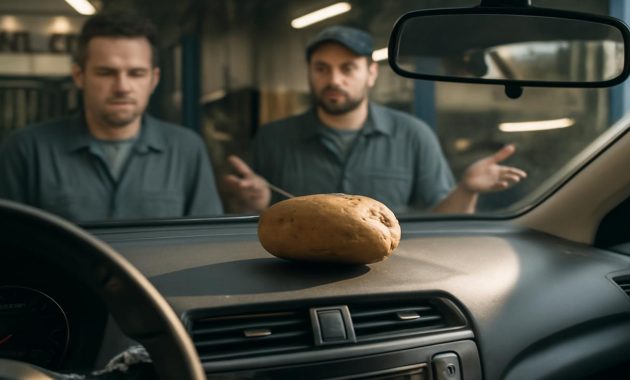
The potato rolled back and forth on the dash each time the car slipped through a curve, a scuffed brown moon tracing its orbit under the windshield. Outside, the rain drummed its fingers on the glass, tested the wipers, needled itself into every gap in the weatherstripping. Inside, the car smelled faintly of wet wool, coffee in a paper cup, and that raw, earthy note you only get from freshly cut potatoes. I watched a bead of water slide down the inside of the windshield, pause mid‑journey, then drip onto the plastic trim with a tiny, exasperated plink.
“Should’ve brought a bigger potato,” my uncle muttered from the driver’s seat, as if we were short on some crucial safety gear. He reached over, pinched the potato like a billiard ball, and dragged it in one steady arc across the fogged glass. The streak it left wasn’t pretty, but the next sweep of the wipers carried the smear away—and in its place, a small miraculous patch of clarity began to resist the fog.
“See?” he said, triumphant. “Mechanic might call it nonsense. But it works.”
The Legend of the Dashboard Potato
The first time you hear it, the idea sounds like a joke from a road-trip comedy: stick a raw potato on your dashboard and your windshield won’t fog up as badly. Seasoned drivers say it with a straight face. Old-timers swear by it. Some younger mechanics roll their eyes so hard they could realign your headlights.
Yet the story persists. Somewhere between old country superstition and roadside science experiment, the dashboard potato has carved itself a curious little niche in driving lore.
Ask around, and you’ll start to notice patterns. Long-haul truckers. Ski-season commuters. People who spend winters in the mountains or by the sea. Somewhere in their memory is a glove compartment that rattled with spare fuses… and a potato that rolled around in the dark, waiting for the next storm.
The appeal is obvious. Fogged windows are claustrophobia in slow motion—the outside world turning to milk, tail lights swelling into smeared red planets, the edges of the road dissolving. It’s the small panic of losing your horizon. If something as humble as a potato can steady that horizon, even a little, it’s no wonder the story won’t die.
Why This Weird Trick Refuses to Go Away
You can buy defogging sprays and anti-fog wipes at any auto parts store. Every modern car has vent settings, air conditioning, recirculation toggles, and sometimes even dedicated “max defog” buttons. And yet, somewhere, someone is still rummaging in the pantry before a long wet drive.
The potato hack lives in this strange overlap between folk wisdom and half-understood science. It’s passed down alongside advice like “crack the window just a hair” and “keep a microfiber cloth by the gearshift.” The difference is, people tell the potato story with a particular gleam in their eye, like they’re gifting you an inside joke from the road itself.
There’s also something about the sensory reality of it. You can feel the starchy flesh under your fingers, smell the faint green-earth scent as the knife slices through. It isn’t a sterile spray from a can; it’s a piece of the ground you grew up on—or at least, that someone did.
Of course, the moment you bring it up in a repair shop, lines are drawn. There are the mechanics who snort and go back to their torque wrenches. There are the ones who shrug and say, “Look, if it works for you…” And then there are the rare few who will lean in and admit, “I mean… there is a little science in there.”
Inside the Glass: What Your Windshield Is Really Doing
To understand why a potato might half‑work—or totally fail—you have to imagine your windshield not as a flat, clean window, but as a bustling intersection of air, water, and heat.
On a damp morning, the air inside your car is loaded with invisible moisture. Every breath you exhale puffs out little clouds that you can’t see—until they hit the chilly inner surface of the windshield. There, the water vapor gives up, turns back into tiny droplets, and suddenly you’re staring at a gray-white film instead of the world.
Mechanically, there are proper ways to fight this. Use the defrost setting. Turn on the A/C even in winter, because air conditioning dries the air. Aim warm, dry air at the glass. Let physics do the heavy lifting.
But not every car’s heater is at its best. Old seals leak. Cabin filters clog. The system that should act like a dehumidifier starts acting more like a sauna. That’s the quiet little crack in the door where folk fixes like the potato squeeze their way in.
The Science (Sort Of) Behind the Spud
Slice open a potato and rub the cut side on glass, and you leave behind a whisper-thin layer of starches and sugars—what some people call “potato juice,” though that makes it sound more appetizing than it is. That residue can do two interesting things:
- It can slightly change how water clings to the glass, sometimes making droplets spread more evenly instead of clustering into opaque beads.
- It can act, very briefly, as a barrier between the glass and the humid air, buying you a little time before condensation forms.
In some conditions, this looks like magic: the patch you wiped with potato fogs less or clears faster. In other conditions, it just smears, making a hazy mess that your wipers fight in long squeaky arcs.
And this is where mechanics start to argue—not so much about whether something happens, but about what that something really is. Is it a legitimate (if crude) hydrophilic coating, like a primitive anti-fog solution? Or is it confirmation bias with a side of homegrown myth?
Ask three techs and you’ll get three answers, usually delivered while they stand under a lift, hands in pockets, glancing at a rusted muffler like a referee watching a slow-motion replay.
In the Shop: Where Stories and Wrenches Collide
The argument often starts casually, the way good shop arguments do.
Someone’s car creeps into the bay with the inside of its windshield painted white from breath and damp carpets. The driver, a skier with a hatch full of wet gear, shrugs helplessly. “Tried everything. Even the potato thing.”
From under the hood, a voice pipes up. “Still doing that? That’s not a fix. That’s salad dressing.”
Another mechanic, perched on a rolling stool, shakes their head. “Hey now. My granddad used to swear by that. WWII convoy trucks, no fancy heaters, no nothing. Just potatoes and a rag. Said it kept ‘em on the road.”
Someone else laughs. “Yeah, and granddad also smoked in the gas station. Maybe not the best benchmark.”
Yet for every eye roll, there’s a story. Nights spent driving logging roads, windows cracked, potato in the glove box. Winter farm trucks with no real defrosters, just wind and willpower and a sack of produce. Generations that had to make do when the proper tools were either too expensive or simply didn’t exist.
The modern techs, surrounded by diagnostic tablets and service bulletins, stand at that crossroads between reverence and reason. They know what a clogged heater core looks like, what a musty, waterlogged cabin filter can do to humidity. They’ve seen how wet floor mats can turn a car into a rolling greenhouse. From their perspective, the real fix is simple: address the source of the moisture and let the HVAC system do its job.
But they also know something else, something softer: a lot of drivers arrive in the bay not just with mechanical problems, but with rituals—little orbits of comfort—and you don’t pry those loose with a torque spec. You have to make room for what people believe, even as you show them what you know.
Roadside Rituals and Quiet Superstitions
Cars accumulate myths the way river stones gather moss. A lucky keychain, a particular pump at the gas station, a habit of patting the dashboard before a long trip. The potato fits neatly into this archive of quiet superstitions.
There’s something inherently human about choosing a simple, tangible object to stand between you and a problem that feels slippery and invisible. Condensation is intangible until it blinds you. Ask it to obey a dashboard button, and it might… or it might not. But a potato? That you can hold, slice, smell. You can see its work traced in a faint, starchy arc.
On an icy dawn, parked at the trailhead or the edge of a field, the act itself becomes part of the day’s beginning. Open the door, feel the rush of cold air. Dig in the grocery bag or glove box. Scuff the cut surface across the inside of the glass with a soft rasp. Wait to see whether the next breath of fog finds a foothold or a barrier.
Whether or not it truly “fixes” the problem is only half the story. The other half is the feeling that you’ve done something, however small, to claim a bit of control over a capricious world of weather and glass.
Testing the Myth on a Wet Afternoon
One rain-heavy afternoon, curiosity won out. We parked the car in an empty lot, turned off the engine, and let the cabin fog up deliberately. Within minutes the windshield turned opaque, the outside world reduced to a watercolor smear of brake lights and muddy sky.
My uncle handed me half a potato like a lab instrument. “Your side,” he said. “Let’s see.”
I pressed the cut face against the glass. It felt faintly tacky, leaving behind a dull, translucent streak. We did one half of the windshield with potato, left the other untouched. Then we sat back, said nothing, and watched.
The untreated side fogged first and hardest, milky and dense. On the potato side, the mist gathered more slowly, almost shyly. Tiny beads formed, but they seemed reluctant to crowd together into a solid curtain. When we finally fired up the defrost, the potato-treated patch cleared a hair faster, as if it had less to surrender.
Was it dramatic? Not exactly. Was it nothing? Also no.
When we mentioned the test to a mechanic friend later that week, he shrugged. “Yeah, that tracks. You’re basically putting a poor man’s anti-fog film on there. But it’s messy, it doesn’t last, and it’s not fixing why the car’s wet inside in the first place.”
He wiped his hands on a rag, then added, “Still, lot of things people do to their cars make less sense than a potato. I’ll give you that.”
A Quick Look at Common Defogging Tricks
Mechanics might spar over the potato, but they tend to agree on the basics. Lining up the folk fixes with the conventional ones looks something like this:
| Method | What It Does | Pros | Cons |
|---|---|---|---|
| Defrost + A/C | Dries and warms air, clears glass efficiently. | Fast, reliable, designed for the job. | Uses more fuel/battery; weak if system is faulty. |
| Cracking a window | Lets humid air escape. | Simple, no tools, always available. | Cold, noisy, not ideal in storms or traffic. |
| Anti-fog spray | Creates a film that changes how moisture forms. | Purpose-built, usually effective. | Costs money, needs reapplication, can smear if overused. |
| Microfiber cloth | Wipes condensation directly from glass. | Cheap, easy, no residue. | Temporary, can leave streaks if cloth is dirty or damp. |
| Potato on windshield | Leaves thin starch film that can alter condensation pattern. | Almost free, mildly effective in some conditions, oddly satisfying. | Messy, attracts dirt, inconsistent, doesn’t solve root moisture issues. |
The Line Between Harmless Myth and Bad Advice
In the grand scheme of questionable automotive habits, the potato is remarkably gentle. It won’t ruin your engine, drain your battery, or compromise your brakes. At worst, it can leave a sticky film that collects dust and glare, especially in bright sunlight or at night when oncoming headlights turn every smudge into a flare.
This is where most mechanics draw a firm but kind boundary. Use your dashboard potato if it gives you comfort, they’ll say, but understand its limits. Don’t use it as an excuse to ignore a heater that can’t keep up, a leak soaking your floor mats, or a ventilation system wheezing through a choked filter.
The real danger is not the potato itself, but what it can distract from: if you’re having chronic fogging problems, there’s probably a deeper issue. Water sneaking in through a door seal. A plugged drain under the windshield cowl. A heater core seeping coolant vapor into the cabin—something no root vegetable can fix.
Pull the potato out as a roadside measure, sure. But once you’re home and dry, it’s worth asking the harder question: why is your car so damp in the first place?
What the Potato Story Really Tells Us
Stand back a moment from the glass and the gadgets, and the potato story starts to look less like a quirky tip and more like a tiny portrait of our relationship with the machines we live inside.
We’ve built cars that can recalibrate themselves in real time, detect pedestrians in the dark, and phone emergency services when we can’t. Yet we still tuck small, earthy objects into door pockets and glove boxes, as if some part of us doesn’t fully trust the glowing icons on the dashboard.
Maybe the potato stands in for a simpler pact with the world: you and a road, you and the weather, you and a thing dug from the soil that has quietly fed people through centuries of much harder journeys. It’s a reminder that, beneath the plastic trims and electronic modules, driving is still about moving through real air and real rain, with lungs that fog glass and fingers that get cold.
And so, in certain cars and certain lives, potatoes will keep rolling back and forth on dashboards, bumping softly against faded inspection stickers each time the driver takes a corner. Mechanics will keep arguing in the shop bay, some with a grin, some with a groan. The myth will wobble forward, neither fully proven nor fully debunked, like a story you tell at the end of a long day that isn’t about being right so much as being together.
In the end, maybe that’s the strangest magic of all: a root from the ground becoming, for a brief wet season, an instrument of clarity. Not perfect clarity. Not scientific clarity. Just enough to push the fog back from the glass and remind you that, beyond it all, the road is still there—waiting, shining dimly through the rain.
FAQ
Does rubbing a potato on my windshield really stop fogging?
It can reduce fogging slightly in some conditions, because the starches left on the glass change how water condenses. But the effect is limited and inconsistent compared with using your car’s defrost and A/C properly.
Can a potato damage my windshield or wipers?
The potato itself won’t harm the glass, but the sticky residue can attract dust and grime. Over time, that layer can increase glare and give your wipers more to smear around, so it’s wise to clean the glass regularly if you try this trick.
Is the potato trick better than commercial anti-fog products?
Generally, no. Commercial anti-fog products are designed to leave a controlled, even film. A potato is an improvised version of that idea—cheaper and more charming, but also far less predictable and often messier.
Why does my windshield fog up so badly in the first place?
Fogging comes from moisture-laden air inside the car hitting a cooler windshield. Wet floor mats, snow-covered boots, leaks, or a weak ventilation system can all add extra humidity, making fogging worse and more frequent.
Should I tell my mechanic if I’ve been using a potato on my windshield?
It’s not mandatory, but it can help explain any odd film or streaks they see when inspecting the glass or wipers. More importantly, if you’re having persistent fogging issues, let them know so they can look for underlying moisture or ventilation problems, not just wipe the glass and send you on your way.