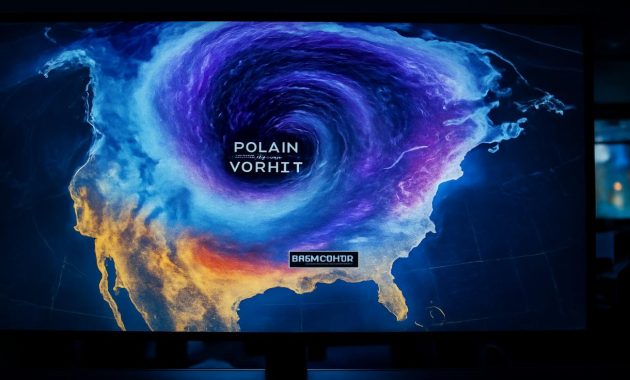
The sky has been fidgety all week. The kind of restless, silvery light that makes you squint and think, Something is shifting up there. The trees seem to feel it, too—bark darkened with odd humidity, branches rattling against a strange, high-altitude wind. In the distance, the horizon looks slightly blurred, as if the air itself is holding its breath. It’s February, and yet what’s approaching doesn’t quite belong to this time of year, or maybe to any we like to remember: an almost unheard-of polar vortex anomaly, gathering its strength in the far reaches of the atmosphere and starting its long, cold descent toward us.
The Quiet Rumbling Above Our Heads
To understand what’s coming, you have to look up—far above the clouds you see from your window, beyond the cruise altitude of passenger planes, into the region called the stratosphere. Up there, some 15 to 50 kilometers (about 9 to 31 miles) above Earth’s surface, winter builds its own hidden architecture of wind and temperature. At its center sits the polar vortex: an immense, swirling pool of frigid air encircled by a powerful current of winds, like a ghostly racetrack spinning around the Arctic.
On most winter days, you don’t notice it. Even meteorologists sometimes talk about the polar vortex like an old, familiar neighbor who mostly keeps to themselves—present, stable, more background than headline. But occasionally, something disrupts this orderly whirl. The vortex weakens, wobbles, or splits. Its icy core spills outward, drifting southward, sliding jagged tongues of Arctic air into places that thought winter had already spoken its last harsh word.
This February, the vortex is doing something rare enough to make even weather veterans pause: it is preparing an anomaly with a kind of intensity that feels mismatched to the calendar. By now, the stratosphere should be beginning its slow march toward spring, warming and calming as sunlight creeps back into the high latitudes. Instead, an extraordinary pattern is taking shape, one that could drag midwinter back onto the stage just as we’re all starting to look for crocuses and lighter coats.
Imagine, for a moment, the planet as viewed from space. You see the Arctic cap, pale and rigid, wrapped in an invisible ring of jet-speed winds. Then something shifts—waves of energy from lower latitudes surge upward, like invisible mountains rising into the sky, bashing against that ring. The vortex staggers, its edges ripple, and it begins to leak. What was once locked in the far north now starts looking for other places to go.
The Strange Mechanics of an Airborne Beast
Down at ground level, we experience weather as immediate: the slap of a wind gust, the sting of sleet, the glow of a mild day in late winter. But this polar vortex anomaly is being woven from events happening miles above your head, orchestrated by forces that feel almost like planetary whispers.
In the upper atmosphere, large undulating waves—called planetary or Rossby waves—are pushing northward with unusual strength. Think of them as great, slow ripples in the atmosphere, shaped by mountain ranges, ocean temperature differences, even patterns of snow cover. This year, they are crashing into the polar vortex with uncommon persistence, injecting heat into its icy heart. That sounds paradoxical: heat into something that brings cold. But it’s exactly this heating that can destabilize the vortex, making it wobble and fragment.
When that happens, the cold at its core doesn’t just disappear. It escapes. Channeled by the wandering jet stream, it descends into the troposphere—the portion of the atmosphere where our daily weather lives—and then it spreads out, like ink dropped into swirling water. The result, at the surface, can be dramatic: sudden temperature plunges, fierce wind chills, heavy snowfalls, and storms that grind daily life to a halt.
What makes this February’s setup especially unnerving to atmospheric scientists is the timing and intensity. Such powerful disruptions of the polar vortex are more often associated with deep winter, not the late-season window when the Northern Hemisphere, in theory, is beginning to shake off the cold. The atmosphere, it seems, has other plans: one more abrupt, icy exhale before spring can take control.
Listening to the Atmosphere’s Subtle Warnings
If you pay attention, the signs have been gathering for days: abrupt changes in mid-level winds, the jet stream’s track becoming kinked and contorted, high-pressure ridges swelling in unexpected places. It’s like listening to a piece of music you know well and suddenly hearing a discordant chord that lingers longer than it should.
In specialized weather centers, supercomputers churn through equations at astonishing speed, visualizing what might happen when that stratospheric chaos finally filters down to street level. Will the vortex’s cold heart pour into North America, Eastern Europe, East Asia? Will it split, sending smaller lobes of frigid air into several regions at once? Or will some countries just get brushed by the edge of the storm, catching only a brief, sharp shiver?
Nothing in weather is guaranteed, but the models are speaking clearly about one thing: wherever that displaced cold air lands, it could arrive with a force that will feel out of sync with our expectations for February. Ground that has already thawed slightly could refreeze in hours. Roads that felt manageable could turn to black glass overnight. River ice, weakened by an early-season warm spell in some regions, might be subject to new, uneven stresses of thaw and refreeze, raising the risk of jams and flooding when the pattern finally breaks.
How This February Is Rewriting the Script
There’s a specific unease that comes with extreme weather out of season. A ferocious snowstorm in January feels harsh but familiar, part of the unspoken contract of winter. But when a nearly unprecedented polar surge crashes into February—when days are technically lengthening and garden centers are quietly unpacking seed packets—it feels like the story is being rewritten mid-chapter.
Part of that unease comes from memory. Many people still recall a previous polar vortex event, with images of frozen fountains, power lines rimed with thick ice, and city skylines dulled by blowing snow and subzero haze. Trains stalled. Schools closed. Emergency shelters overflowed. That event became a reference point—a benchmark for what “bad” winter could look like in a modern, urban world.
Now, forecasters are comparing the upcoming anomaly to those benchmark winters and finding that, in some simulations, this February event is flirting with similar, even more extreme amplitudes of cold for select regions. That does not mean every town will become an icebound tableau straight out of a disaster film, but it does mean the potential for localized extremes is very real.
To get a sense of the contrast, consider a typical late-winter week versus one under the grip of a polar vortex anomaly:
| Feature | Typical February | Under Polar Vortex Anomaly |
|---|---|---|
| Daytime Temperatures | Slightly above freezing to mild in many regions | Well below freezing, potentially by 10–20°C (18–36°F) compared to normal |
| Nighttime Lows | Gradual warming trend, fewer severe cold snaps | Bitter cold, dangerous wind chills, extended subzero periods |
| Precipitation Type | Mixed rain and snow, more frequent thawing | Frequent, heavy snow, ice storms possible, snowpack building quickly |
| Infrastructure Strain | Typical winter wear and tear, manageable disruptions | Power grid stress, transportation delays, higher risk of burst pipes |
| Psychological Feel | “Winter is ending soon” | “Did we just rewind the season?” |
Behind these differences lies an uncomfortable truth: the climate system is changing, and with that change comes variability—sharp, unsettling swings between warmth and cold, calm and chaos. It seems contradictory that a warming world can still produce fierce cold outbreaks, but that paradox is part of the complexity. Warmer oceans, shrinking ice cover, and altered jet stream patterns may all be feeding the atmosphere new scripts, some of which include intense, late-season polar punches.
Humans, Wildlife, and the Sudden Return of Deep Winter
Step outside just before a polar outbreak and listen. You might notice a curious hush. Birds that had begun to test spring songs go quiet. Squirrels that were venturing farther in search of early food stash what they can and vanish. The air itself feels denser, as if bracing.
An event like this doesn’t just rattle our furnaces and schedules; it threads through entire ecosystems. Many plants in temperate regions use gradual temperature cues to decide when to “wake up.” Buds swell; sap starts moving in maple trees; early blossoms push tentatively through the soil. A sudden, brutal cold wave in February can catch them mid-transition, damaging delicate tissue and reducing yields for fruit trees or ornamental shrubs. That, in turn, ripples into food sources for insects, birds, and mammals that rely on early nectar or seeds.
Wildlife, already adapting to shifting seasonal patterns, faces a double bind. If animals emerge earlier from dens or hibernation because of unusual warmth, they may burn through precious fat reserves—only to be hit with a renewed Arctic blast. Waterfowl that have moved north along thawing flyways might find feeding grounds abruptly locked back under ice. Even urban-adapted species, from foxes to feral cats, must suddenly extend their search for shelter and calories, maneuvering through a landscape where humans are also scrambling to cope.
For people, the impacts are both physical and emotional. The sharp sting of air on exposed skin, the crunch of snow underfoot that wasn’t there yesterday, the sudden anxiety over heating bills and school closures—these sensations mix with a subtler feeling: the realization that our mental calendar, the one that says “brutal cold belongs to January,” is no longer entirely reliable.
What It Feels Like on the Ground
There is a particular moment when a polar outbreak first arrives that tends to stick in memory. Maybe you’re standing at your front door, about to step out, expecting a recognizable winter chill. Instead, the cold hits like a wall—sharp, invasive, instantly seeping through the weave of your clothes. Your breath feels sandpaper-dry. Exhalations billow out in thick clouds, hanging in the air a heartbeat longer than you’re used to.
Later that day, the world begins to transform. Pavement darkens and hardens; the faint wetness left over from a preceding warm spell stiffens into treacherous sheen. The soundscape changes, too. Snow on ultra-cold days has a different voice—squeakier, more brittle underfoot. Cars pass with muted tires, their engines sounding louder in the thin air. The wind cuts around building corners, sending miniature blizzards of powder spiraling into alleyways and across fields.
Inside, the temperature differential becomes obvious. Windows collect crystals of frost along their edges, drawing feathery patterns that creep inward with every degree the mercury falls. Radiators ping and clank. Old houses reveal their secrets: where the drafts come in, where the insulation thins. You find yourself gravitating toward the warmest corners, a mug between your hands, watching the forecast like it’s a slow-motion suspense film.
Communities, meanwhile, shift into storm mode. Hardware stores see runs on pipe insulation and space heaters. Shelters coordinate extra beds and blankets for people without homes. Road crews ready salt spreaders and plows. Hospitals quietly prepare for the spikes in cold-related injuries—slips on ice, frostbite, heart strain from shoveling too much too fast.
Preparing for a Rare February Shock
There is a strangely empowering side to all of this: while we can’t stop the vortex from misbehaving, we are not helpless. Awareness buys time, and time can be transformed into preparation.
On an individual level, that might mean walking around your home before the worst of the cold arrives, feeling for drafts along windows and doors. A borrowed roll of weatherstripping or a towel stuffed against a leaky threshold can make a surprising difference. Dripping faucets slightly to keep pipes from freezing. Making sure pets have truly insulated spaces, not just thin-walled shelters.
On neighborhood scales, preparation looks like checking in on vulnerable neighbors—the elderly, people with chronic illnesses, anyone whose mobility makes sudden ice a serious hazard. It means local governments planning warming centers and clear communication: which roads will be prioritized, what to do if the grid strains or fails, how schools will adjust if buses can’t safely run.
At a national and global level, this anomaly is yet another reminder that our infrastructure—and our thinking—must evolve for a climate future where “once in a generation” can become “every few years.” Power grids resilient to both heat waves and deep freezes. Building codes that anticipate temperature swings rather than stable seasons. Emergency systems that don’t just respond to immediate threats but learn from each event, like a living memory, refining protocols every time the atmosphere throws a new curveball.
What This Vortex Is Telling Us
If you step back from the immediate drama—the shrinking temperature gradients on your weather app, the urgent crawl across the bottom of the news broadcast—you can hear something else in this approaching polar vortex anomaly: a message about the era we are entering.
We live at a time when the atmosphere’s “normal” is in flux. That doesn’t mean every storm is a sign of doom, but it does mean that the old rules of thumb about seasons, about what’s typical in February or August, are being quietly renegotiated. The polar vortex, once a distant, rarely discussed piece of the climate engine, has become part of popular conversation precisely because it keeps misbehaving in ways that affect our daily lives.
This February’s event will pass. The vortex will eventually weaken and retreat. Snow will melt; birds will resume their tentative songs. But for many, the memory of this off-season cold blast will linger, becoming another reference point, another story that starts with “Do you remember that winter when…”
And perhaps that’s where this anomaly leaves its most profound mark: in the stories we tell each other, the way we talk about the sky and the seasons, the way we begin to accept that we are, all of us, living inside a system that is shifting around us. The atmosphere is not a backdrop. It is an active, breathing part of our world, capable of moods that can feel gentle, furious, or bewilderingly out of place.
As the strange February winds pick up and the temperature tumbles, you might find yourself stepping outside for a quiet moment, watching the last familiar shapes of your neighborhood soften under blowing snow or sharp stars. The cold on your face is a reminder: the planet is speaking, in air and ice and sudden silence. It has always been speaking. We are just finally learning to listen.
Frequently Asked Questions
What exactly is a polar vortex?
The polar vortex is a large, persistent circulation of cold air high in the stratosphere over the polar regions. It is surrounded by strong westerly winds that usually keep the cold air confined near the poles. When the vortex weakens or is disrupted, some of that frigid air can spill southward, causing severe cold outbreaks in mid-latitude regions.
Why is this February’s polar vortex anomaly considered unusual?
Its intensity and timing stand out. Strong disruptions of the polar vortex are more typical of mid-winter. Seeing such a powerful event taking shape in February, when the atmosphere is usually beginning to transition toward spring, makes it almost unheard of in modern records for some regions.
Does climate change cause polar vortex events?
Climate change does not “create” the polar vortex—it is a natural part of the atmosphere. However, a warming climate can influence the patterns that interact with the vortex, such as jet stream behavior, sea-ice loss, and ocean temperatures. Many scientists are investigating how these changes might be making polar vortex disruptions more frequent or more extreme, but the relationship is complex and still under active study.
What kinds of impacts can people expect during a strong polar vortex outbreak?
Impacts can include extreme cold temperatures, dangerous wind chills, heavy snowfall or ice, travel disruptions, power grid stress, frozen pipes, and increased health risks for vulnerable populations. The exact effects depend on local geography, infrastructure, and how the displaced cold air aligns with storm systems.
How can individuals prepare for an intense cold wave linked to the polar vortex?
Preparation steps include weatherproofing your home, protecting pipes, checking heating systems, stocking essentials like food, water, and medications, ensuring pets and livestock have adequate shelter, and staying informed through reliable weather forecasts. Checking in on neighbors and vulnerable community members can also make a significant difference during extreme cold events.