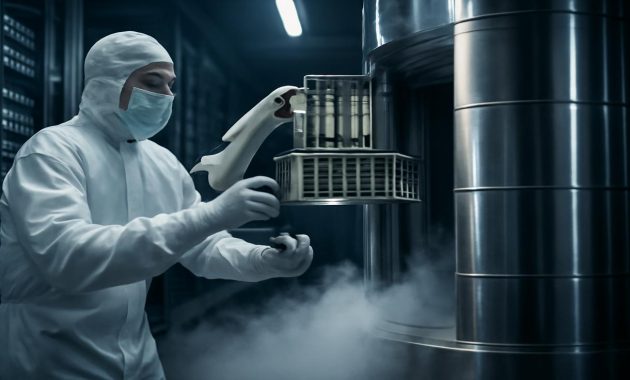
The box is no bigger than a shoebox, but they open it as if it were a treasure chest. Inside, resting in neat rows like tiny, translucent grains of rice, are seeds: wild lupine, ghostly pale; black‑striped sunflower; a handful of prairie grasses with names that sound like vanished tribes. The room hums softly, a low mechanical purr, the kind of sound your bones feel before your ears do. Cold mist coils in the air when the inner door opens. It smells like metal and winter and the faintest green memory of crushed leaves. Somewhere far away, a forest is burning. Here, in this bunker‑bright facility in the American Midwest, an unlikely bet is being placed: that we can freeze life on Earth—literally—before we lose it for good.
The warehouse of almost‑extinct things
The building looks ordinary from the outside, like any logistics warehouse on the edge of a highway town. A white rectangle, a few loading docks, the glint of solar panels catching the wan afternoon light. You’d never guess that inside, tucked behind security doors and temperature alarms and backup generators, sits a kind of temporal ark—rows and rows of ultracold freezers holding plant seeds, coral fragments, spores, insect DNA, even slivers of skin and tiny vials of blood from animals whose wild homes are shrinking by the hour.
The company behind this ark—an American biotech startup that prefers to call itself a “library of living futures” rather than a freezer farm—has built its entire business on a premise that used to sound like science fiction and now feels weirdly practical: if we can’t save every ecosystem in time, maybe we can at least save its software. Freeze it. Archive it. Store it on ice until the world is ready to bring it back.
Step inside and you’re met with a dry, almost paper‑clean chill. White walls. Stainless steel tables. Clipboards and screens lit with rows of codes and Latin names. And lining the long central aisle like metal monoliths, a series of freezers the size of wardrobes. Each one holds thousands of samples, cataloged down to the GPS coordinates of where they were collected. Most are kept around –196°C in vapor‑phase liquid nitrogen—cold enough that time, in a biological sense, almost stops.
“People think of extinction as a cliff,” one of the lead biologists says, sliding a tray of numbered cryovials back into a rack. “But it’s more like a slope. We’re trying to build handholds on the way down.” Her voice fogs slightly in the cold. On the lab bench behind her, a small fern sits in a pot under a grow light, a soft green punctuation mark in a landscape of steel and white.
The logic of last chances
When you zoom out, the logic behind this frozen ark is both brutally simple and deeply unsettling. Climate change, deforestation, ocean acidification, pollution—together they’re accelerating a mass extinction event that, by some estimates, could claim up to a million species in the coming decades. Restoration is slow. Destruction is fast. In between those two speeds is a gap so wide it feels like silence.
Into that silence, this company and a growing ecosystem of partners—botanical gardens, tribal seed keepers, coral researchers, wildlife biologists—are rushing samples. Not because freezing a seed or a sliver of tissue solves habitat loss or stops fossil fuel emissions. It doesn’t. They know that. They say it often, like a disclaimer pinned to their own hopes. But what it does is buy time. It creates a pause button, a possibility that a plant whose last wild stand has burned or a coral reef bleached bone‑white might not be gone. Not entirely. Not irreversibly.
It’s a bet that our future selves will be wiser, and better equipped, than we are now: more able to restore mangroves to coasts, replant ancient orchards, re‑seed prairies, rebuild reefs with coral babies grown from frozen fragments. It is also, uncomfortably, a wager that the current trajectory is bad enough that such interventions will not just be useful, but necessary.
“We’re archiving options,” the company’s founder says, standing in front of a freezer that contains coral gametes collected from reefs in Florida and Hawaii. He’s not wearing a lab coat—just jeans and a faded hoodie printed with a stylized spiral of fern fronds. “Maybe our grandkids won’t need any of this. That would be the best outcome. But if they look around and see empty forests, silent oceans, grasslands turned to dust… I want them to have more than regret. I want them to have tools.”
What does it mean to freeze a forest?
Freezing life is not as simple as tossing a handful of seeds into a deep freezer and hoping for the best. Some seeds—think beans, wheat, many grasses—are naturally inclined to long sleep. Dry them, cool them, and they can remain viable for decades or centuries. Others are more delicate, designed by evolution to germinate fast or to die if conditions aren’t right. Tropical trees, many fruits, some rare wildflowers—they don’t like cold. They don’t like dry. Put them in a freezer and they die for good.
So the team has become part gardener, part hacker. They coax cells apart with enzymes, bathe them in cryoprotectant solutions that prevent lethal ice crystals, then slide the vials into liquid nitrogen vapor where water becomes glassy rather than jagged. For some species, they freeze embryonic plantlets scraped from the tips of roots; for others, microshoots no longer than a fingernail. Each species is its own puzzle. Each puzzle comes with only a handful of chances before its living material, out there in a warming world, disappears.
To keep track of this unfolding, species‑spanning experiment, the company maintains an internal ledger—a quiet, sobering census of life on the edge. A glimpse of it looks like this:
| Category | Example Stored | Reason for Preservation | Potential Future Use |
|---|---|---|---|
| Forest plants | Rare oak and pine seeds | Wildfires, pests, disease | Reforestation, climate‑resilient forests |
| Prairie & grassland species | Native tallgrass seeds | Agricultural expansion | Restoring degraded soils and habitats |
| Coral & marine life | Coral gametes and fragments | Ocean warming & acidification | Rebuilding reefs, assisted evolution research |
| Pollinators & insects | Bee and butterfly lines | Pesticides, habitat loss | Breeding resilient pollinators, ecosystem support |
| Cultural crops | Heirloom maize & beans | Commercial monocultures | Food security, preserving culinary traditions |
Looking down such a list, you feel a strange double sensation: awe at the sheer variety of life that humans have cataloged, and a sinking fear at how much of that variety is now fragile enough to require a cryogenic backup. It’s like opening your phone’s photo gallery and realizing half the pictures are of things that no longer exist outside the frame.
The insane bet: technology vs. time
Critics call it hubris—the idea that a private American company can stand in as guarantor of the planet’s biodiversity. The founder doesn’t disagree. “It is hubristic,” he says, hands shoved into his hoodie pockets as he walks past a bank of freezers. “The whole enterprise of humans terraforming the planet is hubristic. The question is whether we’re willing to use every tool we have, including some that make us uncomfortable, to repair what we’ve broken.”
The bet, at its core, is threefold.
First: that the pace of environmental damage will continue to outrun the pace of political change and conservation. Forests will fall faster than treaties are signed. Coral will bleach faster than emissions are cut. Species will slip out of existence before we even give them names. In that race, cryogenic storage is triage—brutal, imperfect, but better than throwing up our hands.
Second: that technology will keep advancing. The company is banking on improvements in tissue culture, genetic rescue, de‑extinction tools, drone‑driven reforestation, artificial reefs. They expect that some of the samples they freeze today will be revived using methods not yet invented. That assumes a future with stable power grids, functional research institutions, and the will to spend money on restoration in a world that may be grappling with much more immediate crises.
Third: that people still care. That a child born in 2070, who has never seen a wild monarch migration or a reef thicketed with fish, will still want to re‑create them. That we won’t simply adapt to a quieter, emptier world and call it normal. That we will remember enough to miss what we’ve lost.
“People talk about this like it’s insurance,” one of the ecologists on the team says. “But insurance is for when something might go wrong. This is more like a black box on an airplane. You only need it when something already has.”
The ethics of a frozen ark
Walk far enough down any of these aisles of freezers and you run headlong into a tangle of ethical questions. Whose species get saved? Who decides which tiny sliver of an ecosystem is “worth” a spot in the cold? Is it the charismatic megafauna—the wolves, the panthers, the brilliantly colored reef fish? Or the drab, easily overlooked soil fungi that quietly keep forests alive? How do you weigh one against the other in a world of limited space, time, funding?
The startup has tried, deliberately, to avoid becoming a private vault of corporate‑owned DNA. Many of their samples are stored under agreements with tribes, local communities, research institutions. Some of those agreements specify that any future use must benefit the people and places where the samples came from—what the founder calls “biological reparations built right into the contract.” In some cases, the communities keep their own passwords and encryption keys; the company is more like a secure basement than a landlord.
And then there’s the danger of moral hazard: the fear that because we can, in theory, freeze a gene bank of Earth, we might feel less pressure to protect actual Earth. Less urgency to stop deforestation or phase out fossil fuels, because we have backups. It’s a concern the team encounters often.
“If you think a vial in here can replace a forest,” the biologist says, “you’ve never spent time in a forest.” She describes the way an old‑growth stand smells after rain, the feel of duff underfoot, the low vibrational hum of insects, the trading of carbon and signals between tree roots and mycelium. None of that is captured in a vial of frozen cells. What’s in the freezer is not a forest. It’s a seed of possibility that only matters if there is still a place to plant it.
Small victories in the cold
For all the grand narratives swirling around this work, much of it is painstakingly, almost tediously small. A lab technician spends half a morning under a laminar‑flow hood, teasing apart tiny plantlets with sterile forceps, placing them in individual tubes no bigger than a fingertip. Someone else spends an hour debugging a temperature alarm. There are spreadsheets. So many spreadsheets.
But every now and then, the cold room gives something back.
There was the whitebark pine from a high‑elevation forest choked by beetles and disease, whose seeds refused to store well using conventional methods. After nearly a decade of trial and error, the team thawed a batch of cryopreserved embryos and watched, almost holding their breath, as the first needles pushed through the potting soil under the grow lights. Trees from those lines are now part of experimental plantings on mountain slopes where, if they survive, they’ll anchor ecosystems that also shelter grizzlies and Clark’s nutcrackers.
There was a small, unassuming coastal plant—once common in salty marshes, now nearly gone from much of its range because of sea‑level rise and development. From a few remaining patches and some dried seeds in an herbarium, the lab built a living line, froze it, thawed it, and grew enough to send back to a restoration project. The first time one of the botanists visited the site and saw an entire muddy flat stippled once again with the tiny, green stars of that plant, she cried.
And there are the corals. Freezing corals is notoriously hard; their cells don’t like cold. Yet slowly, using new cryoprotectants and carefully controlled cooling rates, the team has managed to bank gametes from dozens of species—their genetic possibilities locked away in glass vials while their wild parents bleach in warming seas. In test tanks, thawed corals from the bank have grown into little knobbly colonies under blue lights, flickering like underwater cities in miniature.
What do we owe the future?
Standing in front of a humming wall of freezers, the question becomes harder to dodge. What do we owe to the people—and creatures—who will live with the consequences of our choices?
One answer is obvious: we owe them less damage. Fewer emissions, less pollution, more intact habitats now, before anything needs a freezer. That work is already well known: decarbonize, protect, restore, vote, protest, plant, defend. None of the scientists here would suggest that cryogenic vaults are a substitute.
But perhaps, they suggest, we also owe the future a fuller spectrum of possibility. Not just warnings and apologies, but raw material with which to remake, re‑weave, re‑imagine. Maybe that looks like frozen seeds that can one day green a barren hillside, or coral lines that handle heat a bit better than their grandparents did. Maybe it looks like the preservation of food crops whose flavors carry the stories of particular places and peoples. Maybe it’s as small as a single bee line that pollinates a plant medicine yet undiscovered.
Out beyond the parking lot, the light is fading. A line of geese crosses the sky, dim Vs against the orange smear of sunset. On a summer evening like this, the world can seem intact, even generous: crickets starting their shrill orchestra in the roadside grass, the smell of someone grilling two houses down, the low rush of highway noise like distant surf. The idea of mass extinction feels abstract, almost melodramatic.
Back inside, the freezers murmur on, as indifferent to the dusk as they are to the headlines. Inside them, grasses from a prairie that’s now a soybean field rest beside coral from a reef hammered by storms. A seed from a tree that no longer stands in its original forest lies next to a tiny, frozen sliver of tissue from a pollinator that once stitched the two together. Time, in here, has been thinned to a razor’s edge and laid flat. Waiting.
When future scientists—or maybe land stewards, or gardeners, or fishers—open these vials, the world outside their door will not be the same as the one we know. Warmer. Leaner. Possibly scarred in ways we can only guess. Yet if the bet pays off, they will still have, in their gloved hands, a chance to restore some of what we squandered.
Is it enough? Of course not. No freezer can store the feel of cold river water on bare feet, the shy tilt of a fox’s ears, the way a forest’s scent changes as clouds roll in. It cannot hold relationships between species, songs learned from parents, migrations mapped in muscle memory. Those things live only in living worlds.
Still, there’s something quietly radical in the decision to try. To say: we will not let this go easily. We will not shrug and walk away from a burning library just because we cannot carry every book. We will grab what we can, as carefully as we can, and trust that someone, someday, will know how to read it.
Frequently Asked Questions
Is freezing species a real conservation strategy or just science fiction?
It is very real. Cryobanks for seeds, animal genetic material, and even coral already exist around the world. What’s new is the scale and urgency: companies and institutions are now racing to preserve as much biological diversity as possible before it disappears in the wild.
Can frozen seeds and tissues really be brought back to life?
Many can. For “orthodox” seeds that tolerate drying and freezing, viability after decades in storage is well documented. For more delicate species, labs use specialized cryopreservation and tissue‑culture techniques. Not every species survives the process yet, but success rates are steadily improving.
Does this mean we don’t need to protect habitats anymore?
No. Frozen material is a backup, not a replacement. A forest is far more than its seeds, and a reef is more than its corals. Without living habitats—soil, climate, water, pollinators—revived species have nowhere to thrive.
Who owns the frozen genetic material?
Ownership varies. Many projects are governed by agreements with local communities, tribes, and research institutions that specify how material can be used and who benefits. Ethical cryobanks are moving away from private control toward shared stewardship and benefit‑sharing.
What are the biggest risks of relying on this kind of “frozen ark”?
Key risks include moral hazard (using cryobanking as an excuse to delay real climate and conservation action), unequal access and control over genetic resources, technological failure, and the simple fact that not all species or ecosystems can be fully captured or restored from frozen samples.
Originally posted 2026-03-05 00:00:00.