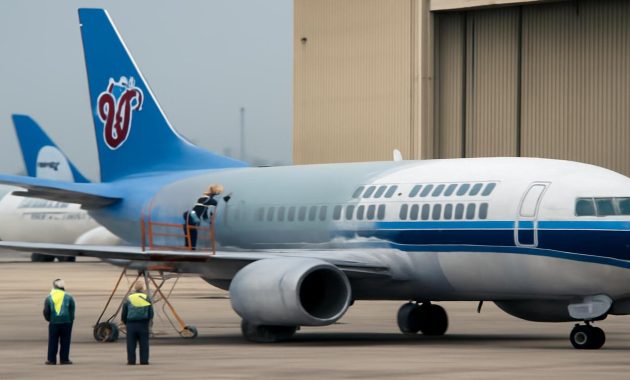
On a misted Shanghai morning, you might not notice anything unusual at first. The air smells of jet fuel and sea salt, the rumble of taxiing aircraft trembles through the glass of the terminal, and somewhere a child presses a nose to the window, tracing the outline of a distant plane with a fingertip. But down along a quiet corner of the tarmac, away from the boarding gates and duty-free perfumes, a row of silver and white Boeing jets glint in the pale light, waiting—almost like migratory birds that stayed too long in the wrong season. Now, after years of uncertainty, they are finally preparing to take off again, not with passengers this time, but on a quieter, more symbolic journey: back home to the United States.
The Sleeping Giants on the Tarmac
For years, these aircraft have stood still—parked, paused, and slowly gathering stories in their silence. They were not ruined or forgotten; they were survivors of a shifting sky, stranded halfway between promise and doubt. Many of them are Boeing 737 MAX jets, once the pride of modern fleets, then swiftly grounded worldwide after two catastrophic crashes in 2018 and 2019. What followed was a kind of aviation winter. Regulatory agencies pulled back. Airlines postponed or canceled orders. Crews retrained and waited. Hangars turned into quiet refuges for machines built to move.
In China, the pause lasted longer than almost anywhere else. While much of the world slowly restored the 737 MAX to service after software fixes, recertification, and layers of new safeguards, China held back. Its skies stayed closed to these particular aircraft, even as domestic travel rebounded and terminals once again filled with the thrum of life. And so, on the edges of airports from Guangzhou to Urumqi, rows of Boeings waited in the hazy light, their windows dark, their engines wrapped in protective covers like bandaged wings.
The image was strangely poignant. These were not relics of a past age; they were brand new or nearly so—aircraft that had barely lived. For aviation spotters, they were ghost birds, modern creatures stranded by a complex web of safety concerns, geopolitics, pandemic-era disruptions, and hard economic choices. Every airline planner knew it: A jet that doesn’t fly is a jet that costs money. But underneath the financial calculus, there was something more human: a question about trust. When passengers stepped into a narrow fuselage thousands of feet above the earth, what did they believe about the world holding them up?
The Decision to Let Them Go
Now, in airports across China, that stillness is beginning to break. The government has started allowing some of those grounded or undelivered Boeing jets to be returned to the United States. Not as typical ferry flights to launch new routes or paint new logos, but as a kind of unwinding of commitments, an uneasy handshake across the Pacific. These aren’t abandoned machines. They’re reassigned destinies.
The move signals more than a logistical adjustment. It’s part of a careful rebalancing of the aviation ecosystem—China recalculating its fleet needs, Boeing reassessing its presence in one of the world’s largest markets, and airlines on both sides of the ocean quietly shifting pieces on a crowded chessboard. Airline executives speak in the cool language of capacity, utilization, and fleet optimization. But if you stand near the maintenance bays and look up at a jet being readied for its long, empty flight eastward, the reality feels far more visceral than a line item on a balance sheet.
Consider the journey these aircraft are about to take. After months or years of idling, ground crews walk around them with methodical patience: checking landing gear, peeling away protective tape from sensor ports, inspecting engine intakes for the stray nests of opportunistic birds. The interiors, never really used, still smell faintly of fresh plastic and manufactured fabric. Some seats still carry the crispness of cushions that have never known the weight of a nervous traveler or a sleeping child. Technicians power up systems that have been dormant, listening for the familiar whir and click of electronics waking, like a heartbeat returning to a long-sleeping body.
Between Two Skies: China, Boeing, and a Fragile Trust
What does it mean for China to return aircraft to the United States? On the surface, the answer is pragmatic: changing market conditions, overcapacity in the wake of the pandemic, and a long backlog of aircraft that no longer perfectly match the country’s evolving needs. Domestic demand surged and then shifted. Long-haul international routes have been slower to fully recover. Chinese airlines are re-evaluating what they truly need in the next decade—and in some cases, the answer is “fewer of these particular planes.”
But beneath that practicality lies a more delicate story of trust and technology between superpowers. Boeing has long seen China as a pillar of its future, a place where rapidly growing middle classes would fill cabins from Beijing to Los Angeles. At the same time, China has been nurturing its own aviation ambitions, pouring effort into its homegrown COMAC C919, hoping one day to lessen its dependence on foreign aircraft makers. The era of easy assumptions—that Boeing and Airbus would forever dominate the global conversation—has started to fray.
So when news spreads that Boeing aircraft sitting on Chinese soil are being prepared for a one-way flight back to the U.S., it resonates far beyond the airports. It hints at shifting allegiances, diverging strategies, and a future where the balance between nations and their skies is less certain. You can feel it in the cautious phrasing of official statements, in the quiet concern of aviation workers wondering what this means for their long-term roles, in the subdued optimism of Boeing employees who see not just a loss, but also a strange kind of relief: planes in limbo finally getting a purpose again.
Machines with Stories to Tell
Every airplane carries a story in its wings. Sometimes that story is written in maintenance logs, where technicians scrawl terse notes about minor quirks and fixes. Sometimes it lives in the memories of flight attendants, who recall the nervous first-time flyer, or the quiet couple holding hands after a tearful goodbye. These particular Boeing jets in China are different. Their stories have been largely internal so far—awaiting a life that was interrupted before it began.
Take one imagined aircraft—a 737 MAX, built in Washington state, ferried across the ocean with a test crew and a skeleton staff of engineers. It arrives in China under a high sun and a ceremony of welcome. Cameras flash. Writers from industry magazines note the delivery. For a few weeks, maybe, it runs practice flights, crew familiarization routes, short hops with empty seats and training checklists. Then, when the world’s regulators ground the type, it is parked. Year after year, as headlines swing from crashes to recertification to new crises and global pandemics, the plane waits. Tires are turned to prevent flat spots. Systems powered periodically so they don’t fade. Its body is sound, but its future, hazy.
Now picture that same jet rolling gently from its parking line, pushed back by a tug that has nudged countless aircraft into their takeoff positions. No passengers file down the jet bridge. There is no rush of cabin crew adjusting luggage bins or reciting safety briefings. Instead, a slim ferry crew takes their seats. Paperwork is signed. Clearances granted. The engines spool up with a deep, rising growl that seems almost surprised to hear itself again. As the aircraft lifts off the runway and the ground falls away, there’s a sense that a long-stalled story has finally found a new chapter, even if it’s not the one originally scripted.
Air Currents of Economics and Emotion
To understand why this moment matters, you have to look at the invisible air currents that drive global aviation: economics, politics, public sentiment. Airlines operate on razor-thin margins and long timelines. A single aircraft can serve for 20 years or more, weaving its way through recessions, oil shocks, regulatory changes, and shifting tastes in cabin design. The decision to return planes to Boeing is rarely about a single issue. It’s a convergence of pressures and opportunities.
There’s the question of cost. Idle aircraft still demand attention—storage fees, maintenance, preservation tasks. There’s the cost of training crews, of uncertain resale value, of regulatory limbo. For Chinese airlines facing changing demand patterns and an increasingly competitive domestic landscape, trimming complexity from the fleet offers its own kind of relief. For Boeing, reabsorbing these jets is both a challenge and an opportunity: find them new homes, convert some for other uses, fold them back into the broader dance of global fleets.
Yet lurking beneath the discrete numbers on a company ledger is a softer consideration: how people feel about flying. Even after recertification, not every passenger easily forgets the headlines about the MAX. Some scan their boarding passes and quietly Google the aircraft type before a trip. Some airlines downplay the model designation in public announcements, aware that names evoke emotions, and emotions, in the air, can be fragile. Sending some of these aircraft back to the U.S. from China is indirectly part of that larger project of rebalancing confidence—putting planes where they can be most effectively managed, explained, and integrated into fleets that know how to speak about them.
When Steel Birds Travel Without Us
There is something almost haunting about a plane on a long flight with almost no one inside. The cabin lights dimmed, rows of empty seats reclining into darkness, safety cards tucked into untouched seatback pockets. Outside, thin air rushes past at hundreds of miles per hour, clouds peel away in slow, silent layers, and landmasses unspool below like forgotten maps. From the ground, we imagine jets like arrows; from inside an empty ferry flight, they can feel more like drifting whales—enormous, purposeful, but oddly solitary.
The return of these Boeings from China to the United States will largely happen this way: quiet, practical, minimally crewed. No movies playing, no meal carts inching down aisles, no sliding of headphones on and off as passengers check the progress map against some imagined line of their own lives. Yet these journeys carry a psychological weight beyond their sparse manifest. It’s a reminder that our infrastructure is not static; it can be re-routed, rethought, even recalled when the world changes faster than our plans.
When an aircraft departs its host country after years of quiescence, it changes the emotional geography of that place in tiny, often unnoticed ways. The ground crews who looked after it move on. The pilots who hoped to one day captain that exact model turn their attention elsewhere. The airports subtly realign their expectations—how many gates they’ll need for future narrow-body operations, what kind of support infrastructure they should invest in, which maintenance certifications will matter in the long arc ahead.
Skies in Transition: A Subtle Shift in Power
In the talk of returning jets, there’s an undercurrent that watchers of the natural world might recognize: ecosystems adjusting under new pressures. For decades, global aviation has mirrored the migrations of birds—predictable routes, familiar hubs, reliable seasons of high and low traffic. But in recent years, like changing weather patterns, the systems have become more volatile. Trade tensions and technology rivalries have crept into what once felt like a mostly apolitical space: the simple act of crossing a sky.
China’s decision to send some Boeing aircraft back is not an outright rejection, nor a clean break. It is more like the slow turning of a flock mid-flight. Maybe only a few birds at first. Maybe barely noticeable to anyone not paying close attention. Yet over time, those small directional changes can redraw entire migration maps. Domestic aircraft development, shifting alliances, changing regulatory tempos—all of these will shape which names and logos adorn the jets that lift from Chinese runways a decade from now.
On the American side, there is both anxiety and resolve. Boeing is still a central pillar of U.S. manufacturing identity, woven into the story of American engineering prowess and economic might. Each plane that returns is a puzzle piece that must be re-fit into a larger picture: some may find roles with U.S. carriers, others might eventually travel on to third countries, repainted and re-registered, losing the thread of their original saga but gaining new ones. Still others could be rerouted into freight, moving from people to packages, their windows forever framing only the cargo hold walls.
A Glimpse Inside the Numbers
Behind the tactile, sensory world of tarmacs and turbine blades lies a quieter ledger of numbers and timelines. While each specific aircraft has its own path, the broad outlines tell a story of scale and adjustment more clearly than any single photograph.
| Aspect | Before Returns | After Returns Begin |
|---|---|---|
| Status of Boeing jets in China | Dozens stored or undelivered, many idle for years | Gradual repositioning to U.S. for reassignment or resale |
| China’s fleet strategy | Heavy reliance on Boeing and Airbus deliveries | Increased selectivity; growing role for domestic models |
| Boeing’s China outlook | China as core long-term growth engine | More cautious, diversified focus on multiple regions |
| Public perception of 737 MAX | Marked by mistrust and regulatory concerns | Slow rebuilding, still sensitive to headlines |
| Global fleet flexibility | Constrained by grounded and stored aircraft | More dynamic as jets are reallocated worldwide |
These aren’t final tallies or definitive outcomes; they’re snapshots of a system in motion. Just as wind shifts around the wing of a plane to keep it aloft, these transitions in ownership, deployment, and trust swirl and adjust to keep a sprawling, fragile global network functioning. Every aircraft released from storage is also a decision about where, and how, we choose to move.
What This Means for the Rest of Us
Most travelers will never know whether the plane they board once sat in a distant field, its wheels sunk slightly into foreign soil as seasons passed. They’ll feel only the familiar thump of wheels leaving the runway, the gentle pressure against their chest, the way the world below collapses into patterns of rivers and roofs. Yet somewhere in that upward rush is the echo of decisions like this one: China beginning to send Boeing aircraft back across the ocean, rewriting the invisible map that connects factories, nations, and flight paths.
For aviation enthusiasts, this is a moment to watch closely, the way a naturalist studies the early signs of migration shifting with climate. For policymakers, it’s a reminder that no technology exists in a vacuum; a jet is not only a machine, but also a diplomatic instrument, a financial asset, a cultural symbol. For the rest of us, it’s an invitation to pay attention—to ask not just, “How long is my flight?” but also, “What story did this aircraft live before I stepped aboard?”
As China’s stored Boeings awaken and angle their noses east, they join the never-ending circulation of aluminum and ambition that circles our planet. Some will eventually carry families to reunions, students to new universities, business travelers toward handshakes and contracts. Others will move only cargo, their cabins dark, their work anonymous. But each one, in leaving the quiet corners of Chinese airports, leaves behind a trace of a particular era—a time when a plane could be built for one future, grounded by another, and finally saved by a third.
A Sky That Remembers
If you could stand in the jetstream of one of these returning aircraft and listen—not just to the roar, but to the layered hum of all that brought it here—you might hear more than engines. You might hear the cautious approvals of regulators flipping through safety reports late at night. The conversations in boardrooms on both sides of the Pacific, some tense, some hopeful. The footsteps of ground crews walking past every few days in the quiet months, checking covers, brushing dust from sensors, murmuring to each other under their breath.
You might also hear the future, faint but gathering: new aircraft designed and tested, new routes carved through the upper air, new generations of pilots who will know these current tensions only as a chapter in their training manuals. The sky, after all, is patient. It has hosted wooden biplanes and supersonic darts, giant double-deckers and sleek composite birds. It remembers each experiment and mishap, each triumph and recalibration. The return of Boeing aircraft from China to the U.S. is one more of those careful adjustments—another subtle change in the great, restless flock of steel birds that circle our spinning world.
And somewhere, years from now, a traveler boarding a plane in Seattle or Chicago or Miami may settle into a seat, slide a hand along the armrest, and gaze out over a wing that once watched the seasons change in China. They will never know the whole journey of that metal and wire and code. But as the engines rise in pitch and the ground begins to fall away, they will feel that familiar, quiet surrender to forces they cannot see: lift, thrust, trust. The plane will rise. The story will continue. The sky, as always, will hold its counsel—and keep its secrets.
Frequently Asked Questions
Why is China returning Boeing aircraft to the United States?
China is returning some Boeing aircraft—especially certain 737 models—to the U.S. as part of a broader reassessment of its fleet needs, regulatory environment, and long-term strategy. Shifts in demand after the pandemic, evolving safety and certification timelines, and a desire to refine fleets have all contributed to the decision.
Does this mean China is rejecting Boeing completely?
No. The returns reflect a recalibration rather than a total break. Chinese airlines still operate Boeing aircraft, and the manufacturer remains an important player in the region. However, the move signals more caution, diversification, and a stronger interest in domestic aircraft development.
What happens to the returned aircraft once they reach the U.S.?
After arriving in the United States, the aircraft are inspected, updated if needed, and then either reassigned to U.S. or other international airlines, converted for cargo use, or integrated into Boeing’s broader inventory for future placement.
Is it safe to fly on a 737 MAX today?
Aviation regulators around the world have required extensive modifications, testing, and pilot training before allowing the 737 MAX back into service. While perceptions vary, the aircraft now operates under stricter oversight and additional safety layers compared with its early years.
How does this decision affect ordinary passengers?
Most passengers will not notice direct changes. They may fly on aircraft that were once stored or reassigned without ever knowing their history. Indirectly, these moves can influence ticket pricing, route availability, and airline fleet choices, but for the average traveler, the experience of boarding and flying remains largely the same.
Originally posted 2026-03-05 00:00:00.