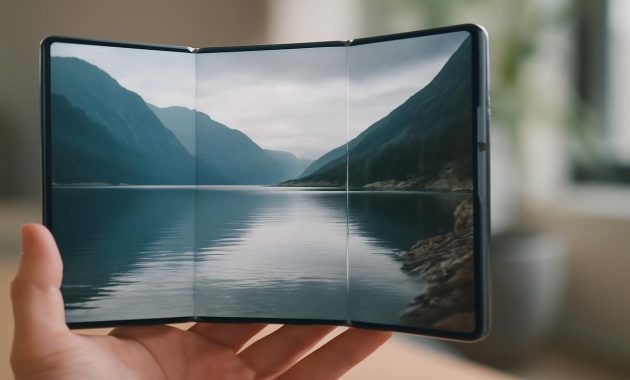
The first time you see a phone unfold into three luminous panes of glass, your fingers hesitate. It feels like you’re about to break a rule of physics, like opening a book that keeps unfolding into more pages than its spine should reasonably hold. The Samsung Trifold isn’t subtle. It doesn’t slip quietly into your life the way a standard slab phone does. It arrives with the drama of a transforming object, part gadget, part origami, part statement piece—and wrapped inside it all is one controversial compromise that you can’t quite ignore, no matter how dazzled you are by those three glowing screens.
A Device That Feels Like Future Tense
Set the Samsung Trifold down on a table and the first impression is almost deceptive. Folded, it’s a thick, compact rectangle—denser than your average phone, sure, but not absurd. The real magic begins when your thumb finds the hinge and you start to unfurl it, panel by panel, like a carefully folded map.
There’s a tiny breath of resistance at first, a mechanical whisper as the hinges wake up. Then it opens, not in one motion, but in segments. One screen becomes two, and then—click—a third surface reveals itself. Your field of view triples. Black glass becomes a small, portable universe of panels and pixels. It’s the kind of tactile experience that makes you grin despite yourself, that makes people at the next café table lean over and ask, “Wait, what is that?”
In a world of look-alike slabs, the Trifold radiates difference. You don’t casually check email on it without also noticing the way the light curves across its seams, or the faint, satisfying firmness as the final hinge locks in place. If most phones are passive tools, the Trifold is an event waiting to happen in your hands.
The Sound and Feel of Three Hinges
Living with the Trifold is an ongoing dialogue between hardware and habit. The hinges are at the center of this conversation. You feel them every time you open the device, not as a flaw, but as a physical punctuation mark. They give the unfolding a rhythm: one hinge, then the next, a small choreography of clicks and soft tension.
The exterior casing feels reassuringly solid, more like a tiny book of glass and metal than a fragile gadget. There’s a certain weight to it—inevitable with three screens stacked like nested doors—that you start to register in your pocket, in your bag, in your hand at the end of a long day. It’s not too heavy to carry, but you’re always aware it’s there. This isn’t the quiet, forgettable presence of a slim flagship; it’s a small companion that insists on being felt.
The first few days, you may find yourself unfolding it just for the pleasure of the motion, watching how the displays wake up in sequence. A notification sparks to life on the outer screen; open the first fold, and the interface stretches, almost sighing into the new space; open the second fold, and the phone doesn’t just get bigger—it becomes something else. A mini tablet. A dashboard. A control center.
And that’s when you realize what three screens really mean: not just more pixels, but more intention. Each mode—folded, half-open, fully extended—feels like a different tool, inviting a different kind of attention.
Multiplying Space: How Three Screens Change the Day
The real magic of the Trifold isn’t the spectacle of the folding itself; it’s the way your day quietly reorganizes around the abundance of space. On that fully expanded canvas, your scattered digital life suddenly finds room to breathe.
Imagine a morning. On the left panel, your email: a messy stream of bold subject lines and half-finished replies. In the center, your main workspace—a browser window with an article you’re reading, or a document you’re editing. On the right, a messaging app, conversations ticking along like a side-channel of consciousness. You’re no longer trying to squeeze productivity through a keyhole. You’re surrounded by it.
There’s something oddly calming about this tri-pane layout. Instead of jumping between apps every few seconds, you glance. Eyes move from left to center to right in small arcs, the way they would across a well-organized desk. A recipe on one screen, a video call on another, your notes open on the third. Or maybe a game occupies the middle panel while chat and music controls flank it like digital wings.
The Trifold encourages a kind of digital multitasking that feels less frantic and more spatial, like laying out physical papers on a large table. You don’t forget what you were doing moments ago because it’s still there, glowing gently on a side screen, waiting.
The Controversial Compromise
But all this cinematic unfolding comes with a price, and it’s not just the literal one. Every bold experiment leaves a footprint somewhere, and with the Samsung Trifold, the controversy tends to condense around one stubborn point: the front-facing, folded experience.
Fold it closed and that elaborate, triple-pane wonder collapses into a single, tall, narrow outer screen. It’s usable—of course it is—but it doesn’t feel quite… natural. The aspect ratio is a little off from what your fingers and thumbs have been trained to expect through years of standard smartphones. Typing feels tighter; some apps look slightly compressed, like they’re standing up straighter than they’d like to be.
This is the compromise the design makes. To give you that expansive interior canvas, something had to yield, and here it is: when shut, the Trifold can feel a bit like peeking at a movie through a doorway instead of standing in the room. Functional, but not fully satisfying.
For some people, this will be a quirk they easily adapt to—a muscle memory recalibration, nothing more. For others, it’s a deal-breaker, a constant reminder that the device has been optimized for its most dramatic form factor, not its most common one. After all, you don’t always have two hands free to unfold your world. There are train rides, grocery lines, windy sidewalks, moments when you just want to glance, tap, move on.
The question becomes: are you willing to adjust your daily rhythms for the promise of that sprawling interior space? Are you buying a phone that sometimes becomes a tablet—or a tablet that sometimes pretends to be a phone?
Living Between Phone and Tablet
What’s fascinating about the Trifold is how quickly it blurs the boundaries between devices. Once you have three screens that can cooperate, the line between phone and tablet—once sharp and obvious—starts to dissolve into preference and posture.
On a quiet evening, you might prop it up on a table, half-folded in a tent-like pose. The middle and one outer screen become your viewing surface while the unused section rests like a stand. Suddenly you’re watching a show without hunting for something to lean the device against. On a flight, you expand it fully, download a few episodes or open a downloaded book, and the seat-back tray becomes a stage for a personal cinema.
In meetings—or these days, video calls from a cluttered desk—it becomes a hybrid control deck. Camera and call interface in one panel; shared presentation in the center; notes or chat off to the side. You’re not alt-tabbing through your life; you’re simply shifting your gaze.
But this between-worlds identity has its own tensions. The more you treat the Trifold like a tablet, the less content you are with its closed-mode quirks. The more you insist it behave like a traditional phone, the more you’re under-utilizing what makes it remarkable. It’s a device that rewards those willing to live in that in-between state, neither fully phone user nor fully tablet user, but something more hybrid and experimental.
Durability, Doubts, and the Patina of Use
Any time glass starts bending, skepticism follows. People ask the same questions over and over: How long will the hinges last? Will the crease deepen? What happens after a year, or two?
The Trifold’s hinges feel sturdier than earlier generations of foldables, the way the heavy spine of a hardcover feels more reassuring than a flimsy paperback. Samsung coats its language in confidence—tests, cycles, engineering jargon—but you don’t really trust a foldable with your real life until you’ve lived with it. Until it’s been tossed into bags, opened hundreds of times on the couch at midnight, survived being snapped shut with crumbs on the coffee table nearby.
Over time, a device like this collects a kind of patina. Not just smudges and micro-scratches, but the soft, reassuring knowledge that it has opened and closed thousands of times and still feels solid. You learn exactly how much pressure to apply when unfolding. You learn the feel of the hinge halfway open, the balance point where it will sit in your hand without effort. You learn the tiny differences in vibration when a notification pings on one panel versus all three.
Still, that fragile question—will it last?—never completely disappears. It lives at the edges of your awareness, the way you’re always slightly more careful with a favorite hardcover than a mass-market paperback. You enjoy it, but you’re conscious of the investment built into every satisfying click.
Numbers, Specs, and the Shape of Preference
Underneath the spectacle, the Samsung Trifold is still a machine of numbers: screen sizes, refresh rates, battery capacities, hinge cycles, megapixels. But those figures only start to make sense when you see how they intersect with actual daily habits.
To place it in context, imagine a simple snapshot of how it compares to more familiar devices:
| Feature | Samsung Trifold | Standard Smartphone | Small Tablet |
|---|---|---|---|
| Screen Setup | Three folding panels | Single flat display | Single flat display |
| Portability | Pocketable but thick | Slim and light | Bag-only for most users |
| Multitasking Space | High—3 apps comfortably | Limited—1–2 apps | High, but not pocketable |
| Everyday One-Hand Use | Compromised outer screen | Optimized experience | Not designed for one hand |
| “Wow” Factor | Extremely high | Low to moderate | Moderate |
On paper, the Trifold often looks like a supercharged convergence of phone and tablet. In practice, your enjoyment depends on how often you’ll actually lean into that convergence. If you rarely multitask or prefer to live in one app at a time, much of its potential becomes ornamental. If, on the other hand, you routinely juggle messaging threads, documents, videos, and calls, those specs turn into something you can feel: less friction, fewer switches, more presence.
Who Is This For, Really?
The Trifold doesn’t try to please everyone. It’s not the quiet workhorse you hand to someone who “just needs a phone.” It is, unapologetically, a device for people who want to live at the edge of what’s possible—with all the trade-offs that entails.
It’s for the creative who sketches on one panel while reference images sit open on another. For the remote worker who lives inside video calls and documents and gets tired of hopping between them on a cramped screen. For the traveler who wants to turn a hotel bedside table into a little cockpit of entertainment and planning. It’s for people who look at a normal phone and feel a little boxed in, a little constrained.
But it’s also for the patient, for those willing to adapt. You have to accept that the outer screen isn’t perfect. That the thickness is real. That sometimes people will stare. That early-adopter tech often rides ahead of the software that fully exploits it, leaving some experiences feeling like glimpses of a future still under construction.
If your ideal phone disappears into your pocket and your mind, appearing only when summoned, the Trifold might feel like too much. It insists on presence. It demands to be opened, used, explored. It turns small moments—checking a map, responding to a message, queuing up a playlist—into acts you feel in your hand and your attention.
And that, perhaps, is its strangest strength. In an era where our devices increasingly fade into the background of our lives, the Samsung Trifold pulls you back into a conscious relationship with your screens. You don’t just live through it; you live with it, unfolding and refolding your day, one hinge at a time.
Frequently Asked Questions
Is the Samsung Trifold comfortable to use as a regular phone?
It’s usable, but not ideal. The outer screen works fine for quick tasks, notifications, and basic one-hand use, but its unusual proportions can feel cramped compared to a standard smartphone. You get the most comfort when the device is partially or fully unfolded.
Does the triple-fold design feel fragile?
It feels more robust than early foldables, with solid hinges and a reassuring weight. Still, it’s a more complex device than a normal phone, so you’ll naturally be a bit more careful. Over time, many users report building trust as the hinges withstand daily use.
Who benefits most from a three-screen foldable?
Heavy multitaskers, remote workers, content creators, and anyone who frequently jumps between several apps at once will get the most benefit. If you mostly use one app at a time, the added complexity may not be worth it.
Does the crease bother you when the device is fully unfolded?
You can see and sometimes feel it, but once content fills the screens, your eyes tend to tune it out. It’s present, but for many users it becomes background texture rather than a constant distraction.
Is the Samsung Trifold a replacement for both phone and tablet?
For some people, yes. It can realistically stand in for a small tablet while still fitting in a pocket, making it a compelling all-in-one device. For others, the compromises in closed-mode might still justify keeping a simpler phone or a dedicated tablet alongside it.
Originally posted 2026-03-05 00:00:00.