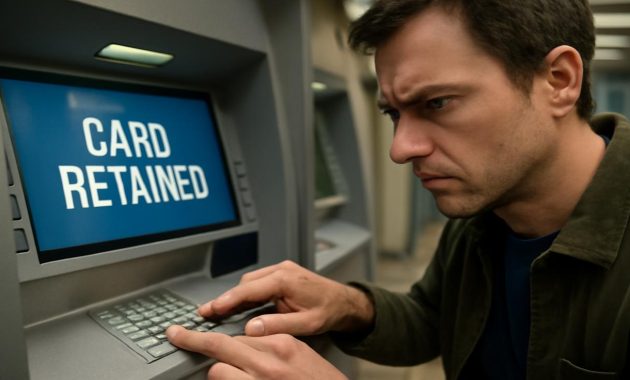
The machine swallowed my card on a Tuesday that smelled like rust and rain. I remember the thin, metallic taste of panic rising in my mouth as the ATM screen blinked, thought about it for a moment, and then—nothing. No card. No cash. Just my own reflection in the scratched plastic, staring back at me with wide eyes and a sinking stomach. Somewhere behind that silent slot, my access to groceries, rent, and the rest of my week sat trapped in a humming metal box bolted to the wall.
The Moment the Machine Goes Quiet
It usually starts the same way. You’re in a hurry. Maybe it’s late, cold, or hot enough that your shirt sticks to your back. The dull whirring of the ATM feels comforting at first—a familiar machine in an increasingly uncertain world.
You tap in your PIN. You choose your amount. You’re already thinking ahead: the next errand, the bus you might miss, the message you need to reply to. You’re half here, half somewhere else.
Then the machine makes a sound that isn’t quite right. A pause. The soft buzz stops. The slot doesn’t spit the card back. The screen lingers on “Processing…” far longer than it should, like a person who has just realized they don’t know what to say.
Your mind jumps: Did I enter my PIN wrong too many times? Is my card expired? Did someone tamper with this ATM? Did it just… break?
Right here—this thin slice of time, the few seconds when the card hasn’t come back yet, when the screen hasn’t told you what’s wrong—is where your best chance lives. There is a fast technique that, if you use it in those first ten to fifteen seconds, often works like a little magic trick. Not a hack. Not anything illegal. Just a clever way to speak the ATM’s language before it fully decides to keep your card.
The Fast Retrieval Technique (Before the ATM Locks Your Card)
The trick isn’t violent or dramatic. No prying, no banging, no random button mashing. Instead, it’s about timing and knowing how most ATMs are programmed to behave.
Here’s the sequence most machines follow: they read your card, allow a transaction, then, at the end, they wait a short window of time for you to take the card back. If you don’t, they assume you’ve forgotten it and “pull it in” to keep it safe. Many models give you a very short grace period—even after they’ve started to retract it—where the system still thinks, this card might yet be taken.
That window is your opportunity. When you realize the card isn’t coming back or the screen hangs, don’t walk away, and don’t just stare helplessly. Instead, move with calm urgency through this sequence:
- Stay right in front of the ATM. Keep your eyes on the card slot and your fingers close. Don’t panic, don’t leave.
- Press the “Cancel” button firmly once. Just once. No frantic stabbing, no jamming every key in sight. Many ATMs are programmed to abort a frozen transaction and eject the card when “Cancel” is pressed during that brief in-between moment.
- Watch the slot and listen. Sometimes you’ll hear a faint mechanical cough, a quiet whirring, or a click as the system tries again to release the card.
- If there’s no immediate response, press “Cancel” again after 3–5 seconds. One more time, not a barrage. You’re nudging the ATM’s logic, not fighting it.
- Gently place your fingers at the edge of the slot. Do not insert anything inside. But do let your fingers be ready, as though you’re catching a small envelope being slid under a door. If the ATM decides to re-try the ejection, you’ll want that fraction of a second.
This quiet little dance, played out in under fifteen seconds, is surprisingly effective. Some machines, sensing an incomplete transaction or a brief software hiccup, will attempt a soft reset that concludes with a card ejection. Pressing “Cancel” at the right moment can encourage that reset without triggering a full security lockdown of the card.
And when it works, it happens fast. One second the slot is an indifferent, dark rectangle. The next, your card edges outward like a shy animal testing the air, and your hand closes over it with the kind of relief that feels much bigger than its small rectangle of plastic.
Reading the Machine’s Mood
Not all ATMs behave the same way. Some are old and stubborn, their plastic buttons worn smooth like river stones. Some are slick and modern, all glass and touchscreens, humming with hidden rules. Learning to “read” the machine in front of you is half instinct, half observation.
Watch the screen. Is it still active, thinking, spinning, flashing “Processing…” or “Please wait”? Or has it jumped to a hard message, something like “CARD RETAINED – CONTACT YOUR BANK”? That difference matters.
When the message is vague, when the machine is hovering in uncertainty, the fast retrieval technique often has a chance. A still-active screen, a faint mechanical murmur, the sense that the system is still mid-process—these are signs that it hasn’t fully committed to keeping your card yet.
Once the machine clearly says your card has been retained, the odds drop. Many banks program that as a final decision: the card is logged, marked, and locked inside until a technician or bank employee retrieves it. Pressing buttons after that point is like arguing with a door that has already been locked from the inside.
Even then, though, timing isn’t just about seconds—it’s about how you respond. The faster you move into your next steps, the more control you get back over the situation, even if the card is gone for now.
What Not to Do in the First 60 Seconds
Panic makes people creative in all the worst ways. There’s something about seeing your card vanish into that slit of darkness that shakes loose the oddest ideas.
People jam pens, keys, even other cards into the slot, as if the machine will cough up the original in gratitude. Others hit the screen. Some try to cover the camera with a hand or hat, as though they’ve just become the main character in a late-night crime film.
Each of those responses has something in common: they usually make a fixable problem worse.
- Never insert anything into the card slot. You can damage the reader, get the foreign object stuck and your card trapped deeper, and possibly be blamed for tampering.
- Don’t walk away too quickly. Some ATMs eject the card after a short internal check. If you turn your back and walk off, the card might slide out—ready for the next person’s hand instead of yours.
- Don’t keep randomly pressing all the keys. ATMs don’t respond well to chaos. You might accidentally trigger a lock, reset, or another retention rule.
- Never accept help from a stranger who wants to “reprogram” the ATM. If someone stands too close, gently but firmly ask for space. Most scams start with forced helpfulness.
In those early seconds, your job is narrow but crucial: try the quick cancel-and-wait retrieval, then shift calmly to protecting your account if the machine truly won’t let go.
The Quiet Checklist While You’re Still Standing There
After trying the fast technique and realizing the card really is stuck, there’s a particular stillness that settles in. The machine hums softly. Maybe the branch is closed, the lights behind the glass already turned down. Traffic passes behind you; a taxi idles, people walk dogs, someone laughs into their phone. The world continues, unfazed by your small private crisis.
But you’re not helpless, even without your card in hand. This is where a calm mental checklist becomes your lifeline.
| Action | Why It Matters | Ideal Timing |
|---|---|---|
| Press “Cancel” once or twice calmly | Can nudge the ATM to retry card ejection | Within the first 10–15 seconds |
| Watch for any on-screen message | Tells you if card is retained or system error | Immediately, while still at the machine |
| Note the ATM details | Helps your bank trace the event | Before you leave the ATM |
| Call your bank’s emergency or card hotline | Blocks misuse if the card is compromised | Within minutes of the incident |
| Check your recent transactions | Spots fraud early if it’s a skim or scam | As soon as you can access your account |
Make a quick mental note—or better, snap a photo—of the ATM. Capture the bank name, location, street sign, any ID number on the machine, and the exact time. If there’s a tiny sticker with a service phone number on the side of the ATM, include that too.
Then, still standing there, call your bank’s official number from the back of another card, from your bank’s app, or from their official site. If it’s your bank’s own ATM and it’s attached to a branch, call the branch directly if they’re open. Tell them plainly: the ATM kept your card, you tried to recover it, and it did not release.
In most cases, they’ll immediately block the card and arrange a replacement. If it’s your bank’s ATM during business hours, they might retrieve it later and hold it at the branch—though some banks will still insist on issuing a new card rather than handing back the captured one, for safety.
When the Problem Isn’t Just a Glitch
So far, this sounds like a story of stubborn machines and unlucky moments. But sometimes, a retained card is less accident and more ambush.
There are devices, small and mean, that criminals fix onto card slots: thin shims, overlays so delicate they look like part of the ATM itself. Some are designed to “eat” your card and then release it later into a waiting hand. You go home thinking the bank will sort it out. The scammer returns, removes the device, and walks away with your card and—if they’ve skimmed your PIN—your access to your money.
That’s why your instincts, tuned to your senses, matter as much as your logic:
- Did the card slot look normal when you arrived, or was it oddly loose, misaligned, or clumsy-looking compared to the rest of the machine?
- Did your card meet resistance going in, like something soft or thin inside the slot?
- Is there a suspicious piece of plastic around the slot that looks like it doesn’t quite belong?
If your answer to any of these is yes, your card might not be sitting safe and sound in the steel belly of the ATM—it might be lodged in a device someone else plans to harvest.
In that case, the fast retrieval technique becomes even more valuable. If your gentle, well-timed use of “Cancel” coaxes your card back out, you’re not just saving yourself a phone call; you might be saving your account from a thief.
And if the card doesn’t come back, assume the worst until proven otherwise. Stay nearby, quietly watch the area for a few minutes. If someone approaches the ATM and seems particularly interested in the slot or panel, do not confront them—but do take note and call the bank and, if appropriate in your area, the non-emergency police line to report a suspicious ATM.
Rewriting the Story in Your Favor
There’s a subtle power in turning a small crisis into a moment of competence. The next time you walk up to an ATM, you’ll carry a little more awareness with you—like someone who has learned to read weather from clouds, or water from ripples.
You’ll notice the machine’s face: is the card slot clean, snug, unremarkable? Is the keypad fixed firmly, or does it wiggle under your touch? Is there anything extra, anything that looks layered on?
You’ll know that if the screen hesitates, if the card doesn’t immediately present itself like a soldier at attention, you have a short, precious window. Your hand will move with intention: a single press of “Cancel,” a quiet pause, another, and your fingers waiting lightly by the slot, poised but not forcing.
Sometimes, the card will slide back into your fingers like it never considered abandoning you. Sometimes, it won’t. Machines are imperfect, and so are the humans who build and program them. Networks falter, rules misfire, cards fail.
But the story doesn’t end at the mouth of the machine. It continues in your choices, your calm, the way you step from reflex panic into deliberate action: recording the details, making the right call, shutting down the possibility of fraud before it has time to grow teeth.
We like to imagine technology as either benevolent or hostile, a friend or a betrayer. In truth, it’s more like weather—shifting, complicated, sometimes predictable if you know what to watch for. And like weather, it rewards those who pay attention early rather than those who curse the storm after it’s already broken.
Carrying the Technique with You
On another night, months after that first rainy Tuesday, you might find yourself at a different ATM. Maybe it’s tucked into the side of a small grocery store, its screen blinking sleepily in the dim glow of fluorescent lights. You’ll slide your card in, listening to the soft inward sigh of the mechanism. Your fingers will hover in that casual, ready way you practiced without even thinking.
If all goes well—and it usually does—you’ll get your cash, your card, and the rest of your evening will unfold untouched by crisis. But if the ATM hesitates, if the card lingers in the unseen spaces of its internal rails, you’ll know what to do, and you’ll know to do it fast.
Press “Cancel.” Wait. Listen. Press again once. Be ready at the slot. Use those first fragile seconds when the machine is still deciding what to do with you.
It’s a small, quiet skill. No one on the sidewalk will applaud. You’ll just walk away, card in pocket, like someone who met a problem at the edge of happening and softly convinced it to back down.
And for a simple piece of plastic that opens doors and fills bags and keeps the month moving—that’s a skill worth having.
FAQ
What is the fastest way to get my card back if the ATM keeps it?
The quickest method is to act within the first 10–15 seconds: stay at the machine, press “Cancel” once, wait a few seconds, press it again if needed, and keep your fingers ready at the card slot. Many ATMs will attempt to eject the card again during this brief window.
Is it safe to press other buttons to try to retrieve my card?
Stick to the “Cancel” button only. Randomly pressing keys can confuse the machine or trigger additional security steps, making it more likely your card will be permanently retained.
Can I try to pull my card out with another card, pen, or object?
No. Inserting anything into the slot can damage the ATM, trap your card deeper, or make you appear to be tampering with the machine. It can also interfere with any automatic ejection the ATM might attempt.
If the ATM says “Card retained,” can I still get it out using this technique?
Once the screen clearly says “Card retained” or “Please contact your bank,” the internal system usually locks that card in. At that point, the fast retrieval method is unlikely to work. You should contact your bank immediately to block the card and arrange a replacement.
What should I do immediately after my card is kept?
Note the ATM location, bank name, time, and any machine ID. Call your bank’s official hotline right away to report what happened. Ask them to block the card to prevent any misuse and follow their instructions about replacement or retrieval.
How do I know if my card was taken by a scam device instead of the ATM?
Signs include a card slot that looks loose or misaligned, unusual resistance when inserting your card, extra plastic frames around the slot, or keypads that feel like overlays. If your card is kept and you noticed anything strange, treat it as suspicious: report it to your bank and, if needed, to local authorities.
Can the next person at the ATM get my card if it comes out after I leave?
Yes, it’s possible. Some ATMs may take longer to eject the card or reset. If you walk away too soon, someone else could find your card in the slot. That’s why it’s important to stay for a short while, try the fast retrieval technique, and then immediately call your bank if your card doesn’t return.
Will the bank ever give my card back if the ATM kept it?
Policies vary. Some banks, especially if it’s their own ATM at a staffed branch, may retrieve and hold your card for you. Others will destroy the retained card and issue a new one for security reasons. Your bank can tell you what they do in your region.