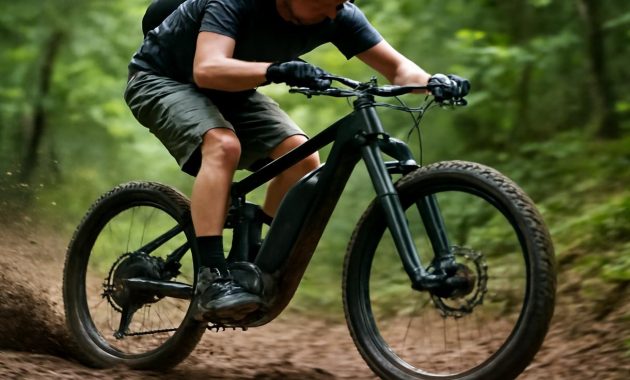
The first time I saw it, the morning mist was still hanging low over the parking lot at the edge of the forest. A small crowd had gathered in that awkward half-circle people make when they’re curious but don’t want to look too eager. In the middle of it all, leaning casually on its kickstand, was the reason we were all there: a muscular, silent, almost understated machine with “Decathlon” stamped along the frame. One of the staff rolled it forward, and the gravel barely crunched. Someone whispered, “That thing’s electric?” Another voice answered, “Yeah. And it’s way cheaper than it should be.”
In that moment, it felt like we were watching a quiet revolution on two wheels. No glossy showroom. No champagne launch. Just a bike, the smell of wet pine, and a bunch of people wondering if this was finally the super-powerful electric mountain bike that didn’t demand a small fortune in return.
The Day the Forest Went Quiet
The trails were still damp from the night’s rain, the kind that makes roots glisten and rocks just slick enough to be interesting. I wheeled the Decathlon e-MTB—chunky tires, solid suspension, battery neatly tucked into the frame—toward a climb I’d usually avoid on a cold morning. You know the one: the long, grinding fire road that seems to lift straight into the clouds, where halfway up your legs start bargaining with your lungs.
Normally, that climb is an orchestra of chain noise, ragged breathing, and the low-level self-doubt that comes when your heart rate spikes before your coffee’s kicked in. But not this time. I tapped the power button, felt the motor hum to life like a cat stretching under your hand, and started pedaling.
It wasn’t a jolt. It was a push—gentle at first, like a tailwind you didn’t notice until you realized you were going faster than usual. The forest didn’t echo with engine noise or mechanical protest. It just…quietly stepped aside. Birdsong, the soft hiss of rubber over wet dirt, and my own surprised laughter were the loudest things around.
I’ve ridden plenty of e-MTBs before, the sort that cost as much as a used car, with space-age branding and spec sheets that read like a tech manifesto. This Decathlon bike didn’t feel like that. It felt almost suspiciously normal. Familiar. Accessible. Like someone had taken the idea of a high-powered electric mountain bike and quietly asked, “Okay—what if regular humans could actually afford one?”
Power, Without the Attitude
Electric-assist mountain bikes are usually framed like status symbols. The price tags alone can make you feel like you’re signing a contract for a second mortgage. Yet here was this Decathlon model, braided into a very different story: performance first, ego second, budget firmly in the conversation.
As I clicked through the assistance modes, the bike’s personality revealed itself. Eco mode: just enough help to smooth the ride, like a friend pushing from behind when you hit a steep bit. Trail mode: a sweet spot where your own strength and the motor’s torque shake hands and start moving as one. Boost mode: that slightly wild grin territory where climbs turn into something suspiciously like play.
The motor didn’t lurch or whine. On the steepest pitch, when the trail pitched skyward in a rude wall of dirt and roots, I braced for that jerky surge some cheaper e-bikes deliver. Instead, the power came on smoothly, almost politely, translating each pedal stroke into forward momentum without ripping the rear wheel loose. No wheel spin tantrums. No sudden loss of control.
There’s something profound about that: power without arrogance. For years, electric mountain bikes felt like they came with an unspoken warning—if you’re not a pro, you’re going to be in over your head. This one, even at full assistance, felt rideable. Approachable. Like a machine that wanted to partner with you, not prove something to you.
The Decathlon Difference: Where Price Meets Dirt
Somewhere between the second climb and the third descent, I realized what made this bike feel different wasn’t just the motor or the geometry. It was the quiet fact that it comes from a place like Decathlon—a brand that’s made its name by not gatekeeping the outdoors.
Walk into one of their stores and you’ll see kids wobbling on entry-level bikes, hiking boots lined up like soldiers, paddles, tents, climbing gear—all humming with the same promise: you belong out here, too. This e-MTB fits that ethos like a glove. It brings trail-shredding power into a price bracket that, while not pocket change, no longer feels like a dare.
To make it concrete, here’s how it roughly stacks up against the typical e-MTB experience you might have seen—and why it feels like a small rebellion:
| Feature | Decathlon e-MTB | Typical High-End e-MTB |
|---|---|---|
| Price Range | Significantly lower, designed to be accessible | Often 2–3x higher, premium market |
| Motor Power & Assist | Strong, natural-feel assist for steep climbs | Similar or slightly higher torque, sometimes overkill |
| Battery Capacity | Generous for long trail days at mixed assist | Comparable or larger, but at a steep price |
| Suspension & Components | Trail-ready, robust, sensibly chosen parts | Top-tier, sometimes more than most riders need |
| Target Rider | Everyday riders, new e-MTB users, budget-conscious adventurers | Enthusiasts, racers, tech collectors |
What that table doesn’t say, but you feel instantly when you ride it, is this: you don’t have to be rich or fast or experienced to deserve an electric mountain bike with real muscle. This thing is built for the person who gets off work at five, glances at the sky, and thinks, “I’ve got time for a quick lap before dark.”
On the Trail: How It Really Feels
Here’s the truth about any mountain bike, electric or not: the spec sheet vanishes as soon as your front wheel drops into a descent. Numbers fall away. What remains is sensation—how the bike moves beneath you, how it forgives your mistakes, how bravely it leads you down a line you’ve only ever watched from the sidelines.
Pointing the Decathlon e-MTB downhill for the first proper run, I was ready to forgive a lot in the name of affordability. Maybe the suspension would feel harsh. Maybe the brakes would be a little underwhelming. Maybe the whole thing would carry its weight like a full backpack that shifted annoyingly with every move.
What actually happened was pleasantly unremarkable—in the best way. The suspension soaked up chatter from the roots, but still gave enough feedback to keep the trail readable. On a series of tight switchbacks, the bike felt more nimble than its electric heart might suggest. That infamous “e-bike weight” was there, sure, but it was balanced. Predictable. Like hiking with a well-fitted pack you quickly forget about.
Then came the rocky section: fist-sized stones, random ledges, and a rutted line that always made me second-guess my speed on a regular hardtail. I aimed in, let the front wheel roll, and waited for the shudder that sometimes comes with budget-friendly components pushed too hard. Instead, the bike stayed composed. The frame didn’t whine. The wheels held their line. The brakes bit firmly, without that heart-sinking squish that signals a long stop and a longer walk home.
It wasn’t perfect—no bike is. Hardcore riders might wish for more travel here, a different drivetrain there, a slightly lighter wheelset. But those are the kind of details you nitpick once you’re already deep into the sport. For someone stepping into e-MTBs for the first time, or graduating from a tired commuter hybrid, this felt not like a compromise, but a doorway.
The Hidden Superpower: Expanding Your World
One of the most underrated things about a powerful electric mountain bike isn’t that it makes climbing easier. It’s that it changes the scale of your day. Trails that used to be “weekend only” destinations, reserved for those rare long windows of time, suddenly slip into your Tuesday evening routine.
With the Decathlon e-MTB, that shift happens quietly. The battery range is generous enough that you don’t ride with a calculator in your head, constantly weighing whether you’ll make it back to the car. Instead, you start thinking in loops, side quests, that single extra viewpoint you used to skip because it meant another punishing climb.
On one ride, I reached a familiar crossroads where I usually turn left, back toward home. To the right: a longer circuit, another 300 meters of climbing, and a lookout I rarely visited because, frankly, I just didn’t have the legs after a full day of work. That evening, with assist on a moderate setting, right suddenly felt reasonable. Tempting, even.
I went for it.
The extra loop didn’t feel like a punishment. It felt like a bonus track, unlocked by a battery and a motor that weren’t there to show off—they were just there to help. At the top, as the last light brushed the treeline in a dusty orange, I realized something: this bike doesn’t just make old trails easier. It makes your map bigger.
That’s the real superpower here. It invites people further. Riders who might have bailed at the first sign of a brutal gradient now find themselves saying, “Yeah, let’s see what’s over that ridge.” Those who are older, less fit, or just new to the sport aren’t forced into the binary of suffer or stay home. They get to choose how they ride, not whether they ride at all.
Built for Real Life, Not a Catalog
If you ride often enough, your bike eventually stops being just gear and starts becoming part of your everyday rhythm. It leans against café walls, collects dust in hallway corners, and occasionally picks up scars that tell their own strange little stories. An electric mountain bike, especially, has to live in the overlap between adventure and routine.
This is where the Decathlon ethos shows up again, quietly but unmistakably. The bike is built not only to impress on spec sheets, but to survive regular use—the kind of use that means muddy commutes, rushed hose-downs in the driveway, last-minute rides in questionable weather.
The controls are intuitive, readable even when your glasses are streaked with rain or your gloves are bulky. The battery removes and locks with a solid, satisfying click—no delicate choreography required. Thoughtful details, like cable routing that doesn’t snag easily and contact points designed for long hours in the saddle, speak to a design process that’s been informed by real-world riders, not just engineers in a lab.
And then there’s the simple comfort of knowing that, should something go wrong, you’re not dealing with a boutique unicorn brand that requires shipping your pride and joy halfway across the country. Decathlon’s network—stores, workshops, parts availability—means the ownership experience is grounded. This isn’t some fragile, precious object. It’s a tool, and a companion, meant to be used hard and often.
Who This Bike Is Really For
Somewhere on that last descent of the day, chasing the last usable light, it occurred to me that trying to describe the “typical” rider for this electric mountain bike might be the wrong approach. Because, in a way, the bike is designed to erase the idea that there’s a typical rider at all.
It’s for the forty-something parent who can finally keep up with teenagers on the climbs, instead of waving from the bottom of the hill. It’s for the weekend hiker who’s been eyeing bikes on the trail and thinking, Could I do that? It’s for the seasoned rider whose knees have started protesting long slogs but whose love for singletrack hasn’t dimmed one bit.
It’s also for the beginner who might have bought a cheap, underpowered e-bike online and then discovered that “mountain-ready” was more marketing than truth. On this Decathlon rig, that beginner gets a fair shot at falling in love with the sport instead of fighting their equipment from day one.
Is it the absolute lightest, flashiest, most aggressively specced machine on the market? No. That’s not what it’s trying to be. This bike is something rarer right now: a highly capable, super-powerful electric mountain bike that doesn’t stand at the gate checking your wallet before it lets you through.
On the ride back to the car, lights flicking between trees, the motor humming quietly at a low setting, it felt less like I’d just tested a product and more like I’d glimpsed a future where more people are out here—on the climbs, in the corners, at the viewpoints usually reserved for the ultra-fit and the ultra-equipped. And that, more than wattage or battery cells or component lists, might be the most exciting thing about it.
FAQs
Is a Decathlon electric mountain bike powerful enough for serious trails?
Yes. Decathlon’s e-MTBs are designed with robust motors and capable batteries that can handle steep climbs and technical terrain. While they may not chase extreme, race-focused specs, they offer more than enough power for demanding trail riding and long days in the hills.
How does the price compare to other electric mountain bikes?
Decathlon deliberately prices its e-MTBs well below many high-end competitors. You still get strong performance and reliable components, but without paying the premium that often comes with niche or boutique brands.
Can beginners use this bike, or is it just for experienced riders?
It’s very beginner-friendly. The assistance modes are intuitive, the handling is stable, and the geometry is forgiving. Riders new to e-MTBs will find it approachable, while more experienced riders will still appreciate its capability on real trails.
What kind of range can I expect from the battery?
Range depends on terrain, rider weight, assist level, and riding style, but you can generally expect enough capacity for a solid trail session or even a long ride when using mixed assistance modes. Many riders comfortably cover multiple climbs and descents on a single charge.
Is it hard to maintain an electric mountain bike from Decathlon?
Maintenance is straightforward. Most components—brakes, drivetrain, suspension—are standard and can be serviced like any other mountain bike. Decathlon’s in-house workshops and parts support also make it easier to keep the bike running smoothly over time.
Can I use a Decathlon e-MTB for commuting as well as trail riding?
Yes. Many riders use their e-MTB as a dual-purpose machine. With the right tires and a few practical additions—like lights and mudguards—it can handle weekday commutes and still be ready for weekend trail adventures.
Who is the ideal rider for this kind of electric mountain bike?
The ideal rider is anyone who wants strong off-road performance without spending a fortune: newcomers to the sport, returning riders, budget-conscious adventurers, and experienced trail fans who prefer value and reliability over flashy branding.
Originally posted 2026-03-05 00:00:00.