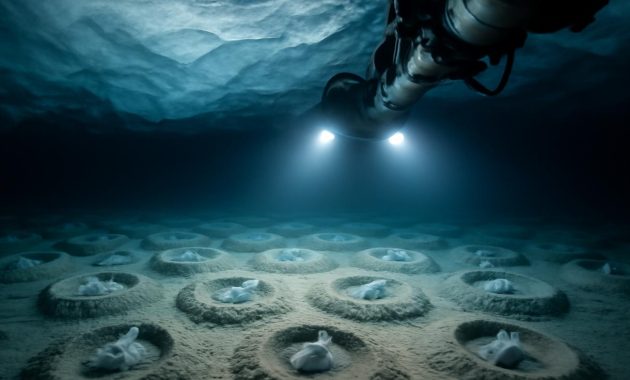
The first thing the scientists noticed was the sound—the faint mechanical hum of the ship’s engines softened by thick Antarctic ice, the quiet clicking of sonar, the distant groan of floes shifting against steel. Outside, the Weddell Sea was a frozen desert of white and blue, seemingly empty. Underneath, they expected more of the same: a cold, dark, sparsely inhabited deep. Instead, as the sonar images scrolled across the screens, a pattern began to emerge—dots, rings, shadows, repeating in eerie regularity. Someone leaned closer, frowning, then laughed in disbelief. These weren’t rocks. They were nests. Fish nests. Thousands upon thousands of them, stretching for kilometers beneath the ice, hidden in a place no one thought to look.
A Hidden City on the Seafloor
Imagine riding in a research vessel over ice so thick you can’t see a hint of water. The horizon is a pale, endless smear. The air hits your face like broken glass. You stand on deck for only a minute before your eyelashes frost over. Up here, it feels like nothing could possibly survive, let alone thrive. Yet below, a vast underwater city is humming with life—a sprawling metropolis of nests, parents, and unborn young, all carved into the soft seafloor like a secret message from another world.
This is what researchers stumbled upon in the Weddell Sea off Antarctica, when they deployed cameras and sonar beneath the ice. The instruments descended into the cobalt darkness and began to send back images—and there it was. A network of shallow pits dotted the seabed, each roughly the size of a large dinner table. In many of them, a ghostly fish hovered protectively over clusters of eggs. These were icefish, pale and almost translucent, with blood so clear it looks like water. They live in temperatures that would kill most other fish in minutes. And here they were, in numbers that defied belief.
As the ship glided slowly forward and the cameras kept rolling, the scale of the discovery unfolded. Not a few nests. Not hundreds. Not even thousands. The images revealed an area of nesting grounds covering hundreds of square kilometers—millions of nests, layered like a living mosaic on the Antarctic seafloor. A colony larger than many cities back home, existing unseen beneath a lid of ice.
The Day Science Blinked in Surprise
You might imagine that scientists, used to working at the edges of the known world, are difficult to shock. Yet in the control room of the research vessel, disbelief turned quickly into a kind of hushed awe. It was as though someone had switched on a light in an empty theater and revealed a full cast already performing on stage, oblivious to the audience that had just found them.
The sonar first hinted at the structure: regular, repeating shapes that spread beyond the edges of the screen. When a towed camera followed, the truth came into focus. Shallow, circular nests, about 75 centimeters across. Many were brimming with eggs, amber clusters resting on bare seafloor. Others were guarded by fish, their sleek bodies suspended just above the nest, fins flicking slowly. Some nests were empty, their rims still clear—a sign they had been used recently or were waiting for new arrivals.
Each image seemed to pose a question. Who are these fish, living in a place so remote and extreme? Why are they nesting here, in such staggering numbers? And how did we miss this for so long?
Part of the answer lies in the sheer difficulty of working in Antarctica. Sea ice, brutal storms, and months of darkness put much of the Southern Ocean out of easy reach. Research expeditions are rare, expensive, and tightly scheduled. You go with a plan, hoping nothing breaks and no storm traps you in drifting ice. It leaves little room for wandering. This time, a routine survey turned into something else entirely—a reminder that even in the age of satellites and seafloor maps, the planet still holds massive secrets.
The Icefish at the Heart of It All
The architects of this underwater mega-colony are icefish, members of the genus Neopagetopsis, often called Antarctic icefish. They look as if they were dreamed up in a late-night sketch session: pale, almost see-through, with no red color in their blood. That’s because they lack hemoglobin—the molecule that usually ferries oxygen around the body. Instead, their blood is thin and clear, adapted to carry dissolved oxygen in the near-freezing Southern Ocean, where cold water holds more oxygen than warmer seas.
Most of the year, icefish live in the frigid darkness, feeding on smaller creatures like krill and tiny fish. They are part of the quiet machinery that keeps Antarctic ecosystems running. But during breeding season, something extraordinary happens. They gather in this specific region of the Weddell Sea, where water currents bring a reliable flow of slightly warmer, nutrient-rich deep water. It’s just enough to make a difference in egg development, just right for life to take a chance in the cold.
The seafloor in this area becomes a kind of nursery plain. Each nest is a shallow bowl dug into the sediment, like a thumbprint pressed into clay. Male icefish carefully guard the eggs, fanning them with their fins to keep oxygen flowing. In the grainy light of the cameras, you can almost sense their vigilance—the way they hover, the way they refuse to abandon the nest even when a robotic camera arm drifts closer than is polite.
A Seafloor That Won’t Sit Still
It’s hard to appreciate the scale of this discovery until you picture it in terms of distance and density. The nesting field, as mapped by the expedition, stretched across an area of roughly 240 square kilometers. That’s about the size of a medium-sized city. In some places, there were around one nest per three square meters—imagine walking across a field where nearly every step would land you beside another carefully tended cradle of eggs.
Below is a simplified table to help visualize just how vast this underwater nursery really is:
| Feature | Approximate Value |
|---|---|
| Total nesting area | ~240 km² |
| Estimated number of nests | Several million |
| Average nest diameter | ~75 cm |
| Eggs per occupied nest | Up to ~1,500+ eggs |
| Water temperature near nests | Around -1.8°C to -0.5°C |
Looking at these numbers, it’s tempting to reduce the discovery to pure statistics, but the reality feels far more intimate. Each nest is a small story: one fish, one patch of seafloor, one gamble against the cold. Together, they form a tapestry of life almost orchestral in its scale—millions of quiet, beating chances stacked side by side.
The water here is not entirely still. Subtle currents bend around the seafloor slopes, bringing oxygen and transporting heat. The rise and fall of ice above, the shifting of seasons, and the movements of other creatures—seals, whales, drifting plankton—all weave into this hidden community. For predators, this nesting ground is a banquet. For the icefish, it is both sanctuary and battlefield, a place where some offspring will survive and many will not.
Why Here, and Why Now?
The nests cluster in a narrow band where environmental conditions are just right. Slightly warmer water from the deep circulates upward here, bathing the nests in temperatures that, while still lethal to most life on Earth, are ideal for icefish embryos. The currents also help keep the eggs supplied with fresh, oxygen-rich water.
To a human eye, the difference between -1.8°C and -0.5°C might feel like arguing over degrees of misery. To an egg developing on the seafloor, those tenths of a degree can mean the difference between life and death, between hatching on time or not at all. The ice above, acting as both shield and lid, keeps surface storms at bay while trapping a stable layer of cold water.
There’s also a longer history at work. Over evolutionary time, the Southern Ocean has been a laboratory of extremes. As ice advanced and retreated, many fish lineages went extinct. Icefish adapted instead—shedding hemoglobin, growing larger hearts, evolving antifreeze proteins in their blood that prevent ice crystals from shredding their tissues. These traits let them tolerate an environment that, to most species, is an instant no-go. The nesting colony in the Weddell Sea is not an accident; it’s the culmination of millions of years of experimentation, finely tuning a species to its world.
Ripples Through the Food Web
Discovering a colony like this is not just a curious footnote for marine biologists. It has huge implications for how we think about Antarctic ecosystems. If millions of icefish are converging here to breed, that means an enormous pulse of energy is moving through this region every year.
Think of each nest as a packet of calories—energy stored in eggs, in the bodies of guarding adults, in the predators that arrive to take advantage of the aggregation. Weddell seals, for instance, are known to dive to great depths, slipping through cracks in the sea ice to hunt in the dark below. For a seal, a dense field of icefish nests is like discovering a hidden orchard in a barren landscape.
Whales, too, may benefit, as do seabirds that rely on the overall productivity of the region. The nesting site becomes a seasonal engine, pumping life outward: some eggs hatch into young fish that disperse into the surrounding ocean; others are eaten, transferring energy further up the food chain. Even the empty nests matter, churning and rearranging the seafloor, affecting the tiny invertebrates that live in the sediment and the microbes that process nutrients.
Before this discovery, scientists had only rough guesses about where Antarctic fish spawned at such scales. Now, they have a concrete, living example—one that helps tie together scattered clues about population sizes, predator diets, and the invisible flows of carbon and nutrients in the deep Southern Ocean.
A New Frontier for Protection
There’s an urgency that creeps into the conversation when scientists talk about this nesting ground. Once you know a place like this exists, the next question is simple and pressing: how do we protect it?
Much of the Southern Ocean has been relatively untouched by heavy commercial fishing, mostly because the conditions are so harsh and the ice is so unpredictable. But technology improves relentlessly, and interest in Antarctic resources—from krill to toothfish—continues to grow. A breeding ground of millions of icefish suddenly looks very vulnerable if industrial fishing fleets ever decide to move in.
Conservation groups and international bodies are now weighing how to classify and protect such habitats. Marine protected areas (MPAs) are one tool—geographically defined zones where certain human activities are limited or banned. The nesting site, sitting beneath sea ice in a remote sector of the Weddell Sea, may not look like a typical candidate for protection, but its ecological importance is immense. It’s like discovering a forest of ancient trees and realizing that nearly everything in the surrounding landscape depends on it in one way or another.
There’s also the looming shadow of climate change. Warming oceans, shifting currents, and thinning sea ice all pose threats that are harder to fence off. The very conditions that make this nesting ground so productive—its delicate balance of temperature, oxygen, and circulation—could be disrupted in ways we are only beginning to understand. Protecting the site from direct human exploitation is a first step. Understanding how it might respond to a rapidly changing planet is the longer, more difficult journey.
What This Discovery Says About Us
There is something quietly humbling about the idea that millions of fish have been gathering under Antarctic ice, year after year, entirely unnoticed by our species. We have mapped the surfaces of Mars and the Moon in greater detail than many parts of our own seafloor. We pride ourselves on knowing, on measuring, on categorizing—but much of Earth still moves and lives outside our field of view.
The icefish nests remind us of that gap. They are a testament to how much is left to find, even in places we thought we understood. They are also a mirror. What we choose to do with this knowledge—whether to let curiosity guide us toward stewardship, or to see only an opportunity for extraction—will say a great deal about the kind of species we are.
On the deck of the research vessel, as the cold gnawed at fingers through layers of gloves, the images kept coming, nest after nest, an endless repetition that somehow didn’t feel monotonous. Each one carried the same gentle shock: they are here; they have been here all along. The scientists watched in the glow of computer screens as the underwater city unfolded, its inhabitants oblivious to the small human drama playing out above them.
Far below, under pressure and ice, a male icefish hovered over his nest, fanning his eggs with slow, deliberate strokes. He did not know that a camera had filmed him, that somewhere far away people would see his fragile guardianship projected on big screens in lecture halls and newsrooms. He did not know that his nest was one of millions now at the center of a scientific sensation. All he knew, if knowing is the right word, was the feel of the cold water, the pull of instinct, the need to stay—right there, in that small bowl in the seafloor—until the moment his young were ready to face the Southern Ocean on their own.
In a world where so much feels like it has already been claimed or explained, this discovery offers something increasingly rare: a sense of surprise, almost of wonder. It whispers that the planet still holds layered mysteries, that entire cities of life can exist in the dark, waiting patiently for us to notice—and, perhaps, to care enough to let them continue.
Frequently Asked Questions
Where exactly were these fish nests found?
The nests were discovered in the Weddell Sea, a remote part of the Southern Ocean off Antarctica. They lie beneath thick sea ice, on the seafloor hundreds of meters below the surface, in an area that is extremely difficult to access for most of the year.
What kind of fish are making these nests?
The nests belong mainly to Antarctic icefish, a group of species adapted to the frigid temperatures of the Southern Ocean. These fish are known for having clear blood without hemoglobin and special antifreeze proteins that help them survive in sub-zero waters.
How many nests are there really?
Survey data suggests there are several million nests spread over roughly 240 square kilometers of seafloor. In some areas, scientists recorded around one nest every few square meters, indicating an exceptionally dense breeding aggregation.
Why is this discovery important?
Finding such a massive spawning ground helps scientists understand how Antarctic fish populations sustain themselves and how energy moves through the Southern Ocean food web. It also highlights a critical habitat that may need protection from future fishing activities and environmental changes.
Are these nests protected?
At the moment, the area is not fully protected by a permanent, large-scale marine protected area, though it is difficult to reach and currently faces limited direct exploitation. However, the discovery has sparked discussions among scientists and policymakers about granting the region stronger conservation status.
How did scientists find the nests if they are under ice?
Researchers used a combination of ship-based sonar and towed camera systems that travel just above the seafloor. These instruments can operate under sea ice, sending back detailed images and acoustic maps even when the surface is completely frozen over.
Could climate change affect this nesting ground?
Yes. Changes in ocean temperature, currents, and sea-ice cover could all alter the conditions that make this area suitable for icefish spawning. Even small shifts in temperature can affect egg development and survival, making the colony potentially vulnerable to long-term climate trends.