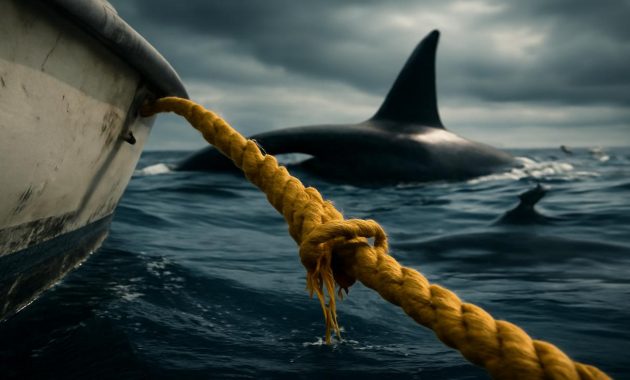
The first thing they noticed was the silence. Not the easy, lull-you-to-sleep kind of quiet that sometimes settles over the ocean, but the sort that presses against your eardrums and makes you aware of your own breathing. The diesel engine idled low, the bow rose and fell in a steady rhythm, and the night wrapped itself around the boat like a wet blanket. Then, out of the gloom, the orcas appeared.
A Ring of Black and White
It was just after first light when the fishermen spotted the tall, black dorsal fin slicing through the pewter surface of the water. They were working the edge of a shelf, a place where the sea floor dropped away sharply and currents collided, stirring nutrients up from the deep. The kind of place where baitfish gather, and behind them, everything else that hunts.
At first, it felt like a gift. Orcas—killer whales, if you prefer the old name—have a way of making even hardened deckhands go quiet. There’s an intelligence in their movements that feels deliberate, almost theatrical. The fishermen, tired and salt-crusted, leaned along the rail to watch. A second dorsal fin appeared, then a third. Within minutes, the boat was ringed by a loose formation of black-and-white bodies, their white eye patches ghostly in the dim morning light.
The crew could hear them breathe. A powerful exhale, a mist of vapor, then the smooth roll of a body long as a pickup truck gliding just beneath the surface. One of the younger crewmen raised his phone, trying to catch it on video. Another, older, shook his head.
“They’re too close,” he muttered. “They’re not just passing through.”
The captain, who’d been fishing these waters for three decades, watched from the wheelhouse window, arms crossed. Orcas around a boat weren’t unheard of. But orcas circling—lingering—felt different. The plotter screen glowed behind him, the boat’s icon sitting still against the depth contours, held in place by the anchor line running taut from the bow.
The Weight Beneath the Hull
The ocean looked deceptively flat, but every boatman knows how much tension can hide in that stretch of rope disappearing into the blue. The anchor line was the lifeline to the seafloor, keeping the vessel from drifting into shallows or onto reefs. It was also, at that moment, the only thing tethering them in place while a pod of apex predators swam in slow, deliberate arcs around their hull.
“They’re hunting something,” the captain said finally. “Question is: are we in the middle of it?”
The orcas began to close the circle, drawing nearer with each pass. One surfaced only a few yards off the bow, its dorsal fin casting a long shadow over the deck. Another rolled on its side, eye visible, watching the boat—or the line beneath it. The crew felt the hairs rise on the backs of their necks. Being watched by something that knows it’s at the top of the food chain never sits easily with the human nervous system.
The radio crackled with static, then a familiar voice from another vessel miles away. Talk of a strong bite that morning. Of seals in the distance. Of wind backing off later that day. The ordinary soundtrack of a fishing ground. But on this particular boat, no one was thinking about the catch anymore.
“We should pull anchor,” one deckhand suggested. “Ease out. Give ’em space.”
The captain hesitated. The anchor lay deep, and hauling it in meant running the winch, adding noise and vibration to a situation already teetering on an edge they couldn’t quite name. Still, sitting still while an orca’s sleek body brushed dangerously close to your hull felt worse.
He nodded. “Let’s bring her up.”
The Sudden Lurch
The winch motor whined to life, a high, mechanical wail that felt out of place next to the soft sighs of orca breath. The crew watched the line as it slowly came in, wet and glistening, droplets pattering onto the deck. The bow dipped slightly as the anchor broke free from the bottom.
And then the boat shuddered.
It wasn’t the steady, predictable tug of a swell hitting off-angle. It was abrupt, violent—like something had grabbed hold of the line and yanked back. The winch squealed, then stalled. The deckhand on the lever swore, bracing himself as the rope snapped tight, humming with tension. The orca closest to the bow vanished beneath the boat in a blur of black.
“Kill the winch!” the captain shouted from the wheelhouse, but the deckhand’s hand was already off the control. The boat rolled slightly to port as another force—stronger, more erratic—pulled on the line from below.
Then came the sound no one on board would ever forget: a deep, resonant crunch, followed by a shudder that ran from the bow rail down into the soles of their boots. The rope jumped, fibers stretching and squeaking under the load. Somewhere beneath them, in water darker than ink, a set of jaws had closed on their lifeline.
“That’s not the bottom,” one crewman whispered. “That’s something alive.”
Another crunch, this time followed by a shower of frayed strands as a section of the line snapped, then caught again on a backup knot. The boat lurched forward, then backward, as if caught in a tug-of-war between the winch and something far more muscular.
The orcas surfaced again, but now they kept a little more distance. One slapped its tail, a sharp crack of sound against the surface, then dove straight down toward the line. Moments later, the rope went slack, then tight again, but this pull was different—shorter, faster, as though several smaller bodies were darting in and out, testing, tearing.
Shadows With Teeth
The first dorsal fin that broke the surface wasn’t black and triangular like an orca’s. It was gray, shorter, more angular—its edges rough, like torn paper.
“Sharks,” someone breathed.
They rose like ghosts from below, shapes resolving into distinct, muscular bodies. A half dozen, then more, circling closer, the water around the bow boiling with movement. Their backs flashed slate gray in the thinning darkness; mouths opened in quick, purposeful strikes at the rope trailing down into the depths.
The fishermen could see it clearly now: rows of teeth closing around the thick anchor line, sawing, tugging, testing. The sharks seemed agitated, their movements sharp and erratic. Every few seconds one would dart in, clamp down on the rope, and twist its head violently side-to-side. The line jerked with each attack.
“They’re biting the anchor,” the captain shouted, voice cutting through the chaos. “Get knives, be ready to cut us loose if we have to.”
Below them, something much larger moved—deeper, broader-bodied. An orca swept past, a black-and-white torpedo, displacing a cloud of smaller shapes. The sharks scattered, then regrouped with a kind of frantic energy. Whether they were joining in a hunt, stealing scraps, or simply confused by the turmoil, it was impossible to say. But one thing was clear: their focus had shifted from whatever lay in the murk to the vibrating, bloodless rope.
Every crack of teeth on synthetic fiber sent shivers through the hull. The rope, now fraying in multiple places, looked shockingly flimsy compared to the raw strength arrayed against it.
When Predators Collide
To stand on a small boat while orcas and sharks converge beneath you is to feel the full weight of the food chain press in on your fragile slice of fiberglass and steel. The fishermen were no strangers to predators. They’d seen big sharks take fish right off their lines, watched orcas strip tunas with surgical precision. But having both apex hunters sharing the same patch of water, this close, felt like something else entirely—as if they’d drifted into the middle of a conversation not meant for them.
In recent years, reports from fishermen along various coasts have begun to echo a similar pattern: orcas appearing around anchored boats, followed or accompanied by sharks that seem unusually interested in gear and hardware rather than bait or catches. Anchor lines get chewed. Float ropes come back shredded. Metal fittings bear crescent-shaped dents where powerful jaws have tested them.
Marine biologists, piecing together these anecdotes, suggest several possible explanations. Sharks can detect faint electrical fields, and thick synthetic ropes, thrumming with vibration as they cut through water, may mimic the sensory signatures of struggling prey. The commotion of orcas hunting—high-speed chases, sudden lunges, the flash of white bellies and flukes—could draw sharks in like moths to a porch light. Caught in the turbulence, the sharks may mistake stationary objects—like anchor lines—for something living.
On the deck that morning, though, the fishermen weren’t thinking about scientific theories. They were thinking about whether the next bite would shear the line completely and send the damaged anchor shooting upward, or worse, send the boat swinging violently sideways into one of the orcas’ paths.
“If that line parts under load, it’s coming back like a whip,” the captain warned. “Everyone stay clear of the bow. No heroics.”
The sharks continued their assault, their bodies writhing just below the surface as they gnawed and twisted. Occasionally, a pale flash—belly or jaw—broke the dark water, revealing eyes as black and unreadable as the depths beneath them.
A Moment of Standoff
Then, as abruptly as it had built, the tension shifted. The orcas changed their pattern. Instead of circling, they lined up with the current, moving more quickly, more purposefully. One, a big male with a scar slashing across his dorsal fin, sped under the bow, passing within inches of the anchor line. His broad tail flicked once, powerful and utterly controlled.
The sharks, in contrast, seemed almost jittery now, veering out of the orcas’ path at the last moment, only to dive back at the rope again. More than once, their flanks brushed the hull, sending faint vibrations through the soles of the men’s boots.
“They’re nervous,” a deckhand said quietly. “Sharks don’t like being that close to orcas.”
Stories from other crews filtered through the captain’s mind—yarns told over coffee in harbor diners. Orcas mauling great whites. Sharks vanishing from known hotspots after a pod of killer whales moved through. Even aerial photos making the rounds on phones: orcas cruising calmly while blood blooms darkened the turquoise water below.
Here, though, no one saw blood. No floating carcasses. Just a tangle of motivations: orcas on some purposeful mission, sharks whipped into a frenzy by cues invisible to human senses, and a fishing boat stuck—literally—between them.
Another deep crunch came up through the hull, followed by the sound of fibers giving way with a sickening pop. The line snapped, this time for good.
The boat lurched as the tension vanished, sending one crewman stumbling into a coil of rope. The bow swung with the current, freed from its mooring. Somewhere below, the severed anchor began its slow, lonely descent to the seafloor. The remaining length of line slithered over the rail and disappeared after it, trailing a ragged fringe where teeth had done their work.
Drifting Through the Aftermath
For a few heartbeats, no one moved. The boat, now adrift, rocked gently in the swell, its motion oddly soothing after the violence of the last minutes. The sharks, robbed of their peculiar new toy, wove aimlessly just below the surface, then began to peel away one by one, silhouettes shrinking into the blue-green haze.
The orcas lingered longer. One surfaced close enough that the fishermen could see scars along its flank, pale lines like old stories etched into skin. It exhaled with a soft thunder, mist hanging briefly in the morning air. Then it rolled onto its side, that unmistakable white eye patch facing the boat. For a moment, man and whale regarded each other across a narrow strip of water.
Did it understand the havoc that had just unfolded? Was the shredded rope to it what human trash is to seabirds—an unfortunate tangle in the path of more important business? The fishermen could only guess. Whatever answer might live behind that dark eye remained inaccessible, sealed beneath layers of instinct, memory, and a world experienced through senses humans barely comprehend.
Eventually, the orca flipped upright again, gave a final flick of its tail, and slipped beneath the surface. The last tall dorsal fin faded into the distance, leaving only the gurgle of the hull and the slap of small waves against metal.
The spell broke. The captain snapped into motion, guiding the crew to fire up the main engine, check systems, and chart a path back toward safer, shallower water. The radio crackled again—someone asking about their anchor, someone else laughing nervously, someone swearing they’d had sharks biting their gear the previous week after orcas had passed by.
“Add us to the list,” the captain replied. His voice sounded steadier than he felt.
Patterns in the Blue
Back in port later that day, over steaming mugs and fried fish, the story spilled out in sharp, vivid fragments: the circle of orcas, the crunch of teeth on rope, the sudden freedom of being cut loose. Other crews listened with the particular intensity of people who know they’ll likely face the same sea, the same animals, the same unpredictable ballet of forces.
One skipper recounted how a shark had bitten clean through a pot line the season before, leaving expensive gear lost to the depths. Another swore that orcas had begun treating anchored fishing boats like mobile buffets, ransacking lines for easy meals and leaving behind chaos in the form of shredded ropes and spooked sharks.
Marine scientists, when they hear these stories, take notes and nod thoughtfully. The ocean is changing—warming currents, shifting prey patterns, human noise and gear filling more and more of the water column. Orcas, famously adaptable, are experimenting with new hunting strategies around boats. Sharks, attuned to the faintest signals of distress or opportunity, are pulled into the wake of these experiments.
To an animal that has evolved to home in on the faintest twitch of a dying fish, the vibration of an anchor line flexing under the weight of a boat might feel like a siren call. Add the electromagnetic signature of metal links, the turbulence of orcas in pursuit, and the dense clustering of scent and sound around a floating human platform—and you have a perfect recipe for confused, determined attention.
But if the scientists see patterns, the fishermen feel them. Not as theories, but as new risks layered onto an already precarious existence. Anchor lines that used to be simple tools now occasionally feel like invitations. The quiet moments on the water, once comforting, can slide without warning into tense standoffs with animals powerful enough to rearrange the day’s plans with a single bite.
A Thin Line Between Worlds
What stays with you, long after the coffee has cooled and the boat has been hosed down, isn’t just the drama of sharks biting ropes or orcas circling hulls. It’s the sensation of being suspended between worlds—of realizing, in a visceral way, how thin the strands are that tether human life to some semblance of control out there.
An anchor line is more than rope or chain. It’s a promise of stability in a fluid, shifting landscape. When something with rows of teeth decides to test that promise, it exposes the illusion at the core of seafaring life: that we can stake a claim, even temporarily, on a patch of water that belongs, in truth, to everything but us.
On that morning, the fishermen stepped back onto the dock with their legs still unconsciously compensating for the roll of the sea. They carried with them not just another story for the harbor, but a fresh respect for the invisible currents of behavior that swirl beneath the surface—currents as real and powerful as any rip or tide.
Somewhere offshore, on that same ledge where the seafloor drops away, the anchor they lost lies in a patch of sand or mud, rope trailing like seaweed. Sharks pass overhead, perhaps, drawn briefly to the memory of vibration and tension. Orcas glide by on their own errands, their presence leaving ripples not just in water, but in the habits and nerves of the humans who work above them.
And every time another crew reports sharks biting their lines just moments after orcas arrive, the pattern sharpens, like a sketch slowly gaining detail. The ocean, as always, is speaking in its own language—one of fin and tooth, of rope and hull, of silence that turns heavy right before something happens. The fishermen, listening as best they can, translate it into stories.
Stories that begin with a quiet sea, a ring of black and white, and the sudden, jarring realization that the thing you thought held you in place can be undone in an instant by a set of jaws you never even see.
At a Glance: The Encounter in Numbers
| Location | Offshore shelf edge, deep-water drop-off |
| Time of Day | Early morning, just after first light |
| Estimated Orcas | 5–8 individuals in loose formation |
| Estimated Sharks | 6+ visible around the bow |
| Key Gear Affected | Primary anchor line, supporting knots and fittings |
| Outcome | Anchor line severed by shark bites; vessel left adrift |
Frequently Asked Questions
Why would sharks bite an anchor line instead of hunting fish?
Sharks rely heavily on vibration and electrical cues to find prey. A tensioned anchor line vibrates and hums subtly in the water, especially when a boat moves with swell or current. In the confusion of orcas hunting nearby, sharks may mistake that vibration for the signal of a struggling animal and bite first, “ask questions” later. It’s not that they prefer rope to fish—they’re simply investigating a strong sensory cue in a chaotic scene.
Do orcas and sharks normally interact like this around boats?
Orcas and sharks do share hunting grounds, but intense, visible interactions right next to boats are still relatively uncommon—and that’s what makes these encounters so memorable. Orcas sometimes displace or even prey on large sharks, while sharks may move in to scavenge or capitalize on leftovers. Boats, with their gear and noise, add complexity. Reports of orcas and sharks appearing together near anchored vessels do seem to be increasing in some regions, but scientists are still working to understand how common these events truly are.
Are fishermen in danger when sharks attack their anchor lines?
The immediate physical danger is less about sharks attacking people and more about what happens if a highly tensioned line suddenly parts. A snapping rope can recoil with enough force to injure anyone standing in its path, and a boat released unexpectedly from its anchor can swing or drift into hazards. The animals themselves typically focus on gear, not humans, but the mechanical risks of damaged equipment are very real.
Is this behavior caused by climate change or overfishing?
There isn’t a single clear cause that scientists can point to, but broad changes in the ocean do play a role. Warming waters and shifting prey distributions can bring orcas and sharks into new overlap zones or closer to fishing activity. Overfishing can force predators to get more creative and opportunistic, including investigating boats and gear more frequently. These anchor-biting episodes likely reflect a mix of environmental change, learned behavior, and the sheer adaptability of top predators.
What can crews do if this happens to them?
Most crews focus first on safety: keeping clear of loaded lines, being ready to cut gear if necessary, and avoiding sudden maneuvers that might escalate the situation. Many will reduce engine noise, stay calm, and wait for the animals to move on before attempting to retrieve or reset gear. Documenting the event—notes, photos, or video—can also help contribute to a growing body of knowledge that might one day turn today’s unsettling surprises into better-understood patterns of life in the sea.