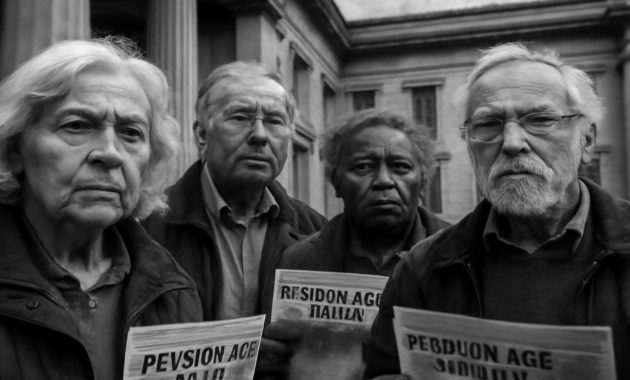
The news crept in on a grey, rain-damp morning – the kind the UK does so well. You could almost smell the change in the air, like cold metal and wet leaves. Over the hum of kettles and the hiss of bus brakes, a headline began to ripple through phones and radios: the UK was ending retirement at 67. A new state pension age had been officially announced. Not a rumour this time. Not a think-tank forecast or a speculative column. Real. Decided. Coming.
The Morning the Age of Retirement Shifted
For a moment, nothing visibly changed. Trains still shuddered into stations. Children still shrugged on school bags. Office lights blinked awake across city blocks like squares on a vast circuit board. But in kitchens, in break rooms, under hi-vis jackets and nurse uniforms and supermarket tabards, a quiet recalculation began.
Helen, a 52-year-old nurse from Birmingham, heard it first on the radio, half listening as she buttered toast. “The UK government has officially announced a new state pension age, bringing an end to the previous retirement threshold of 67…” The words blurred together after that. She turned the volume up with butter still on her fingers, heart pacing ahead of the newsreader’s voice.
“Again?” she murmured to the empty kitchen. She’d already watched the pension age move once in her lifetime. Now, once more, the line she’d silently marched towards was being nudged further out, like a horizon that keeps receding as you walk.
Across town, in a co-working space smelling faintly of coffee and warm laptops, 29-year-old software developer Malik read the same announcement on his phone. To him, the idea of retirement had always felt remote, like Saturn’s rings or the deep ocean trenches – real, but distant. Still, as he scrolled through the details, even he felt that subtle, unsettling tilt of the ground beneath long-term plans.
The New Pension Age: What’s Actually Changed?
Stripped of all the commentary and political noise, the core of the change sounds almost simple: the UK has ended the previous state pension age of 67 and set a new, higher official pension age. The exact number comes wrapped in technical language and timetables, but the heart of it is unmistakable – people will have to wait longer to claim their state pension.
This isn’t a gentle, hypothetical future tweak. It’s a defined, official line in government documents now, coloured in with dates, birth years, and phased rollouts. For some, the change will be small – a year or two more at work than expected. For others, especially those in their 30s and 40s, retirement may shift several years further down the road.
The government’s reasoning feels familiar: longer life expectancy, pressure on public finances, rising healthcare costs, a population with more grandparents than grandchildren. The old maths of pensions – many workers supporting a smaller number of retirees – is being rewritten for a country that’s quietly grown older.
Still, policy doesn’t land on spreadsheets. It lands in knees that already ache from warehouse shifts. In carers whose backs remember every lift of every patient. In teachers whose voices are already threadbare by Friday afternoon. Saying “we’re all living longer” sounds reassuring until you remember that not everyone is living longer in the same way, or with the same health.
The Human Timetable
For years, people have been quietly pencilling in their own retirement stories: the allotment finally getting the attention it deserves, the camper van trundling through the Highlands, the long-promised book finally being written in the morning light of an unhurried day. Those stories are not necessarily cancelled now, but many are being edited – revised in the margins with a slightly heavier hand.
What this new pension age really does is redraw time. It takes the invisible calendar we carry in our heads and stretches it. And that stretch doesn’t feel the same for everyone.
Who Will Feel This Change the Most?
Somewhere on a train heading north, a man in his late 50s scrolls through an article about the new pension age, his thumb moving more slowly with each sentence. He has worked in construction for almost four decades. The wind and rain have carved lines around his eyes more deeply than his actual age suggests. For him, a higher pension age doesn’t just mean “a few more years”. It means more winters on scaffolding, more early mornings scraping frost off the windscreen, more joints considering rebellion.
Contrast that with an architect in her 40s, working mostly from a warm home office, her tools digital and her work posture supported by an ergonomic chair. She reads the same announcement, frowns, and starts running new spreadsheets on her savings. Her body, though, is unlikely to be the battlefield that decides whether she can keep working.
The new pension age arrives into a country already uneven. Life expectancy differs sharply between wealthier areas and poorer ones, between sedentary office jobs and physically gruelling work, between those with access to good healthcare and those who postpone appointments because the bus fare is too much this month.
Not Just About Age, but About Work
The shape of your working life now matters even more. The policy doesn’t discriminate on paper – it doesn’t say “nurses here, office workers there, builders over there”. But in the joints and lungs and mental health of millions, discrimination finds a way.
People in manual or frontline roles often start working younger and wear their years faster. Asking them to work “just a bit longer” lands differently than it does for someone whose toughest daily load is an inbox.
It’s not just physical either. There’s the emotional weathering of social work, teaching, healthcare. Burnout doesn’t politely pause because the pension age has changed.
How the Numbers Land in Everyday Lives
It’s easy to feel distant from official dates and phrases like “phased implementation” or “long-term fiscal sustainability”. To bring the change closer to the ground, imagine a kitchen table in any ordinary home. A few years, a handful of dates, and a lot of feelings gather there, scattering like loose coins.
Below is a simplified look at how a rise in the pension age might feel across different ages. It’s not (and cannot be) every detail of policy, but a human snapshot rather than a legal document:
| Current Age | Old State Pension Age | New Reality | What It Feels Like |
|---|---|---|---|
| Late 50s–early 60s | Around 66–67 | Likely small shift, perhaps 1–2 years more | Plans postponed, not scrapped, but a bitter stretch |
| 40s–early 50s | Previously planning around 67 | More notable delay; extra working years likely | Need to replan savings, career paths, and health |
| 30s | 67 was a vague target | Retirement age shifts meaningfully higher | Retirement feels more distant; private saving more critical |
| 20s and younger | Mostly theoretical | New normal: later state support | A life expectation set from the start: work for longer |
At one end of the spectrum are those who say, “I was never planning to stop at 67 anyway.” To them, work is not just income; it’s identity, rhythm, reason. In fact, they worry more about what to do when work ends than about how long it lasts.
At the other end are those who see their state pension as a lifeline, not a top-up – the difference between getting by and not. For them, every additional year of waiting is not an abstraction; it’s another twelve months of scraping, stretching, and hoping the car doesn’t die or the boiler doesn’t wheeze its last breath.
Work, Health, and the Long Middle of Life
Somewhere in the middle are millions of people facing a quiet but profound question: not “how long must I work?” but “how can I last that long?” It reframes everything from diet to sleep, from how forcefully you lift boxes now to whether you dare decline that overtime when your manager asks again.
The new pension age doesn’t clinically specify “take better care of your body and mind”, but that’s the subtext humming beneath the policy. Not everyone has the space, money, or support to answer it, and that is where the fault lines start to show.
Rethinking What Retirement Even Means
There’s another, quieter shift happening alongside the official announcement. It’s not written in any law, but in conversations and daydreams: the very idea of retirement is changing.
When our grandparents thought of retirement, it was often a cliff edge: one week in work, the next week at home, a sudden widening of days. A gold watch, perhaps. A farewell card thick with rushed signatures. Then the slow blankness of calendar pages, gradually coloured in with hobbies and holidays and hospital appointments.
Now, retirement is starting to look more like a gradient than a cliff. The later the state pension age moves, the more people begin to imagine stepping down, not stepping off: shifting to part-time work, lighter roles, portfolio careers, or seasonal income long before the state steps in.
The New Patchwork of Later Life
Imagine a woman in her 60s who once might have retired fully at 67. Under the new age, she blends her later years instead. Three days of paid work at a local charity shop or library. Two days of helping with grandchildren. A small online craft business that pays modestly but feeds her sense of creativity. It’s not the old fantasy of “do nothing forever”; it’s something else – a patchwork life with both rest and responsibility.
For some, that patchwork will be chosen. For others, it will be forced. The difference, often, will be preparation: savings, skills, health, and the quality of work they’ve had access to along the way.
There’s also the psychological side. A later pension age might gently erode the expectation that life has three neat acts: education, work, then retirement. Instead, the arc may bend and fold: career breaks, retraining in midlife, part-time seasons, side businesses and community roles interwoven with paid work.
That could be strangely freeing, if the transition is handled with care and support. Or it could be punishing, if all it means is that people must cling to any job they can manage, regardless of their health, until an ever-receding date finally arrives.
Nature, Time, and the Long View
Step outside, away from the numbers and the headlines, and the world insists on its own timetables. A rook lifts lazily from a chimney pot. The river continues its slow, unbothered sliding past the city’s edge. In a hedgerow, blackberries slowly darken towards autumn, indifferent to policy announcements.
One of the strange comforts of nature is its refusal to match our bureaucratic lines. Retirement ages and pension forecasts feel fragile in comparison to the turning of seasons. Yet that’s also where a deeper question waits.
If we’re going to work longer, what kind of life are we working towards? Not just in the numbers sense – “do I have enough in my pension?” – but in the textural sense: do I have the health to walk the coastal path I’ve always wanted to see? The energy to kneel in a garden without a silent wince? The time to sit by a loch or a lake or a city park pond long enough for the ducks to stop watching me warily and go back to their own business?
Planning Beyond the Spreadsheet
The official end of retirement at 67 nudges us not just to think financially, but sensorially. To picture the air we want to breathe in our seventies, the weight we want to carry (or put down), the communities we want around us when work finally slows or stops.
It might mean making decisions now, while the new pension age still feels like a distant landmark. Learning to say “no” to relentless overtime that eats into health. Saving a little more, even when it stings. Asking uncomfortable questions at work about flexible patterns, retraining, or roles we might transition into as our bodies change.
It could also invite something gentler: taking stock of what gives meaning that isn’t tied to a payslip. Small friendships. Skills that don’t show on a CV. Places, especially green ones, that remind us we exist outside job titles.
Finding Our Way Through the Shakeup
The UK’s decision to push the official pension age higher has the rough edges of an historic moment. It joins a line of shifts that people will remember – “I was 45 when they changed it again,” someone might say years from now, the way older relatives recall when decimalisation arrived or when Sunday trading began.
In the days after the announcement, the country will talk in different tones. Some voices will crackle with anger on call-in shows and social feeds. Others will sound resigned. A few will say, with a shrug, “I’d be working anyway.” Between them all, there’s a quieter, more personal work beginning: reimagining the story each person tells about the end of their working life.
Maybe we will become a nation of longer workers but also of more gradual transitions. Perhaps the extra years will spur deeper conversations about workplace health, fairness between professions, and how to support those whose bodies can’t keep pace with the new timetable.
What’s certain is that the line in the sand has moved. The age of “67 and out” has officially ended. The state pension now waits further down the path. How each of us walks that path – and how we look after one another along the way – may matter as much as the number printed on the policy.
Outside, somewhere, the clouds are beginning to break. A thin shaft of light slips between buildings, glancing off windows, catching a pigeon’s wing mid-beat. Time, indifferent and steady, moves on. The question for all of us, in this new era of later retirement, is not just how long we will work, but how well we will live through all those extra years we have been quietly given.
Frequently Asked Questions
What does it mean that the UK has ended retirement at 67?
It means the state pension age is no longer set at 67 as the upper threshold. The government has officially set a higher pension age, so people will have to wait longer before they can claim their state pension. Exact impacts depend on your age and the detailed schedule of the policy.
Will everyone have to work longer now?
In practical terms, most people who rely on the state pension will need to work longer or find other income sources until they reach the new pension age. Some may retire earlier using personal savings or private pensions, but the state support will begin later than previously planned.
Does this change affect people already receiving a state pension?
Generally, changes to the state pension age apply to people who have not yet reached their pension age. Those already drawing their pension are usually not pushed back. However, the exact protections depend on the final legislation and your specific circumstances.
What can I do now if I’m worried about the new pension age?
You can review your expected retirement date, check your State Pension forecast, look at your workplace and private pensions, and consider increasing contributions if possible. It may also help to think about how you might transition to lighter or more flexible work as you get older.
Is this change permanent, or could the pension age move again?
Pension ages have been reviewed and adjusted several times in recent decades, and they can change again in future as life expectancy, demographics, and public finances evolve. The current announcement sets a new official age for now, but future governments may revisit it.
How does this affect people in physically demanding jobs?
They may feel the impact more sharply, as working extra years in manual or high-stress roles can be harder on the body and mind. This is why debates about fairness, early access, occupational health, and flexible retirement options are likely to intensify.
Will this automatically improve the pension system’s finances?
Raising the pension age typically reduces the time the state pays pensions, which can ease financial pressure. However, it also creates new challenges: supporting older workers’ health, finding suitable jobs for them, and addressing inequality for those who struggle to work longer.