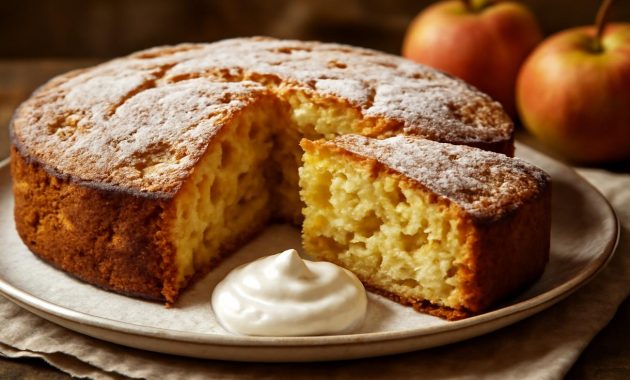
The first thing you notice is the smell. Before you see the batter, before you peel a single apple, there is the quiet promise of warmth drifting through your imagination: baked fruit, vanilla, and the soft tang of yogurt, all rising together in a cake that asks very little of you and gives back so much. It’s the kind of dessert that doesn’t announce itself with layers or frosting or elaborate swirls. Instead, it sidles into your afternoon like a familiar friend—light, moist, not too sweet, and wonderfully simple, built on the humble partnership of oil and yogurt.
The Kind of Cake That Fits Between Moments
This light, fast apple cake isn’t the kind you reserve for birthdays or holidays, though it’s more than welcome at both. It belongs to the in-between places of life: the quiet space between the last email of the workday and the first clink of dinner dishes; the gray, rainy Sunday when you’re still in slippers at noon; the early autumn afternoon when apples on the counter begin to whisper, “Now or never.”
Because it’s made with oil and yogurt instead of butter, there’s no waiting for anything to soften, no stand mixer humming in the background like an appliance symphony. Instead, you pull out a bowl—just one, if you’re feeling efficient—and stir. The oil slips in easily, bringing moisture without drama. The yogurt folds in, thick and cool, its gentle acidity keeping the cake tender long after it leaves the oven.
There’s a small kind of freedom in a recipe like this. It doesn’t ask you to be precise to the gram or hover nervously at the oven door. It forgives interruptions: a phone call mid-mixing, a child asking for help with homework, a dog nudging your leg for a walk. You come back, stir again, tuck in the apples, and it carries on, steady and unbothered.
The Quiet Alchemy of Oil, Yogurt, and Apples
There’s something almost meditative about chopping apples for cake. The peel yields under the knife, curling into bright ribbons on the cutting board. The flesh is cool and slightly damp, releasing a scent that feels both crisp and nostalgic. You don’t need perfect cubes or textbook slices—just pieces small enough to soften and nestle into the batter. Imperfection is not only allowed here; it’s part of the charm.
Oil and yogurt, as a team, do something special. Oil, being liquid at room temperature, slips into every corner of the crumb, making the cake feel soft and springy rather than dense. Yogurt, with its subtle tang, balances sweetness and adds a quiet richness without heaviness. Together, they create a cake that feels almost weightless but somehow still satisfying, like the culinary equivalent of a light cardigan on a cool evening.
Butter has its place—on toast, in flaky pastry, in slow, elaborate baking days—but for this cake, oil and yogurt offer a kind of unshowy reliability. No creaming. No waiting. No anxiety about overmixing as you’d have with a delicate sponge. You whisk wet ingredients in one bowl, stir in the dry, fold in apples, and there it is: a rustic, cloud-soft batter ready for the oven in the time it takes a kettle to boil.
Choosing Your Apples Like a Storyteller
The apples you choose will shape the story of this cake. A firm, tart variety will keep its personality after baking, offering small, bright bursts against the gentle sweetness of the crumb. A sweeter apple will melt more readily, weaving itself into the batter until you’re not always sure where fruit ends and cake begins.
If your fruit bowl is a collection of “almosts”—the apple that’s a little too soft for snacking, the one with a bruise you’ve been avoiding—this cake welcomes them. Peel away what’s tired, keep what’s still good, and fold it all in. The oven does the rest, wrapping imperfection in warmth and sugar and spice.
The Texture of Ease: Light, Moist, and Effortless
There’s a particular kind of satisfaction in slicing into this apple cake once it has cooled just enough to hold its shape. The knife slides down, the crumb springs back gently, and the slices ease away without crumbling. You see pale, tender cake marbled with apple pieces, maybe a freckling of cinnamon if you used it, maybe the glisten of sugar on top where you scattered a spoonful before baking.
On the tongue, it feels both familiar and surprising. Light, yet indulgent. Moist, but not sticky. There’s enough structure to carry the fruit, but not so much that it ever feels dry. It’s the sort of cake you can eat in the middle of the afternoon without the heaviness that sometimes follows a more decadent dessert. You take a bite and think, “Yes, I can absolutely have another slice.”
And because it uses oil, it keeps well. Wrapped loosely on the counter, the cake stays tender the next day and even the one after that, if it somehow lasts that long. A quick warm-up in the oven or a few seconds in the microwave wakes up its aroma, turning yesterday’s leftovers into today’s small luxury.
A Simple Blueprint: The Not-Quite-a-Recipe Recipe
Even the most relaxed cake benefits from a little structure. Here’s a simple blueprint that you can adapt again and again, your own personal formula for an effortless apple dessert:
| Component | Basic Guideline |
|---|---|
| Flour | About 1½ cups (all-purpose or a mix with whole wheat) |
| Leavening | 2 tsp baking powder + a pinch of salt |
| Sugar | ½ to ¾ cup, depending on how sweet you like it |
| Oil | ½ cup neutral oil (sunflower, canola, light olive) |
| Yogurt | ¾ to 1 cup plain yogurt (Greek or regular) |
| Eggs | 2 large eggs |
| Apples | 2–3 medium apples, peeled and chopped or sliced |
| Flavor | 1–2 tsp vanilla, optional cinnamon or nutmeg |
From there, it’s a simple dance: whisk together the wet ingredients—eggs, sugar, oil, yogurt, and vanilla—until smooth. Sift or stir in the flour, baking powder, and salt just until combined. Fold in the apples. Bake in a greased pan until your kitchen smells like home and a toothpick emerges with only a few soft crumbs.
A Cake That Adapts to Your Life
Once you’ve made this apple cake a couple of times, it starts behaving less like a recipe and more like a habit. You catch yourself glancing at the fruit bowl and mentally scanning the pantry: flour, yes. Oil, yes. Yogurt, always. In half an hour, you could have a cake in the oven and the rest of your evening stretching gently around it.
The beauty lies in how easily it adapts. Maybe one day you swap in a spoonful of brown sugar for depth, or sprinkle cinnamon sugar on top for a faint crunch. Another day, you stir a handful of chopped nuts into the batter for texture, or add a small apple more than the recipe suggests, turning each slice into an excuse to hunt for pockets of fruit.
If you’re feeding kids between school and practice, you might dial down the sugar and lean on the natural sweetness of the apples. If you’re hosting a friend for coffee, you might dust the finished cake with powdered sugar or spoon a dollop of yogurt or whipped cream on the side. It’s the same cake, but also not quite—quietly shape-shifting to suit the moment.
Seasons in a Pan
Though this cake seems tailor-made for autumn, with its cool air and piles of apples, it doesn’t need to be confined to that season. In late summer, you might thread thin slivers of early apples through the batter, still tart and bright. In winter, when the days are short and the light comes in sideways, the cake feels like a small rebellion against the darkness—golden, fragrant, and warm.
Even in spring, when you’re craving lighter flavors, it holds its own. Use a particularly tangy yogurt, add a splash of lemon zest, and the cake feels suddenly fresher, more awake. The apples soften but keep enough bite to remind you that fruit once grew in real orchards, under real sky, before it found its way into your mixing bowl.
Small Rituals, Big Comfort
There’s a quiet kind of ritual to baking that doesn’t always need fanfare. The way you line the pan with paper or brush the sides with oil. The moment you draw the whisk through the batter and it thickens, smooth and pale. The way the oven door closes with a soft thump, turning your mixture of ordinary ingredients into something entirely new.
While the cake bakes, time slows down just a little. You might wash the cutting board, shuffle through the mail, glance out the window as steam begins to cloud the glass above the sink. The smell grows stronger, blooming out of the oven and into the hallway, maybe even slipping under doors. It smells like someone thought of you in advance. Like comfort prepared before you knew you’d need it.
When it’s done and you transfer it to a rack, there is the faint, crackling sigh of cooling cake. You wait—ideally, though not always patiently—until the edges loosen from the pan and you can tip it out. It lands with a soft, reassuring thud. For a second, as you peel away the paper or run a knife around the sides, the world narrows to this single, golden circle or rectangle of possibility.
Sharing the Effortless
What makes this apple cake special isn’t just the recipe; it’s the way it invites sharing. It’s not a showpiece that requires a formal occasion. You can slice it into rough squares and tuck them into a lunchbox. Wrap a few pieces in parchment and hand them to a neighbor over the fence. Carry the whole pan, still warm, to a gathering where someone will eventually ask, “Who made the cake?” and you’ll shrug and say, “Oh, it’s just something simple.”
There’s a particular kindness in baking something that’s light both on the palate and on the baker. You don’t arrive at the table exhausted from multi-step processes or intricate decorations. Instead, you arrive with energy left to listen, to talk, to savor. The cake becomes exactly what it should be: a backdrop for connection, not the main event demanding applause.
And perhaps that’s the magic of it. In a world that often rewards complication, this apple cake stands quietly in the corner, proving that ease and effortlessness can coexist with depth and comfort. Oil, yogurt, apples, flour, sugar, eggs. Stir, pour, bake. Share.
Letting the Cake Become Your Own
Over time, this quick apple cake can become a kind of signature without ever needing to look exactly the same twice. You might learn that you prefer it a little less sweet, or a little more spiced. You might decide that thinly sliced apples layered on top feel right for you, like edible petals, while someone else in your home lobbies for chunky pieces hidden throughout the crumb.
Maybe you start to remember the feel of the batter instead of the exact measurements—a ribbon of thickness that tells you when to stop adding yogurt, a certain gloss that means the oil has done its work. This is when baking stops being a set of instructions and becomes a conversation between your hands, your senses, and your appetite.
One day, you may pull the cake from the oven and realize you made it almost absentmindedly between tasks, mixing and whisking on instinct. You slice it later, maybe with a cup of tea cupped in your hands, and feel a quiet gratitude not just for the taste, but for the small, sustaining ritual it has become.
Serving Suggestions for Different Moods
This cake is as flexible in serving as it is in making:
- For a slow morning: Cut a generous wedge, warm it slightly, and serve with a spoonful of thick yogurt or a drizzle of honey. Let the apples and tangy dairy echo each other softly.
- For an after-dinner dessert: Add a scoop of vanilla ice cream or a cloud of lightly sweetened whipped cream. The cold cream against the warm cake is a kind of simple luxury.
- For a coffee break: Dust with powdered sugar and serve plain, on a small plate beside your mug. The lightness of the crumb makes it perfect for lingering sips.
- For a picnic or walk: Cut into tidy squares or bars that can be eaten by hand. The moisture from the yogurt and oil keeps things from drying out, even outdoors.
Whichever way you serve it, the feeling is the same: something homemade, unpretentious, and deeply comforting, made without stress and shared without ceremony.
FAQ: Light Fast Apple Cake with Oil and Yogurt
Can I use Greek yogurt instead of regular yogurt?
Yes. Greek yogurt works beautifully and gives the cake a slightly richer texture. If it’s very thick, you can loosen it with a tablespoon or two of milk or water so it blends more easily into the batter.
Do I have to peel the apples?
No, peeling is optional. Peeled apples give a softer, more uniform texture. Leaving the peel on adds a bit of color and slight chew. If the skins are tough or waxy, peeling is usually better.
What kind of oil is best for this cake?
A neutral-tasting oil is ideal—sunflower, grapeseed, canola, or a light (not strong-flavored) olive oil. Strong oils can overpower the delicate apple and yogurt flavors.
Can I make this cake ahead of time?
Absolutely. The cake keeps well for 2–3 days at room temperature if wrapped or stored in an airtight container. The yogurt and oil help it stay moist. For longer storage, you can freeze slices and thaw as needed.
How do I know when the cake is done?
The top should be lightly golden and feel springy in the center when gently pressed. A toothpick or skewer inserted into the middle should come out mostly clean, with a few soft crumbs but no wet batter.
Can I reduce the sugar?
Yes. You can usually reduce the sugar by about a quarter without affecting the structure very much. Keep in mind that less sugar means the cake will be less sweet and may brown slightly less.
Is it possible to make this cake dairy-free?
It can be adapted. Substitute the yogurt with a thick, unsweetened plant-based yogurt and make sure to use oil rather than any butter. The texture may vary slightly, but the cake will still be tender and moist.
Can I add other fruits or mix-ins?
Yes. Pears, a few berries, or a small handful of nuts (like walnuts or almonds) can all be folded into the batter along with the apples. Just avoid adding so much that the cake becomes overcrowded and doesn’t rise properly.
What size pan works best?
A standard 20–23 cm (8–9 inch) round or square pan works for most basic versions of this cake. Adjust baking time slightly depending on thickness—thinner cakes bake faster, thicker ones take a bit longer.
Can I use whole wheat flour?
You can replace part of the all-purpose flour (about one-third to one-half) with whole wheat flour. The cake will be slightly denser and more rustic, but still moist thanks to the oil and yogurt.