The first time someone told me there was a fish that could predict the end of the world, I laughed. It sounded like something pulled straight from a myth-tangled storybook, the kind you read as a child and then slowly forget as taxes and traffic and inboxes stack up in your life. But the person telling me this wasn’t a storyteller. He was a marine technician who’d spent years dropping instruments into the darkness off the Pacific coast of the United States. “You don’t forget the first time you see one,” he said quietly. “It feels like the ocean is sending up a warning.”
The Fish That Isn’t Supposed to Be There
You almost never see an oarfish alive.
It lives so far beneath the reach of sunlight that the world it knows is more pressure than color, more vibration than shape. Some scientists think it spends its days hovering vertically in the water column, head angled toward the surface, silver body hanging like a long, wavering ribbon. Others imagine it swimming slowly, eel-like, along deep slopes and submarine canyons. What we do know is that it’s there—thousands of feet below—an elongated shimmer in the dark.
Then, every so often, it appears where it is absolutely not supposed to be: in the shallows, near the surf line, or lying slack and shining on a public beach with tourists shielding their eyes and reaching for their phones.
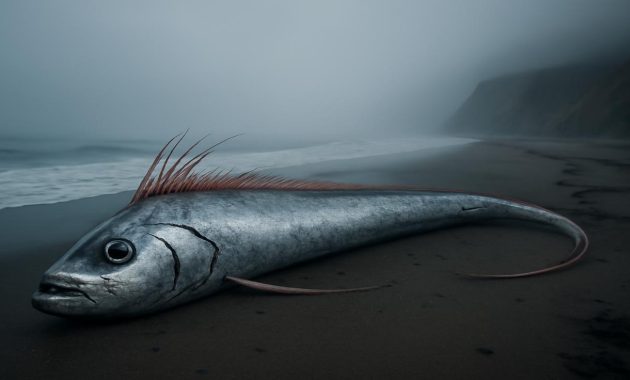
The first one I ever saw wasn’t even whole. It was a photograph tacked to a corkboard at a field station in southern California: a bright silver body stretched along the sand, people standing around it looking both triumphant and unsure. The fish itself—Regalecus russelii, one of the species known as oarfish—looked ancient, almost ceremonial. Its crimson dorsal fin began between its enormous round eyes and ran down the length of its body like a banner. The technician who’d spotted it had scribbled one line beneath the photo: “Came in before the storm.”
I didn’t realize at the time that those four words were the edge of a bigger story, one that would pull me into a web of folklore, seismology, and deep-sea biology.
The “Messenger From the Deep”
If you ask around in coastal communities, especially along the Pacific Rim, you discover quickly that the oarfish has a reputation that far outpaces the number of times anyone actually sees it. In parts of Japan, it has long been called a “messenger from the palace of the sea god,” a creature that surfaces as a harbinger of earthquakes and tsunamis. Stories tell of long, serpent-like fish washing ashore before major quakes and deadly waves. In those tales, the oarfish doesn’t just die on the sand—it arrives with a message.
That piece of folklore has drifted across the ocean, riding newspaper headlines and social media posts. So when, in the last dozen years or so, oarfish have occasionally appeared along the coasts of California and other parts of the United States, the stories followed. Photos of these impossible fish—some more than 15 feet long, their skin like brushed aluminum—circulated online with ominous captions. “Deep-sea earthquake fish washes ashore,” one headline blared. Others were less subtle: “End-of-days sea monster surfaces—disaster coming?”
At first glance, it’s easy to see why people reach for the supernatural. The oarfish doesn’t look like the other residents of our seas. It is long and impossibly thin, with a high crimson fin that makes it look as though it’s wearing a crown of flames. Its eyes are big and round, as if permanently startled. Seen up close, it feels old in some irreducible way, not old as in dying, but old as in story—like a creature that remembers the planet before we had the words to name it.
So the question hangs in the air: When this rare fish turns up in the shallows of the United States, is it just lost, or is it telling us something?
What the Science Says (and Doesn’t Say)
Scientists, as always, start with the data. A handful of oarfish strandings are on record in the United States, particularly along the Pacific coast—from California’s Catalina Island to the shores of the Pacific Northwest. They’re rare enough that each one becomes news. But when you line up those dates beside charts of major earthquakes and tsunamis, a hard truth settles in: the timing doesn’t clearly match.
Researchers in Japan have done this kind of comparison carefully, asking whether spikes in reported oarfish sightings line up with seismic events. Most studies have come back inconclusive or negative. The ocean is vast; earthquakes are frequent; fish die or become disoriented all the time for reasons that have nothing to do with tectonic plates. The scientist’s answer to the prediction myth, for now, is sober: there is no solid evidence.
And yet, the story lingers. Part of it is human nature—we’re pattern seekers, always trying to organize chaos into cause and effect. Part of it is that we know so little about the deep sea that any time something from down there comes up here, it feels meaningful, even prophetic. When an oarfish appears on a California beach and, months later, an offshore quake rattles the coast, it’s tempting to tie the two together with a thread of fate.
But even scientists admit there’s more to learn. The deep ocean is stitched with fault lines and fringed with subduction zones. Many of those lie beneath the routes that oarfish and other deep-water species use. It’s not impossible that subtle changes in water chemistry, pressure, or low-frequency vibration—changes associated with geological stress—could affect the sensitive creatures that live there.
Whether or not the oarfish “predicts” disaster, it thrives in a place where the Earth is constantly shifting, grinding, and reshaping itself. To see one on the beach is, in a sense, to be handed a silver ribbon of proof that we share the planet with forces operating on scales of depth and time that we barely understand.
When the Deep Comes Ashore
The stories people tell about seeing an oarfish in the United States are strangely similar, even when the exact details change. There is almost always a sense of wrongness—not fear, exactly, but dislocation.
On a fog-softened morning in central California, beachcombers might be out searching for shells when they notice a slick metallic shape at the edge of the surf. At first, they think it’s seaweed tangled around a log. As they get closer, the shape resolves into something narrow and impossibly long, the skin shining like foil in the muted light. Gull footprints scatter around it. The fish looks out of place in the shallows, as if somebody dropped a deep-sea secret onto the wrong page of the book.
In another story, a group of divers off the coast of Florida spot something drifting in the blue haze beneath them—an upright, shimmering thread. As they swim closer, they realize it’s an oarfish, hovering vertically like a silver spear planted in the water. One diver later recalls feeling “watched,” as if the fish’s huge eyes were not just observing them, but measuring their presence in its world.
Whether the encounter happens in cold Pacific water or a warm Gulf current, the mood is similar. People fall quiet around these animals. The clamor of beach talk or dive chatter drains away, and what’s left is a kind of reverence laced with unease. This reaction might be older than science, older than written myth. Humans have always looked to animals—especially wild, elusive ones—to help us interpret the moods of the Earth.
| Aspect | Oarfish | Common Coastal Fish |
|---|---|---|
| Typical Length | 10–26 feet (rare reports even longer) | 1–3 feet |
| Habitat Depth | ~600–3,000+ feet (mid to deep sea) | Shallow coastal waters |
| Body Shape | Ribbon-like, extremely elongated | More compact, torpedo-shaped |
| Dorsal Fin | Bright red, runs entire body length | Short, near middle or back |
| Cultural Reputation | “Messenger” of quakes and tsunamis | Mostly viewed as food or sport |
Why the Myth Persists
Part of the enduring allure of the oarfish-as-oracle idea lies in the simple drama of timing. Imagine a year when three or four of these animals wash up on different stretches of U.S. coastline, and not long afterward a major quake strikes across the ocean, sending a far-traveled swell to our shores. News outlets pair the two events in quick, breathless segments. Posts on social media layer the images together: silver serpent on a beach, seismograph needle leaping. The human brain does the rest.
We are narrative creatures before we are rational ones. Our ancestors survived in part by connecting dots quickly: dark clouds plus animal restlessness might mean a storm; early frost plus low fruit yields might signal hunger. In that older logic, an impossibly rare fish suddenly appearing at our feet cannot be random. It must be a sign of something.
There’s another, quieter reason the myth holds. Disasters—especially the big, slow-building ones like earthquakes, tsunamis, and climate-driven storms—make us feel helpless. We can study fault lines and build better levees, but we cannot reach down into the planet and still the grinding of plates. The idea that some living creature might sense shifts before we can, might give us a clue, is deeply comforting. If the world is going to break, we want a whisper of warning.
The oarfish, then, becomes an intermediary: a long, silver line between the human world and the unseen machinery of the Earth. When it surfaces, it brings with it the hope that nothing in this universe happens without at least a hint, if we only knew how to read it.
What the Oarfish Really Foretells
Strip away the earthquake prophecies for a moment, and the oarfish is still a kind of messenger. It carries news from a part of the planet we rarely glimpse directly. Every time one strands on a United States beach, biologists rush to sample tissue, measure length and weight, and examine stomach contents. Each piece of data is a breadcrumb leading us deeper into the dark.
In an era when we talk openly about a changing climate, shifting oceans, and acidifying waters, deep-sea species take on new importance. They live in a world we assume to be more stable than the surface, buffered by depth and cold and pressure. But even that deep realm is not immune. Warm water can sink; currents can wobble; chemical imbalances can slowly trickle down.
If oarfish begin to show up more frequently on U.S. shores—not just once in a decade, but regularly—it might mean something is stirring beneath the surface. Maybe not the crack and lurch of a classic tectonic disaster, but a slower, more pervasive one. Imagine conditions changing so subtly that only the animals that spend their lives marinating in the deep notice at first. They might be nudged closer to the surface, forced toward unfamiliar temperatures or currents in search of food that no longer thrives where it used to.
To stand next to a stranded oarfish, then, is to stand in the path of a messenger that carries not a single prediction, but a whole tangled report about the state of the sea.
Listening Without Legends
So how do we listen without leaping straight into legend?
One answer is humility. When an oarfish appears along the U.S. coast, scientists can treat it not as a lone prophet, but as a datapoint. They can look at the water temperature records in that region, at recent changes in currents, at seismic activity, at plankton blooms. They can tuck the encounter into a larger pattern, one that might stretch over decades. In that long view, perhaps a more grounded kind of “prediction” emerges—not of a single quake, but of the direction our oceans are heading overall.
Another answer is to allow the story to retain some of its mystery without demanding that it serve as a fortune-teller. It’s possible to say, “We don’t have evidence that oarfish predict disasters,” and also say, “Seeing one reminds us that the forces shaping our lives are bigger and deeper than we think.” The fish doesn’t have to be supernatural to unsettle us in productive ways.
Imagine a child on a beach in Oregon or California, staring at the glistening length of an oarfish. They hear a parent or ranger explain that this animal usually lives far out at sea, in water so deep it is almost never lit. They might not remember the Latin name or the exact depth, but they will remember the feeling: that beneath the waves, there is a world as distant and strange as outer space, and what happens there matters up here.
The Secret You Can Stand Beside
The notion that a rare fish found in the United States can foretell major natural disasters will probably never fully disappear. The story is too sharp, too cinematic: a silver serpent in the surf, the looming sense of something about to break. In the age of screenshots and short attention spans, it’s a story built to travel.
But underneath that hungry myth is a quieter, sturdier truth. The oarfish reminds us that we live on a restless planet stitched with invisible boundaries: between shallow and deep, light and dark, known and unknown. It inhabits the seam where ocean meets geology, where water presses against rock that is slowly, endlessly shifting. When it washes up on a beach in California or the Gulf Coast or elsewhere along U.S. shores, it invites us into that seam for a moment.
You don’t have to believe the oarfish is a prophet to stand in awe of it. You can simply stand there and let your senses fill: the weight of the humid air, the shush of waves rolling in, the faint metallic smell of salt and scales. You can trace the long line of its body with your eyes and imagine it disappearing downward, back into a column of blue that darkens and darkens until color itself gives up. You can look at its wide, startled eye and feel, for a moment, that the world is older and stranger than your daily life ever suggests.
In that moment, the disaster it foretells is not a single cataclysm but a different kind of loss: what happens if we move through our days as if the deep places do not exist, as if they are not shaping our coasts, our weather, our future. The oarfish is a reminder that the stories we tell about the sea—and the care we offer it in return—will echo far beyond the tide line.
So if you ever walk a U.S. beach and stumble upon that long, impossible ribbon of silver, pause. Listen. Not for the promise of an exact date when the ground will shake or the sea will rise, but for the softer message carried in on the waves: the world is speaking in ways we are only beginning to understand, and you are standing, quite literally, at the edge of its voice.
FAQ
Do oarfish really predict earthquakes and tsunamis?
There is no solid scientific evidence that oarfish can predict earthquakes or tsunamis. While folklore links their appearances to disasters, careful studies have not found a reliable pattern connecting oarfish strandings to seismic events.
Where are oarfish found in the United States?
Most confirmed oarfish sightings and strandings in the United States have occurred along the Pacific coast, especially in California, but they can potentially appear in deep waters off other U.S. coastlines as well.
How big can an oarfish get?
Oarfish are among the longest bony fish in the world. They commonly reach lengths of 10–20 feet, and there are unconfirmed reports of individuals exceeding 30 feet.
Why do oarfish come to the surface or wash ashore?
Scientists aren’t completely sure. Possible reasons include illness, injury, disorientation, changes in water conditions, or being pushed by currents. Because they normally live in deep water, any event that weakens them can make them more likely to drift into shallower areas.
Are oarfish dangerous to humans?
No. Oarfish are not considered dangerous to people. They lack the large teeth or aggressive behavior associated with predators and mainly feed on small organisms like plankton and tiny crustaceans.
Can seeing an oarfish be a sign of climate change?
A single sighting doesn’t prove anything by itself, but patterns of unusual behavior in deep-sea creatures, including more frequent strandings, can prompt scientists to look more closely at changing ocean conditions related to climate and currents.
What should I do if I find an oarfish on the beach?
Keep a respectful distance, avoid touching the animal, and contact local wildlife authorities or a nearby marine science institution. They may be able to collect valuable scientific information from the specimen.