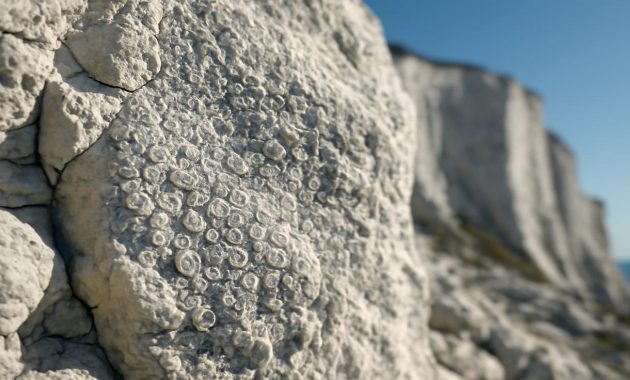
On a bright, wind-stung morning on England’s south coast, you stand at the edge of the world. Or at least, it feels that way. Below, the sea heaves and folds in slow green surges. Above, gulls drift like scraps of paper caught in an invisible updraft. And stretching away in both directions is a wall of pale stone so sheer and luminous it seems to hold the sky in place. This is one of England’s most iconic cliff lines—chalk-white, camera-famous, stitched into postcards and movie scenes and childhood holidays. You run your hand along the cool surface and think, as most of us would: rock. Solid. Ancient. Unquestionable.
But that is only partly true. Because what you’re touching isn’t just rock at all. It’s the ghostly, tightly packed architecture of millions upon millions of microscopic algae—tiny creatures that once floated freely in a very different sea. The stone beneath your fingers is, almost literally, the memory of an ocean.
The Day the Cliff Turned into an Ocean
Imagine for a moment that this cliff face is a window instead of a wall. Peer through it, and what you’d see is not a solid landmass but a warm, shallow sea spread over what would one day become Europe. Go back about 90 to 100 million years, into the late Cretaceous, and forget the wind-battered view in front of you. There is no England as you know it. No cliffs. No seafront cafés. No coastal path stitched along the edge like a careful hem.
Instead, you’d be swimming in water that feels almost bath-warm, a sea rich with dissolved minerals and flooded with sunlight. Suspended in that glowing water are billions of microscopic algae called coccolithophores. You can’t see them with the naked eye, but if you scooped up a handful of water in a clear jar and let the sun pour through, you’d notice a faint milkiness to it—an underwater haze made of life.
Coccolithophores are tiny, single-celled algae, each one wrapped in an exquisite shell of calcium carbonate plates called coccoliths. Think of a microscopic snowflake crossed with a shield. These algae drift in the sunlit upper layers of the ocean, turning light and carbon dioxide into life through photosynthesis. It’s work as ordinary to the planet as breathing—yet, given enough time, world-changing.
When each coccolithophore dies, its calcium shell begins the long, slow journey downward. One plate, then another, then a storm of them, sinking like a never-ending snowfall into the darkness. Over thousands, then millions of years, these plates pile up on the seabed: a soft, pale ooze, meters thick, then tens of meters, then hundreds. Under the weight of everything that falls above it, that ooze compresses, hardens, and—very gradually—turns into chalk. The same chalk that now towers over the modern sea in those iconic cliffs.
How to Build a Cliff Out of Microscopic Shells
It’s almost comedic, when you think about it. We tend to imagine cliffs being built by enormous forces: the crashing of waves, the grinding of glaciers, volcanic eruptions heaving rock into the sky. And yes, those forces are real. They’ve sculpted mountains, carved valleys, split continents. But the cliffs you’re looking at here—the famous chalk escarpments along parts of England’s southern coast—owe their existence to something infinitely smaller and quieter.
Under a microscope, a sample of chalk doesn’t look like a simple white smear. It becomes a crowded city of tiny shapes: discs, rings, plates, spirals. Each of those patterns is the fossilized shell of a single coccolithophore, created in life to protect a cell so small it could slip through the weave of the finest cloth you own. The chalk is not just made of algae; in a textural, literal sense, it is algae—pressed and packed into stone.
Over time, the layers of chalk thickened on the ancient seabed, sometimes stretching to several hundred meters. Other sediments mixed in—thin streaks of darker material, pockets of flint formed from silica-rich organisms like sponges and radiolarians. If you could cut a perfect slice through an English chalk cliff and lay it flat on a table, it would read almost like a diary. Each layer: a season, a climate shift, a quiet record of changing oceans.
| Feature | Description |
|---|---|
| Main builder | Microscopic algae (coccolithophores) |
| Building material | Calcium carbonate plates (coccoliths) |
| Time to form cliff deposits | Tens of millions of years in the Cretaceous period |
| Original environment | Warm, shallow, nutrient-rich seas covering much of Europe |
| Why the cliffs are white | Pure, fine-grained chalk with relatively few dark impurities |
At a distance, a cliff looks monolithic: a single slab. Up close, with the right tools, it dissolves into a gathering of individuals—each one a tiny algae shell, each layer a long-lost sea surface.
The Algae Architect You Never Knew You Needed
There’s something humbling about realizing that some of the most dramatic coastlines on Earth were quietly engineered by organisms you couldn’t see on your best day with perfect eyesight. These algae—so delicate that a needle-tip could shatter them—have shaped landscapes that have guided ships, inspired painters, and defined national identities.
Stand at the cliff edge and listen. You’ll hear the wind, the snap of salt in the air, the muffled roar of waves folding into shingle far below. But if you could turn time into sound, you might also hear the soft, endless rain of coccoliths settling on the seafloor, century after century. No drama. No fanfare. Just persistence.
“Rock” sounds permanent. “Algae” sounds flimsy. Yet here they are, intertwined: the fragile becoming the fortress. This is one of the strangest truths of geology—that the most solid things we know are often the slowest stories of the smallest lives. The cliffs, in that sense, are less like fortresses and more like libraries, stacked with microscopic pages.
We like our builders big: mountains built by tectonic plates crashing; canyons carved by rivers raging. But here, the master architects are less imposing than a dust mote. Coccolithophores work in numbers that our minds stumble over: billions upon billions upon billions, season after season, drifting, blooming, dying, sinking. Each one adds only the faintest whisper of thickness to the seafloor. Cumulatively, those whispers become a wall of chalk several hundred feet high.
To most visitors, the idea that they’re effectively walking along the edge of an ancient algal deposit never crosses their mind. The story we usually carry is simple: cliffs are rock, rock is solid, and solid things were always here in some form. The deeper, slower story—that this wall was once a living haze in the sunlit skin of a long-vanished ocean—makes the view not smaller, but vaster.
The Slow Reveal: How Science Uncovered the Cliff’s True Identity
The revelation that these chalk cliffs were built largely by algae didn’t happen overnight. It came gradually, piece-by-piece, as microscopes sharpened, geological mapping improved, and the language of Earth’s history became clearer.
Early naturalists and geologists in the 18th and 19th centuries noticed that chalk wasn’t like hard, crystalline rock. It crumbled easily, smudged to a fine powder between the fingers, and sometimes contained tiny shells visible even without magnification. Under the first decent microscopes, this powder transformed into a crowded field of minute shapes: plates, discs, and fragments that looked strangely intentional, almost engineered.
Those shapes—coccoliths—were eventually linked to living plankton in modern oceans. Samples of seawater revealed algae wearing the same calcium armor that filled the chalk. Suddenly, the clean white cliffs were no longer an anonymous deposit. They had authors.
Further research tied the chalk to a specific chapter in Earth’s timeline: the Cretaceous period, roughly 145 to 66 million years ago, an era of high sea levels and greenhouse climates. Much of what is now Europe lay underwater then, beneath broad, shallow seas. In these seas, coccolithophores flourished on a planetary scale.
When satellites later scanned the modern oceans, they sometimes captured vast swirls of milky turquoise: living coccolithophore blooms large enough to be seen from space. These blooms tint the water just enough to reveal their presence from orbit—a living echo of the ancient seas that once built the chalk. The same kind of organism that now drifts invisibly off the coast was once the construction crew for the very cliffs people trek out to admire.
It flips the usual direction of our gaze. We come to the cliffs to look down—into the water, into the drop. Science invites us to look the other way as well: from modern water up into the past, from a handful of plankton back into rock.
Cliffs as Climate Diaries
A Wall of White That Remembers the Weather
Once you know that a chalk cliff is made of algae, the next realization arrives quickly: this isn’t just geology. It’s climate history written in stone. Coccolithophores don’t flourish in a vacuum; they respond to temperature, light, nutrients, and chemistry in the water. In other words, they are deeply entangled with the mood of the planet.
Layer by layer, chalk captures chemical clues about the ocean that birthed it. Tiny variations in the ratio of elements such as carbon and oxygen can tell scientists how warm the water was, how much carbon dioxide was circulating through the atmosphere, how fast the carbon cycle turned. The cliffs don’t just stand above the sea; they remember its every change.
In a lab, a sliver of chalk shaved from a cliff can be turned into numbers—temperatures, CO₂ levels, shifts in acidity. That data can then feed into our understanding of how Earth behaves in a greenhouse world, how oceans store and release carbon, how life adapts to slow, relentless change. The chalk becomes a quiet oracle, speaking in isotopes and trace metals.
There’s irony here, too. Many of the fossil fuels we burn today are made from long-dead plankton buried and cooked in the crust. Their carbon is now being launched skyward in a geological instant. Meanwhile, right above the waves, chalk cliffs—built from different microscopic algae—record an earlier age of warmth and rising seas, an age whose echo we’re beginning to feel again. The algae built the cliffs; their far botanical cousins helped fuel our engines; and somewhere in between, our future climate is being debated in stone.
Walking on the Edge of an Ancient Bloom
Seeing the Familiar Coast with Altered Eyes
Next time you find yourself at the edge of a chalk cliff—whether it’s a famous, postcard-perfect stretch or a quieter, lesser-known reach—try walking a little more slowly. Feel the grit under your boots on the coastal path, the faint crunch as chalk dust breaks away. Each grain you grind into the soil once belonged to a single living cell, floating in a Cretaceous sun.
Lean over (safely distant from the edge) and watch waves explode into foam against the base of the cliff. Those same waves are now reclaiming the chalk, grain by grain, spiriting it back into the sea from which it came. Erosion here isn’t just geology; it’s an ongoing dialogue between ancient ocean life and the modern ocean’s energy. What was once a falling snow of coccoliths has become a steady rain of chalk dust back into salt water.
Run your fingers along a flint nodule, glossy and dark against the matte white. Even that contrast tells a story of changing chemistry, of silica moving through sediments, of different micro-organisms leaving their mark. You start to see the cliff as a collage of past oceans layered vertically.
Consider, too, how this unlikely origin shifts the emotional weight of the place. It’s tempting, standing before such a towering wall, to feel small in the face of “rock” and “time.” But knowing that this wall is built from organisms no larger than a speck of dust bends that feeling into something more intimate. The mighty becomes multitudinous. The impossible becomes incremental.
We tend to think of nature’s dramas as happening in obvious ways: storms, quakes, landslides. Yet the longest-running stories are written slowly, by tiny authors. Coccolithophores didn’t set out to build icons. They simply lived, died, and let gravity do the rest. Out of their quiet, repeated lives arose a landscape of white cliffs that would one day be used as landmarks for sailors, backdrops in films, metaphors in speeches, and symbols in national lore.
Why This Unlikely Finding Matters Now
From Ancient Algae to Modern Choices
It’s easy to place the algae-built cliffs firmly in the category of “curious facts”—interesting, surprising, but fundamentally detached from our daily lives. Yet the deeper you follow the story, the more it threads into the present.
First, there’s the climate connection. Coccolithophores are not just historical; they’re very much alive in today’s oceans. They still play a role in locking carbon away in the deep sea by building calcium carbonate shells that eventually sink. The same basic process that built the chalk cliffs continues now—just on a smaller, faster, more fragile stage.
As the ocean warms and becomes more acidic due to rising CO₂ levels, these algae face new challenges. Acidic water makes it harder to build and maintain their calcium shells. Changes in ocean chemistry and temperature can shift where and how these blooms occur. When scientists worry about the future of marine ecosystems, coccolithophores are part of that concern, because they help steer the ocean’s response to carbon—both as creators of shells and as photosynthesizers capturing CO₂.
Understanding how vast algal blooms once thrived and then quietly wrote themselves into rock helps researchers model what might happen next. The cliffs serve as both record and warning: a testament to how thoroughly the planet can reorganize itself under different climate regimes.
There’s also a philosophical weight to the discovery. Knowing that an iconic cliff is largely the work of algae rearranges our mental hierarchy of importance. Suddenly, the invisible feels indispensable. Microscopic life stops being background and becomes central—a force that shapes coastlines, climates, and even cultures, without ever asking permission or announcing itself.
When you stand at the top of a chalk cliff and let your eyes run along the white arc of stone, you’re not just admiring a view. You’re looking at the cumulative effect of small things acting consistently over very long timescales. That, in itself, is a kind of quiet instruction. Many of the problems we face—climate change, biodiversity loss, the health of our oceans—are also stories of small, repeated actions piling up. The cliffs show how profoundly those piles can matter.
Frequently Asked Questions
Are these cliffs really made by algae and not “real” rock?
They are very much real rock—but the rock is mostly composed of the fossilized calcium shells of microscopic algae called coccolithophores. Over millions of years, the accumulated shells on the seafloor were compressed into chalk, which we now see as towering cliffs.
How long did it take for algae to build these chalk cliffs?
The chalk deposits formed over tens of millions of years, mainly during the Cretaceous period. Each generation of algae contributed only an extremely thin layer, but sustained over vast time, that gentle accumulation built cliffs hundreds of meters thick in places.
Why are the cliffs so bright white?
The striking whiteness comes from the purity and fineness of the chalk, which is made primarily of tiny calcium carbonate plates. There are relatively few dark impurities mixed in, so the rock reflects a lot of light and appears brilliantly white, especially in sunshine.
Do coccolithophores still exist today?
Yes. Coccolithophores are still common in modern oceans and sometimes form huge blooms visible from space. They continue to play a role in the global carbon cycle by capturing carbon dioxide and building calcium carbonate shells that can sink to the deep ocean.
Can climate change affect these algae and future chalk formation?
Changing ocean temperatures and increasing acidity can affect coccolithophores by making it harder for them to build and maintain their calcium shells. While new chalk is not forming on the scale it did in the Cretaceous, changes to these algae today can still alter how the ocean absorbs and stores carbon in the long term.
Are all white cliffs in England made of the same material?
Many of the iconic white cliffs along England’s southern and eastern coasts are made of chalk, largely built from coccolithophores. However, not every pale cliff is chalk; some may be different sedimentary rocks. Local geology determines the exact composition.
Is the chalk in the cliffs the same as chalk used on blackboards?
Traditional blackboard “chalk” was often made from natural chalk similar to that in the cliffs, though modern sticks are frequently made from other materials like gypsum. The chalk in the cliffs is the natural, unprocessed version—compressed algae shells straight from Earth’s geological archive.