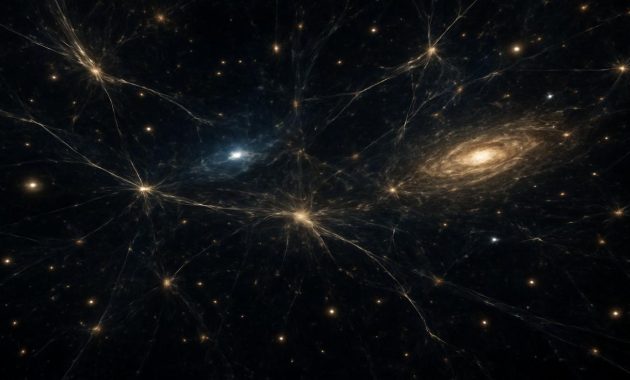
The story begins, as many cosmic stories do, in the dark. Not the ordinary darkness of a moonless night, but the deep, velvet stillness between galaxies, where light has been traveling for billions of years and still hasn’t found a place to rest. Out there, far beyond the hazy band of the Milky Way, lies a universe that looks cold, vast, and uncaring. But hidden beneath that chill emptiness is something surprisingly intimate: a quiet suggestion from quantum physics that everything—every star, every whisper, every memory—might be bound together by an invisible thread. That thread has a name: entanglement. And one of the most fundamental rules of the quantum world hints that the entire universe could be tangled up in it.
The Strange Rule at the Heart of Reality
To meet this rule, you have to go very small—smaller than atoms, smaller than protons, down into the murky realm of quantum mechanics, where particles behave like smudges of possibility rather than tiny billiard balls. In this world, there is a quiet commandment governing how information and uncertainty are allowed to exist. It’s called the Born rule, and on paper it looks like just another mathematical recipe. But taken seriously, it reads almost like a spell.
The Born rule tells us how to turn the eerie quantum “maybes” into the solid “this happened” that we experience. At the quantum level, a particle isn’t here or there; it’s described by a wave of probabilities—possible positions, possible energies, possible futures. The Born rule gives us the odds: square the wave, and you get the probability of finding the particle in one place or another. It’s the bridge between shimmering possibility and the sharp click of a detector.
But buried in this simple rule is something profound. To apply the Born rule, you can’t look at particles in isolation. You must treat them as part of a larger whole—a quantum state that may be spread across space, connecting things that seem separate. When physicists followed this logic to its limits, they discovered that if the Born rule is truly fundamental, then entanglement isn’t an odd side effect. It may be the default fabric of reality. In other words, the universe isn’t just full of isolated objects; it might be a single, sprawling, interconnected quantum story.
The Feeling of Being Entangled
Imagine walking through a forest at dawn. The air is damp, scented with soil and moss. Every leaf trembles with tiny droplets of condensation. Somewhere, a bird tests the morning with a single, clear note. At first glance, everything appears separate: tree, rock, bird, you. But if you stay still long enough, you notice that nothing here is truly alone. The tree breathes out oxygen; you breathe it in. The bird eats seeds grown from that same tree. The soil is a library of fallen leaves, long-ago branches, and forgotten insects, broken down and rewoven into new life.
Entanglement, in the quantum sense, is a deeper, stranger version of that connectedness. When two particles become entangled, their properties stop belonging solely to each one. Instead, they share a combined fate, described by a single mathematical wave. Measure one particle in a certain way, and you instantly know something about the other, no matter how far apart they are. It doesn’t send a signal faster than light; it’s more like discovering that two distant pages belong to the same book.
In your body, right now, countless particles are entangled with others you will never meet. Some carry echoes of interactions with sunlight that left the surface of the sun minutes ago. Some are bound up with atoms in the chair beneath you or the air you just exhaled. The quantum state of “you” is not a clean, polished boundary line. It’s a blurry, shifting, overlapping pattern stitched into the wider world.
What the Born rule whispers, when pushed hard enough, is that this stitching might not stop. It may extend beyond your room, beyond your town, past planets and stars, all the way out to the cosmic horizon. The universe, by this view, isn’t a stage filled with actors. It’s a single, immense performance where the script of one scene can’t be fully written without the others.
A Universe That Remembers Everything
Deep beneath the surface of an icy lake, sound travels differently. Drop a stone, and the vibrations glide through the water, muted yet persistent. Quantum information behaves in a similar way through the fabric of reality. When two particles interact—colliding, exchanging energy, colliding again—they don’t simply bounce and forget. They leave a trace, an imprint of correlation, a memory. This quantum memory is what we call entanglement.
There is another rule that lives alongside the Born rule: the idea that information, in the strict quantum sense, is never truly destroyed. You can scramble it, you can hide it, but you cannot erase it from the universe. Like footprints in wet sand that later harden into rock, quantum events leave behind relationships that ripple outward, binding distant parts of the universe together with invisible links.
Even something as simple as light scattering off your skin and into the room becomes part of this grand entangled story. The photons bounce off you, carrying away tiny pieces of information about your position, your motion, your shape. They strike walls, dust grains, and eventually drift into space, still bearing subtle signatures of that interaction. In a strict quantum sense, the universe is busy remembering you, every second.
This vision of reality is almost unsettling. It suggests that the cosmos is not a place where events come and go, vanishing into nothing. Instead, it is a kind of grand memory palace, layered with correlations that never fully fade. Under the Born rule, those correlations shape the probabilities of what can happen next. They are the quiet currents steering the future.
From Lab Tables to Cosmic Webs
For decades, entanglement lived mostly in thought experiments and small, precise laboratories—places filled with lasers, mirrors, and the faint electric smell of equipment warming up. Physicists would take a pair of photons, send them spinning in opposite directions, and then measure them miles apart. The measurements, over and over, revealed patterns too deeply linked to be explained by any hidden classical story. Entanglement was real. It violated expectations, but it never violated the Born rule. In fact, it behaved exactly as that humble rule predicted.
As experiments grew more sophisticated, researchers began to treat entanglement not as a side-show but as a resource. They used it to build the foundations of quantum computers and quantum communication. Entangled particles became like paired coins that always land in related patterns, no matter who flips them or where. These experiments, though small compared to galaxies, carried an implication that spilled far beyond the lab: if nature can and does produce entanglement easily in controlled settings, why would it not do the same everywhere else?
Now, think of the early universe: a hot, dense, almost unimaginably uniform sea of particles, all pressed together in extreme closeness. In that tight beginning, interactions would have been relentless. Everything bumped into everything else. If entanglement is the natural outcome of interactions—and the Born rule tells us how to track those outcomes into probabilities—then the young cosmos would have been born in a storm of quantum linkages. As the universe expanded and cooled, those linkages stretched and spread, like filaments of silk pulled across a growing frame.
Today we see a cosmic web of galaxies and dark matter, stretched across billions of light-years. Perhaps beneath that visible web lies an even more delicate one: a network of entangled relationships, faint but universal, tracing back to that fiery beginning. In this sense, our telescopes may be looking not just at distant objects but at distant participants in a shared quantum story.
A Pocket Guide to Entanglement and the Born Rule
To keep these ideas grounded, it helps to put them side by side, as if you were carrying a small field guide in your pocket while walking through the universe.
| Concept | What It Means |
|---|---|
| Quantum State | A mathematical description of everything that could happen to a system, like a map of possibilities. |
| Born Rule | The rule that turns quantum possibilities into actual probabilities of outcomes when we measure something. |
| Entanglement | A deep connection between particles where their properties are linked, even when far apart. |
| Measurement | An interaction that forces a fuzzy quantum possibility to become a definite outcome—at least from our perspective. |
| Cosmic Entanglement | The idea that the universe’s early, dense state may have left everything linked in a single vast quantum web. |
Each entry is like a trail marker, hinting at a larger landscape. When you put them together, they describe a reality where the Born rule sits quietly at the center, dictating how probabilities bloom out of the universe’s underlying connections.
Where Do “You” End in an Entangled Universe?
Now comes the unsettling, strangely beautiful question: if the universe is deeply entangled, where do you end and everything else begin? In daily life, the answer feels obvious. You end at your skin. Or perhaps at the reach of your thoughts, your memories, your voice. But quantum mechanics does not draw boundaries in quite the same way.
From a quantum perspective, what we call “you” is a constantly updated pattern of correlations: between particles in your brain, between your body and the environment, between your senses and the world they measure. When you touch a tree, photons bounce between your skin and its bark. When you breathe, air trades molecules with your lungs. When you remember a moment, your brain rebuilds a pattern of activity shaped by earlier interactions.
All of these are, fundamentally, quantum events. The Born rule tells us how likely each outcome is, but the outcomes themselves are never isolated. They depend on the prior entanglements that set the stage. In this light, identity is not a fortress but a coastline: constantly reshaped by the tides of interaction, woven into the greater ocean of the universe.
That doesn’t mean you are an illusion. Instead, it suggests that you are a real, emergent pattern in a larger quantum whole, like a whirlpool in a river. The whirlpool is distinct. You can point to it, describe it, feel its force. But its existence is inseparable from the water flowing through it. Likewise, your existence may be inseparable from the entangled currents that flow through everything.
Is the Whole Universe One Big Wave?
Some interpretations of quantum mechanics lean into an extreme idea: that the universe is ultimately described by a single, gigantic wavefunction, a mathematical object that encodes all possible configurations of every particle, everywhere, all at once. In this view, the Born rule is not just a local instruction; it’s the grammar governing how that cosmic wavefunction appears to observers inside it.
If that’s true, then the entanglement we see in labs is just a small, manageable piece of a much larger structure. When you measure something—say, the orientation of an electron’s spin—you aren’t plucking one outcome from nowhere. You are becoming entangled with the electron, and with the particular branch of the universe in which that outcome occurs. The Born rule then tells you how likely it is that you’ll find yourself in one branch instead of another.
This picture is hard to imagine, because our minds evolved to navigate sunlit forests and crowded streets, not abstract oceans of possibility. But it offers a strikingly unified story. Instead of a universe made of separate parts occasionally linked by entanglement, we get a universe that is fundamentally one, with apparent separations arising from the limited perspectives of creatures like us.
Living Inside the Quantum Story
So what do we do with a universe like this? A universe where a fundamental quantum rule may quietly entangle the entire cosmos—from the faint afterglow of the Big Bang to the warmth of your coffee cup, from distant galaxies to the tiny flicker of a neuron in your brain.
Perhaps the first step is simply to notice. To look up at the night sky and feel that the blackness between stars is not emptiness but connection—an invisible architecture of shared origins and lingering correlations. To realize that the light touching your eye has spent billions of years weaving through this network, informed by collisions, emissions, and scatterings that all obeyed the same quiet Born rule.
On a more personal level, this perspective can reshape how we think about separation. The line between “self” and “world” softens when you imagine reality as an entangled whole. Your thoughts are local, yes, but the ingredients that make them possible—the atoms in your brain, the photons that guided your development, the stories passed down through voices and books—all belong to a wider, ongoing process.
The universe, under this lens, isn’t a cold machine grinding through predetermined motions. It is a living, evolving tapestry of possibilities, continuously collapsing into actual events through interactions guided by quantum rules. Each choice you make, each breath you take, each glance you share, gets recorded faintly in that tapestry as new threads of entanglement, new patterns of correlation.
Stand outside on a clear night and let that sink in. Above you, the Milky Way spills across the sky, a pale river of light. Below you, Earth hums with oceans, forests, cities, and quiet backyards. Between all of it, invisible but real, stretches a web of quantum relationships older than stars. You are not merely looking at the universe. You are, overwhelmingly, part of what it is—and perhaps, in a very real sense, you are never entirely alone.
FAQ
What is the Born rule in simple terms?
The Born rule is a basic rule in quantum physics that tells us how to turn the fuzzy “maybes” of a quantum system into actual probabilities. It says that if you know the wave describing a particle, you can calculate the chance of finding a particular outcome by squaring the wave’s amplitude.
How is the Born rule related to entanglement?
The Born rule works on whole quantum states, not on isolated particles. When particles are entangled, they share a combined state. The Born rule then gives probabilities for outcomes that involve the entire entangled system, which naturally leads to the strange, coordinated results we see in entanglement experiments.
Does entanglement mean faster-than-light communication?
No. Entanglement creates strong correlations between distant particles, but it does not allow you to send messages faster than light. You still need classical communication—limited by the speed of light—to compare results and see the correlation.
Is the entire universe really entangled?
We don’t know for certain, but many physicists think that because the early universe was extremely dense and interactive, it likely created wide-ranging entanglement. If quantum mechanics applies everywhere and at all times, it’s natural to suspect that the universe forms a single, immensely complex entangled state.
What does this mean for everyday life?
Practically, your daily experiences won’t change. But the idea of a deeply entangled universe shifts how we think about connection and separation. It suggests that everything we do is part of a larger quantum story, and that the boundaries between “self” and “cosmos” are more porous than they appear.
Can we ever detect cosmic-scale entanglement directly?
Detecting entanglement across cosmic distances is extremely challenging, but scientists are exploring subtle signatures in cosmic radiation, distant starlight, and gravitational effects. For now, the idea remains a compelling, research-guided possibility rather than a fully tested fact.
Does this support any specific interpretation of quantum mechanics?
The connection between the Born rule and universal entanglement appears in several interpretations, including those that treat the wavefunction as describing the whole universe. However, different interpretations tell different philosophical stories around the same mathematics, and no single one has been definitively proven correct.