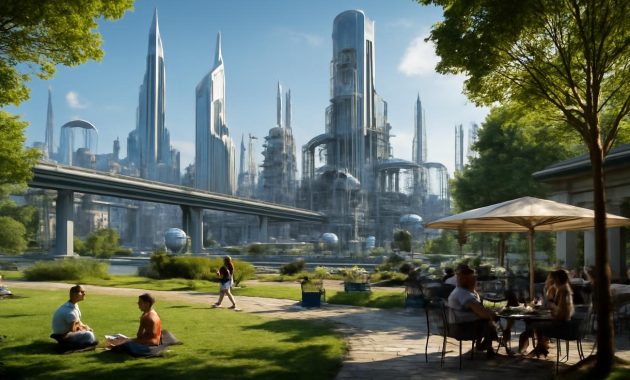
The letter from Stockholm arrives in an ordinary white envelope, the sort that might carry a utility bill or a dentist reminder card. It lands in a mailbox shaped like a small red barn at the edge of a quiet cul-de-sac in Boise, Idaho. No one expects world-shifting news to come here. The air smells faintly of wet asphalt and pine needles; a neighbor’s dog barks, a lawn sprinkler ticks in the distance. But when Maya, a 29-year-old former logistics coordinator now “transitioning” into something that doesn’t quite have a name, tears it open with her thumbnail, the world tilts—just a fraction, but enough that she will remember the sound of the paper ripping for the rest of her life.
The letter is simple, formal, and strangely understated for what it announces: the Nobel Prize in Physics this year is awarded not for discovering a new particle or peering deeper into the cosmos, but for a theory—now a sprawling, global experiment—that rewires the meaning of work itself. A theory that, when first floated, sounded like science fiction combined with political heresy: a fully automated, AI-driven, planetary-scale infrastructure capable of providing abundance while requiring almost no human labor.
As she scans the words again and again, the part that sticks out is not the technical description of “self-governing cyber-physical resource grids.” It’s the citation line the committee chose to highlight, the one already being quoted across a buzzing internet: “For this Nobel Prize in Physics, Elon Musk and Bill Gates are right about our collective future: we will have more free time, but we will no longer have jobs.”
The Morning After the Nobel
By dawn the next day, the world has broken into two emotional time zones. In one, people are exhilarated, even giddy, as if a long-held, half-secret wish has finally been spoken out loud by someone who matters. In the other, people move through their morning routines with a tightness in their chest, scrolling headlines about “the end of jobs” with coffee that suddenly tastes too bitter.
Maya sits in her small kitchen, barefoot on cool tile, toaster humming behind her. Outside, the delivery drones buzz overhead like fat black dragonflies, tracing their invisible lanes in the sky. The news feed on her table projects onto the surface in a faint blue wash. Her reflection warps around the scrolling text: Nobel Prize, automation, end of work, new social contract. She flicks a finger and a replay begins—last night’s press conference in Stockholm.
The laureate, a soft-spoken systems physicist with a voice like dry leaves, explains how it happened. How the mathematics of network optimization and quantum control were married to industrial robotics and decentralized power systems. How urban farms layered with sensor webs learn to feed cities with almost no human hands. How self-repairing machines now fix roads, lay fiber, maintain solar fields, and operate cargo ships that navigate oceans more safely than any human captain.
“The laws of physics,” he says calmly, “never promised us that human muscle or human attention were prerequisites for production. We assumed it because, for a few thousand years, it was true enough. It isn’t anymore.”
In a distant clip, Elon Musk’s old interviews resurface, grin crooked as he warns of AI eating jobs. Bill Gates’ measured tone returns from the archives, talking about taxing robots and cushioning the blow. Back then, it felt like one more tech billionaire anxiety tour. But somewhere between those televised warnings and this Nobel ceremony, the warnings became a blueprint.
Maya remembers other warnings too, older than Musk or Gates: science fiction paperbacks with dog-eared covers, their futures filled with idle citizens drifting through gleaming cities, or darker dystopias of permanent underclasses numbed by entertainment. None of those paper futures mentioned how it would feel on a Tuesday in Boise, bread popping from the toaster while your phone quietly tells you that the job market you were trained for has evaporated faster than polar ice.
The Physics of Letting Go
We’re used to thinking of physics in hard, unsentimental terms: falling apples, stubborn equations, stars collapsing in on themselves. But this Nobel—this pivot—sits on a much more intimate frontier: the microscopic mechanics of your own day. The friction of waking to an alarm because someone, somewhere, will pay you a wage if you show up on time.
For generations, our lives have orbited the concept of work like planets locked in a gravitational dance. Job, paycheck, rent, groceries, the worn ache in your shoulders on Friday night: these were the predictable constants. But the laureate’s equations describe a different orbit. They sketch out a society where human beings are no longer the “engines” of production but the beneficiaries of a machine-driven metabolism of the world.
Imagine the hum beneath your city. Autonomous drilling rigs tracing subterranean heat for district-level geothermal systems. Fleets of electric vehicles coordinating like flocks of starlings, delivering goods while constantly repositioning to soak up surplus solar power where the grid is brightest. Agricultural robots tending polyculture fields that look more like restored prairies than industrial rows of monocrops. Everything learning, adjusting, trading information and energy.
No foreman shouts. No HR department posts job listings. The work is happening; it simply no longer needs us in the way factories once needed hands. That’s the unnerving beauty: the physics of efficiency, scaled until human labor becomes an optional add-on, not a necessity.
Elon Musk once put it bluntly: “There will be fewer and fewer jobs that a robot can’t do better.” Bill Gates echoed, pointing out that we’ve taxed labor forever but not automation, and that this imbalance would force a reckoning. They were dismissed by some as catastrophists, by others as futurists flexing their brands. But what they saw—what that quiet systems physicist eventually proved on a whiteboard in some fluorescent-lit lab—was that the fundamental rules of matter and energy actually favor a no-job world once you cross a technological threshold.
We crossed that threshold. Not with a bang, but with a soft, rolling sequence of optimizations: warehouse by warehouse, field by field, city by city. Until one morning you woke up and half the openings on the job board were gone, not because of a recession, but because the system simply didn’t need you to move stuff, watch stuff, or fix stuff anymore.
The New Shape of a Day
On the morning after the Nobel announcement, Maya does something radical in its ordinariness: she goes for a walk. Not on a lunch break bracketed by meetings, not as a rushed attempt to “get steps in” before bed. Just a walk, because there is time now, and because the nervous fizz in her blood needs somewhere to go.
The neighborhood is half-awake. A retired teacher tends tomatoes in a vertical garden that climbs like ivy along her fence, tiny robots humming softly as they adjust irrigation. A teenager sits cross-legged on the curb, augmented reality glasses on, hands sketching in mid-air—a 3D art assignment for a global studio collective that pays in reputation points, not wages. A middle-aged man bikes past leisurely at 9:30 a.m., the hour that, in the old world, would have defined him as unemployed and anxious. Now his posture is loose, almost jaunty. The label no longer fits; the category itself is dissolving.
Everywhere, you can sense the subtle awkwardness of a species that has hit the brakes after centuries of acceleration. People sneak glances at one another, as if asking silently: What are you doing with all this time? Are you doing it right?
One of the strangest side effects of the automation wave was how it broke the clock. “Nine-to-five” lost its monopoly. The grid needs tending 24/7, but it’s machines that keep watch, their inspections and micro-adjustments taking nanoseconds. Human time has become elastic, unpinned from the factory whistle and the wall calendar.
To grasp this shift, it helps to see how a typical day transformed once the world embraced a no-job economy underpinned by physical abundance. Consider the contrast:
| Aspect of Daily Life | Industrial Job World | Post-Job, Automated World |
|---|---|---|
| Main Use of Morning | Commute, prepare for work, rush | Personal projects, learning, leisure, caregiving |
| Core Source of Income | Salary or hourly wage from an employer | Universal dividend from automated production and shared infrastructure |
| Primary Identity | Job title (“I am a teacher, engineer, driver”) | Roles and passions (“I write, I restore streams, I care for neighbors”) |
| Time with Family/Community | Residual; evenings and weekends | Central; woven through the day |
| Main Constraint | Lack of time; work schedules | Choice and meaning; how to use abundant time |
If you squint, that third column sounds utopian. More free time, secure income, a life not held hostage by a boss’s calendar. Musk and Gates, standing years back on conference stages under bright lights, painted something like this when they said automation would free us from drudgery. But what the Nobel committee’s sentence admits, in its clear and clinical way, is that the price of this liberation is the loss of something we didn’t know we were clinging to: the job as our central organizing story.
Work, Jobs, and the Quiet Panic of Meaning
There’s an important distinction hiding in plain sight: work is not the same as a job. Work is what you do to shape the world—raising children, composing music, mending a broken friendship, tending a forest. A job is a formal agreement to trade your time and skills for money. The Nobel, Musk, Gates, and the humming planetary network of machines are conspiring only against one of these, not the other.
But humans are creatures of story, and for more than a century our dominant story has been job-shaped. The first question at parties, the way we introduce characters in novels, the checkboxes on official forms—“occupation” has stood in for “who are you?” We’ve worshiped at the altar of busyness, praised overtime, romanticized the grind. When someone says, “I’m a nurse,” you don’t just learn how they earn money; you file away a whole sketch of values, hardships, talents.
When jobs began to evaporate—first slowly, then all at once—something invisible cracked. People who had enough to eat, a warm place to sleep, and even more free time than they’d ever known reported a strange, low-grade despair. Days stretched out like unmarked pages. Without the external scaffolding of shifts and deadlines, anxiety seeped in: Am I doing enough? Contributing enough? Am I… enough?
This is the part Musk and Gates were more tentative about, perhaps because spreadsheets and rocket schematics cannot capture the full weight of an identity crisis. The physics laureate can show, with clean lines on a chalkboard, how an automated grid reaches peak efficiency when you remove human “noise” from minute-to-minute operations. What his equations can’t answer is how a mother in Mumbai or a former factory worker in Detroit should reconstruct a sense of worth when the world no longer needs them to clock in.
In the months after the Nobel, a new kind of conversation spreads—from kitchen tables to town halls, from quiet online forums to packed auditoriums. Philosophers sit down with software engineers. Former warehouse pickers join panels alongside roboticists. Therapists talk about grief—not only for lost wages, but for the vanishing story of “earning your keep.” The world starts to realize: the hardest engineering problem was never the robots or the grids. It was always this—how to re-engineer meaning itself.
The Ecology of a Jobless Planet
Walk far enough from Maya’s cul-de-sac and the neighborhood gives way to something that doesn’t have a name yet. It’s not quite “suburban,” not quite “rural,” and not completely “wild.” The lawns are smaller now, interrupted by community orchards and wetlands; the roads bend around old oak trees instead of slicing them down.
Once, this kind of landscape would have been called “underdeveloped” or “unproductive.” There would have been pressure to build another office park, another distribution hub, another strip of identical chain stores. Jobs, the argument would have gone. We need the jobs.
But now, the warehouses are mostly silent except for the whir of automation. The office towers, those glass-and-steel reliquaries of the email era, are slowly being rewilded or converted into co-living spaces, studios, libraries, indoor farms. The economic gravity that once demanded every square meter justify itself in payroll has weakened. In its place: a different logic, one that feels closer to ecology than to commerce.
With the old job engine winding down, the pressure on the planet shifts. The Nobel-winning framework didn’t just free human time; it redesigned how we extract, move, and consume material. The algorithmic nervous system running beneath our feet is ruthlessly efficient not only about cost, but about waste. Turning forests into furniture for profit makes less sense when machines can calculate the long-term climate impact with brutal clarity and match it against the modest marginal gain in comfort that a new coffee table provides.
So the world, very slowly, starts to breathe easier. Some mines go quiet. Shipping lanes thin. Mega-factories that once roared with human and mechanical noise become compact, closed-loop systems requiring only periodic human oversight. Nature creeps back into the margins we used to pave.
In this context, the disappearance of jobs looks different. Our great-grandparents’ fear was: “If we don’t have jobs, we’ll starve.” Ours, increasingly, is: “If we cling to jobs as we used to know them, the planet will.” Musk and Gates, technologists to their core, argued that automation was inevitable and should be managed. The Nobel Prize translates that inevitability into the quiet authority of scientific consensus: the physics of our world simply favors doing more with fewer human hands and less ecological cost.
With that confirmation, the policy experiments that once seemed radical edge closer to normal: universal basic dividends funded by automated productivity; “contribution sabbaticals” for people to immerse themselves in art, caregiving, or restoration projects; shared ownership models for infrastructure so that no single corporation holds the keys to the grid that feeds and warms billions.
And here, unexpectedly, stories from modern nature storytelling magazines begin to read less like escape and more like manual. Tales of people learning bird calls, mapping urban foxes, cataloging wildflowers in vacant lots, restoring creek beds choked by decades of runoff—these are not just quaint side projects. They become prototypes for a post-job identity: human beings as stewards, not engines; as listeners, not just builders.
The Courage to Be Useless (At Least in the Old Way)
In one of those newly repurposed office towers, now a community studio, a group of former gig workers sit in a circle on mismatched chairs. They’re part of a “Transition Lab”—one of thousands that have sprung up around the world. There are no résumés pinned to the walls, no whiteboards covered in bullet points about “career trajectories.” Instead, the room smells faintly of clay and coffee. On a side table, someone’s experiment in small-batch fermented vegetables bubbles softly.
The facilitator, once an HR manager obsessed with performance metrics, now opens the session with a question that would have gotten her laughed out of any workplace training a decade ago: “What are you drawn to do when no one is watching and no one is paying you?”
The answers come slowly at first. “I like fixing old bikes.” “I write stories, bad ones so far.” “I want to learn how to help at the wetland out by the highway.” “Sometimes I just want to sit with my grandmother and record her memories of the village she left behind.”
Outside, the automated world hums along, mostly indifferent to their confessions. The food delivery system doesn’t care whether these people ever learn to code. The power grid isn’t waiting for them to file expense reports. The main “demand” they place on the system is simply to be alive and well enough to witness it. In an older economics, that would have been called “unproductivity.” Here, in this circle, it has another name: being human.
This is the quiet revolution hiding inside the physics: the courage to be “useless” in the narrow industrial sense, and to find instead a broader usefulness that isn’t easily measured. Watching a sunset with your child won’t show up in GDP, but it might shape a life more profoundly than any quarterly bonus. Replanting a hedge with native flowers will never be listed as a “career milestone,” but the bees don’t care about your LinkedIn.
As automation takes over the repetitive, dangerous, and mind-numbing tasks we once justified as “just part of the job,” we are left with the strange, bright, terrifying possibility that the center of a good life has little to do with employment. Musk gestured at this when he said that in an AI-saturated world, we’d need universal income and new ways to find meaning. Gates gestured when he talked about redirecting our best minds from ad tech and financial optimization to climate, health, and education.
What neither of them could fully script—no one can, really—is the personal act of standing in this new space and deciding what to do with it. That’s on us.
A Letter Addressed to All of Us
By evening, Maya has walked farther than she meant to. The sky is turning the color of spilled ink, streaked with orange. In her pocket, the Nobel committee’s letter is folded and refolded, softening at the creases. It wasn’t addressed to her, not personally. But in a sense, it was addressed to everyone living through this hinge moment in history.
On the way home, she passes a construction site where a handful of humans and an army of machines are quietly transforming an old shopping mall into something new: part makerspace, part greenhouse, part public bath. No one on-site looks particularly hurried. The machines work at their own pace, synchronized in the invisible rhythm of the network. A human watches, not because the machines would fail without him, but because he likes to be here, to smell the tang of cut metal, to feel the ground tremble when the larger exoskeletons take a step.
Back at her kitchen table, Maya sets the letter down and opens a blank document on her tablet. She has no job in the old sense. The nonprofit she worked for dissolved last year, its logistics folded into a global relief system coordinated by AI. The severance and the new universal dividend cover her needs. For months, she has felt like she’s drifting—unmoored, guilty about her idleness, giddy at her free mornings, then guilty again.
Now, as the glow from the screen lights her face, she starts to type, not a résumé, not an application, but a different kind of plan. One that includes volunteering twice a week at the wetland restoration project she saw posted on the community board. Taking a course on narrative journalism. Recording her grandfather’s stories about migrating from a farm that no longer exists. Starting a neighborhood “repair night” to teach kids how to fix things instead of throwing them away.
None of this will be a job. All of it will be work—in the oldest, most human sense of the word.
Outside, the drones continue their rounds. The automated fields adjust their irrigation in response to tonight’s forecast. Somewhere in Stockholm, the systems physicist who just won the Nobel sits alone in his hotel room, perhaps a little stunned by the fuss. The laws of physics, after all, haven’t changed. What’s changing, slowly and all at once, is us.
Elon Musk and Bill Gates were right about one thing: as the machines grow more capable, our calendars will loosen. We will have more free time. But the ending of “jobs” is not, it turns out, the ending of purpose. It’s an invitation—a demanding one—to write a new story about what we’re for, now that we are no longer indispensable to the production line.
The letter in Maya’s hands is only the formal announcement. The real Nobel, the one that will take decades to award or withhold, will be measured elsewhere: in how we choose to fill the hours that have been given back to us, and in whether we can learn, at last, to be at home in a world where we are not the gears, but the gardeners.
Frequently Asked Questions
Will automation really eliminate most traditional jobs?
Not overnight, and not uniformly across all regions and sectors. But the trend is clear: as AI and robotics improve, many routine, predictable tasks in logistics, manufacturing, transport, finance, and even parts of medicine and law can be done more cheaply and reliably by machines. Over time, this reduces the overall demand for human labor in those areas.
Does a post-job world mean people will stop working altogether?
No. People will still work, but less in the form of paid employment and more through self-directed projects, caregiving, creative pursuits, and community or ecological stewardship. The shift is from “work as wage-earning necessity” to “work as chosen contribution.”
How would people survive financially without jobs?
In most serious proposals, income comes from some form of universal dividend or basic income, funded by the productivity of automated systems and shared infrastructure. Taxes on resource use, data, energy, or automation itself can help distribute the benefits of machine labor to everyone.
What happens to social status when job titles disappear?
There is likely to be a long, messy transition. Over time, status may shift away from job titles toward other signals of contribution and character: creativity, community leadership, ecological care, mentorship, artistic or scientific achievement, and kindness. New forms of recognition and reputation systems will probably emerge.
Is this future inevitable, or can we choose a different path?
Technological capability alone doesn’t determine the future. We can choose policies that slow, shape, or redirect automation, and we can design social systems that either concentrate power and wealth or distribute them. The physics favors high automation; what we do with the time and abundance it creates is still very much up to us.