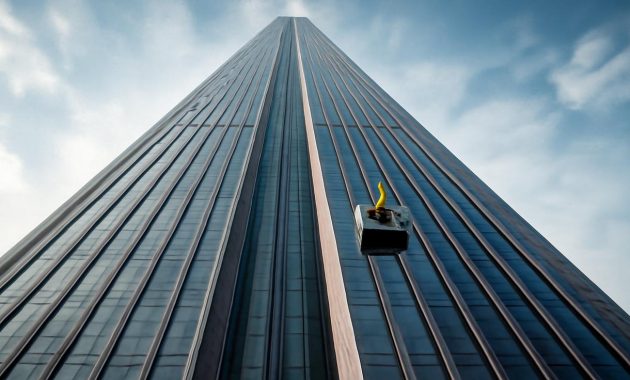
The courier leans his electric scooter against a sea of others, each one ticking softly as the batteries cool in the humid Shanghai evening. Neon blue and pink streaks ripple down the glass faces of the skyscrapers above him, reflecting in a puddle at his feet. In one hand, he grips a stack of insulated bags, each heavy with the scent of cumin lamb, ginger fried rice, and bubble tea slowly losing its chill. In the other, he holds his phone, where a single number flashes in tiny digital defiance: 83F. Eighty-third floor. He laughs under his breath, tightens the straps on his delivery boxes, and steps into the building where gravity suddenly feels like a suggestion, not a rule.
The City that Grew Upward
In many Chinese cities, the skyline doesn’t just rise—it erupts. Glass towers punch into low clouds, and entire neighborhoods seem to balance on the air. You can walk a single block in Shenzhen or Chongqing and feel as if the ground has pulled away beneath you, replaced by a maze of elevated walkways and stacked plazas, with apartments, offices, malls, gyms, and clinics all layered vertically instead of spread across the land.
This vertical revolution isn’t just an architectural story. It quietly rewrote the script of daily life—especially for people whose work depends on speed, timing, and human hunger. Not long ago, food delivery meant scooters weaving through traffic and couriers threading between parked cars and fruit stands. Now, in some parts of urban China, the most challenging kilometers of a delivery happen after the scooter is parked.
The problem is beautifully simple and maddeningly complex: skyscrapers have grown so tall, so dense, and so segmented by security barriers, elevators, and access controls that a new, hyper‑local micro‑profession has emerged—people who specialize in getting meals from the building’s ground level all the way up to the highest floors.
When Elevators Become Battlefields
Imagine it’s noon in a tech tower in Guangzhou. Thirty, forty, even fifty floors of programmers, accountants, sales reps, and designers all go hungry at the same time. Their phones light up with orders: noodles, dumplings, rice bowls, coffee, protein smoothies, late-morning milk tea. On the street below, delivery riders from Meituan, Ele.me, and other platforms converge like migrating birds, a flash of branded jackets and insulated boxes.
But they no longer all surge directly into the lobby. In many buildings, security has tightened and lobby space is limited. Couriers may be stopped at turnstiles, unable to access office floors without registered passes. Elevators choke under the strain of lunch hour. And time—always ticking in the delivery world, always monitored by apps and algorithms—begins to bleed away in the slow crawl up and down the tower.
This is where the “vertical couriers” step in. They are not officially recognized as a separate profession in most city databases, but inside the towers they are as real as the smell of spicy hotpot wafting through the air. Some are appointed by property management, others are freelancers who struck deals with riders, and in certain buildings, they are employees hired just to handle food and parcel traffic between the lobby and the high floors.
The rules of the game are basic: street couriers bring orders to a designated collection point in or just outside the lobby; vertical couriers take it from there, navigating the building’s inner geography to hand food to the right person, on the right floor, in the right office—before it grows cold.
Life Between Floors
If the outside courier’s world is asphalt and wind and sirens, the vertical courier’s world is climate‑controlled and fluorescent. Yet it’s no less intense. Think of being trapped in a living puzzle—hundreds of floors, dozens of elevator banks, each with specific access codes, card swipes, or timed restrictions. During peak lunch, a vertical courier might juggle 20–40 orders at once, each one a slowly ticking clock inside the app.
On a busy day in a Shanghai business complex, a vertical courier named Li might receive a flurry of calls almost at the same time. One order for the 49th floor. Three for the 52nd. A bubble tea run for a design firm on the 67th. Two separate noodle orders for the 72nd floor—placed three minutes apart, which means two different timers, two chances to be “late.”
He queues at the elevator bank reserved for low to mid floors, taps his resident access card, and slips into a car already crowded with office workers clutching laptops and tumblers of green tea. The doors close, a soft hiss, a lurch, the faint feeling of your stomach lagging behind. Digital numbers climb: 17, 18, 19. People step out, air rushes in, the space reshapes. For Li, every second inside that elevator is money and pressure. If he misses the right sequence—say, he has to take a separate bank to reach the upper levels—his carefully planned route fractures.
By the time he reaches the 49th floor, he’s already mapped his next steps. Deliver to the accountant by the corner window. Turn down a corridor that smells like printer ink and citrus-scented cleaner. Swipe into another elevator lobby, hoping a car is already waiting. The corridors blur into a private geography only he knows: where the receptionists are strict, where the interns never pick up their phones, where people tip during overtime but not on Friday evenings.
A Table of Vertical Time
Compared with traditional street delivery, “the vertical mile” inside skyscrapers takes a different kind of time. Here’s a simplified comparison some couriers use when planning their shifts:
| Stage of Delivery | Street Courier (Average) | Vertical Courier (Average) |
|---|---|---|
| Travel Time per Order | 8–15 minutes on scooter | 5–10 minutes using elevators, stairs |
| Waiting Time | Traffic lights, parking < 5 minutes | Elevators, security 5–15 minutes |
| Orders Handled Simultaneously | 3–6 per route | 10–40 during peak hours |
| Main Challenge | Traffic, navigation | Elevator congestion, access control |
| Environmental Exposure | Weather, pollution, road risks | Indoor air, crowding, time pressure |
On a mobile screen, those numbers compress into slender rows, but for the people who live them, the difference is visceral. Street couriers battle rain and rush hour. Vertical couriers battle elevator algorithms and the unpredictability of human movement inside a skyscraper.
Security Gates, Face Scans, and Workarounds
Urban China has embraced access control technology with near‑science fiction enthusiasm. Many office towers require face recognition, QR code scanning, or pre‑registered visitor passes. For visitors, it’s an occasional inconvenience. For food couriers, it can be a career’s worth of friction points.
In response, a patchwork of informal systems has evolved. At some buildings, property managers set up dedicated shelves or temperature‑controlled cabinets in the lobby. Street couriers never go beyond these stations; office workers come down to fetch their food when notified by app. But in the tallest towers, that model collapses under its own weight. Imagine three thousand people trying to catch an elevator down and up again during a 90‑minute lunch window. The math is cruel.
So the building hires or allows vertical couriers. Sometimes they are easy to spot: wearing badges with building logos, pushing trolleys stacked with food, swiping master keys like hotel staff. Other times, they are semi‑invisible, working with delivery riders on a commission basis. A rider arrives, hands off five or ten meals at once, and pays a fixed fee per order to a vertical courier who knows the building well and can move faster within it.
This arrangement benefits almost everyone—except when it doesn’t. When an elevator malfunctions, when security tightens without warning, when a company changes floors and forgets to update the address in the app, chaos cascades. Meals go missing, timers run out, complaints pile up. For a job that often pays per successful order, uncertainty is the most exhausting part.
The Hidden Skill Set of Vertical Delivery
From the outside, the work might look like simple running around: pickup, elevator, handoff, repeat. But talk to vertical couriers and a more complex craft emerges. They must learn:
- Building Cartography: Every tower has its own logic. Some split floors into A and B zones with separate lifts. Others hide entire office suites behind unmarked doors. A skilled vertical courier memorizes these paths the way taxi drivers once memorized city streets.
- Elevator Timing: Over weeks, they pick up rhythms: which bank is overloaded at 12:10, which car tends to arrive half empty, which service elevator is sporadically available.
- Social Reading: Receptionist in a bad mood? Better to wait quietly. A team working against a deadline? Knock gently and leave the food outside the meeting room. The job demands an intuition for when to be visible and when to be ghost‑like.
- Micro Negotiation: Security staff, managers, interns, and cleaners—vertical couriers deal with all of them. A little goodwill—a shared cigarette, a polite greeting, respect for building rules—can open doors, sometimes literally.
There’s also the quiet art of preserving food quality. In a 70‑story ride, soup can slosh; iced drinks can sweat; fried items can steam themselves into soggy disappointment. Many vertical couriers develop their own tricks: holding bags a certain way, loosening lids slightly, stacking boxes to avoid crushing delicate dishes. They may not cook the food, but they’re the last guardians of how it tastes.
Stories from the Upper Floors
On the 60th floor of a tower in Shenzhen, a small marketing firm has a ritual. Every Thursday, they order from the same noodle shop. The staff have names for the couriers, though often they don’t know their full stories—only their arrival patterns, their hurried smiles. There’s “Always-Earbuds Guy,” “Purple Shoes Auntie,” and “The One Who Runs.”
“The One Who Runs” is a vertical courier who took the job after leaving a factory position. He prefers being in motion to standing by an assembly line. On good days, he says, the building feels like his own vertical village. He knows who’s likely to order extra chili, who always forgets to put their phone on loud, which floor smells like strong coffee at all hours. He has watched interns become team leads, seen office plants die and be replaced, noticed how lights burn late near tax season or product launches.
These couriers witness the subtle emotional weather of the tower. They see the tired faces during overtime meals, the sudden bursts of celebration when someone orders cake, the quiet loneliness of single workers eating at their desks. In luxury residential skyscrapers, they deliver midnight snacks to insomniac students, medicine for elderly residents, breakfast trays to couples who never meet them face‑to‑face.
And sometimes, they become part of the building’s stories. A courier who helped carry a heavy package for a pregnant employee. Another who, during a sudden thunderstorm, lent his spare rain poncho to a security guard. In a vertical city where people often feel strangely detached from one another despite their physical proximity, these brief exchanges stitch together thin threads of connection.
The Economics of a New Niche
Vertical delivery exists because it plugs a gap between efficiency and human reality. Big delivery platforms optimize routes on a citywide scale. Property managers optimize access for long‑term tenants. Food outlets optimize kitchens to push out meals at speed. But the fine-grained logistics of actually moving a hot dish through a maze-like tower? That remains stubbornly human.
For the platforms, using vertical couriers can lower late-delivery penalties and keep overall customer satisfaction high. For the building, it reduces crowding and security headaches. For the street courier, who might otherwise spend precious minutes wrestling with lobby protocols, it’s a chance to keep the scooter moving and earnings higher.
Vertical couriers themselves sit at an odd intersection. Some are paid hourly by property managers, others get a small fee per order from riders, and a few negotiate direct tipped arrangements with offices that rely on them heavily. The income varies wildly from tower to tower and city to city, but the pattern is recognizable: they are indispensable, yet often invisible in formal job statistics.
What they gain in familiarity—working mostly inside one building, with predictable routes instead of chaotic roads—they sometimes lose in stability. If a company relocates, if a platform changes its policies, if a tower installs new automated lockers that reduce the need for human hands, their livelihood can wobble overnight.
What the Future Holds Above the Clouds
Stand beneath one of these towers at dusk and it’s hard not to imagine the future accelerating. Already, some Chinese buildings are testing smart lockers with built‑in refrigeration on multiple floors, or app-connected cabinets in elevator lobbies where couriers can drop off food without knocking on office doors. Delivery robots on wheels have begun to roam a few high-tech campuses, edging their way toward office corridors and residential lobbies, guided by sensors and pre‑mapped paths.
Drones sometimes dominate the headlines, but for now, the real frontier is this quieter, messier zone inside the tower walls. Here, innovation bumps against regulations, building codes, and deeply ingrained habits. People like the knock on the door, the quick confirmation that their lunch made it from street stall to sky desk intact.
Even if robots and automated systems become more common, there will likely be long stretches where humans and machines overlap. A drone or external courier might drop deliveries at a rooftop or lobby hub; vertical specialists—perhaps more like building concierges by then—could handle exceptions, solve problems, and manage the last few steps. The job might morph, but as long as towers climb and humans crave convenience, someone will have to understand the rhythms of these vertical neighborhoods.
There’s also a deeper environmental and social question. If cities keep building upward to save space and curb sprawl, then the way services move inside these stacked communities will determine much more than whether lunch arrives hot. It shapes how people experience the place they live and work: isolated in sealed boxes, or loosely linked by the small acts and faces that punctuate their days.
Listening to the Towers
At street level, it’s easy to think of a skyscraper as a single object—a monolith of steel and glass. But step inside and ride the elevator enough times, and it begins to feel like something else: a vertical city folded into a narrow footprint. Every floor has its microclimate of lighting, aroma, tension, and laughter. Every elevator ride is a thread tying them together.
In this hidden city, the new class of vertical couriers are its nervous system, carrying impulses of food, drink, and parcels up and down. Their footsteps echo in stairwells, their hands hover over elevator buttons, their phones vibrate endlessly with digital nudges. They listen differently to the building: the whine of overloaded cables, the direction of air conditioning drafts, the hum of lunch hour intensifying then ebbing away.
Somewhere in the middle of all this, a courier steps into an elevator alone for the first time that day. The doors close. For a brief moment, the world is quiet except for the soft whir of motion. The floor count climbs: 35, 36, 37. In the insulated bag at his feet, dozens of meals wait, heat pressing against foil, sauces shifting in their containers. Above, hundreds of people glance at their phones, wondering how much longer until their order arrives.
When the doors open again, the courier moves forward, swallowed back into the currents of the vertical city. His job exists because the towers around him grew so tall that gravity itself became a logistical challenge. And in meeting that challenge, he turned the empty space between ground and sky into a living, working route—one delivery at a time.
Frequently Asked Questions
Are vertical food couriers officially recognized as a job in China?
In most cases, they are not listed as a separate formal occupation. They usually work as building staff, part-time assistants, or informal partners of major delivery platforms, even though their role is distinct from regular street couriers.
Why can’t regular delivery riders just go up to the top floors themselves?
Security controls, access cards, facial recognition, and elevator congestion make it inefficient for outside riders to move freely inside tall towers. They would lose too much time, reducing the number of deliveries they can complete and hurting their earnings.
How do vertical couriers get paid?
Payment models vary. Some are paid hourly by property management companies; others receive a fee per order from outside couriers or building tenants. In some towers, they also earn tips during peak or overtime hours.
Do buildings use lockers or robots instead of vertical couriers?
Some modern buildings use smart lockers or cabinets to store food, and a few tech campuses experiment with delivery robots. However, in many crowded skyscrapers, human couriers are still more flexible at handling irregular requests and navigating complex floor layouts.
Is this kind of job likely to disappear in the future?
The role may change as technology advances, but as long as buildings remain extremely tall and densely occupied, there will likely be demand for people who understand their internal logistics. Even if automation spreads, humans will still be needed to solve exceptions and manage the most complicated last few meters of delivery.