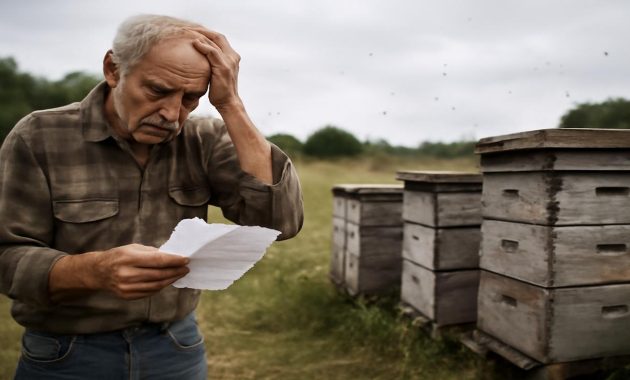
The first time Erik noticed the bees, he thought someone’s tractor had broken down on the gravel road. That low, vibrating hum drifted over the rye field on a warm May afternoon as he stood by his kitchen window, mug of coffee cooling slowly in his hands. It was a familiar sound—he’d grown up in the countryside—but something about it tugged at him differently now that he was retired, his days no longer sliced neatly by work shifts and deadlines. He stepped outside, squinting into the light, and saw them: slow-moving shapes on a flatbed trailer, painted boxes in soft blues and whites and yellows, like toy houses for very small, very busy tenants.
By the time the beekeeper’s old van turned up the driveway—a white vehicle with rust blooming along the wheel arches—the hum had settled into a steady background presence, like distant traffic in a city. Only here, there were no cities, just fields, a ragged strip of birch forest, and the small, red wooden house where Erik had hoped to grow old quietly, tending his roses and complaining about the price of electricity.
How a Friendly Favor Turned into a Headache
It started harmlessly enough. The beekeeper, a lanky man in his forties named Jaan, stepped out of the van with an apologetic smile and a handshake that felt both rough and careful, like he was used to working with things that stung.
“Your neighbor gave me your number,” he said. “I’ve been looking for a place to set up a few hives. The farmers around here use fewer pesticides. Better for the bees.”
They spoke on the driveway for twenty minutes. The air smelled of moist earth and pine resin. A crow complained from a power line. Erik listened to Jaan’s quiet enthusiasm—the winter losses, the miracle of a healthy queen, the way a strong hive can sound like a living engine. It reminded him of the way his father had once spoken about soil and seeds and the slow, patient work of growing food.
“I don’t need anything fancy,” Jaan said. “Just a corner of the field you’re not using. I’ll keep the place tidy. I can even share some honey with you.”
Honey. Bees. Land going to some quiet use. It seemed perfect: a small contribution to nature, something good happening on property that mostly sat idle since Erik had retired from his city job and rented out the cultivated part of his fields to a neighbor. The back patch, the rougher land that had gone to meadow, looked ideal for a scattering of hives.
“If you’re not making money off it,” Jaan added, “it shouldn’t really matter for you, right?”
Erik nodded. The land had been in his family for generations, but he wasn’t a farmer in the official sense. He didn’t claim subsidies, didn’t run a business out of it. He paid the usual property taxes on his house and land, grumbled like everyone else, and left it at that. Lending out a corner for bees felt more like sharing a view than entering into any kind of scheme.
“Sure,” he said. “Set up your hives. No rent. Just… look after them.”
They shook on it. No contract, no money—just a handshake and a warm jar of honey that appeared on his doorstep later that summer, thick and floral, tasting faintly of clover.
A Summer of Bees and Quiet Pride
All that first summer, the bees became part of the soundtrack of Erik’s days. When he sat on the porch in the evenings, the light dissolving into thin gold over the meadow, he could hear them like a living breeze. He watched them drift over his raspberry bushes, dip into the wildflowers along the ditch, and disappear into the forest edge.
Sometimes, when Jaan came to check the hives, Erik would wander down to the apiary. There, in the slow heat, he stood at a respectful distance while Jaan worked in his veil and gloves, moving with the delicate confidence of someone who knows exactly how far creatures can be pushed before they fight back.
“Listen,” Jaan said once, tilting his head toward the open hive. “You can tell if they’re angry by the pitch.”
To Erik, it all sounded the same—an urgent, vibrating chorus. But he nodded anyway, because it felt good to stand there with someone who clearly cared about something small and fragile in a world that seemed constantly on fire.
At the grocery store, he found himself telling the cashier—who’d been scanning his purchases in silence for years—that he “had bees” now. Not exactly true, but close enough. He talked about them with his grandchildren, who’d only ever seen bees in picture books and on glowing screens. They searched for the queen on a sunny afternoon while Jaan held a frame up to the light, the comb glowing like amber.
“You’re practically a farmer again,” his sister joked on the phone. He laughed. The idea pleased him: the retired office worker quietly supporting pollinators, doing his bit for biodiversity.
Then, one grey November morning, the envelope arrived.
Bad News in a Thin White Envelope
The letterhead looked official in that bland but unmistakable way: local tax authority, return address in neat black type. The paper smelled faintly of dust and toner. Erik sat at the kitchen table, crumbs from his breakfast roll still on the plate, and read it twice before the words truly sank in.
“Reassessment of land use,” it said. “Change in classification: agricultural use. Applicable agricultural tax due.”
There were numbers—bigger than he’d expected, smaller than a catastrophe, but large enough to make his chest tighten. The tax on that portion of his land had increased, recalculated because it was now deemed to be in “agricultural use” due to the commercial beekeeping activity present on it.
He felt a slow burn of confusion and anger rise in his throat.
He called the listed number. After a twenty-minute symphony of hold music, someone picked up. Their voice was polite, distant, the practiced tone of someone who had already had this conversation a hundred times.
“I’m not making any money from this,” he said, more sharply than he intended. “I lent the land for free. It’s just a few hives. I’m not a farmer.”
On the other end: a rustle of papers, the soft tapping of keys.
“The land is being used for agricultural production,” the voice replied. “Tax is based on use, not on whether you personally earn income from it.”
The logic was neat, bloodless. Bees collected nectar, produced honey; honey was sold on market stalls and in little local shops. Somewhere in that chain, money moved. Somewhere, profit existed. Even if none of it flowed in Erik’s direction, the land had quietly changed categories in the eyes of the law.
“But I thought…” he began, and then stopped, unsure of what exactly he had thought. That good deeds would be rewarded? That small, informal arrangements lived in a separate universe from bureaucratic reality?
By the end of the call, he knew two things: yes, the tax was due, and no, they did not care about jars of honey or friendly handshakes under a blue sky.
The Beekeeper’s Dilemma and the Retiree’s Rage
When he told Jaan, they stood between the hives, their boots sinking slightly into the thawing ground. The bees had started to fly again, small yellow-brown darts against a backdrop of dull spring colors.
“I had no idea,” Jaan said, genuinely stricken. “My other landowners never mentioned anything like this.”
“Maybe they can afford it,” Erik snapped, then regretted it. “I live on a pension. Every new bill matters.”
They stared at the hives in silence. This little rectangle of land, which had felt like a gift to nature, had become a legal category with a price tag attached.
“I can try to cover part of it,” Jaan offered. “But my margins are tight. Winter losses were heavy, and prices for feed… you know how it is.”
And he did know, because he’d listened. He’d read about bee colonies collapsing, about cheap imported honey undercutting local producers, about how people loved the idea of bees the way they loved the idea of clean oceans—right up until someone asked them to pay a bit more, or give up a little convenience.
“I don’t want your money,” Erik said. It was partly pride, partly the knowledge that whatever small sum the beekeeper could offer would never quite cover the tax hike.
But under that was something else: a sense of betrayal, vague and directionless. Not by Jaan, not really. By a system that had managed to turn a neighborly arrangement into a semi-commercial land use classification with a line item on his tax notice.
“Maybe I should just ask you to move them,” he muttered.
Jaan flinched, as if stung.
“If that’s what you want, I’ll do it,” he said quietly. “But it will hurt the bees to move them during the season. And it will hurt me, too.”
The bees flew between them, uninterested in human categories—ownership, taxation, retirement income. They cared only about flowers, about weather, about the long, collective work of survival.
Opinion Splits in a Small Community
News in a rural area travels the way smoke does: slowly at first, then suddenly everywhere. Before long, people at the village store were asking about “the bee tax.” Some sympathized loudly.
“It’s absurd,” one neighbor said, sliding a carton of milk across the counter. “You try to do something good for the environment, and they punish you. Next they’ll tax birdhouses.”
Others took a different view.
“Look, if it’s agricultural land, it’s agricultural land,” the man who rented Erik’s main fields shrugged. “I pay my share. Why should beekeepers get a free ride just because their animals fly?”
The argument moved from the store to the local social media groups, where people could be braver, or crueler, behind screens. Some called Erik naïve for not checking the rules first. Others accused the tax office of short-sightedness: “We keep talking about saving bees, and then we make it harder for people who try.”
Someone even suggested that this kind of rule would push small beekeepers out entirely, leaving only the large-scale operators who could afford dedicated land and legal advice.
In the middle of all this chatter stood Erik, tired and frustrated. He had not set out to become a symbol of anything. He just wanted to help some bees and enjoy a peaceful retirement without unexpected bills.
Where the Law Sees Fields, Not Stories
The heart of the conflict lay in a stubborn fact: laws are written to see categories, not intentions. In the eyes of the tax code, the moment his land hosted a commercial apiary, it wasn’t just a meadow anymore. It was a site of agricultural production, even if the only thing he personally harvested was a small sense of pride.
From a policy perspective, it made a certain cold sense. If every commercial user could scatter their operations across friendly retirees’ back fields, then who exactly should be taxed? The beekeeper with his mobile hives, or the landowner whose property turned, even partially, into a business asset?
The law, of course, had already answered that question. Use determined category; category determined tax. Whether the landowner charged rent or received anything beyond a jar of honey was, officially, irrelevant.
But the human side of it told another story: a retiree on a fixed income, trying to do a small good deed, ends up paying for the privilege. In a world groaning under headlines about disappearing pollinators, the message felt off, like applauding volunteers while quietly fining them for using the town hall.
Counting Costs: A Quiet Calculation
For weeks, the decision hung over Erik’s head. In the evenings, he’d sit at the kitchen table with a notepad, scribbling numbers. Tax increase on one side. The hostility of moving the hives, the sense of failure, on the other. Pride tangled with principle.
He could afford it, technically. Not without noticing, but without starvation. It would mean fewer little luxuries—one less trip to see the grandchildren this year, maybe. It felt unfair, but unfairness was no stranger to him. Life was full of it: his wife’s sudden illness, the slow creep of prices on things that never seemed to justify their cost.
But this particular unfairness stung differently, because it had started with generosity.
“You’re overthinking it,” his sister told him on the phone. “Either accept the tax and keep the bees, or ask him to move them. You don’t owe anyone a habitat.”
“Maybe not,” he said softly, “but if people like us don’t lend land, who will? Big companies? They’ll charge for every square meter.”
The question, he knew, was larger than his meadow. It was about what happens when every act of kindness gets pulled into the orbit of systems built to track value in money alone.
A Simple Table, a Complex Reality
At one point, trying to make sense of the situation, he drew it out as a kind of ledger, an old habit from his working days.
| Aspect | Before Beehives | After Beehives |
|---|---|---|
| Land use category | General property / meadow | Agricultural (beekeeping) |
| Tax level on that area | Standard land tax | Higher agricultural tax |
| Income to landowner | None | Symbolic (honey jars) |
| Environmental benefit | Wild plants only | Pollination boost, local honey |
| Main financial burden | Landowner (basic tax) | Landowner (increased tax) |
On paper, the unfairness crystallized: more benefit to the ecosystem, some to the beekeeper, and yet the extra cost landed squarely on him.
It made perfect sense to a certain kind of logic, and no sense at all to another.
What Should Change: Rules, or Expectations?
The story divided opinion beyond the village. Some argued that the law was simply doing its job, and that private arrangements should always factor in potential tax implications. “The retiree should have made a formal agreement with the beekeeper,” they said. “Share the costs, put it in writing. That’s what grown-up cooperation looks like.”
Others pointed out that this expectation assumes everyone has easy access to legal advice and the mindset to treat every neighborly favor as a contract negotiation. It also overlooks the quiet, fragile web of trust that holds many rural communities together. Turn every handshake into a document, and something tender evaporates.
Then there were those who looked at the bigger environmental picture. If governments loudly promote pollinator-friendly initiatives, shouldn’t the tax system reflect that? Could there be exemptions, or at least reduced rates, for small-scale, non-profit land uses that support bees, birds, and biodiversity—even when there’s a commercial element nearby?
Some countries already experiment with such ideas: lower taxes for rewilded land, incentives for tree planting, grants for hedgerow restoration. Why not do something similar for private landowners who host beehives without monetary gain?
The answers, of course, aren’t simple. Every exemption invites potential abuse. Create a loophole big enough for a beehive, and someone will eventually drive a truck full of something else through it.
In the End, a Quiet, Imperfect Choice
Spring tilted into summer again. The bees grew louder, the air thicker with their invisible flight paths. On an evening when the sky burned slow orange and the first swallows dipped over the field, Erik walked down to the hives alone.
He stood there for a long time, listening. The sound had become a measure of the seasons for him now, a living barometer that said: we are still here, still working, still trying.
He thought about the tax bill, about the thin edge of resentment that had crept into his enjoyment of this place. He thought of Jaan, who had started to talk about moving some of the hives to a more “official” site out of sheer guilt.
In the end, the decision he made wasn’t heroic or clear-cut. He kept most of the hives, but not all. They agreed to reduce the number, enough that part of the land would be reclassified again, softening the tax impact. They sat at the table with a map, drawing rough borders with a pen, translating a meadow into zones that could satisfy both bees and bureaucracy.
“We’ll put more of them at my cousin’s farm,” Jaan said. “He’s already classified as agricultural. They won’t blink at a few more hives.”
It was a compromise, like most things in adulthood: no one entirely satisfied, no one entirely crushed. The tax office remained unmoved. The online debates cooled. The bees went on, indifferent.
Sometimes, when friends visited and asked about the headlines they’d seen—“Retiree hit with tax for hosting beehives”—he’d shrug, tell the story, and feel their outrage spark and then fade.
“Would you do it again?” one of them finally asked.
He looked out the window at the remaining hives, at the little specks of gold and brown that stitched flower to flower in his field.
“I’d ask more questions,” he said. “But yes. I think I would. Just… with my eyes a bit more open.”
Because in the end, the story wasn’t just about tax codes or retiree budgets. It was about the messy place where good intentions crash into systems not built to recognize them. It was about how much we’re willing to pay—literally and figuratively—for the small, beautiful things we say we want to protect.
And it was about a man who lent his land to bees, discovered the cost of that kindness, and chose, even angrily, even reluctantly, not to turn his back on the hum that had come to mean something more than money.
FAQs
Why did the retiree have to pay agricultural tax if he didn’t earn money?
Tax authorities usually classify land based on its actual use, not on whether the landowner personally earns income. When his land hosted commercial beehives, it was treated as agricultural use, triggering a higher or different tax category even though he received no rent.
Could the beekeeper have been taxed instead of the landowner?
Beekeepers are generally taxed on their business income, but land tax typically follows the property, not the activity owner. Unless there is a specific legal structure (like a formal lease with clear tax obligations), the landowner is usually responsible for land-related taxes.
Would a written agreement between the retiree and the beekeeper have helped?
A written agreement could have clarified who pays what and allowed the beekeeper to compensate the retiree for increased costs. However, it wouldn’t automatically change the land classification; that depends on how the law defines agricultural use.
Are there places where hosting beehives gets tax benefits instead of penalties?
Some regions offer incentives or lower taxes for environmentally friendly land uses, such as conservation, rewilding, or hosting pollinator habitats. Whether beehives qualify depends on local rules. It’s not universal, and in many areas, beekeeping is still treated as standard agriculture.
What can landowners do before lending land to a beekeeper?
They can check local tax and zoning rules, ask the tax office how beekeeping affects land classification, and draw up a simple written agreement with the beekeeper about sharing any extra costs. It’s also wise to talk to neighbors and other landowners who have already hosted hives.
Does this kind of tax situation discourage people from helping pollinators?
It can. When landowners face unexpected financial burdens from hosting hives, some decide it’s not worth it. That’s why many argue for clearer, more supportive policies that encourage, rather than penalize, small-scale pollinator-friendly initiatives.
Is the retiree’s reaction common in such situations?
Yes. Many people feel frustrated when a well-meaning, informal arrangement runs into rigid rules. Some accept the cost and continue; others ask beekeepers to move. The story highlights how important it is to align environmental goals with practical, fair regulations.