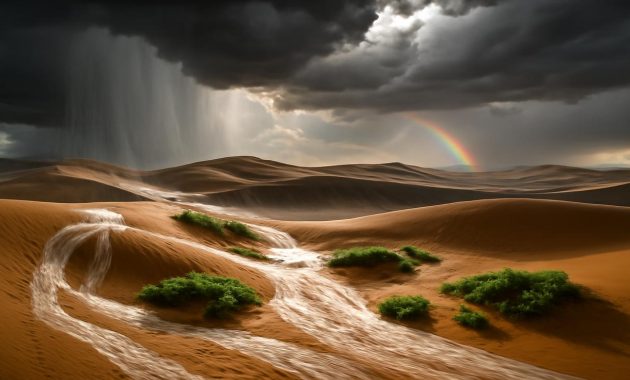
The first raindrop lands on the sand and disappears without a trace. Out here, in the world’s largest hot desert, water is a rumor, a distant memory whispered by fossil lakes buried beneath dunes. The air is dry enough to sting your throat, the horizon miraged into silver. For centuries we’ve told the same story about this place: the Sahara is eternal, unchanging, a great golden wall that divides north from south, desert from savanna, Mediterranean from tropical Africa.
But what if that story is wrong? What if the next chapter for the Sahara is not more heat and thirst, but rain—too much rain—and with it, a slow, unsettling transformation that could redraw the ecological and political map of Africa?
When the Desert Remembers It Was Once Green
Walk long enough into the Sahara and you might stumble over something that shouldn’t be there: the polished tip of a spearhead, a shard of painted pottery, a fossilized fish, or the faint outline of an ancient lakeshore. These are clues that the Sahara carries a memory: once, this wasn’t a desert at all.
Around 10,000 years ago, during what scientists call the African Humid Period, monsoon rains pushed far to the north. What is now a parched ocean of sand became a mosaic of grasslands, wetlands, and lakes. Hippos lounged in green-edged pools. Crocodiles hunted in rivers. Humans painted cattle and hunters and boats on rock walls that today look out over desolate plains of stone.
The desert, it turns out, is not entirely permanent. It breathes in and out with the slow pulses of Earth’s orbit, tilting and wobbling just enough to shift where monsoon rains fall. Over millennia, the Sahara has cycled between green and brown, lush and lifeless. Until now, those shifts have traced the gentle arc of planetary rhythms.
A recent study, however, suggests something different could be brewing—a more abrupt change prodded not by orbital wobbles but by the planet’s warming fever, powered by the greenhouse gases we’ve poured into the sky. According to this emerging research, excessive rainfall could return to the Sahara, not as a pleasant greening, but as a disruptive force that might upend the delicate balance of life, water, and power across Africa.
When Too Much Rain Becomes Its Own Kind of Drought
We tend to think of rain as blessing, desert as curse. A green Sahara sounds like good news, an ecological fairy tale: trees marching north, rivers coming back to life, farmers planting where only goats now wander. Yet the models and paleoclimate records hint at something more complicated—and unnerving.
The new generation of climate simulations and rainfall reconstructions paint a picture of the Sahara as a switch, not a dial. Under certain warming scenarios, intensified West African monsoons could surge northward, unleashing sustained, excessive rainfall on regions that today receive barely a whisper of moisture. Once the system tips, it might not ease gently into a stable “green Sahara,” but instead jump into a new state.
Excessive is the unsettling word here. Not the gentle, seasonal rain that farmers crave, but relentless downpours, swelling rivers, and long, saturated seasons that might drown more than they nurture. In a landscape shaped entirely around scarcity, too much water can be as jarring as too little.
Dust—the fine Saharan powder that rides the wind for thousands of kilometers—could dramatically decline as vegetation takes hold. That might sound benign, until you remember that Saharan dust currently fertilizes distant Amazon forests and helps cool the Atlantic Ocean by reflecting sunlight. Change the Sahara, and you change the sky far beyond North Africa.
Meanwhile, the rain itself would not fall evenly. Some regions could see dangerous floods while others could watch their current, fragile patterns of rainfall unravel. The delicate, hard-earned balance that millions of people depend on could become suddenly unreliable.
Rivers Rewritten, Borders Redrawn
Follow a raindrop as it falls on the northern fringe of the Sahel today and you’ll see the stakes. That raindrop may sink into fragile soils, feeding a millet crop that will barely be enough to stretch through the lean season. Or it may rush into a seasonal stream that feeds the Niger or Senegal Rivers, lifelines for cities, farms, and fishing communities downstream.
Now imagine a future where the Sahara is catching far more rain—year after year, decade after decade. New rivers could carve paths through what are now barren valleys. Old riverbeds, long abandoned, might fill again. Underground aquifers could recharge, but so could the risk of erosion and catastrophic flooding.
In a continent where river basins often cross many borders, water is already political. Countries negotiate dams on the Nile, argue over hydropower on the Congo, calculate irrigation projects along the Niger. Add a shifting Sahara, with its new or swollen waterways, and the questions multiply. Who owns a river that didn’t exist in a previous generation’s treaties? How do you share a lake that appears where there was once a salt pan?
The study’s warning is not a science-fiction scenario about instant rainforests erupting from dunes. It is subtler, and maybe more disquieting: altered rainfall patterns that rearrange advantages and vulnerabilities across the continent. Regions that have learned to survive with very little water might suddenly find themselves rich in it—at least for some years. Others, whose economies, cities, and crops depended on predictable patterns, might discover that their old calculations no longer make sense.
| Aspect | Today’s Sahara & Sahel | Under Excessive Rainfall Scenario |
|---|---|---|
| Rainfall | Extremely low, erratic; short wet season in Sahel | Monsoon shifts north; longer, heavier wet seasons |
| Land Cover | Bare sand, sparse shrubs, fragile savanna edge | Expanding grasslands, shrubs, scattered woodlands |
| Dust & Atmosphere | Massive dust export; cools regions, fertilizes oceans | Less dust; altered Atlantic temperatures, ocean biology |
| Human Livelihoods | Pastoralism, drought-prone farming, high migration | New farming zones, flood risks, shifting migration routes |
| Regional Stability | Tensions over scarce water and land | New disputes over emerging water and fertile land |
The Living Edge Between Green and Brown
If you really want to understand why a wetter Sahara could shake Africa’s balance, you have to stand in the Sahel—the vast, semi-arid band that runs just south of the desert, from Senegal’s Atlantic coast to Chad and Sudan in the east.
In the Sahel, the difference between a good year and a bad year can be a few weeks of rain. Millet, sorghum, and cowpeas rise from soils that crack open when the sun returns. Herds of cattle, goats, and camels push north when grasses sprout, then retreat south in the dry season. Here, families read the sky with an intimacy that satellites still struggle to match.
Too little rain, and crops fail, hunger spreads, and migration quickens. Too much rain, arriving too fast, and the thin soils slough away, villages wash out, newly planted seeds drown. The Sahel is a lesson in balance, in just-enoughness.
So what happens if the belt of heaviest rainfall migrates north into the Sahara, pulled by a warmer atmosphere and altered ocean temperatures? Some Sahelian regions could see their precious rainfall decline or become more chaotic. The line where pastoralists move with their herds, where farmers risk their seeds in dusted furrows, could creep north or shatter entirely.
Communities living on this edge have always adapted—switching between herding and farming, introducing drought-tolerant crops, sharing wells and pastures through complex local agreements. But climate models suggest that the pace of change could accelerate beyond what traditional knowledge can easily absorb.
In that uncertainty, the seeds of conflict can germinate as quickly as grass after a storm. When land that was once safely “too dry to care about” suddenly becomes marginally fertile, it becomes desirable. Pastures become fields. Fields become claims. What used to be open, negotiable space hardens into lines of ownership, borders, and, sometimes, battlefronts.
Green Dreams, Unequal Realities
There’s another, quieter danger in the idea of a wetter, greener Sahara: seduction. It’s easy to imagine vast new breadbaskets unfurling where only dunes now rise. Planners and investors could start to see potential: solar farms interlaced with irrigated fields, new cities anchored by freshwater lakes, trans-Saharan transport corridors stitching north and south more tightly together.
But the pattern of climate benefits rarely matches the map of human need. Excessive rainfall in the Sahara doesn’t automatically erase drought in the Horn of Africa, or heat stress in already-boiling cities. It doesn’t guarantee that new water will flow to those who lack it most.
The study’s warning suggests another risk: that those with the resources to move fastest—governments, corporations, regional powers—might seize new opportunities in a changing Sahara while marginalized communities watch their own lands more tightly controlled, or their migration routes cut off. In a continent where colonial-era borders have already carved through cultures and ecosystems, a reconfigured Sahara could deepen old inequalities if handled carelessly.
Nature’s transformations have always been entwined with questions of justice. Who gets to decide how a newly wet valley is used? Who controls a river that did not exist in their parents’ childhoods? Whose story of the land becomes the one that counts when the ground itself is changing?
Dust in the Wind, Shadows on the Ocean
To feel the full weight of a changing Sahara, you have to follow its dust. Grains finer than flour rise on hot winds and travel across the Atlantic, dimming Caribbean skies, feeding microscopic life in the ocean, and settling over Amazonian leaves. Pieces of Africa, carried by the atmosphere, nourish a distant rainforest that in turn helps regulate the planet’s climate.
Excessive rainfall and vegetation in the Sahara would pin much of that dust to the ground. Less dust means clearer skies, more sunlight reaching the surface of the Atlantic, and potentially warmer sea-surface temperatures. Warmer waters can play into the formation and intensity of tropical storms and hurricanes.
They also feed back into the very monsoons that watered the Sahara in the first place. The climate system is a knot of loops and echoes: change the desert, and you change the ocean; change the ocean, and you might change where and how the desert gets its rain.
Ecologically, the ripples widen. The Amazon, already under pressure from logging, fire, and expanding agriculture, relies in part on nutrients delivered by that Saharan dust. Starve that aerial supply line, and you add another strain to a forest that helps inhale some of humanity’s carbon emissions. Far to the north, over the Mediterranean, shifts in dust and heat could alter wind patterns and rainfall regimes for countries from Spain to Turkey.
The Sahara may look like an empty place, but it is, in many ways, the beating heart of a vast climate network. Excessive rainfall here would not be a local quirk; it would be a planetary event.
Listening for the Future in Old Stones
To anticipate what might come, scientists have been listening carefully to the Sahara’s past. They read mud cores pulled from the bottoms of ancient lakebeds and from the Atlantic seafloor, where layers of dust settle year by year. They scan satellite imagery for the ghostly outlines of vanished rivers. They test climate models against the record of those long-ago greenings and dryings.
The picture that emerges is sobering: the Sahara doesn’t always change gradually. It can flip. In geological terms, the difference between desert and savanna may play out in a few centuries or even decades once the right thresholds are crossed. What’s more, there is no guarantee that a human-driven, rainier Sahara would mirror the benign African Humid Period of the distant past.
The world it would be entering is different: hotter overall, swaddled in more greenhouse gases, ocean currents already disrupted, biodiversity frayed. The same push that nudges monsoons north could, in other regions, parch farmlands or displace whole coastlines.
And yet, the Sahara’s story is not only a warning. It is also a reminder: landscapes we think of as immutable are anything but. A child born today in Niger or Morocco may live long enough to see shrubs where there were once only dunes, or flowing water where their grandparents spoke of endless dryness. That kind of change is terrifying, but it is also an invitation—to plan, to adapt, to decide together what kind of future to build in a world that refuses to stand still.
Choosing How the Story Unfolds
Standing at the edge of a Sahelian village after the first big storm of the season, you can smell the earth’s relief: a deep, mineral scent rising from dust turned to mud. Children stomp through puddles. Goats complain from hastily built shelters. Above, lightning flickers like someone testing a faulty switch.
It’s in moments like this—when rain is both gift and threat—that the study’s warning feels less abstract. The question is not simply whether the Sahara will be wetter in 50 or 100 years. It’s how societies, from local councils to continental unions, will respond as water rearranges itself on the map.
Much of what happens next lies outside the Sahara itself. Global choices about emissions will shape how violently the climate system swings. Policies on land use, migration, and shared rivers will determine whether new rainfall fuels cooperation or competition. Investments in early warning systems, resilient agriculture, and locally led adaptation could turn what might be a slow-motion disaster into a chance—however uneasy—for renewal.
The Sahara has always been a place of crossings: caravans, cultures, winds, and now, climate signals. Excessive rainfall here could remake not only a landscape, but also the ties between nations, ecosystems, and distant oceans. The desert may yet remember it was once green. The challenge, for the rest of us, is to ensure that when the rain returns, it doesn’t wash away more than we can bear to lose.
Frequently Asked Questions
Could the Sahara really become green again?
Not overnight, and not into a dense rainforest, but evidence from the past shows that large parts of the Sahara have been covered in grasslands, lakes, and scattered trees when monsoon rains pushed north. Under strong warming scenarios, models suggest a partial return to wetter, greener conditions is possible—though likely in complex, uneven ways.
Why is “excessive” rainfall a problem in a desert?
Landscapes, infrastructure, and livelihoods in and around the Sahara are built around scarcity. Sudden or sustained heavy rainfall can trigger floods, erosion, and crop failures. Soils can be washed away before vegetation can stabilize them, and communities may not be prepared for the new risks that come with too much water.
How would a wetter Sahara affect the rest of Africa?
Shifts in rainfall could change where farming and grazing are viable, altering migration routes and land-use patterns. New rivers or lakes might emerge, raising questions about ownership and shared management. Regions that lose rain could face heightened stress, while areas that gain it may experience land conflicts and rapid, uneven development.
What about impacts outside Africa?
A greener, wetter Sahara would likely produce less dust. That could warm parts of the Atlantic Ocean, influence hurricane activity, and reduce nutrient supply to the Amazon and Atlantic ecosystems. Changes to Saharan dust and heat also feed back into global wind and rainfall patterns.
Is this scenario inevitable?
No. The likelihood and intensity of such changes depend heavily on future greenhouse gas emissions. Lower-emission pathways reduce the chances of extreme shifts in monsoon patterns. Even if the Sahara does become wetter, the social and ecological outcomes will depend on how well societies prepare, cooperate, and adapt.