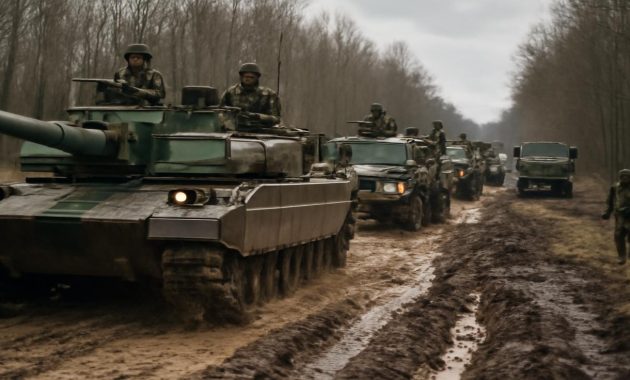
The first thing they noticed was the sound. Not the roar of engines or the clank of armored tracks, but the strangely soft chorus of foreign boots on Romanian soil, the low murmur of French voices curling through the mist above a Transylvanian field. The cold October air smelled of woodsmoke and damp earth; somewhere, a dog barked; somewhere else, a blackbird cut a sharp line through the sky. On the horizon, vehicles moved in disciplined columns, their silhouettes etched against the bruised blue of an Eastern European autumn afternoon. The exercise had a name that sounded like something from an old legend—Dacian Fall—and for many of the men and women stepping onto this ground, it already felt like a story they’d be telling for the rest of their lives.
Autumn Maneuvers, Ancient Echoes
The Romanians had warned them about the wind. It came down from the Carpathians with a sly, insistent edge, slipping beneath jackets, around collars, through seams in tents and armored doors. As the day unfolded, that wind tugged at French flags stitched to uniforms, teased loose tarps on supply trucks, and drew pale trails from soldiers’ breath each time they exhaled.
Down in the makeshift command post—a rectangle of camouflage netting, folding tables, glowing screens, and maps so large they had to be clipped together—someone had chalked the name of the exercise across a whiteboard: “DACIAN FALL 24”. The letters had smudged slightly, as if time itself had brushed a thumb across the words.
It felt appropriate. Dacia, the old Roman name for this land, sounded like something unearthed from beneath layers of soil, a whisper from a time when frontiers meant something carved into the earth by swords and shield walls. Today, the frontiers were different. Lines existed on digital maps, infrared scans, and encrypted transmissions. Yet the weight of geography hadn’t changed as much as we liked to pretend. Eastern Europe was once again the place where power, fear, and hope met in uneasy proximity.
Never before had France deployed so many troops to Eastern Europe in peacetime. It wasn’t just a statistic; you could hear it in the crowded sleeping tents, smell it in the field kitchens where long queues formed for hot rations, and feel it in the subtle hesitation of the villagers who came to watch the armored convoys pass. The scale was new, but the logic was old: presence as signal, preparedness as message.
The Double Target Nobody Saw on the Maps
On paper, Dacian Fall had a tidy description: a multinational exercise designed to test interoperability, reinforce NATO’s eastern flank, and fine-tune the coordination between French and Romanian units under realistic conditions. Briefing slides showed precise arrows, colored sectors, performance objectives. It all looked clinical, clean.
But talk to the officers after midnight, when the laptops shut and the coffee turned bitter-cold in their tin mugs, and they’d admit there was a different way to see it. The exercise had a double target. The first was easy to name: deterrence. Tanks, troop carriers, artillery units, reconnaissance drones—all moving like pieces on a chessboard with the express purpose of telling anyone watching: this ground is not empty, this sky is not unguarded, these borders are not just lines on a map.
The second target was quieter and more human: trust. Trust between allies who, until recently, had rarely shared more than an exchange program or the occasional staff officer. Trust between soldiers who did not share a native language, but who would, if needed, share the same danger. Trust between a Western European power and an Eastern European frontier state, both carrying very different historical anxieties, but now bound by the same explicit promise: an attack on one is an attack on all.
In that sense, the French deployment was not just about the number of boots on the ground. It was about whether those boots moved in confidence, in concert. Whether a Romanian commander would believe, deep down, that if the worst ever came, the tricolor patch on a French uniform signaled not just presence, but commitment.
When Radios Speak Different Languages
“Radio check, canal un… test, test, vous recevez?” The French voice crackled over the headset, tinted with static and the faint metallic echo of distance. On the other end, a Romanian sergeant frowned at his set, then replied, “Recepționat… wait… received, we copy you.” There was a soft burst of laughter behind him; someone nudged his shoulder. Language, suddenly, was a tactical puzzle as much as drag coefficients and firing ranges.
Interoperability isn’t glamorous. No one writes stirring speeches about aligning radio frequencies, adapting map grids, or arguing over the exact meaning of “clear the sector.” Yet this is where multinational exercises either succeed or crumble. In the early days of Dacian Fall, there were moments of pure comic confusion: French crews misinterpreting a Romanian acronym, Romanian drivers trying to decode a string of French shorthand shouted over the noise of an engine. Occasionally a translator had to sprint between vehicles, helmet askew, notebook in hand.
But by the end of the second week, the rhythm had changed. The mixed patrols—French and Romanian soldiers riding together in the same armored vehicles—began to develop their own hybrid slang. A Romanian lieutenant would bark an order using the French term for “go forward” combined with a Romanian shorthand for “north.” Hands, too, became part of the shared language: a universal series of gestures honed by necessity. A rotated palm to mean “slow”; a clenched fist at shoulder level to signal “stop, now.”
Standing near the tree line one dusk, watching a Franco-Romanian reconnaissance patrol fan out across a ridgeline, you could literally see the double target coming into focus. Deterrence in the form of coordinated maneuvers, overlapping fire sectors, synchronized drone coverage. Trust in the way the French squad leader silently deferred to a Romanian corporal who knew the lay of the land better; in the way they shared cigarettes during a break, laughing about the relative merits of French ration coffee versus Romanian instant.
Numbers on Paper, Mud on Boots
The size of the French deployment looked impressive in a briefing: battalion-level commitments, heavy armor, combat engineers, logistics columns extending like a metal spine down the Romanian countryside. But numbers, by themselves, are blunt instruments. On the ground, there were quieter metrics—things you could only feel once you stepped into the mud and the noise.
To capture the scale of Dacian Fall in a way that fits a phone screen—where many people would first read about it—you could break down one mid-exercise snapshot something like this:
| Element | French Contribution | Purpose on the Ground |
|---|---|---|
| Personnel | Several thousand troops, including infantry, armor, engineers, logistics, and air-defense units | Core maneuver forces; building presence and testing large-scale coordination |
| Armored Vehicles | Main battle tanks, infantry fighting vehicles, armored personnel carriers | Deterrence by mobility and firepower; practicing rapid response across varied terrain |
| Air Assets | Helicopters, surveillance drones, liaison aircraft | Reconnaissance, close support, real-time intelligence sharing |
| Support Units | Medics, mechanics, signal corps, logistics convoys | Sustaining operations, keeping the whole machine moving in field conditions |
| Combined Command | Joint French-Romanian HQ elements | Decision-making, planning, and execution under a unified framework |
Those rows don’t capture small details: the sound of a mechanic’s hammer at 2 a.m. under a floodlight trying to coax a stubborn track back into cooperation; the bright, antiseptic smell of a field medical tent; the sticky mud that clung to boots and turned the simplest walk into a minor test of balance.
Yet those details matter because they are where theory either survives or dissolves. Large numbers on a slide mean nothing if, in the field, fuel runs out, radios fail, or tempers fray. Dacian Fall became a kind of stress test for that unprecedented French presence in Eastern Europe. Could it move across unfriendly terrain without losing tempo? Could it plug into Romania’s infrastructure without overwhelming it? Could it adapt when the landscape—or the scenario—refused to cooperate?
When the Scenario Fights Back
Midway through the exercise, the planners inserted a surprise. Somewhere along a twisting rural road, a simulated “enemy” ambush forced a French logistics convoy to reroute. It was the kind of inject that looks simple on paper: red icons appear on a digital map; green icons take a detour. But on the ground, it was a cascade of improvisation.
Suddenly, drivers found themselves navigating through a village that hadn’t been on their pre-briefed route. Chickens scattered in front of armored tires, and an elderly man stood in his yard, coat collar turned up, watching as unfamiliar vehicles rolled past his gate. Children waved—some shyly, some with outright excitement. A French corporal, seeing them, lifted a hand off the wheel just long enough to wave back.
The convoy, now under the joint guidance of French and Romanian officers, adjusted on the fly. A Romanian liaison pointed out a low bridge that might have been an unwelcome surprise for one of the taller vehicles. A French NCO flagged a muddy slope that could bog down the whole column if they weren’t careful. This was the second target—trust—playing out in real time: different experiences converging into one shared solution.
Echoes in the Villages and Forests
For many Romanians, especially in smaller towns and villages, the exercise unfolded not on screens or in press releases, but from the roadside. They became unintentional witnesses to a rehearsal for a crisis everyone hoped would never come.
Farmers paused their tractors to watch armored vehicles push through low morning mist. Shopkeepers stepped out to the thresholds of their small stores, the smell of fresh bread or motor oil drifting into the street as a convoy passed. In some places, the French presence felt almost surreal: the sharp blue-and-red of French unit insignia against barns weathered by decades of Carpathian winters.
There was curiosity, too. At a temporary open day near one of the training ranges, local families wandered among parked vehicles, their children’s hands sweeping across cold metal, eyes wide as soldiers showed them inside the cramped bellies of armored carriers. French and Romanian troops stood side by side, answering questions in a jumbled mixture of Romanian, French, and English, occasionally calling over a translator like a referee for disputed words.
Not everyone was comfortable, of course. History lingered heavily in Eastern Europe; foreign uniforms, no matter how friendly, could stir old worries. But the physical presence of French forces offered something tangible where often there had only been promises. It turned abstract commitments into the sharp tang of diesel in the air, the visible grit of tank tracks pressed into the soil, the sound of foreign voices learning how to pronounce Romanian place names.
The Forest Line
Out near the edge of one wooded training area, the exercise unfolded in a different dimension. Here, under the dense canopy of oak and beech, the air was heavy with the smell of wet leaves and soil rich enough to swallow a careless boot. This was the domain of small units: scouts, infantry, forward observers.
When dusk thickened into real darkness, those soldiers moved in near-silence. A French scout, face streaked with camouflage paint, slid behind a tree trunk, his breath shallow and measured. A Romanian counterpart lay prone nearby, one gloved hand pressed into the cold earth, listening for vibrations more than sound.
Overhead, a small drone hummed, its faint electric whine barely noticeable over the rustle of branches. Down in the undergrowth, laptops glowed like small, artificial campfires as officers tracked shifting icons on their screens. The forest, at night, is a place where human senses revert to an older calibration. Every snapped twig becomes a question. Every shadow stretches with possibility.
This, too, served the double target. In the darkness among the trees, the concept of deterrence was less about spectacle and more about quiet competence. If anyone, somewhere beyond the NATO line, watched these maneuvers from afar, they would see layered capabilities: eyes in the sky, boots in the mud, data flowing between them. And the trust element? It existed in the unspoken understanding that if something went wrong in that cold, damp darkness, help would come—from whichever flag happened to be closest.
From Exercise to Memory
By the time Dacian Fall wound down, the Romanian autumn had deepened. Trees along the training areas had shifted from tired green to a mixture of rust, gold, and the dark, wine-red leaves that looked almost black against a cloudy sky. The evenings came earlier; the mornings felt sharper.
Packing up an exercise is always a strange, transitional ritual. Tents come down, leaving behind faint rectangular ghosts of flattened grass. Cables are coiled, boxes labeled, vehicles lined up nose-to-tail for the long road home or the next staging area. The roar and rumble of the first days give way to a more subdued soundtrack: zippers, tape, shouted inventory numbers.
Yet something always remains. For the French forces, this largest-ever deployment to Eastern Europe wasn’t just a notch in a readiness report. It became an archive of experiences: the Romanian major who explained, over steaming cups of bitter coffee, what it felt like to grow up near a border that now felt suddenly fragile again; the night a joint patrol got lost for a moment in a fog so thick it seemed to erase the world beyond arm’s length; the way a Romanian mechanic and a French electrician somehow managed to fix a generator using a hybrid toolkit and a dictionary app.
For Romania, the memory would be equally layered: a reassurance that, in a time of tension, allies did not just send words or symbolic detachments, but substantial, complex formations willing to learn the folds and edges of their terrain. That reassurance had its own sensory details—jet noise overhead, headlights snaking along dark country roads, the faded smell of exhaust hanging over a field where, not long before, nothing more warlike than a tractor had ever passed.
In the years to come, Dacian Fall would likely be cited in policy papers and defense white books as a “milestone” or “demonstration of resolve.” Those phrases would be accurate but incomplete. What they would not capture is the way a French soldier, leaning against the side of an armored truck on the final day, looked at the horizon and quietly said to his Romanian counterpart, “If something ever happens… well, now I know what it feels like to be here.”
That, in the end, was the double target hitting home. A visible message outward: we are here, and we can move, fight, and coordinate on this ground. And a more intimate message inward, shared among allies: now we understand each other a little better. The soil feels less foreign. The sky looks a little more shared.
Questions That Linger After the Convoys Leave
When the last French convoy rolled out, when the final tents vanished and the fields began to reclaim their quiet, the story of Dacian Fall didn’t end. It lingered in questions whispered in government offices, debated in living rooms, murmured over late-night news segments.
Would this be the template for future Franco-Eastern European cooperation, or a one-off peak defined by a very particular moment in history? Would deterrence achieved by these large, visible training events be enough to prevent miscalculation? And—perhaps the hardest question of all—how long could such large-scale commitments be sustained before fatigue, politics, or competing crises shifted attention elsewhere?
For the soldiers who had actually been there, the questions were more personal and more immediate. When would they come back, if ever? Would they recognize these fields again years later, or would the landscape have blurred in their memory, merging with other exercise grounds, other borders, other autumns?
In the stillness that followed, the wind moved again through the Eastern European grasslands and forests. Somewhere in Romania, the echo of engines slowly faded, and life resumed its familiar patterns. But beneath that surface of everyday routine, a new layer had been added—a memory of an autumn when a distant ally arrived not as rumor or reassurance, but as a tide of people and machines and shared risk, all bearing a name steeped in history: Dacian Fall.
FAQ
What was the main purpose of the Dacian Fall exercise?
Dacian Fall aimed to test and strengthen military cooperation between France, Romania, and other NATO allies on the eastern flank. Its goals were twofold: to enhance deterrence by showing a credible, large-scale presence, and to build practical trust and interoperability between different national forces on real terrain under realistic conditions.
Why was the French deployment to Eastern Europe considered unprecedented?
France had never before deployed such a large and complex force package to Eastern Europe in peacetime. The scale—ranging from heavy armor and infantry to air assets, engineers, and logistics—represented a significant commitment, signaling that France saw the security of Eastern Europe as directly tied to its own.
What does “double target” mean in the context of Dacian Fall?
The “double target” refers to the exercise’s two main objectives. The first was strategic deterrence: demonstrating NATO’s readiness and capability to defend its eastern members. The second was relational and practical: deepening trust and day-to-day coordination between French and Romanian forces so they could operate seamlessly together if ever required.
How did local Romanian communities experience the exercise?
Local communities saw the exercise up close—through convoys passing their villages, open days at training areas, and encounters with foreign soldiers in uniform. For many, it brought reassurance as well as curiosity, turning abstract political commitments into a visible, tangible presence of allied forces on Romanian soil.
Did Dacian Fall change how French and Romanian soldiers viewed each other?
Yes. Shared field conditions, joint patrols, and problem-solving under pressure helped break down initial barriers of language and culture. By the end, many French and Romanian soldiers had developed a practical, experience-based trust, making future cooperation more intuitive and less formal.