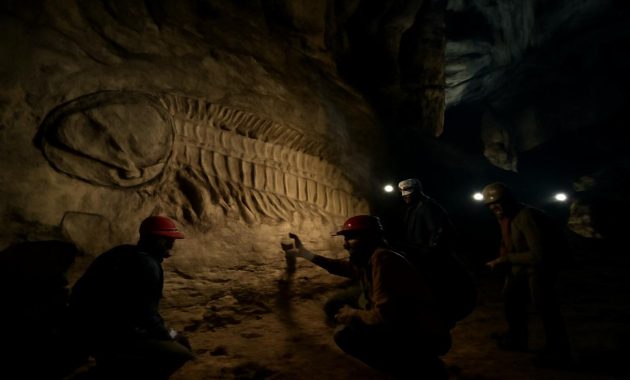
The first thing they saw was a row of teeth—needle-fine, wickedly curved, and gleaming faintly under the cave lamps. For a silent breathless moment, no one spoke. The air in the tunnel of Mammoth Cave felt heavier, as if the ground itself was holding its breath along with them. Then someone whispered, “That… used to be alive.” And just like that, 325 million years of darkness lifted, and two vanished predators began to step back into the light.
An Ocean in the Dark
Long before any human ever ducked under a limestone ledge or clicked on a headlamp, before the first bats spiraled through the underground chambers, this place wasn’t a cave at all. It was an ocean.
Picture it: a shallow inland sea stretching over what we now call Kentucky. The air is thick and humid, warmer than a modern tropical afternoon. No birds wheel overhead yet—there are no birds. No flowering plants, no grasses. The land, where it rises in low swampy islands from the sprawling water, is ruled by gigantic ferns, scale-barked trees, and bizarre insects the size of small birds.
Beneath the waves, predators prowl. They are not sharks as we know them, not sleek torpedoes like the great whites of nature documentaries. These hunters are stranger—armored with cartilage and spines, evolutionary experiments from a time when the very idea of “fish” was still being rewritten. They glide over reefs of crinoids and brachiopods, snapping at anything that moves with jaws built for crushing and slicing.
That world is gone. The sea dried up. Mud hardened to stone. The slow breath of groundwater carved the hollows that would become Mammoth Cave, today the world’s longest known cave system—more than 400 miles of passages threading through the underground darkness. But somewhere in that ancient seabed, something stayed behind. Bones. Teeth. Fragments of bodies locked in the rock, waiting.
The Day the Predators Resurfaced
It happened on a day that, at first, looked like any other field excursion. The researchers were moving carefully through a rarely visited branch of Mammoth Cave, their headlamps slicing thin tunnels of light through the darkness. The only sounds were the scrap of boots on stone, the clink of metal against rock, and the occasional quiet murmur as someone marked a note or checked a map.
In a narrow side passage, a low, eroded wall caught the eye of one of the paleontologists. Something about the pattern didn’t look quite right. They knelt down, brushing a gloved hand gently across the stone. The rock here was old—Mississippian in age, laid down roughly 325 million years ago in that long-vanished sea.
At first it was just a curve: a pale arc nested in the darker matrix. A jaw? A fin spine? Another lamp turned, flooding the wall with more light. More details emerged: a symmetry that bones often betray, the fine serrated edges along a ridge, the faint outline of a skull’s side pressed into the stone as if it had tried, unsuccessfully, to push through to the other side of time.
They realized they weren’t looking at scattered fragments. They were looking at skeletons. Two of them. Two large, long-lost predators embedded in the rock, almost complete. Creatures no one had ever seen alive, but whose shadows had haunted paleontology journals and fragmentary fossil records for decades.
On the cave floor around them, water dripped steadily in the darkness. Above, millions of tourists would walk the paved paths of Mammoth Cave, snapping photos of stalactites. Down here, in this quiet pocket of stone, a very different kind of history was about to be rewritten.
Predators Without Names
We like to think we know the history of life: the big dinosaurs, the famous Ice Age mammals, the neat diagrams of evolution. But what these two predators from Mammoth Cave remind us is that there are whole chapters we’ve really only skimmed. The late Paleozoic seas—the worlds of 325 million years ago—are one of those unfinished chapters.
Fossils from that time are often incomplete. You’ll get a tooth here, a bit of jaw there, maybe a segment of spine or a partial fin. Paleontologists do their best with those pieces, sketching rough outlines of the creatures that once roamed those oceans. But like trying to reconstruct a movie from a handful of frames, there’s a lot of guesswork involved.
These two predators, likely early cartilaginous fishes—relatives, in a distant, convoluted way, of modern sharks and rays—change that. Their nearly complete skeletons, so unexpectedly preserved in the dissolving chambers of the cave, are like finding the full script and half the footage of a lost film.
Imagine bodies long and muscular, perhaps several feet in length. Not the biggest giants of the sea, but formidable hunters in their own right. Their jaws are lined with batteries of teeth—some fine and pointed for gripping, others blunter, set up for crushing armor or shells. The arrangement of their fins, the angles of their jaws, the oddities in their backbones—these are the kind of details only a near-complete fossil can reveal.
And details matter. Where their fins attach tells us how they swam. The shapes of their vertebrae hint at whether they darted with quick bursts of speed or cruised more slowly, conserving energy. The wear on their teeth can reveal what they ate—hard-shelled creatures like early crustaceans, perhaps, or softer-bodied prey they could swallow whole.
For now, we might call them “predators without names.” Official scientific names will require formal description, comparison, and publication—an operation that may take years. But already, these animals are speaking. Through the patterns etched in their bones, they are telling us where they fit—or don’t fit—on the tangled family tree of early sharks and their kin.
The Cave That Wouldn’t Stop Giving
Mammoth Cave is famous for its human stories: Native American explorers leaving behind torches and footprints, saltpeter miners scraping gunpowder from the earth, 19th-century tourists in hoop skirts and top hats marveling at the frozen underground rivers of rock. But beneath all the stories and stages and guided tours, the cave itself is simply doing what caves do best: recording time in stone.
In a way, Mammoth Cave is a geological archive, and its shelves are the layers of limestone that form its walls. Each layer is a snapshot of an ancient seafloor or shoreline. If you know how to read them, these rocks become pages of an old, yellowing book, each one full of creatures whose names we are only beginning to learn.
What makes this particular discovery so remarkable is that cave environments usually aren’t gentle with fossils. Moisture, chemical dissolution, collapsing ceilings, even human traffic—all can damage delicate bones over millions of years. The fact that not just one but two large predators survived in near-complete condition inside a labyrinth that’s still actively evolving is astonishing.
It suggests that, back in their own time, these animals died in just the right way. Maybe they were trapped in a sudden slump of mud in that ancient sea, quickly buried before scavengers and decay could erase them. Maybe the sediment chemistry was unusually favorable to preservation. Then, eons later, as groundwater began to gnaw out the cave’s passages, the rock around them was carved just enough to reveal their skeletons—but not enough to destroy them.
Now, in our own flicker of geologic time, we find them. A convergence of chance, patience, and human curiosity. Two predators, once supreme in their world, reduced to silent outlines in stone—and then, almost overnight, transformed into scientific treasure.
What the Bones Are Telling Us
For modern researchers, the excitement isn’t just about the thrill of discovery; it’s about the questions these fossils can finally answer—and the new ones they will raise.
Early cartilaginous fishes rarely fossilize well. Their skeletons are mostly cartilage, not hard bone. Cartilage decays quickly, leaving paleontologists with flimsy scraps compared to the robust bony skeletons of many other ancient fish. When both predators in Mammoth Cave turned up with much of their skeletons intact, it was like being handed access to an entire anatomical blueprint.
Researchers can now trace the configuration of their fin skeletons, study the structure of their gill arches, and examine the interlocking plates and rods that framed their skulls. Each feature becomes a clue in understanding how the familiar shark-and-ray body plan came to be. Did these predators swim with the stiff, side-to-side thrash of a modern shark, or something more eel-like, with their whole bodies undulating through the water? Were their tails forked or paddle-shaped? Did they rely on speed, ambush, or crushing jaws to dominate their food chain?
Then there’s the ecological angle. Two large predators in the same deposit raise tantalizing questions: Were they competitors, hunting the same prey? Were they different ages of the same species? Did they die in the same event—perhaps a sudden change in water chemistry, or a storm-driven burial?
By analyzing the subtle details—like growth rings in their cartilage (if preserved), or chemical signatures locked in their teeth—scientists can start reconstructing not just a single moment of death, but an entire ecosystem’s long-vanished rhythms.
| Feature | Clue About the Predator | What It Reveals |
|---|---|---|
| Tooth shape and wear | Sharp, pointed vs. blunt, flattened teeth | Indicates diet: soft-bodied prey vs. hard-shelled animals |
| Fin placement | Fins closer to head or tail, large or small | Suggests swimming style and maneuverability |
| Vertebrae structure | Sturdy or flexible spinal column | Hints at speed, agility, and hunting strategies |
| Body proportions | Long, slender vs. deep-bodied shape | Reveals whether it was a sprinter, cruiser, or ambush hunter |
| Associated fossils | Shells, plants, or other fish nearby | Builds a picture of the ancient food web and habitat |
Time Travel, One Layer at a Time
There’s an odd sensation that comes with standing in front of such ancient remains. Your headlamp catches the curve of a tooth, the sweep of a jaw, and your brain instinctively wants to animate it. You imagine it moving, water sluicing past its gills, eyes tracking the flicker of prey in a forest of ancient sea lilies.
But the trick, as every good paleontologist knows, is to balance imagination with restraint. These predators are both a portal and a puzzle. They let us step briefly into a world that existed before mammals, before reptiles dominated dry land, before continents had even settled into their familiar shapes. Yet they also demand humility. For every question these fossils answer, a dozen more rise up out of the stone.
Some of the most profound answers won’t be obvious to casual observers. They’ll come from tiny shavings of fossil analyzed under electron microscopes, from cross-sections so thin they glow when lit from behind, from data run through computer models that simulate swimming motions or jaw forces. The story of these predators will sharpen not just through fieldwork, but through quiet, painstaking laboratory hours.
And all of that—from the first glint of a tooth in the cave wall to the final lines of a scientific paper—is really a single continuous act of time travel. In bits and pieces, we are learning how ancient oceans breathed, how early predators stalked, how lineages lived, died, and left echoes in our modern seas.
Why Ancient Predators Still Matter
It’s fair to ask: why should we care about two long-dead hunters from 325 million years ago, especially when today’s oceans are crowded with urgent problems—overfishing, warming waters, acidification, habitat loss?
One answer is that you can’t fully understand the present without the past. The predators in today’s seas—sharks, tunas, orcas—are inheritors of a long legacy of ocean hunters. The strategies they use, the body shapes they’ve evolved, the very structure of marine food webs have been shaped by hundreds of millions of years of experimentation. Every fossil like the ones from Mammoth Cave fills in part of that evolutionary ledger.
If we learn, for instance, that these ancient predators were early adopters of a particular jaw mechanism or fin arrangement, we may better understand why similar traits reappear in many later lineages. Evolution has favorite tricks, and it tends to reuse them. Finding out when certain tricks first appeared can reveal which environmental challenges they answered—and, sometimes, what finally broke them.
There’s also the perspective that deep time offers. Standing inside a cave formed over millions of years, examining creatures that last swam when the world was almost unrecognizable, it becomes harder to see our current age as the only story that matters. We are part of a staggeringly long narrative of change, adaptation, and extinction.
That doesn’t make modern crises less urgent. If anything, it sharpens them. Life has survived asteroid impacts, supervolcanoes, and wild climate swings. But it has never before had to survive a species that understands its own power and yet often refuses to act on that understanding. The fossils in Mammoth Cave survived unimaginable stretches of time, sheerly by accident. Whether today’s oceans will be thriving, or fossilized warnings for some distant future, depends on choices we’re making right now.
The Quiet Echo in the Dark
Someday soon, these long-lost predators will be fully described in scientific literature. They’ll get Latin names, positions on family trees, careful measurements, and labeled diagrams. Their photographs will appear in textbooks and nature magazines. Students will learn about them in lectures with glowing slides showing their reconstructed forms.
But it’s worth pausing, just for a moment, in the dark place where their story surfaced.
Picture that narrow passage again, deep inside the world’s longest cave. The air is cool and damp. The tang of limestone is faint but pervasive. Your boots crunch softly over bits of broken rock. Your headlamp beam slides over the walls, and then, suddenly, there they are: the silhouettes of two ancient hunters, frozen mid-swim in stone.
They do not roar or move or threaten. They simply are—evidence that the world has been many different places, worn many different faces, and hosted more lives than we can possibly count. You stand there, heart ticking away in your chest, and for a moment, your own timeline feels very small.
Then you realize: the beauty of fossils isn’t just that they connect us to what came before. It’s that they remind us how much of the story is still missing, how much we have yet to find. Somewhere, in the unlit ends of cave passages or the crumbling faces of cliffs, other long-lost creatures wait. Maybe not as perfectly preserved as these predators; maybe just a tooth or a scale.
Still, each discovery is a light switching on in a room we didn’t know was there. The world’s longest cave just lit a new one—releasing two ghostly hunters from 325 million years of darkness. We don’t yet know everything they’ll teach us. But we know this: the past is not finished speaking.
FAQ
How old are the predators discovered in Mammoth Cave?
The fossils are from rocks dating to roughly 325 million years ago, during the Mississippian period of the late Paleozoic era. At that time, much of what is now Kentucky was covered by a warm, shallow inland sea.
What kind of animals were these predators?
They appear to be early cartilaginous fishes—distant relatives of modern sharks and rays. Their skeletons, including jaws and fins, suggest they were active marine predators, though formal scientific description will be needed to confirm their exact classification.
Why is the discovery in Mammoth Cave so important?
Cartilaginous fish rarely fossilize well because their skeletons are mostly cartilage. Finding not just one but two nearly complete predators provides a rare, detailed look at their anatomy, evolution, and ecological role in ancient seas. It helps fill in a poorly known chapter of marine history.
How were the fossils preserved inside a cave?
The animals were originally buried in seafloor sediments that later turned into limestone. Millions of years afterward, groundwater carved Mammoth Cave through those limestone layers. The cave walls essentially “cut through” the ancient seafloor, exposing the fossils that had been locked inside.
Can visitors to Mammoth Cave see these fossils?
Many significant fossil sites within caves are in restricted or sensitive areas to protect both the fossils and visitor safety. Whether these specific fossils will be made visible to the public depends on conservation decisions. Often, high-quality casts, models, or images are displayed instead to balance preservation with education.
What can these predators tell us about modern oceans?
They help scientists trace how marine predators evolved, showing when certain body shapes, jaw types, and hunting strategies first appeared. Understanding those long-term patterns gives context for modern marine ecosystems and how they might respond to rapid changes today.
Are more discoveries like this likely in Mammoth Cave?
Yes. Mammoth Cave extends for hundreds of miles, and new passages and scientific insights are still being uncovered. With every careful survey and research project, there’s a chance of finding additional fossils, each one adding another piece to Earth’s deep-time story.