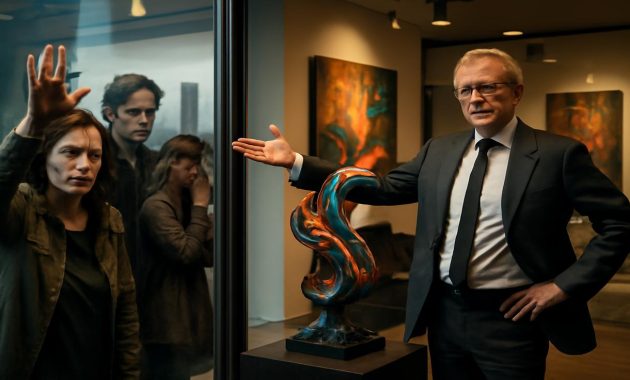
The first time anyone in Maple Row heard that Daniel Price was planning to “burn his money on useless art,” it was a Tuesday, the kind of washed-out afternoon when the clouds sagged low and the town’s single main street smelled faintly of wet pavement and fryer oil. Rumors there usually traveled by way of the post office—folded into envelopes of small talk, sealed with a raised eyebrow—but this piece of gossip didn’t need an envelope. It burst out of the door on the breath of Mrs. Callahan, who had just seen Daniel’s lawyer step into his ivy-wrapped mansion with a briefcase and step out again looking pale and tight-lipped.
By dinnertime, half the town knew: the childfree millionaire on the hill, the quiet one who’d made a tech fortune somewhere no one quite understood, was planning not to leave his money to his family. Not to his aging parents, not to his brother whose car coughed smoke, not to the cousins working double shifts. Instead, he was going to spend it—deliberately, extravagantly—on art. Art that, according to one furious aunt, “no one asked for and no one needs.”
“It should be illegal,” she said, over the clatter of plates in the diner. “A moral crime. That’s what it is.”
The Man Who Refused to Play His Part
It’s easy to dismiss a story like this as another rich-man tantrum, a headline built to trigger outrage feeds. But if you sit with it—if you imagine being in that family, or being Daniel himself—the whole thing feels less like gossip and more like a crack running down the center of what we think money is even for.
Daniel didn’t grow up rich. His childhood home on the edge of Maple Row still sagged a little in the middle, the soil under the porch damp with the memory of flooded springs. He was the awkward kid, the one who spent more time with broken radios and borrowed library books than with the other boys at the creek. People remember him riding his bike alone, pockets clinking with scavenged screws.
By his late twenties, though, he’d slipped away into another world—tech hubs, venture capital, cities with rooftop bars and grocery stores that sold five kinds of oat milk. The town only heard of his success in fragments: first a small acquisition, then a huge one, then the word “millions” said in a whisper that somehow sounded louder than a shout.
He came back only occasionally: holidays, a summer week here and there. No spouse. No kids. He’d arrive in a rented black car, carrying a single leather duffel, and leave behind an aftertaste of unanswered questions.
It was only when his father had a minor stroke that he moved back for good, buying the old stone house on the hill and filling it with long windows and quiet furniture. People assumed what people always assume: that in the end, the money would “come home.” That the wealth he’d built out there, in the strange world of invisible code and investor calls, would eventually settle like golden dust over his family, and maybe even over the town.
That’s the script. You succeed, you share. You owe.
The Decision No One Was Supposed to Hear
The trouble started because someone left a door open—metaphorically, if not literally. An overheard phrase, a misdirected email, a lawyer who underestimated how quickly gasoline words can find a match in a small community.
The shorthand version of the story went like this: Daniel had instructed his legal team that when he died, his estate would not pass to his family. Not to his brother, not to his cousins, not even as a token. Instead, a complex structure of trusts and foundations would funnel the money into projects he was just beginning to map out. Most of them were, by any practical measure, spectacularly unnecessary.
The list—still in draft form, but glimpsed by a furious relative—read like a dare:
- An artist-in-residence program for sculptors working only with discarded plastic collected from local landfills.
- A traveling, free-to-visit “Museum of Failed Inventions,” featuring prototypes, sketches, and stories of ideas that never made it.
- Funding for experimental composers who write music meant to be played once, in one place, and then never recorded.
- Gigantic kinetic wind sculptures installed along forgotten rural highways that barely see ten cars a day.
“Tell me that’s not insane,” his cousin Mara said, shaking as she held up a printed copy of a draft proposal. “We can’t pay our medical bills, and he wants to fund music you’re not even allowed to record?”
In the fluorescent glare of her kitchen, the page did look like madness. Or cruelty. Or both.
Who Owns the Future of Your Money?
Beneath the outrage—beneath the hurt and the accusations and the legal threats another cousin immediately began researching—there’s a quieter, heavier question: To what extent does anyone own the future of their money?
We tend to talk about inheritance as if it were gravity. Money falls downward along bloodlines. Parents to children, siblings to siblings, aunts and uncles to nieces and nephews. When that doesn’t happen, we call it “cutting someone out,” as though they had a natural right to be in.
But legally, in most places, Daniel is well within his rights. If you have no dependents, you can choose to leave your fortune to a dog, to a college, to a stranger, or to a plan to build a floating library of unread books. Law has remarkably little to say about whether such choices are fair—or kind.
For his relatives, though, the law was beside the point. They didn’t just see a breach of tradition; they saw a kind of moral vandalism. In their view, Daniel’s wealth was not just his, in the same way a tree’s fruit doesn’t belong only to the branch it hangs from. It had roots, and they were shared: long hours his parents had worked, sacrifices made, holidays skipped. He might have turned code and timing into capital, but they had turned hunger and worry into the foundation that made such a leap possible.
“He doesn’t exist in a vacuum,” Mara said. “None of us do. You don’t get to pretend you made yourself out of thin air and then act like no one else has a claim.”
When Art Becomes the Villain
It didn’t help that the thing Daniel was choosing instead of them was art. Not hospitals, not scholarships for kids from Maple Row, not public housing or debt relief. Art. Art that sounded, to his relatives, more like a riddle than a necessity.
“Useless art,” his brother called it, face red, when the family finally confronted Daniel in his glass-walled living room, framed by evening light sliding off the hills. “You know what’s art? Keeping the lights on. Making sure Mom doesn’t skip her meds because they’re too expensive. That’s art. This”—he waved a trembling hand at the printed summary of Daniel’s plans—“this is an insult.”
Daniel listened. He didn’t interrupt. He’d never been good at eye contact, but he met his brother’s gaze and held it as the words piled up: selfish, heartless, ungrateful. At one point his aunt actually said, “It’s a moral crime. You’re choosing sculptures over your own blood.”
Only then did he speak.
“You think I haven’t helped?” he asked. It wasn’t defensive so much as tired. “I’ve been paying Mom and Dad’s medical bills for three years. I helped with the down payment on your house. I paid for your kids’ braces and Mara’s car after the accident. I’ve written checks quietly, for a long time.”
The room wobbled around that confession. There are few things more destabilizing than realizing you’ve built an entire argument on a story with missing chapters.
But even that didn’t fully soften the edges.
“That’s not the point,” his aunt snapped. “You’re going to die someday, and instead of making sure your family is secure you want to throw it at… at… garbage sculptures and broken gadgets and music no one can listen to twice. It’s wrong. It should be illegal.”
The Strange, Stubborn Usefulness of the “Useless”
Art has always had this problem: the people who need it most are often the ones who can least afford to defend it. A mural doesn’t fix a leaking roof. A poem doesn’t cure a chronic illness. A strange, one-time-only piece of music won’t pay off student loans.
And yet, beneath the purely practical, art does a different kind of work. It unsettles, reframes, connects, protests. It turns the world from a flat spreadsheet into something you can feel with your whole nervous system.
When Daniel was asked later—by the one family member still talking to him without shouting—why art, of all things, he thought for a long time before answering.
“Because it’s what kept me alive,” he said. “Not just food and rent and hospitals. It was the graffiti I passed walking home from my night shift. The weird little theater shows in basements. The songs that made the coding marathons feel less like dying. I don’t have kids. But I can help give the world more of the thing that made it bearable for me.”
“But why not both?” she asked. “Why not help the family and the art?”
He didn’t answer right away. When he did, his voice had that same tired edge as in the living room argument.
“Because for the family, it will never be enough. There’s always another emergency, another bill. I’ve watched money turn into a way to keep needing more of me. I don’t want to be a pipeline. I want to build something that doesn’t rely on me checking my phone at 2 a.m. for another crisis.”
A Quiet Table of Outrage and Choice
To make sense of a conflict like this, it can help to lay it out plainly—what each side feels, fears, and insists upon. The story may be emotional, but the outline of it can be oddly simple.
| Perspective | Core Belief | Main Fear |
|---|---|---|
| Relatives | Family has a moral claim on wealth created from shared roots. | Being abandoned and left struggling while “their” money funds frivolity. |
| Daniel | Money is an individual tool of expression and responsibility. | Being reduced to a lifetime emergency fund, never free to choose. |
| Outside Observer | Both sides carry valid pain; rights and kindness don’t always align. | A society where wealth deepens rifts instead of easing them. |
The table doesn’t show the late-night phone calls, or the slamming doors, or the creeping guilt that lodged under Daniel’s ribs like a stone. But it reveals the architecture of the conflict: competing ideas of what money morally should do, and whom it should answer to.
Should It Be Illegal to “Waste” a Fortune?
Wrapped inside his aunt’s furious declaration—that what Daniel was doing “should be illegal”—is a question that stretches far beyond one angry living room: To what extent should the state have the power to dictate the “right” way to use private wealth?
Most countries already nudge and prod through tax codes. Inheritance taxes, charitable deductions, estate rules—all of them quietly shape what people think is possible or wise. But the idea of criminalizing a choice like Daniel’s opens an entirely new door.
If it’s illegal to fund “useless” art instead of your relatives, who decides what counts as useless? Does a mural on an underpass qualify, if it doesn’t directly feed anyone? Does a scholarship to a philosophy department? A dance company? A public park that could have been low-income housing?
Draw the line around practicality, and you risk erasing much of what makes a culture more than a survival machine. Draw it around family, and you risk turning bloodlines into legal chains.
That’s the uneasy truth: the freedom that lets one millionaire firehose his money into art installations also lets others lock their wealth away in trust funds, yachts, or bunkers in New Zealand. The outrage tends to peak when the choice offends not just our politics, but our sense of personal obligation.
The Childfree Part No One Wants to Talk About
Hovering over the whole story is another detail that keeps getting mentioned like an accusation: Daniel has no children. “Childfree millionaire” rolls off tongues with a faint sneer, as if he’s hoarding not just money but the future itself, refusing to pass either along.
We live in a world where, in many cultures, parents are still seen as the default adults and everyone else as a kind of incomplete draft. The usual narrative goes like this: you grow up, you have kids, you work to give them a better life, and eventually your wealth slides neatly into their waiting hands.
Childfree people complicate that script. Without heirs, their money floats unanchored, a kind of social wild card waiting to be claimed by charities, institutions, or extended family. When they choose something other than relatives, the reaction can be sharper, as if they’re not just refusing a request but rejecting an entire value system.
For Daniel’s family, his lack of children should, in their minds, have been a blessing. No college funds to drain the estate, no toddler-shoes-into-teenage-car-payments pipeline. The path from his bank account to their lives felt, to them, wide open.
To watch that path be rerouted—to watch it twist instead toward art they didn’t understand—felt less like a personal choice and more like a public insult.
“If he had kids, I’d get it,” Mara said, eyes raw. “You take care of your own. But he doesn’t. So who are we, if not ‘his own’?”
There are no easy answers in that question. Only the uncomfortable reality that, for some people, “my own” includes strangers who will stand under a wind sculpture on a forgotten highway and feel less alone, or a young artist who will, for the first time, be told their work matters enough to fund.
What Responsibility Do We Owe Each Other, Really?
Walk down any city street at dusk and you’ll pass lives stacked above and below each other like mismatched books. Someone is deciding whether to refill a prescription or pay rent. Someone else is sketching a mural that will never see a wall. Someone is drafting a will.
Behind all of those decisions is the same raw material: limited resources, unlimited need, and a web of relationships as invisible as it is binding.
Is Daniel wrong? Wrong in the legal sense, no. Wrong in the moral sense, depends on which moral universe you stand in.
There is a version of this story where he is a villain of indifference, hiding behind abstractions about art while people he knows by name scramble to keep the heat on. There is another version where he is simply refusing to let his worth be measured solely by how much he patches over other people’s emergencies—choosing, instead, to pour his resources into something expansive, strange, and, yes, seemingly “useless.”
Most real stories live somewhere between those extremes, in the gray zone where compassion and exhaustion overlap. Daniel is not a pure patron saint of weird creativity, nor an ice-cold miser. His relatives are not pure gold-diggers, nor are they saints of entitlement. They are, all of them, people trying to wrestle with a question that has outgrown polite conversation:
What do we owe each other, when we finally have more than we need?
The Bonfire You Can’t Quite Look Away From
Art “burns” money. So do weddings. So do vacations and fireworks and the decision to buy flowers for a grave instead of more food for the living. Every day, people spend resources on things that will not outlast the month, much less the century.
What makes Daniel different is scale, and intention. He is planning, consciously, to raise a bonfire out of his fortune—a series of bright, unnecessary flames against the vast dark of practical need. To his relatives, it looks like watching a house go up in fire while you’re standing outside in the rain.
To him, it looks like finally being allowed to say: this is what my life was for.
The outrage in Maple Row will fade. New rumors will take its place. The sculptures will rise or not. The musicians will play their once-only songs or find another way. Daniel’s will, when the time comes, will be read in a room that smells faintly of old paper and coffee. Some people will walk out of that room disgusted. Some will walk out resigned. Somewhere, maybe, a stranger will walk into a free museum of failed inventions and feel a sudden, enormous tenderness for all the ways we try and fall short.
And somewhere in the middle of all that, the rest of us are left with the afterimage of this strange fire and a question cooling in our hands: if your money is, in the end, a story you get to tell only once, who are you writing it for?
Frequently Asked Questions
Is it legal to leave your entire fortune to art projects instead of family?
In most jurisdictions, yes. If you are mentally competent and have no legal dependents you are obligated to support, you can generally direct your estate however you choose, including to art funds, foundations, or specific creative projects.
Do family members have any legal right to contest such a will?
Relatives can often contest a will, but success usually depends on proving issues like lack of capacity, undue influence, or failure to follow legal formalities. Simply disliking someone’s choices rarely meets the legal standard to overturn them.
Why do some people call this kind of decision a “moral crime”?
Many cultures see family as having a strong, almost sacred claim on a person’s resources, especially when they are struggling. When a wealthy relative chooses distant beneficiaries or abstract causes over immediate family needs, some see it as a betrayal of that moral expectation.
Is art really a responsible use of large amounts of money?
That depends on your values. Critics argue that money should first address urgent practical needs like healthcare, housing, and debt. Supporters counter that art plays a vital role in culture, mental health, and social change, and deserves serious investment alongside basic services.
How can families talk about inheritance without ending up in conflict like this?
Honest, early conversations help. Discuss expectations before a crisis, clarify what is and isn’t promised, and consider written plans that balance support for relatives with personal passions or causes. Transparency rarely removes all hurt, but it can prevent the shock that often turns disappointment into lasting resentment.