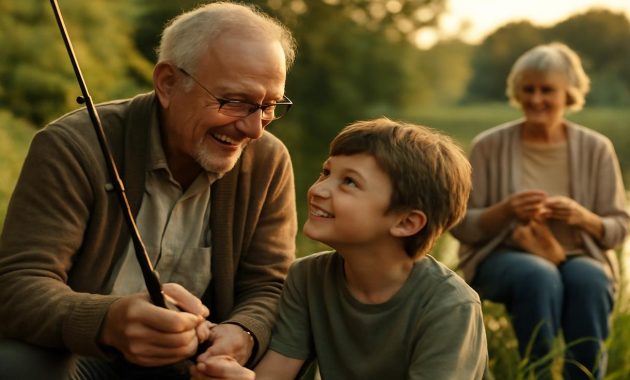
The first thing you notice is the sound. A screen door sighing shut, the shuffle of soft slippers, maybe the faint clink of a spoon in a chipped mug. There’s always some familiar smell too—cinnamon and dust, stew and soap, or the lavender drawer sachets that seem to follow them like a gentle cloud. You’re eight years old again, stepping into your grandparents’ house, and the world suddenly slows down. Your shoulders drop. Time feels wider, kinder. It’s not just nostalgia; it’s how your nervous system remembers safety.
Psychologists would call this a “secure base”—a place and person that makes your brain let out its long-held breath. Grandparents can be that, in a way almost no one else can. Not all, of course. Some are distant or distracted; some never got the chance. But the grandparents who are deeply loved—the ones whose names are whispered decades later with warmth and longing—tend to share a handful of quiet, powerful habits. These habits aren’t about being perfect, endlessly patient, or baking elaborate pies. They’re about how they make a child’s small and tender world feel.
You might be a grandparent now, or someone imagining that season of life in the distance. You might be the grown-up grandchild, still navigating the weather systems that your grandparents once taught you to read—clouds, moods, and everything between. Wherever you stand, it’s worth exploring what psychology tells us about why some grandparents are remembered as home itself.
1. They Make Children Feel Truly Seen
Children remember the adults who noticed them—not just their grades or their sports trophies, but the odd little details: the way they lined up their toy cars by color, the dignity with which they carried a favorite worn-out stuffed animal, the way they drew suns with tiny faces in the corner of every page.
Attachment research shows that kids thrive when they experience “attunement”—an adult tuning in to their inner world, not just reacting to their outer behavior. Loved grandparents have a knack for this. They don’t only ask, “How was school?” They ask, “What was the funniest thing that happened today?” or “When did you feel proud of yourself this week?” And then they actually listen. They look up from the newspaper. They put the phone down. Their eyes soften and stay.
There’s a kind of micro-magic in these moments. A grandchild pushes a drawing across the table. A hurried adult might mumble “Nice job!” without looking. But a grandparent who is deeply loved will pause and say, “Tell me about this part right here.” Suddenly, it’s not validation for being “good enough” art—it’s curiosity about the child’s mind. Psychologists call this “reflective functioning”: treating the child as a person with thoughts, feelings, and intentions worth understanding.
Over time, this kind of attention teaches children something profound: my inner world matters. They grow up with a sturdier sense of self, less thrown by other people’s opinions, because somewhere in their story, there was a grandparent who always had time for one more explanation of their weird imaginary universe.
Everyday Ways They Show This
- Remembering the child’s current obsession—dinosaurs, space, a particular video game—and asking specific questions about it.
- Using the child’s name often, with warmth, not just as a signal of trouble.
- Noticing mood shifts: “You seem quieter today. Tired, or is something bothering you?”
It’s not grand gestures. It’s the steady hum of being noticed.
2. They Offer Steady, Non-Anxious Love
In a world that asks kids to go faster and perform better, deeply loved grandparents move at a different tempo. They’re not perfect; they worry, they get tired, their knees complain. But around them, children often feel less pressure to be anything other than themselves.
Developmental psychology tells us that children need “unconditional positive regard”—that sense that their worth isn’t on the line every time they make a mistake. Parents, tangled in daily logistics and long-term hopes, can struggle with that. Grandparents, a small step removed from the front lines, sometimes hold it more easily. Their love has less to prove and more to savor.
Imagine a child coming home with a failed test. A parent, stressed and scared about the future, might immediately jump into problem-solving, lectures, or panic. A grandparent, hearing the same story, might first say, “Oof, that must have felt awful. Come sit with me for a minute.” In that pause, they are signaling: your worth is not the same thing as your performance. Only after the emotional dust settles do they gently ask, “Want help figuring out what went wrong?”
Psychologically, this is pure gold. The child’s nervous system learns to link mistakes not with shame, but with acceptance plus gentle guidance. This fosters resilience—the ability to bounce back rather than crumble or avoid challenges altogether.
The Texture of This Kind of Love
- They say “I love you” often, but also show it through consistent availability.
- They separate behavior from identity: “What you did wasn’t kind” instead of “You’re a bad boy/girl.”
- They hold boundaries without emotional explosions—“No more cookies today, love, but we can have some tomorrow,” said once, calmly.
Kids remember how their body felt with certain adults. Loved grandparents often become associated with a sense of safety: a slow heartbeat, relaxed muscles, a nervous system that can finally rest.
3. They Create Rituals That Turn Time Into Memory
Ask adults about the grandparents they adored, and they rarely talk about one spectacular vacation. They talk about rituals: the Saturday morning pancakes shaped like initials; the garden tour at dusk where each plant had a story; the way Grandpa would always hum the same off-key song while washing dishes.
Rituals might seem small, but psychologically, they are powerful. They provide predictability, which calms the brain, and they encode belonging. Research on family traditions shows that these repeated, meaningful moments boost children’s sense of identity and emotional stability. Grandparents, often unhurried by school schedules and work deadlines, are uniquely positioned to weave these rituals into a child’s life.
Picture a grandparent and grandchild walking the same forest trail every Sunday. Maybe they name particular trees, track the seasons by the smell of the air, or watch the creek’s changing moods. Over months and years, that walk becomes more than exercise. It becomes a story of growing up, nested inside a landscape that holds their shared time.
These rituals don’t have to be outdoorsy or elaborate. A nightly phone call where Grandma asks two simple questions—“What was the best part of your day?” and “What was the hardest?”—can become a ritual that scaffolds emotional literacy and connection, even across distance.
Examples of Grandparent Rituals
| Ritual | What It Builds in Children |
|---|---|
| Weekly walk or nature outing | Mindfulness, curiosity, shared memories, stress reduction |
| Special greeting or goodbye (song, handshake, silly dance) | Sense of belonging, joy, secure attachment signals |
| Cooking one “signature dish” together | Competence, cultural identity, embodied memory of care |
| End-of-day or weekly check-in questions | Emotional vocabulary, self-reflection, trust |
| Seasonal traditions (first snow walk, summer berry picking) | Connection to nature, time awareness, anticipation and delight |
The key is repetition with warmth. Over years, these small loops of time become the backbone of “Remember how Grandma always…?” stories that glow in adulthood.
4. They Respect the Child’s Autonomy (While Still Being the Grown-Up)
Deeply loved grandparents carry an interesting balance. They are clearly adults—holders of stories, recipes, and warnings about slippery stones after rain. Yet, they often offer children a sense of agency rare in other relationships.
Self-determination theory, a cornerstone of motivation psychology, suggests that humans have three basic psychological needs: autonomy, competence, and relatedness. Grandparents, at their best, feed all three. They let a grandchild choose the game, decide whether they want to join a walk, or pick which seed to plant in the garden. When possible, they say, “Would you like to…?” instead of “You have to…”
At the same time, they’re not afraid to be the grown-up. If a child wants to do something genuinely unsafe, a wise grandparent steps in with calm authority: “I can’t let you climb that high; my job is to keep you safe. Let’s find another way to explore.” That phrase—my job is to keep you safe—is a particularly powerful one in child psychology. It removes blame from the child and situates boundaries as care, not control.
How This Looks in Real Life
- Offering choices within structure: “We’re going to the park. Do you want to bring your bike or your scooter?”
- Inviting opinions: “What do you think we should cook today?” and taking the suggestion seriously.
- Encouraging problem-solving: “Hmm, the puzzle piece doesn’t fit that way. What else could you try?”
When grandparents treat children as capable, decision-making humans—while still offering the safe container of adult guidance—they help build self-esteem that is sturdy, not fragile. The grandchild learns: “I can think, choose, and try; and if I misjudge, I’m still loved.”
5. They Tell Stories—And Listen to Them
Sometime after dinner, the light thinning at the edges of the curtains, is often when it happens. A grandparent leans back, eyes turned somewhere inward, and starts a story. Maybe it’s about their own childhood on a farm, or the time the town flooded, or how they once got lost in the woods and found their way home by following a river. The child leans in, spoon suspended halfway to their mouth. The ordinary room opens into a long corridor of time.
Psychologists call this “intergenerational narrative.” Research suggests that children who know stories about their family’s past—both the good and the hard—tend to have greater resilience and a stronger sense of identity. It’s not about presenting a glossy, heroic family myth. It’s about weaving a tapestry that says, “You come from people who have lived, struggled, loved, failed, and kept going.”
Deeply loved grandparents tell stories that are honest but age-appropriate. They might talk about being afraid in school, or making a big mistake at work, and what they learned. These narratives give kids a roadmap for their own inevitable missteps. Shame loosens its grip when a child realizes: “Even Grandpa messed up sometimes—and he’s okay.”
But the most beloved grandparents don’t only talk; they invite stories back. They ask, “What’s your earliest memory?” or “Tell me about your best friend,” and then treat the answers like treasures. This reciprocal storytelling feeds a child’s sense of continuity: I exist not just in this moment, but in a larger unfolding tale where my voice matters.
Story Habits That Matter
- Sharing “origin” stories: how the child’s name was chosen, the day they were born, the first time they were held.
- Admitting vulnerability: tales of being scared, embarrassed, or wrong—and how things turned out.
- Inviting retellings: “Tell me again about your school play; I loved that story.” Repetition reinforces worth.
In many ways, grandparents are keepers of the family’s campfire—the ones who stoke the flames of shared memory and hand the storytelling stick back and forth until the next generation knows how to hold it too.
6. They Stay Curious as the Child—and the World—Changes
Perhaps the most quietly powerful habit of deeply loved grandparents is this: they do not freeze their grandchildren in time. They resist the easy comfort of “You’ll always be my baby” as an excuse not to meet the complex teenager or adult standing before them.
Psychologically, this is about “updating your mental model” of someone—recognizing that they grow, shift, and develop new values and identities. Grandparents who are deeply cherished keep asking questions, even when the answers lead into unfamiliar terrain: new music, confusing slang, different beliefs, changing pronouns, shifting careers.
This doesn’t mean they agree with everything. It means they stay present in the conversation. Instead of shutting down with “In my day, we never…”, they might say, “Help me understand what that means for you.” Curiosity is a form of love. It signals, “I want to know who you are now, not just who you were when you fit on my lap.”
Research in lifespan development shows that older adults who maintain flexibility and openness tend to have better relationships and greater well-being. For grandchildren, having an elder who is willing to evolve with them provides a rare and grounding experience: someone whose love is rooted in the past, but whose attention lives in the present.
Signs of This Ongoing Curiosity
- Asking about new interests without mocking or dismissing them.
- Learning small pieces of the child’s world—maybe a video game, a favorite song, or a social cause.
- Apologizing when they get it wrong: “I’m still learning. Thank you for correcting me.”
Children grow into adults who remember that their grandparents didn’t just love who they had been; they made room for who they were becoming.
Weaving the Habits Together
None of these six habits requires grand gestures, wealth, or perfect health. They are built from presence, curiosity, boundaries, stories, rituals, and a love that doesn’t panic when life goes sideways. Psychology gives language to what children have always known in their bones: the grandparents they love most create an emotional ecosystem where it is safe to be fully human.
Maybe you picture your own grandmother’s calloused hands, shelling peas on a summer porch, listening more than she spoke. Maybe you think of a grandfather who never raised his voice, but whose one raised eyebrow could stop a sibling feud—and who always followed a harsh word with a soft conversation later. Maybe your grandparents weren’t like this, and the ache of what you missed sits quietly nearby as you read. That, too, is real and worth honoring.
The beauty of these habits is that they are not chained to biology or age. Step-grandparents, honorary grandparents, mentors, older neighbors—they can all embody them. And if you’re heading toward or already in that season of life, it’s not about becoming some mythic grandparent figure. It’s about choosing, over and over, to slow down enough to really see the child in front of you, to steady your own fears so theirs don’t have to carry them, and to remember that love, at its best, is attentive, flexible, and woven through with stories.
Somewhere, a future adult may one day stir soup on their own stove, catching a whiff of thyme or onion or woodsmoke, and suddenly be back in your kitchen, your yard, your folding lawn chair at the edge of a little league field. They will remember not just what you did, but how it felt to be with you. And if you’ve practiced these quiet, powerful habits, that feeling will be one of the safest homes they’ve ever known.
Frequently Asked Questions
Do I have to live close to my grandchildren to build this kind of bond?
No. Proximity helps, but psychology shows that emotional consistency matters more than geography. Regular video calls, voice messages, letters, and small shared rituals (like reading the same book or a weekly “storytime call”) can create deep connection even across oceans.
What if my relationship with my own children is strained—can I still be a loved grandparent?
It’s more complicated, but not impossible. Repairing or softening tension with your adult children can help open doors to the grandchildren. Even small gestures of humility—apologies, listening without defending—can shift dynamics over time. Meanwhile, if you do have contact with your grandchildren, focus on being a steady, non-anxious presence rather than trying to “fix” family history through them.
How do I avoid spoiling my grandchildren while still being the “fun” grandparent?
Being fun doesn’t have to mean abandoning boundaries. Children feel safest when adults are kind and consistent. You can offer treats, surprises, and relaxed rules in some areas, while still holding clear lines on safety, respect, and rest. Communicate with the parents about what feels reasonable, so your generosity supports rather than undermines the child’s overall structure.
What if I didn’t have good grandparents myself and don’t know how to do this?
Lack of a model can make this feel unfamiliar, but it doesn’t make it impossible. Start small: practice really listening, create one simple ritual, and notice your own emotional reactions so you don’t unload old pain onto new relationships. Reading about attachment, child development, or even watching how other caring elders interact with kids can help you build your own blueprint.
Is it ever too late to build a closer relationship with my grandchild?
While early years are powerful, it is rarely “too late” in a psychological sense. Teenagers and even adults can still be deeply affected by a grandparent’s genuine curiosity, apology, or consistent presence. You may not rewrite the whole story, but you can always add new, healing chapters by showing up in a different way now.