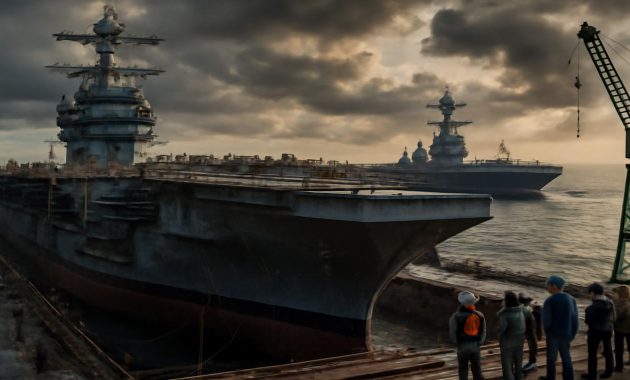
The rain comes in sideways off the Atlantic, needling the exposed skin of the workers high on the scaffolding as if the ocean itself is impatient. Below, in the maze of steel at Newport News Shipbuilding, a new giant is taking shape—bristling with welders’ sparks, echoing with the thud of hammers and the low, constant growl of machinery. This is the USS John F. Kennedy, the second of the Ford-class aircraft carriers, and the pace around her hull has changed. It’s not just busy—it’s urgent. Out beyond the horizon, her older sibling, the USS Gerald R. Ford, is no longer a testbed or a talking point. She’s in the real world now, on deployment, entering the uncertain theater of modern combat. And with that, the era of “next-generation” carriers has ceased to be a future-tense phrase. It has arrived, roaring, directly into the present.
The Ocean’s New Rhythm
Walk the length of the dry dock, and it feels like moving along the spine of a sleeping leviathan. The Kennedy is still incomplete—vast sections of her flight deck are open to the sky, her interior an illuminated labyrinth of half-finished compartments—but there’s an undeniable sense of momentum in the air. Conversations are clipped, purposeful. Forklifts whine, cranes swing slowly over the steel canyon, and there’s the constant smell of hot metal, paint, and salt carried inland on a damp wind.
In the shadow of the towering hull blocks, an older shipbuilder leans on a handrail, watching as a massive section of the flight deck is eased into place. “Things changed when the Ford went forward,” he says, almost shouting over the noise. “Before that, this was all theory. Now she’s out there, earning her keep. Nobody wants this one”—his thumb hooks toward the Kennedy—“to be late to the party.”
The “party” is not something anyone is truly eager for. It is the shifting, unnervingly fluid sphere of modern warfare at sea—where hypersonic missiles streak low over the water, drones hum beyond the horizon, and quiet submarines slip through the dark like rumors. As the USS Gerald R. Ford steams into contested waters for the first time, the U.S. Navy is making it clear: one ship, however advanced, is not enough. The tempo on the waterfront is matching the tempo of global tension.
The Ford-Class Moment
For years, the Ford-class carriers were spoken of in terms of promise and controversy—bristling with technology, weighed down with cost overruns and questions. Electromagnetic catapults instead of steam. Advanced arresting gear. A sprawling, redesigned island and a flight deck optimized to move aircraft faster, launch more sorties, and handle unmanned systems that haven’t even been fully imagined yet.
Now, with the USS Ford on the sharp end of real deployments, those technologies are being tested in ways no trials range can simulate. The catapults no longer exist just in PowerPoints and project briefs—they’re hurling jets into the wind in unpredictable conditions. Elevators for weapons, once a symbol of delay and frustration, are cycling constantly as ordnance moves from the bowels of the ship to the deck above. The Navy, and the world, are watching.
Back in the shipyard, this operational reality has bled into the steel of the Kennedy. There’s a different edge to design reviews, a new urgency to every schedule update. The ship is no longer a conceptual successor—it’s the necessary partner, the follow-on act that will turn a singular leap in technology into a sustained fleet capability. That difference—between a solitary experiment and a class of ships—may shape how the U.S. casts its shadow across blue water for decades to come.
The Pressure of Time
Accelerated construction is, in many ways, an abstraction. You see it in charts and spreadsheets, in revised milestones and delivery estimates. But out here among the scaffolds and cables, it looks and feels very physical. It’s the double-shift crews that arrive before dawn and walk out under stars. It’s the laser-straight seams of welds done in less time but to the same unforgiving standards. It’s supply trucks arriving just-in-time, parts swinging in overhead as soon as the last piece clicks into place.
A young engineer, hard hat splattered with rain and primer, steps aside to let a welding team pass. “Every time there’s a real deployment, or a flash point in the news,” she says quietly, “you can feel it. It runs through everyone. It’s not pressure to cut corners; it’s pressure to deliver faster without failing. Because somewhere, not too long from now, someone’s going to be landing a jet on this thing in the dark.”
In the background, workers fitting an internal passageway shout measurements to each other. The Kennedy is a city under construction—acres of narrow corridors, cavernous hangars, steel ladders that climb like vines. As systems go in—piping, wiring, sensors, consoles—the ship becomes more than an object. It becomes a promise to sailors who haven’t even seen her yet, but who will sleep in these berths and stand watch on these decks.
Living Steel: How the Kennedy Differs
The USS John F. Kennedy is not a carbon copy of the Ford. Each new hull in a carrier class carries the DNA of lessons learned: tweaks to layout, refinements in maintainability, rethought workflows. In the glow of temporary work lights, you can see the subtle differences—slightly re-positioned equipment bays, clearer cable runs, minor structural changes that make future repairs faster.
Shipyard planners talk about “learning curves” with a mix of pride and caution. The first-of-class, like the Ford, absorbs the most friction: new processes, unfamiliar designs, untested sequences. By the time you’re building the second ship, those hard lessons translate into saved time—and, crucially, fewer surprises.
Here, the design anticipates a world the Ford is just beginning to encounter. Space is being carved out with an eye toward unmanned aerial vehicles, evolving electronic warfare suites, and data-sharing networks that bind fleets and satellites together into a single, humming system. Even power management speaks to the future; the Ford-class nuclear reactors are built to supply not just today’s radars and catapults, but tomorrow’s potential energy weapons and advanced sensors.
In one compartment, the hum of discussion drifts from a small group bent over a set of screens. Digital models spin and rotate, showing how a new piece of equipment will fit into a space not yet flooded with cables and pipes. They are choreographing complexity, trying to ensure that when the last bolt is tightened years from now, there won’t be a hidden conflict waiting—no valve blocked by a support beam, no cable tray impossible to reach.
Numbers Behind the Narrative
It’s easy to get lost in the drama of welders’ sparks and looming hulls. But the story of the Kennedy’s acceleration is also one of cold numbers: years shaved, sorties gained, dollars spent and saved. These ships are national investments on a staggering scale, and the logic of their construction must be as formidable as their silhouettes at sea.
| Aspect | USS Gerald R. Ford | USS John F. Kennedy |
|---|---|---|
| Role in Class | Lead ship, technology pioneer | Second ship, refined design |
| Construction Approach | First-time integration of new systems | Accelerated, leveraging lessons learned |
| Operational Status | Deployed, entering combat operations | Under construction, schedule tightened |
| Flight Deck Focus | Validating sortie generation concepts | Incorporating updated layouts and workflows |
| Future Systems Capacity | Baseline for new technologies | Optimized for upcoming unmanned & advanced systems |
In a quiet office overlooking the yard, program managers scroll through schedules that expand and compress like concertinas. Over time, efficiencies compound: a month saved in module fabrication, a week shaved off system integration because the team has done it once before and mapped the pitfalls. Accelerated doesn’t mean reckless; in the carrier world, a single rework decision made in haste can echo in years of delay later.
Ford at the Front, Kennedy in the Wings
Far from the shipyard, the USS Gerald R. Ford moves in patterns that are anything but random. Carriers rarely operate alone, and when the Ford enters a contested region she brings with her a constellation of destroyers, cruisers, submarines, and support ships. Overhead, her air wing arcs and loops, jets carving contrails against a higher, calmer sky than the restless ocean below.
Below deck, sailors thread their way through the ship’s interior, their routines at once mundane and monumental: aircraft maintenance, radar monitoring, flight planning, galley work. To them, the shipyard where their vessel’s twin is under construction is a distant idea. But every launch and recovery they perform on Ford now sends ripples backward in time, informing how Kennedy’s systems will be tuned, how her crew spaces will be arranged, how her training simulators will be designed.
In a carrier strike group, presence is power—even when no weapon is fired. The very act of sailing into a region broadcasts a message: we are here, and we can stay. As world events nudge the Ford into more complex roles, government decisions filter quickly to the waterfront: timelines must adjust, capabilities must come online sooner, and the gap between first and second ship must narrow. Kennedy, unfinished as she is, is already part of the nation’s strategic calculation.
The Human Thread
It’s easy, standing before the Kennedy’s towering bow, to see only machinery and might. But woven into the steel are thousands of human stories that stretch from coastal Virginia to small inland towns where families watch the news and think, quietly, “That’s our ship.” Each welder’s bead, each checklist signed, each design tweak emerges from people who know, at some level, that a future sailor’s life might one day depend on their precision.
In the break room, the conversation isn’t always about geopolitics or naval doctrine. It’s about overtime hours, kids’ homework, aging parents, the perpetual negotiation between home and work that defines so much of American industry. But when the topic does turn to the news—when a crisis flares, when footage of the Ford’s flight deck appears on television—shoulders straighten. There is a real sense that the distant roar of jets is connected to the clatter of tools here.
One electrician, wrapping cables in a narrow compartment, puts it plainly: “You don’t think about politics when you’re tying in a power run. You think about making it safe, making it right. But yeah, when you see the ship’s name in the news, you feel it. You’re part of that.”
A Future Written in Wake and Weld
As the light fades over the shipyard, the Kennedy’s shape stands out in stark contrast, a dark geometry against the deepening sky. Floodlights snap on one by one, turning the site into an island of brightness. Work continues. Out at sea, somewhere beyond the line where the sky swallows the ocean, the USS Gerald R. Ford is carving her own luminous track through black water, wake glowing under the moon.
Between these two worlds—one of half-finished compartments and one of ready rooms and launch rails—lies the story of how a nation updates its symbols of power. Carriers are more than ships; they are moving pieces of foreign policy, embodiments of industrial capacity, and repositories of national imagination. When a country chooses to accelerate the birth of an aircraft carrier, it is making more than a scheduling decision. It is saying something about how it sees the next twenty, thirty, even fifty years of the world’s oceans.
There will be debates, as there always are—about cost, about vulnerability in an age of long-range missiles and cyber warfare, about whether the massive carrier still deserves its throne at the center of naval strategy. But those debates unfold in parallel with another, quieter reality: in one place, sailors are already living the answers, day by day, on Ford’s steel decks. In another, shipbuilders are betting that Kennedy will need to be ready sooner than anyone once planned.
On a wet, wind-swept evening, a final crane lifts the last major block of steel into position. The piece hangs there, a vast, angular shadow, swaying gently over the already colossal structure below. For a moment, the yard seems to hold its breath. Then, slowly, deliberately, the block settles, connects, and becomes part of something larger. The workers step back, eyes narrowed against the light, taking in the new outline of the ship.
Far away, a jet catapults off the Ford’s bow in a blur of sound and motion, climbing into the dark. Two moments, connected by a long chain of events, decisions, and intentions. The Ford in combat, the Kennedy in construction. The present and the near future sharing the same ocean of possibility.
Frequently Asked Questions
Why is the U.S. accelerating construction of the USS John F. Kennedy?
The acceleration reflects growing strategic demands on the Navy. With the USS Gerald R. Ford now deployed and entering real-world combat operations, the U.S. wants to ensure that the advanced capabilities of the Ford-class are available in depth, not just on a single ship. Speeding up Kennedy’s delivery helps close the gap between first and second ship, strengthening overall carrier presence.
How is the USS John F. Kennedy different from the USS Gerald R. Ford?
Kennedy shares the Ford’s core technologies—nuclear power plant, electromagnetic catapults, advanced arresting gear—but incorporates lessons learned from the first ship’s construction and early operations. That means refinements in layout, maintainability, and system integration, and better preparation for future systems like unmanned aircraft and enhanced sensors.
Does accelerated construction mean reduced quality or safety?
No. In large, complex projects like carriers, acceleration typically comes from improved processes and experience, not cutting corners. The Ford’s construction and trials exposed problem areas and inefficiencies. Those are now being addressed up front in Kennedy’s build sequence, allowing work to move faster while maintaining strict safety and quality standards.
What does the Ford entering combat actually change for the Kennedy?
Once the Ford is in real operations, feedback from sailors and officers begins to shape design tweaks, system settings, and even training concepts. That operational knowledge feeds directly into Kennedy’s remaining construction and outfitting, allowing the second ship to enter service more “mature” than the first in terms of how it’s used day-to-day.
Are aircraft carriers still relevant in modern warfare?
Carriers face new threats, especially from long-range missiles and sophisticated surveillance systems. But they also remain uniquely flexible tools: mobile airbases that can project power, provide humanitarian aid, and support allies without requiring land bases. The Ford-class, including Kennedy, is designed with upgraded power, sensors, and deck layouts to adapt to evolving threats and technologies, keeping the carrier concept viable in a rapidly changing world.