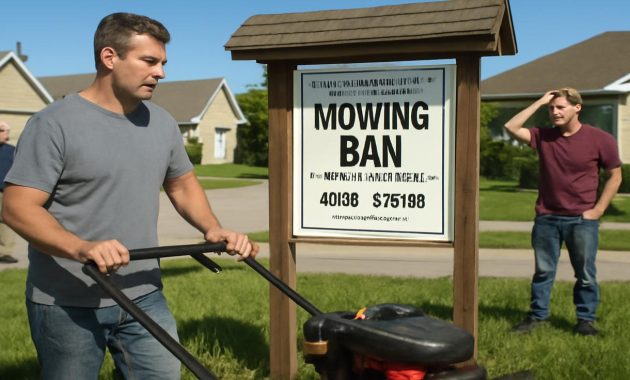
The grass was already high enough to tickle his shins when Tom Parker rolled his mower out of the garage, the sun sharp and white over the quiet cul-de-sac. It was the first warm weekend of the year—the kind that smells like soil waking up and gasoline from a dozen garages opening in unison. Tom checked his watch out of habit. 12:10 p.m. He shrugged. “Better get this done before the game,” he muttered. He’d barely yanked the starter cord when his neighbor, Ana, jogged across the street, waving her hands in alarm.
“Tom! Stop! You can’t mow right now.”
He laughed. “Can’t mow? What, is the grass on lunch break?”
She shook her head. “No, I’m serious. The new rule. Noon to four is off-limits now. They can fine you.”
Tom let the mower cord fall slack, the machine coughing into silence. “You’re kidding,” he said. But she wasn’t. Starting February 21, lawn mowing between 12 p.m. and 4 p.m. isn’t just frowned upon—it’s officially banned, with real penalties attached. For millions of homeowners used to the ritual of the midday mow, this isn’t just another rule. It’s a reset button on a long-standing suburban rhythm.
Why the Lawns Have to Go Quiet at Noon
The new midday lawn-mowing ban didn’t just appear out of nowhere. It’s a response to a collision of pressures that have been building for years—heat waves, worsening air quality, chronic drought in many regions, and the growing chorus of people begging for a little less noise and fumes in their afternoons.
In simple terms, the rule says this: between 12:00 p.m. and 4:00 p.m., homeowners are not allowed to mow their lawns. That includes gas-powered and, in many places, electric mowers too. Violations can lead to fines—modest for a first offense, increasingly painful for repeat offenders.
Why those four hours? At first glance, it feels arbitrary, like someone took a ruler to the day and sliced out the most convenient block of time for working people. But that midday window is usually when the sun is at its most intense, when temperatures spike, and when the air becomes a stagnant bowl holding in heat and pollution. That’s also when mowing does the most combined harm—to the air, to the soil, to insects, and yes, even to the grass itself.
For years, environmental scientists have warned that running gas-powered mowers under scorching sunlight is quietly brutal. A single old-fashioned mower can emit as much pollution in an hour as a car driving for hundreds of miles. Mixed with heat, those emissions help cook up ground-level ozone—the stuff that burns your lungs on “bad air” days.
Then there’s the grass. Under intense midday sun, blades of grass are already stressed and losing water fast. Cutting them at that moment is like giving someone a haircut in the middle of a sandstorm—it adds injury to strain. Lawns cut in extreme heat are more prone to browning, disease, and water demands. In the age of sprinklers and shrinking reservoirs, that matters.
The new rule is a blunt instrument aimed at a tangle of quiet problems. It’s not just about grass. It’s about air. It’s about water. It’s about heat. And it’s about asking the neighborhoods we’ve built to live by slightly different rhythms.
The Midday Mow: A Ritual Under Pressure
For many homeowners, especially those who juggle work, kids, and the hundred tiny obligations of everyday life, midday has always been prime mowing time. Saturdays and Sundays between lunch and late afternoon are when the neighborhood symphony of engines usually crescendos. You can smell it before you hear it: the sweet-sour mix of cut grass and exhaust drifting through open windows.
Maybe you know the feeling. You open your garage, wheel the mower out into the light, and there’s a rare sense of control. Grass is one of the few things in modern life you can still conquer in under an hour. There’s a particular satisfaction to those neat, parallel lines unfurling beneath the wheels. The sweat, the hum of the motor, the quick visual payoff transforming chaos into something tidy and predictable.
Now imagine that stolen hour suddenly off-limits.
This is where the new rule starts to feel personal. It isn’t only about “environmental policy” in some abstract sense—it’s about real, daily habits. The dad who mows when the baby naps. The nurse who works nights and only has a sliver of midday free. The older couple who prefer to mow when it’s bright enough to see every uneven patch.
With fines now in play, this isn’t something you can just ignore and hope no one notices. In many communities, enforcement will be complaint-driven—neighbors calling in violations, or code officers making periodic rounds. Some areas will rely on warnings at first, easing people into the change. Others will go straight for the wallet.
The thought of a neighbor filming your mower with a phone from behind the curtains is enough to make anyone bristle. This is where the line between environmental responsibility and personal freedom starts to feel thin and fragile. Yet underneath the annoyance, there’s a deeper question humming: what kind of neighborhoods do we want to live in, and what are we willing to change to get there?
Heat, Habitat, and the Hidden Life in the Grass
Stand barefoot in your yard at 1 p.m. on a hot day and you’ll notice something you might never have thought about: the lawn is alive with whispers and rustles. Ants threading along invisible highways. Beetles navigating the jungle of stems. Small spiders strung between stalks like acrobats on tensioned ropes. To a mower, it’s just grass. To a dozen small species, it’s a city under siege.
Midday is a brutal time for backyard wildlife. Birds retreat to shade. Bees search more carefully for flowers that haven’t wilted. Many insects drop low into the grass to escape the worst of the heat. This is exactly when a lawn mower becomes not just a noise machine, but a shredding blade pushing through their last refuge.
The new mowing ban, strange as it feels, also holds a quiet mercy for these overlooked residents. By shifting mowing to cooler hours—early morning or late afternoon—you give more of these creatures a chance to recover, to move, to survive.
And the heat itself? It hits lawns harder than most homeowners realize. Under the midday sun, soil temperature can soar well beyond the air temperature, baking root systems and evaporating moisture faster than you can water it back. When you cut grass in that state, you expose more of the soil surface, accelerating that loss.
It’s one reason you often see brown, patchy lawns in mid-summer, even in yards with regular watering. Mowing under punishing sunlight is like peeling back a bandage in the middle of a dust storm. The grass spends its limited energy surviving that immediate trauma, not deepening its roots or staying lush.
Shift mowing to the bookends of the day, and everything changes. The air is cooler, the soil less stressed, the plants less desperate. You still get your tidy lines and trimmed edges, but the lawn has a fighting chance to stay green through rising temperatures and shrinking rainfall.
In a world warming faster than forecast, a rule like this is also a quiet adaptation strategy—one that doesn’t require a PhD to understand, just a different way of reading the clock.
What This Means for Your Weekends (and Your Wallet)
The obvious question for most homeowners is immediate and practical: “When, exactly, am I supposed to mow now?”
If your schedule already feels like an overstuffed suitcase, the new rule can seem almost cruel. But it doesn’t have to be chaos. It just means your mowing window shifts to earlier or later—and your planning needs to catch up.
Here’s how the new rule reshapes the typical mowing week for many people:
| Time of Day | Old Habit | New Reality |
|---|---|---|
| 6–9 a.m. | Rarely used, sometimes “too early” for noise | Prime legal mowing time, cooler temps, less stress on grass |
| 9 a.m.–12 p.m. | Gradually busier, popular weekend slot | Still allowed, but can get hot quickly in summer |
| 12–4 p.m. | Peak mowing window for many homeowners | Banned for mowing; fines possible if violated |
| 4–7 p.m. | Occasional mowing, often for late workers | Main alternative slot; better for grass than midday |
| After 7 p.m. | Generally quiet; some areas have noise ordinances | May still be limited by local noise rules—check your area |
Of course, this shift doesn’t come without friction. If your job locks you into late mornings or afternoons, you may feel cornered into mowing at dawn or racing the sunset. For some, that might mean hiring a lawn service that can mow during allowed morning windows—yet another line item on a budget already groaning under inflation.
Then there are the fines. While the exact amounts will vary by jurisdiction, many areas are adopting a step-ladder approach: a lower fine for the first slip, then higher penalties if you keep breaking the rule. That “quick mow before lunch” can suddenly become the most expensive chore of your month.
But there’s another, quieter cost—and potential savings—tied to this rule. By avoiding mowing during the hottest hours, your lawn will likely demand less water and fewer emergency rescues from brown, stressed patches. Over a full season, that can shave dollars off your water bill. For many homeowners, that won’t fully offset the inconvenience. But it does hint at a basic truth: a lawn treated more gently by the sun is also cheaper to maintain.
Turning a Restriction into an Invitation
Behind every rule that takes something away lies a question: what might we do with that space instead?
Imagine a Saturday where noon rolls around and, instead of the neighborhood erupting into a chorus of engines, there’s an odd, unfamiliar quiet. No mechanical whine bleeding into every open window. No need to shout over the roar while you’re trying to eat lunch on the deck or put a toddler down for a nap.
Maybe you notice the birds first. They’re louder when the mowers are silent. The rustle of wind through trees, the tap of a woodpecker on a utility pole, the buzz of a bumblebee veering past your head. That midday silence—forced or not—becomes a reclaimed soundscape.
This is the hidden opportunity stitched into the new rule. The hours that used to be a default for roaring engines could become something else entirely: reading on the porch, gardening by hand, sitting barefoot in the grass that’s allowed to grow just a little longer before it’s trimmed back.
For some, it might be the nudge they needed to loosen their grip on the perfect lawn image altogether. Maybe this is when you decide to leave a corner of the yard unmowed for a few weeks, just to see what shows up. A spray of wildflowers, perhaps. More bees. A frog tucked into the damp shade of taller blades.
Rules alone don’t change culture, but they can crack open new possibilities. The midday mowing ban could also speed up a broader shift that’s already happening: the move away from thirsty, chemical-laden, hyper-manicured lawns toward more resilient, life-friendly yards—native plantings, clover patches, wildflower strips, and food gardens.
There’s a quiet liberation in realizing you don’t have to wage weekly war on every extra inch of growth. Grass can be a companion instead of a conquest.
FAQs About the New Noon-to-4 Lawn Mowing Ban
Q: Does the rule apply to both gas and electric mowers?
A: In most areas adopting this type of ban, yes. The time restriction is about heat, noise, and air quality combined, so the rule typically covers all powered mowers, regardless of their fuel source. Manual reel mowers may be exempt, but it depends on your local regulations.
Q: What happens if I accidentally mow during the banned hours?
A: Many municipalities plan to start with warnings, especially right after the rule takes effect. However, once the grace period passes, fines can be issued even for a first offense. If you genuinely didn’t know, you may be able to contest the ticket—but it’s better to shift your schedule now than rely on leniency.
Q: How will this be enforced—are inspectors going to patrol my street?
A: Enforcement will often be complaint-based. That means neighbors, passersby, or local officials who notice violations can report them. Some areas may add periodic patrols on weekends, but most won’t have the resources for constant monitoring.
Q: Can professional lawn services mow during the restricted hours if I can’t?
A: Generally, no. The time restriction usually applies to everyone, including commercial landscapers. Some local codes might offer limited exceptions, but they are rare and often tightly controlled.
Q: What if my only free time falls between noon and 4 p.m.?
A: You may need to get creative—splitting mowing over two shorter sessions (early morning and early evening), switching to a lower-maintenance yard design, or, if feasible, hiring a service that can mow during allowed hours. It’s an adjustment, but one that becomes easier when built into your weekly routine.
Q: Is this rule permanent, or could it change in the future?
A: Most such rules are open to future review. If they’re shown to significantly improve air quality, reduce water use, or help with heat management, they’ll likely stay. Over time, as technology and climate conditions change, the details could be revisited—but for now, homeowners should plan as if it’s here to stay.
Q: Does this affect other yard tools, like leaf blowers or trimmers?
A: Some areas are pairing the mowing restriction with broader time limits on noisy or polluting yard tools. In other regions, the noon-to-four ban applies only to mowing. Check your specific local ordinance so you don’t get caught off-guard.
Q: How can I keep my lawn healthy if I have to avoid midday mowing?
A: Aim to mow in the cooler hours—early morning or later afternoon. Keep your mower blades sharp, avoid cutting more than one-third of the grass height at once, and water deeply but infrequently, preferably early in the morning. These practices help your lawn handle heat and stress more gracefully.
The grass in Tom Parker’s yard still grows, hour by hour, whether he mows it at noon or waits until evening. The new rule doesn’t change that. What it does change is the soundtrack of the neighborhood at midday—and perhaps, over time, our relationship with the little patches of green we call our own. Somewhere between irritation and adaptation, there’s a chance to listen differently to the hum of our homes, and to the quiet lives rustling just below the blades.