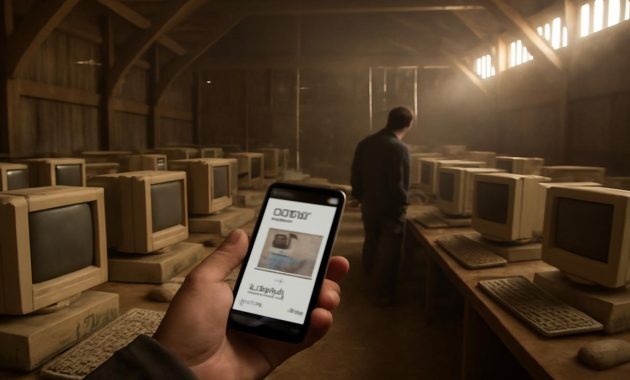
The dust in the barn was older than some of the computers. You could feel it on your tongue—a dry, papery taste that came with every step, every box shifted, every tarp peeled back. Light slipped in through the slats of the weathered wood, turning the floating particles into a golden fog. And beneath that fog, stacked on makeshift shelves and wobbly wooden pallets, sat an army of grey and beige machines that had not hummed, blinked, or booted up in twenty-three years.
There were 2,200 of them. Old desktops, blocky monitors, yellowed keyboards, tangled mice in plastic tubs. Each one once new enough to be a promise—of speed, of connection, of the future. Now they looked more like fossils, relics of a technological era that the world had long since moved beyond.
And yet, against all likelihood, they were about to be given another life—one eBay listing at a time, for less than €100 each.
The Barn That Time Forgot
The barn did not look like a time capsule from the outside. It was just another structure on the edge of a small European village, the kind you barely notice from a passing car. Weather-stained wooden boards. A sag in the roofline. Weeds pressing up against the foundation. If anything, you might imagine hay bales, a tractor, maybe a few rusted tools sleeping under cobwebs.
But open the doors, let your eyes adjust, and it felt like stepping into 1999 all over again.
The owner—let’s call him Markus—never really planned to become the guardian of a forgotten fleet of computers. In the late 90s, when every office was trading in clunky beige towers for something sleeker, a local business was clearing out hardware by the truckload. Markus, practical and opportunistic, saw value in what everyone else viewed as e-waste. He bought the lot, tucked them away in the barn, and figured that, somehow, he’d do something with them “soon.”
Soon stretched into years. Then decades.
Life happened around the barn. Marriages, births, funerals, new jobs, financial crises. Windows got replaced on the house. Cars were bought and sold. The world moved from dial-up to fiber optic, floppy disks to solid-state drives, cathode-ray tubes to high-resolution flat screens. The barn doors stayed mostly shut.
Every now and then, a family member would ask, “What about all those old computers?” Markus would shrug: “They might be useful someday.” Mostly, no one argued. The barn was there. The computers were there. It cost nothing to let them sleep.
The Day the Barn Went Online
It wasn’t nostalgia or a grand plan that finally woke the machines; it was something far more ordinary—money. The kind of quiet, insistent financial pressure that pushes old projects out from the dusty corners of our lives. A rising electricity bill, a repair needed on the roof, maybe the sense that the barn might be needed for something more practical than a shrine to a forgotten upgrade cycle.
One cool afternoon, Markus swung open those wide wooden doors and really looked at the machines for the first time in years. They were still there, of course, standing patiently in their rows like absentee workers waiting for a shift that never came. Labels curling at the edges. Company logos half-faded. Ports and slots that had once felt futuristic now looked almost ceremonial in their uselessness.
He brushed his hand along the side of one tower and left a long, clean trail through the dust. “They must be worth something,” he muttered.
But “worth something” in 2020s Europe doesn’t mean what it did in the 90s. These weren’t retro-cool 80s machines with chunky keys and neon green text. They weren’t rare prototypes or early models of legendary brands. These were workhorses—office PCs, training computers, once-standard desktops that had become invisible when their replacement cycles ended.
Still, they had one thing going for them: there were 2,200 of them. Volume has a kind of gravitational pull of its own.
So Markus did what just about anyone with too much of anything does these days—he went online. He took a few photos with his phone, the barn light slanting over the beige cases. The pictures weren’t pretty, but they were honest. He wrote a description. “Old computers, stored in barn since early 2000s. Untested. Sold as-is. Collection preferred.” And then, crucially, he added a price per unit:
Under €100 each.
When Memory Meets Marketplace
The listing looked almost absurd in the neat, clean grid of an e-commerce site. Between phones and laptops and flat screens, this row of dusty, boxy PCs looked like time travelers who’d taken the wrong exit. But the internet notices strange things—for better and worse—and it noticed the barn.
First, it was the collectors. People who understand that “obsolete” and “worthless” are not the same word. Vintage computing enthusiasts whose idea of a good evening involves wrestling with old operating systems and hearing the whine of spinning hard drives. To them, this was not junk; it was potential.
Then came the recyclers and refurbishers, the folks who live in the space between e-waste and rebirth. They saw the listing not in terms of nostalgia, but in raw material and parts—copper, steel, circuit boards, maybe still-working power supplies. They saw opportunity measured not in megahertz, but in margins.
And, slowly, the story leaked beyond the narrow circles of those who know the smell of hot dust on an old CPU fan. People shared it. “2,200 computers in a barn for 23 years” is the kind of phrase that begs for a click. It sounds like a joke, or a hoarder’s confession, or the beginning of a short story.
But this wasn’t fiction. This was a man with a barn full of the past, trying to turn it into something useful in the present.
Beige Towers, Ghosts of Futures Past
There’s something oddly moving about obsolete technology. Not the sleek glass slabs we carry now, but the chunky, awkward machines that wore their ambition on their sleeves. These computers were huge partly because no one had yet figured out how to make them small, and partly because they wanted to be noticed. They were centerpieces—thudding onto desks with the weight of importance.
For years, each one of those 2,200 machines had been a portal to a very specific kind of future. Inside offices, they handled spreadsheets and letters and clumsy early emails. In homes, they were the family computer, the place where first websites were visited, first games were played, first dial-up calls screamed through modems like wounded robots.
Somewhere in those cases, still screwed closed, were hard drives that may or may not spin up if power were ever returned. Drives that once held year-end reports, university essays, treasured photos, digital scraps of everyday human life. Of course, by the time the barn doors opened to the internet, that data—if it remained at all—was just electronic sediment, unlikely to ever be retrieved.
What remained instead was shape. Texture. Design. The distinctive sound, remembered but not heard, of a CRT monitor warming up. The almost comical clack of old plastic power buttons. The slight, chemical scent of aged electronics mixed with the organic musk of hay dust and oil and wood.
Standing in that barn, surrounded by 2,200 silent machines, you could sense the weight of a very particular moment in human history: the moment when computers stopped being rare and became ordinary. When owning one shifted from a luxury to an expectation. When “going online” went from novelty to necessity.
What Is an Old Computer Worth?
On paper, under €100 per unit sounds like a bargain. That’s less than the price of a couple of dinners out in most cities. It’s a fraction of what each machine cost when it was new, humming fresh from the factory. But price and worth are rarely the same thing.
For the buyer who wanted a parts harvest, a €70 or €80 tower might yield a working power supply, some reusable wires, maybe a vintage case for a retro gaming build. For a hobbyist, that same machine might be the basis of a project—a DOS box for old games, a museum piece, a conversation starter. For an artist, it could become sculpture, stage prop, installation.
For Markus, the calculation was different. Each computer was worth the space it freed, the money it generated, and something harder to name: the relief of finally making a decision about the past.
Sometimes, value is just the satisfaction of opening the barn doors and seeing shelves slowly clear. Of watching, load by load, as memories are lifted into vans or onto trailers and taken away, transformed into someone else’s problem or project or triumph.
| Item | Approx. Quantity | Estimated Price Range (€/unit) |
|---|---|---|
| Desktop Towers | 1,400 | 60–90 |
| Monitors (CRT) | 500 | 40–80 |
| Keyboards & Mice | 300+ | 10–30 |
| Misc. Parts & Cables | Dozens of boxes | Bundle pricing |
The numbers above are only estimates, a rough attempt to map value onto a story that resists neat accounting. But they hint at the strange economy of old machines: how something once cutting-edge can turn into clutter, then—if circumstances align—into a modest but meaningful windfall.
The Slow Unstacking of a Forgotten Future
The sale was not a cinematic auction with raised paddles and a gavel; it was quieter, more incremental. A message here. A bid there. A question from a buyer three countries away: “Can you palletize twenty units and ship?” Another from a local tinkerer: “If I drive over next weekend, can I pick out five towers and two monitors?”
Days blurred into weeks. Every pickup had its own small ritual. The buyer would arrive, step into the dim barn air, and pause—every time—to take in the sheer number of machines. There would be a low whistle, a shake of the head, a laugh. Then come the practical questions. “Do you know if any of them still work?” (No.) “Any idea what specs they have?” (Not really.) “Can we plug one in?” (If you bring your own extension cord and a bit of courage.)
Towers were carried out two at a time, leaving ghost rectangles in the dust on the shelves. Monitors went next, hauled carefully, screens facing inward as if not to see the world they had missed. Boxes of keyboards and mice clacked softly as they were shifted, like faded bones of long-gone workloads.
Each departure changed the soundscape of the barn. The hollow echo grew a little sharper. Footsteps rang differently on the wooden floor. Light found new paths between the thinning stacks. You could mark progress not just by empty space, but by the way your own breath felt less compressed, less crowded by history.
In conversations at the door, buyers would sometimes ask: “Why did you keep them so long?” Markus would shrug, looking past them at the machines. “I thought I might find a use. Or that someday they’d be worth more. Or less.”
He never quite said the other part out loud: that it is emotionally easier to keep something than to admit you no longer need it. That entire barns—and attics, and basements, and garages—are filled with futures we thought we might still return to.
From E-Waste to Elsewhere
There is a darker side to this story, humming quietly beneath the nostalgia: what happens to all this stuff when the curiosity runs out? Old electronics are heavy, toxic, stubbornly persistent. Lead in glass, rare metals in boards, plastics that resist decay with the same tenacity we once admired as “durability.”
For every retro computing fan or artist, there are dozens of people who simply want the cheapest way to get rid of an old machine. The global tide of e-waste grows each year, spilling into landfills and informal recycling sites where the air can taste like burning insulation and scorched solder.
By selling his barn full of computers, Markus didn’t solve that problem—but he did shift the story a little. He moved these machines into the hands of people who saw some kind of remaining use, however temporary or partial. Some would be turned on again, against all odds. Others would be disassembled with care, their materials peeled away for reuse. A few might end up in private collections or small museums, the kind with handwritten labels and volunteer guides who can tell you precisely how it felt to upgrade from 8 MB to 16 MB of RAM.
There is a fragile hope in that redistribution. A sense that, even as we drown in devices, we can still make small, deliberate choices about how we pass along the ones we no longer need.
The Quiet Lessons of a Barn Full of Machines
What lingers after the last tower is carried out and the barn floor is swept? Not just money, though that certainly helps. Not just space, though the sight of emptied shelves has its own uncluttered beauty.
What remains is a kind of story-shaped lesson.
Technology ages much faster than the buildings that hold it. The barn stood for decades before the computers arrived and will likely stand for decades more after they leave, its wood cycling slowly between dry and damp, sun and shadow. The machines, by contrast, traced a quick arc—from modern to mundane to obsolete to oddity.
And yet, for all their rapid obsolescence, they connected people. In their first lives, they moved messages and ideas. In their long sleep, they sat like sealed envelopes from another time. In their second lives—sold off for under €100 each—they created new networks: buyers and sellers, recyclers and repairers, enthusiasts and storytellers trading money and metal and memories.
The story of 2,200 barn-bound computers is not a grand epic. It is smaller than that, but no less telling. It reminds us that objects linger long after our intentions for them have faded. It suggests that sometimes, releasing the past doesn’t mean throwing it away—but letting it find its own, unexpected afterlife in other hands.
And it asks a quiet question, the kind that sits with you as you close a browser tab or a barn door: what is stacked, waiting, in your own hidden spaces? What have you held onto simply because it was easier not to decide? Somewhere between nostalgia and neglect, there might be an opportunity—for release, for reuse, for letting the dust finally settle on something else.
Frequently Asked Questions
Were the computers still working after 23 years in the barn?
Most of the machines were sold as untested, so there was no guarantee they still worked. Some buyers reported that a few towers powered on after careful cleaning and replacing obvious weak points like power supplies or CMOS batteries, but many were valued more for parts or their cases than for full functionality.
Why would anyone buy such old computers today?
Buyers had different reasons: some were vintage computing enthusiasts restoring old systems, others were recyclers extracting usable components and materials, and a few were artists or set designers who needed authentic period hardware for installations, films, or stage productions.
Is selling old computers better than recycling them directly?
Selling can be better if it extends the useful life of components or puts them into the hands of responsible refurbishers. However, it’s important that anything truly unusable eventually goes to certified e-waste recyclers, not landfills, to reduce environmental harm.
How did the owner decide on pricing under €100 per unit?
The pricing reflected a balance between realism and effort. After decades in storage, with no testing and some cosmetic wear, the machines couldn’t command high prices. By keeping them under €100, the owner made bulk purchases and long-distance trips more attractive while still recouping some value.
Could something stored that long in a barn be dangerous to use?
There are risks: dust buildup, moisture damage, degraded insulation, and brittle plastics. Anyone powering up such old equipment needs to inspect it carefully, clean it thoroughly, and ideally test it on a protected circuit. Many buyers focused on safe parts reuse rather than simply plugging everything straight into the wall.
What does this story say about our relationship with technology?
It highlights how quickly devices go from futuristic to forgotten, and how often we delay making decisions about them. At the same time, it shows that even outdated hardware can have surprising second lives when it’s rediscovered, revalued, and redistributed with a bit of creativity and honesty.
How can I avoid ending up with my own “barn full of computers” someday?
Regularly audit the devices you own, donate or sell hardware while it’s still usable, and learn where reputable e-waste recycling options are in your area. The sooner you decide what to do with old tech, the more likely it is to become a resource for someone else instead of silent clutter gathering dust in the dark.