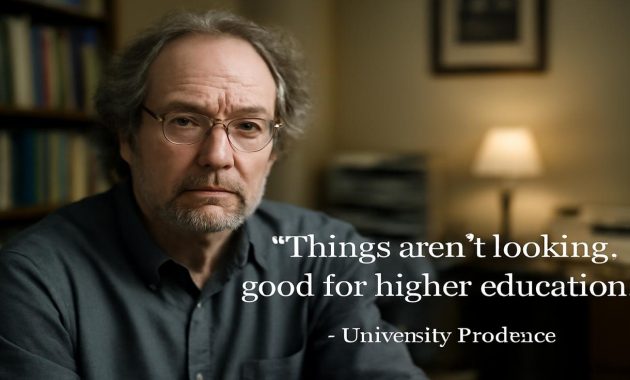
The seminar room smells faintly of dry-erase marker and burnt coffee. Outside the narrow windows, the campus maples are losing their leaves in soft, papery flurries, drifting onto bike racks and overflowing trash cans. Inside, thirty undergrads sit in a loose semicircle, laptops open, someone quietly peeling the label off a water bottle. It’s week nine of the semester, and you can feel it in the room—the tiredness, the quiet panic, the unasked questions about the future.
Professor Hall—gray at the temples, wire-rimmed glasses, the sort of sweater that marks him as permanently tenured—leans back against the desk at the front. He’s been talking about labor markets and productivity curves, the kind of graphs that look neat on slides and terrifying when you realize your life will happen somewhere along their jagged lines.
He stops mid-sentence, looks at the cluster of faces in front of him, and lets out a long breath.
“Look,” he says. “I need to be honest with you. As things stand, there’s no reason to believe your generation will have economic security in the way mine did.”
The room goes still. The hum of the building’s air vents suddenly feels loud. You can hear someone’s pen tap twice and then stop. It’s the kind of sentence that hangs in the air and rearranges the furniture in your mind.
The Day the Promise Quietly Cracked
Later, students will describe that moment as if the fluorescent lights dimmed a little. It wasn’t that they hadn’t suspected it. After all, they’d grown up hearing about recessions and layoffs over the dinner table, watching their parents refresh job boards and smile too brightly when asked how work was going. They’d seen their older cousins move back home after graduation, degrees boxed up with their childhood trophies.
But there was something different about hearing it from a professor whose entire job was to explain how the economy works. A man who had spent decades building neat models out of messy reality was now standing in front of them saying, in essence: the model broke. The promise cracked.
He tried to soften it. He talked about how Gen Z is also one of the most educated, adaptable, and socially aware generations he’d seen. He talked about resilience and creativity. But the core of what he’d said didn’t go away.
Economic security—the quiet assurance that if you worked reasonably hard, life would give you something reasonably stable in return—has been the invisible backbone of the modern university experience. It’s the unspoken contract: endure the lectures, the exams, the group projects with the one person who never answers emails, and in return you get a shot at a life that isn’t always on the edge of collapse.
What happens when that contract dissolves?
“We Did Everything Right” – And It’s Still Not Enough
That afternoon, a handful of students drifted into the campus coffee shop, eyes glazed from too many readings and too little sleep. The espresso machine hissed like it was annoyed by everyone’s problems. A barista with a septum piercing and a tired smile scribbled names on cups: Mia, Jordan, Priya, “Liam-with-an-i”.
At a corner table, three of Professor Hall’s students sat with their drinks and their disbelief.
“I mean,” Mia said, stirring her latte in slow, pointless circles, “we did everything they told us to. Good grades. SAT prep. Volunteering. Internships. Half of us have side hustles and LinkedIn profiles and business casual clothes we can’t really afford. And he just… says that?”
Jordan scrolled silently through job postings on his phone: entry-level roles demanding three years of experience, unpaid internships that somehow expected full-time hours. The screen light washed his face in cold blue.
“My dad keeps saying it’ll be fine because it worked out for him,” he said. “He bought a house at twenty-eight on a teacher’s salary. He thinks I’m being dramatic when I tell him rent for a one-bedroom near campus is more than his first mortgage.”
Priya, who had a spreadsheet for everything including how long each of her socks would last, had her laptop open to a color-coded budget. A thin red line stretched accusingly across the bottom: shortfall.
“I ran the numbers,” she said quietly. “Even if I get the job I want at the salary they’re offering, after rent, loans, food, and health insurance, there’s nothing left. Nothing. Forget savings. Forget a house. I don’t even know if I can afford to get sick.”
No one spoke for a minute. Outside, someone rode past on an electric scooter, hood up against the wind, a bag from a food delivery app strapped to their back. Probably another student, probably rushing between classes and shifts, hustling to keep ahead of an invisible wave.
The Illusion of the Straight Line
For previous generations, life was often described as a kind of staircase: finish school, get a job, maybe buy a car, then a house, then build a family and retirement savings. It wasn’t easy, and it certainly wasn’t equal—race, gender, and class warped the staircase beyond recognition for many people—but there was at least a story structure that made sense. A forward motion. A line that generally went up.
For Gen Z, that line looks more like a heart monitor on a bad day. Peaks and plunges. Graduating into a pandemic. Watching rents skyrocket. Hearing the phrase “once-in-a-lifetime recession” twice before turning twenty-five. Seeing climate headlines that make retirement planning sound almost quaint.
There’s a bitter irony to it: this is also the generation told, constantly, that opportunity is everywhere, that they can be content creators, startup founders, digital nomads. Open your phone and there’s someone your age claiming to make six figures from a phone in Bali. But in the real world of campus jobs and group projects, the numbers don’t add up.
It’s not laziness or entitlement, despite what ranting talk shows like to suggest. It’s math. Cold, unromantic math.
The Quiet Math of Insecurity
Imagine a simple monthly budget for a new graduate moving to a mid-sized city for their first job. Not Silicon Valley, not Manhattan. Just a regular city with decent public transit and overpriced coffee.
| Item | Estimated Monthly Cost (USD) |
|---|---|
| After-tax income (entry-level salary) | $3,000 |
| Rent (shared apartment) | $1,200 |
| Student loan payment | $350 |
| Groceries & basic supplies | $350 |
| Transportation (pass, occasional rideshare) | $180 |
| Health insurance & out-of-pocket care | $250 |
| Phone & internet | $120 |
| Utilities (electric, gas, water) | $120 |
| Clothing, home items, misc. | $150 |
| Modest social life & streaming | $150 |
| Left for savings or emergencies | $130 |
$130 a month, in a good month, if nothing goes wrong. One car repair and it’s gone. One emergency flight home to see a sick relative and it’s gone. One layoff and the whole carefully balanced spreadsheet collapses in on itself like wet cardboard.
This is what the professor meant. Not that Gen Z would never know comfort or joy or moments of stability—but that the scaffolding of predictable security had been quietly disassembled and sold for parts. Housing, healthcare, education, retirement: once pillars that at least aspired to be sturdy, now feel like subscription services you might lose access to at any time.
“Is It Just Us?” – The Weight of Structural Problems on Individual Shoulders
In his office later that week, Professor Hall sat with a student who had stayed behind after class. The door was half open; the hallway outside hummed with passing conversations and the squeak of shoes on linoleum.
“I didn’t mean to scare everyone,” he said, rubbing his forehead.
The student shrugged. “I think we were already scared. You just said it out loud.”
He nodded slowly. “The thing I worry about is that people will hear what I said and think it’s a judgment on individuals—on you—rather than on systems.”
He swiveled his monitor around, showing a series of charts: wage growth flatlining while productivity curves shot upwards; housing prices climbing like ivy on a brick wall; student debt numbers that looked like national defense budgets.
“You’ve been told a story that if you’re not thriving, it’s because you’re not hustling hard enough, or you bought too many lattes, or you picked the wrong major,” he said. “But most of the forces shaping your life are too big for any one person to out-hustle.”
It’s easier, in some ways, to believe it is your fault. If your choices alone created the problem, then your choices might yet save you. It’s much harder to sit with the idea that you are, in part, living inside a story that was written without your consent—and that many of the authors retired with pensions and affordable homes.
Living with a Future That Feels Foggy
On Friday nights, the campus tries to forget all this. Music drifts out of dorm windows, someone’s laughing too loudly near the quad, neon signs blink in the bar district like they’re winking away responsibility. But even the parties feel different than they did a decade ago. The wildness is edged with calculation: How much can you drink and still make your 8 a.m. shift? How many nights out before your checking account gives you that low-balance warning again?
Ask Gen Z students what keeps them up at night and they’ll talk about more than just exams. They’ll mention climate anxiety—the sense that no matter how carefully they plan, the planet beneath their feet is shifting. They’ll mention the feeling of always performing, always curating, always optimizing in a world that measures everything from time to attention to steps per day.
Career counselors tell them to network, to build a personal brand, to treat every club, every project, every online post as a potential stepping stone. It’s like being asked to construct a bridge in the fog using materials you’re not sure you’ll be allowed to keep.
Micro-Hopes in a Macroeconomic Storm
And yet, in the very same breath that Professor Hall admitted there’s no guaranteed security, he also confessed something else, almost sheepishly: “You might be the most quietly hopeful generation I’ve ever taught.”
Not optimistic, exactly. Not in the glossy, everything-will-work-out way. But hopeful in small, stubborn ways.
Hope looks like roommates growing herbs on a windowsill, learning to cook cheap meals from scratch and sharing them with whoever’s around. It looks like group chats organizing mutual aid for a classmate whose paycheck is late again. It looks like students forming co-ops, worker collectives, campus food pantries that feel more like community kitchens than charity.
It looks like refusing to pretend things are fine when they’re not—and still making plans anyway.
One evening, a storm rolled over campus: sky bruised purple, rain coming sideways, the kind that sends people sprinting under awnings. In the library, the power flickered once, twice, then steadied. Students looked up from their screens, then back down, the glow of their laptops the only constant in the shaky light.
On a whiteboard near the entrance, someone had written, in thick blue marker: “WHAT DO YOU HOPE YOUR LIFE FEELS LIKE IN 10 YEARS?”
Underneath, in a scatter of different handwriting, answers bloomed:
“Quiet mornings with coffee.”
“A job that doesn’t make me dread Sundays.”
“Being able to help my parents retire.”
“A dog. A yard. Sleep.”
“Not checking my bank account every time I tap my card.”
None of them wrote “rich.” Most of them wrote some version of “safe.”
Rewriting the Word “Security”
Maybe that’s where the story shifts. If the old promise of economic security was a house, a pension, a gold watch at retirement, maybe the new promise—if there can be one at all—will come from somewhere else.
From solidarity, rather than rugged individualism. From affordable, shared housing models instead of everyone chasing a solitary mortgage. From unions in industries that never used to have unions. From policy changes fought for not as abstract ideals, but as survival tools: rent control, healthcare access, livable minimum wages.
Gen Z did not choose this landscape. They were handed it along with their first smartphones and told to make something of it. And they are. There are young activists pushing for loan reform, for climate action that acknowledges economic reality, for workplaces that understand people are not just productivity units with Wi-Fi.
In the classroom, after his unsettling confession, Professor Hall tried to end on a note that didn’t feel like a lie.
“I can’t stand here and promise you security,” he said. “I can’t even promise stability. The best I can do is help you see the forces at work clearly—so you don’t blame yourselves for the wrong things, and so you can decide, together, what you want to push against.”
He paused, then added, “And I can tell you this: every major shift in economic history was driven by people who decided the current story wasn’t good enough.”
Outside, the trees kept shedding their leaves. Students filed out, backpacks heavy on their shoulders, phones lighting up with notifications: group chats, job alerts, news headlines, reminders to pay bills they could barely afford.
They walked into a future that felt, at best, like a series of maybe’s. But they walked into it together, comparing notes, splitting rides, sharing discount codes, swapping ideas about how to live in a world that had quietly misplaced its promise of security.
It may be true that there is no reason, right now, to believe Gen Z will inherit the kind of economic security earlier generations assumed. But there are plenty of reasons to believe they will refuse to accept that as the final version of the story.
And in that refusal—in that collective decision to see clearly and still move forward—there is a different kind of safety. Not the padded, guaranteed kind, but the safety of not being alone in the dark, of walking through the fog with other people’s footsteps beside your own.
Frequently Asked Questions
Why do experts say Gen Z may not have economic security?
Because multiple structural trends are stacked against them: wages that haven’t kept pace with productivity, soaring housing and education costs, unstable job markets, high levels of debt, and growing climate and health risks. Together, these make the old model of “work hard and you’ll be fine” far less reliable.
Is this just a temporary rough patch for young people?
Not exactly. While every generation faces challenges starting out, the current situation includes long-term structural shifts—like housing shortages, automation, and weakened social safety nets—that aren’t likely to vanish on their own. It’s more than a phase; it’s a different landscape.
Does this mean individual effort no longer matters?
Individual effort still matters a lot—for skills, options, and day-to-day survival. But effort alone can’t fully overcome systemic barriers. You can be hardworking, talented, and responsible and still struggle in an economy that’s fundamentally unbalanced.
What can Gen Z do in the face of such uncertainty?
On a personal level, they can build flexible skills, share resources, and create supportive networks. On a collective level, they can organize, vote, unionize, and push for policies that make housing, healthcare, and education more accessible and secure for everyone.
Is there any real hope for a more secure future?
Yes, but it likely won’t come from waiting for things to “go back to normal.” Hope lies in rewriting the rules: strengthening worker protections, investing in social infrastructure, and creating new models of living and working that prioritize stability and dignity over short-term profit. Gen Z is already playing a key role in that push.